📌 Key Takeaways
- Agentic AI goes beyond generating responses by enabling AI systems to pursue goals and perform approved actions.
- AI agents can connect with CRM, ERP, databases, APIs and other business tools.
- Agentic AI can be applied to customer service, e-commerce, fintech, healthcare, real estate, logistics and travel.
- Development costs can range from around $20,000 for a focused agent to $300,000+ for complex enterprise systems.
- The best approach is to start with a clearly defined workflow, controlled permissions and measurable business outcomes.
Introduction
AI is moving beyond simply answering questions.
Traditional AI tools can generate text, summarize information, recommend products, or respond to customer queries. But what if AI could understand a goal, decide what needs to be done, use different tools, complete multiple steps, and come back with a result?
That is where Agentic AI comes in.
Businesses are increasingly exploring AI systems that can work across CRMs, ERPs, databases, APIs, customer-support platforms, internal knowledge bases, and other business software. Instead of creating another chatbot that only talks to users, companies can build AI systems that actually participate in business workflows.
For example, a customer might ask an AI assistant to find an available product, check its price, create an order, update the CRM, and send a confirmation. An agentic system can coordinate these steps through connected tools and predefined permissions.
This guide explains what an Agentic AI Development Company does, how agentic AI differs from generative AI, common use cases, development costs, technologies, and the process of building an agentic AI solution.
Just Read : AI Agent Development Company Saudi Arabia: Services, Use Cases, Cost & Development Process
What Is Agentic AI?
Agentic AI refers to AI systems designed to pursue a goal and take actions toward completing it, rather than simply generating a response.
A simplified workflow looks like this:
User Goal → AI Reasoning → Planning → Tool/API Usage → Action → Result → Next Action
For example:
“Find me three suitable properties under my budget and arrange a viewing.”
An agentic system could potentially:
- Understand the request
- Search the property database
- Filter properties based on requirements
- Compare available options
- Present suitable properties
- Check viewing availability
- Schedule the selected appointment
- Update the CRM
The important difference is that the AI isn’t only generating text. It is interacting with systems and carrying out an approved workflow.
Agentic AI vs Generative AI
These terms are related, but they aren’t identical.
Generative AI primarily focuses on creating content or producing responses.
For example:
“Write a product description for this smartphone.”
The AI generates the description.
Agentic AI can take a broader objective:
“Find the best smartphone for this customer and prepare the order.”
The agent may need to search products, compare specifications, check inventory, apply business rules, and interact with an ordering system.
| Generative AI | Agentic AI |
|---|---|
| Generates content | Completes goals |
| Primarily response-oriented | Action-oriented |
| Usually one-step interaction | Can involve multiple steps |
| Limited tool usage | Can use multiple tools |
| Human often performs the next action | AI can perform approved actions |
| Chat/content focused | Workflow/business-process focused |
In practice, agentic AI often uses generative AI as one component of a larger system.
What Does an Agentic AI Development Company Build?
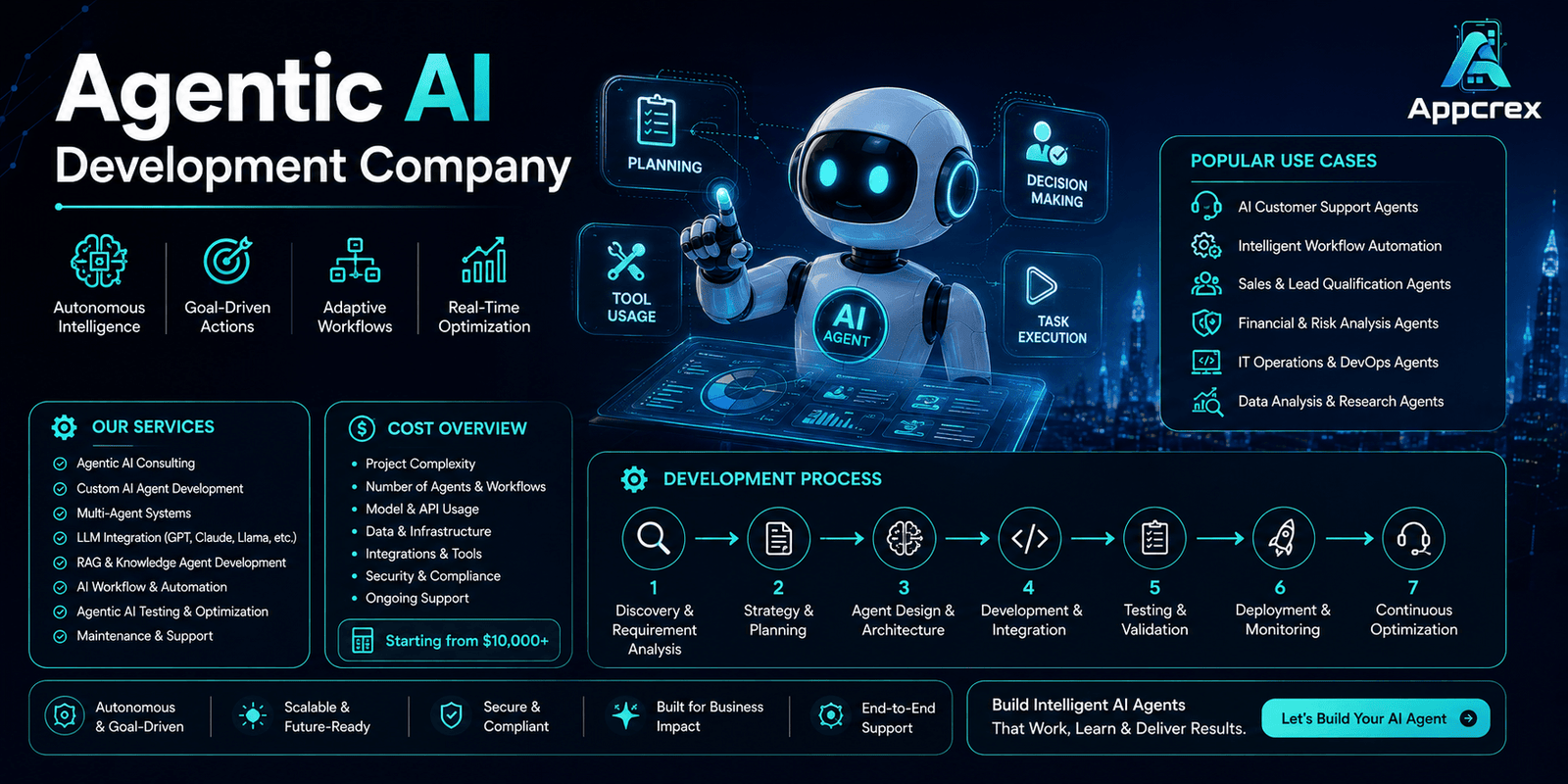
An Agentic AI development company designs and develops AI systems that can reason through tasks, use tools, access business information and execute predefined actions.
The exact architecture depends on the business problem.
AI Agents
An AI agent can be designed for a specific business role.
Examples include:
- Sales agent
- Customer-support agent
- Research agent
- Finance assistant
- HR agent
- Healthcare administrative agent
- Shopping agent
- Travel agent
Instead of building one giant AI system, companies can create specialised agents for different responsibilities.
Multi-Agent AI Systems
Some workflows are too complex for a single agent.
A multi-agent architecture can divide the work.
For example:
Research Agent → Analysis Agent → Approval Agent → CRM Agent
Each agent has a specific responsibility while an orchestration layer manages the overall workflow.
AI Agent Integration
An agent becomes much more useful when it can connect with existing business software.
Possible integrations include:
- CRM
- ERP
- E-commerce platforms
- Payment systems
- Databases
- REST APIs
- Internal knowledge bases
- Customer-support systems
- Booking systems
- Communication platforms
This allows AI to move from a conversational interface to an actual business automation layer.
Just Read : AI Agent Development Company: Complete Guide to Features, Benefits, Cost & Development Process (2026)
Agentic RAG
RAG allows AI to retrieve information from a company’s own data.
Agentic RAG takes the concept further by allowing an agent to determine when it needs information, where to retrieve it from, and what to do with the retrieved information.
This can be useful for enterprise knowledge management, customer support and internal operations.
AI Copilots
Not every business needs fully autonomous AI.
An AI copilot can work alongside employees.
For example, a sales copilot could:
- Read customer information
- Summarize previous conversations
- Identify potential leads
- Suggest follow-up actions
- Draft emails
- Update CRM records after approval
This human-in-the-loop model is often a practical starting point for enterprises.
Agentic AI Use Cases
The most interesting part of agentic AI is how it can be applied to real business processes.
Customer Service
Instead of answering only FAQs, an AI customer-service agent can potentially:
- Understand the customer’s issue
- Retrieve account information
- Check order status
- Search company policies
- Create support tickets
- Escalate complex cases
- Follow up with customers
This can reduce repetitive work for support teams.
The important part is permissions. An AI should only be allowed to perform actions that the business has explicitly authorised.
E-commerce
Agentic AI can create a more conversational shopping experience.
A customer might say:
“I need a laptop for video editing under $1,500.”
The AI could:
- Understand requirements
- Search the catalogue
- Filter products
- Compare specifications
- Recommend suitable options
- Check availability
- Add the selected product to cart
For a mobile commerce platform, the agent can be integrated directly into the shopping experience.
Banking and Fintech
Financial services can use agentic AI for controlled workflows such as:
- Customer support
- Transaction explanations
- Financial information retrieval
- Document processing
- Internal employee assistance
- Fraud-investigation support
- Customer onboarding assistance
For high-risk financial actions, human approval and strong access controls should remain part of the architecture.
Healthcare
Healthcare is another promising area, particularly for administrative workflows.
Agentic AI can assist with:
- Appointment scheduling
- Patient communication
- Document summarisation
- Administrative queries
- Insurance-related workflows
- Provider assistance
- Follow-up reminders
Clinical decisions require a much higher level of validation and professional oversight. Agentic AI should not be treated as a replacement for qualified healthcare professionals.
Real Estate
A real estate AI agent can help automate the journey from enquiry to lead management.
For example:
Customer Enquiry → Property Search → Recommendation → Lead Qualification → Viewing → CRM Update
The system can understand property preferences, search listings, answer questions and help sales teams manage leads.
Logistics and Supply Chain
Logistics businesses manage large numbers of operational decisions.
Agentic AI can assist with:
- Shipment tracking
- Delivery exceptions
- Route-related workflows
- Customer notifications
- Inventory queries
- Vendor communication
- Document processing
An AI agent could monitor an operational event and trigger the appropriate workflow instead of waiting for an employee to manually identify the issue.
Also Read : Logistics App Development: Complete Guide to Features, Cost & Development Process
Travel and Hospitality
Travel businesses can use AI agents for:
- Trip planning
- Hotel search
- Booking assistance
- Customer support
- Itinerary management
- Travel recommendations
- Post-booking support
A travel agent can combine information from several systems to provide a more complete experience.
Agentic AI for Mobile Apps
Agentic AI is not limited to enterprise dashboards.
It can also become a core feature inside a mobile app.
Imagine a travel app where the user says:
“Plan a three-day trip to Dubai within my budget.”
Instead of presenting a static chatbot, the AI could potentially:
- Search available hotels
- Find activities
- Build an itinerary
- Check timings
- Recommend transportation
- Present the complete plan
For businesses planning this type of product, an experienced Mobile App Development Company Saudi Arabia can combine mobile development with AI agents, APIs, backend systems and personalised user experiences.
This creates an important opportunity for businesses that already have a mobile product and want to add an intelligent layer without rebuilding the entire platform.
How Much Does Agentic AI Development Cost?
Agentic AI development costs vary considerably because an agent connected to one internal system is very different from a multi-agent enterprise platform.
| Solution | Estimated Cost |
|---|---|
| Basic AI Agent | $20,000–$40,000 |
| Custom Business AI Agent | $40,000–$80,000 |
| Agentic RAG Solution | $50,000–$100,000 |
| Multi-Agent AI System | $80,000–$150,000 |
| Enterprise Agentic AI Platform | $150,000–$300,000+ |
These are indicative ranges rather than fixed prices.
The final budget depends on:
- Number of agents
- AI model selection
- Complexity of workflows
- API integrations
- Business data
- RAG requirements
- Security
- User interface
- Mobile/web development
- Human approval workflows
- Cloud infrastructure
- Testing
- Monitoring
A focused AI agent can therefore be significantly cheaper than a full autonomous enterprise platform.
How to Build an Agentic AI Solution?
Building agentic AI requires more planning than simply connecting an application to an LLM.
1. Identify the Business Goal
Start with the workflow.
Don’t begin with:
“We want to use AI.”
Start with:
“Which business process should AI improve?”
For example:
- Reduce support workload
- Qualify leads
- Automate document processing
- Improve employee productivity
- Automate order management
2. Map the Workflow
Break the task into individual actions.
For example:
Customer Query → Authentication → Data Retrieval → Decision → API Action → Confirmation
This makes it easier to decide where AI should and shouldn’t be involved.
3. Choose the Agent Architecture
Depending on the workflow, you may use:
- Single AI agent
- Agent + RAG
- Agent + tools
- Multi-agent architecture
- Human-in-the-loop system
Not every problem needs multiple agents.
In fact, starting with a simpler architecture can make the system easier to test and control.
4. Connect the Required Tools
The agent can be connected to approved tools such as:
- Search
- CRM
- ERP
- Database
- Calendar
- Payment API
- Inventory system
- Booking platform
Tool permissions should be clearly defined.
5. Add Business Rules
AI should not have unlimited freedom.
Businesses can define:
- Which actions are allowed
- Which actions require approval
- Spending limits
- Data-access permissions
- Escalation conditions
- Safety rules
This creates a more controlled agentic environment.
6. Test Real Scenarios
Testing should include both normal and unexpected situations.
For example:
- Missing information
- Incorrect user request
- API failure
- Conflicting data
- Unavailable service
- Sensitive information
- Prompt injection
- Unexpected AI output
The objective is not simply to see whether the agent can complete a task.
It is to understand when it should stop and ask for help.
Technology Stack for Agentic AI
A modern agentic AI platform can combine several technologies.
AI Models
Depending on requirements:
- Large language models
- Open-source models
- Commercial AI APIs
- Fine-tuned models
- Embedding models
Agent Frameworks
Development teams may use frameworks and orchestration technologies to manage:
- Tool calling
- Agent memory
- Workflow execution
- Multi-agent communication
- State management
Backend
Common technologies include:
- Python
- Node.js
- Java
- .NET
Databases
Depending on the use case:
- PostgreSQL
- MongoDB
- MySQL
- Vector databases
Cloud
Potential infrastructure includes:
- AWS
- Microsoft Azure
- Google Cloud
Frontend and Mobile
For customer-facing products:
- React
- Flutter
- React Native
- Native iOS
- Native Android
The technology stack should be selected according to the workflow rather than simply choosing the newest AI framework.
Security and Human Oversight
Agentic AI introduces an important consideration that traditional chatbots don’t always face:
the ability to take action.
If an AI can send an email, update a CRM or create an order, mistakes can have real consequences.
A production system should therefore consider:
- Authentication
- Role-based access
- API permissions
- Encryption
- Audit logs
- Approval workflows
- Rate limits
- Action restrictions
- Monitoring
- Prompt-injection protection
- Human escalation
For high-impact actions, businesses should consider requiring human approval before execution.
This is particularly important for financial, healthcare, legal, HR and other sensitive workflows.
How to Choose an Agentic AI Development Company?
Before selecting a development partner, don’t only ask:
“Can you build an AI agent?”
Ask more practical questions:
- Have you built API-connected AI systems?
- Can you integrate AI with our existing software?
- How will you handle permissions?
- How will agent actions be monitored?
- Can the system support human approval?
- How will you evaluate hallucinations?
- How will you protect business data?
- Can the architecture scale?
- What happens when an API fails?
- How will you measure ROI?
A good development partner should understand both AI technology and business workflows.
Why Choose AppCrex for Agentic AI Development?
AppCrex helps businesses turn AI concepts into practical software products and intelligent business workflows.
Our capabilities can include:
- AI Agent Development
- Agentic AI Development
- Multi-Agent AI Systems
- Generative AI Development
- RAG Development
- AI Copilots
- AI Automation
- AI API Integration
- CRM AI Integration
- ERP AI Integration
- AI-powered Mobile Apps
- AI-powered Web Platforms
- Machine Learning
- NLP
- AI Chatbots
Whether you’re building a new AI product or adding agentic capabilities to an existing platform, the development approach can be designed around your business processes, data and integration requirements.
Final Thoughts
Agentic AI represents an important shift in how businesses think about artificial intelligence.
Generative AI made it easier for people to create content and interact with intelligent systems.
Agentic AI takes the next step by allowing AI to plan, use tools, interact with software and complete defined workflows.
But that doesn’t mean every business needs a completely autonomous AI system.
In many cases, the smartest approach is to start small.
Choose one repetitive workflow.
Connect the AI to the necessary data and tools.
Add clear permissions.
Keep humans involved where decisions are sensitive.
Then measure the results.
Once the first agent proves its value, businesses can gradually expand into multi-agent workflows and broader enterprise automation.
That is where agentic AI can move from an interesting technology trend into a genuine business capability.
FAQs
Q. What is Agentic AI?
Agentic AI refers to AI systems designed to pursue goals, make decisions within defined boundaries, use tools and perform multiple actions to complete a task.
Q. What is the difference between AI agents and Agentic AI?
An AI agent is an individual system capable of performing tasks, while agentic AI generally describes the broader approach of building goal-oriented, action-taking AI systems.
Q. How much does Agentic AI development cost?
A basic AI agent may cost approximately $20,000–$40,000, while enterprise multi-agent platforms can exceed $150,000–$300,000 depending on complexity.
Q. Can Agentic AI integrate with CRM and ERP?
Yes. APIs can connect AI agents with CRM, ERP, databases, e-commerce platforms and other business systems.
Q. Can Agentic AI be used in mobile apps?
Yes. AI agents can be integrated into iOS, Android, Flutter and React Native applications.
Q. Is Agentic AI fully autonomous?
Not necessarily. Businesses can design agents with human approval, restricted permissions and predefined workflows.
Q. What is multi-agent AI?
Multi-agent AI uses multiple specialised AI agents that collaborate or perform different parts of a larger workflow.
Q. Is Agentic AI suitable for startups?
Yes. Startups can begin with a focused AI agent addressing one specific business problem rather than building a large enterprise platform from day one.
Q. Can Agentic AI use company data?
Yes. RAG, APIs and database integrations can allow agents to retrieve authorised company information.
Q. Can AppCrex develop Agentic AI solutions?
Yes. AppCrex can develop AI agents, multi-agent systems, RAG solutions, AI copilots, AI integrations and AI-powered mobile and web platforms.
Build Your Agentic AI Solution With AppCrex
Thinking about building an AI agent, multi-agent platform, AI copilot or intelligent business automation system?
AppCrex can help you move from AI strategy and workflow design to development, API integration, testing and deployment.
Whether you’re building a new AI product or adding intelligent automation to an existing mobile or web platform, let’s discuss your requirements.
Talk to AppCrex today and turn your Agentic AI idea into a practical, scalable business solution.