📌 Key Takeaways
- Generative AI can automate customer service, knowledge management, sales, operations and many other business workflows.
- Saudi Arabia is actively investing in AI infrastructure, digital transformation and Arabic AI capabilities.
- Generative AI development costs can range from around $20,000 for a focused MVP to $250,000+ for complex enterprise systems.
- RAG, AI agents, API integrations and Arabic-language capabilities can make an AI solution significantly more useful for Saudi businesses.
- The best approach is to start with one measurable business problem and expand the AI solution after proving its value.
Introduction
Generative AI has moved from being an experimental technology to becoming a practical business tool. Companies are now using AI to automate customer support, create content, analyse information, assist employees, improve search and build intelligent digital products.
Saudi Arabia is becoming an important market for this transformation. The Kingdom’s Vision 2030 programme identifies AI as a strategic priority, while investments in AI infrastructure, data centres, digital services and Arabic-language AI capabilities are creating opportunities for businesses across multiple industries.
For businesses considering AI adoption, the question is no longer simply “Should we use generative AI?”. The more useful question is:
“Where can generative AI create measurable value for our business?”
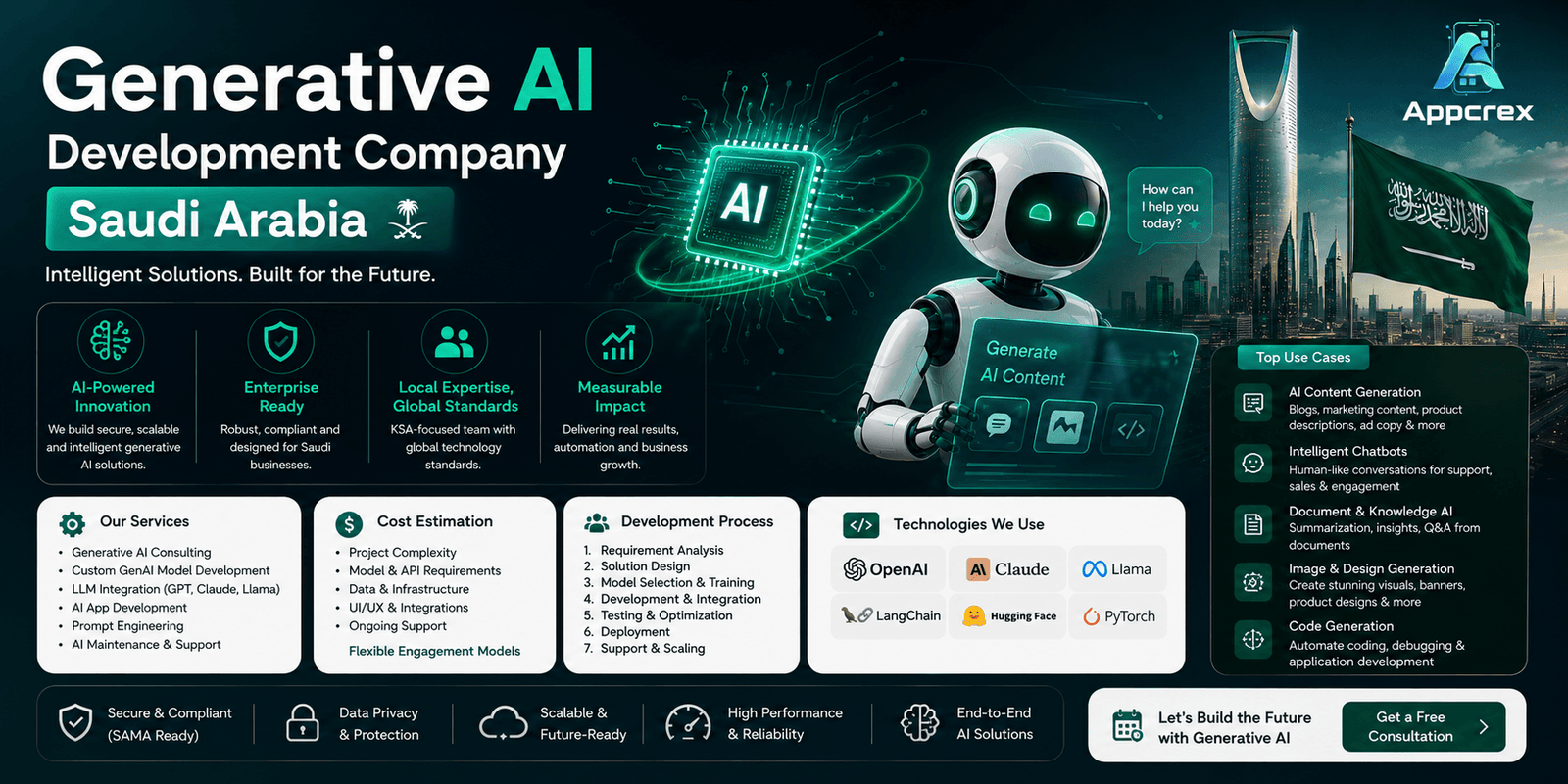
This guide explains what a Generative AI Development Company Saudi Arabia can build, the services involved, estimated costs, practical use cases, technology stack and development process.
What Is Generative AI Development?
Generative AI development involves creating software that can understand information and generate new content or responses.
Unlike traditional software, which follows predefined rules, generative AI systems can work with natural language and other forms of unstructured information.
Depending on the project, a generative AI solution can work with:
- Text
- Documents
- Images
- Audio
- Video
- Business data
- Knowledge bases
- Customer conversations
A company might use generative AI to build an intelligent customer-service assistant, an internal knowledge platform, an AI sales assistant or a completely new AI-powered product.
The technology can also be integrated into an existing mobile app, website, CRM, ERP or enterprise platform.
Why Saudi Businesses Are Investing in Generative AI?
Saudi Arabia has made AI and digital transformation an important part of its economic development strategy.
The Kingdom’s Vision 2030 reporting highlights AI as a national priority and describes investments in AI models, data infrastructure and digital capabilities. Saudi initiatives have also focused on developing Arabic AI capabilities and expanding the infrastructure needed for large-scale AI adoption.
This creates opportunities for businesses in sectors such as:
- Banking and fintech
- Healthcare
- Retail
- E-commerce
- Real estate
- Logistics
- Tourism
- Hospitality
- Education
- Government services
- Manufacturing
- Professional services
For many companies, the opportunity isn’t to build another generic chatbot. It is to connect AI with their existing business data and workflows.
That is where custom generative AI development becomes valuable.
Just Read : AI Sales Agent Development Company in UAE: Complete Guide to Features, Cost, Benefits & Business Use Cases
Generative AI Development Services in Saudi Arabia
A good AI development project should be built around a business requirement rather than a particular AI model.
Custom Generative AI Solutions
Businesses can develop AI systems designed around their specific processes, data and customers.
Examples include:
- AI assistants
- Enterprise copilots
- AI search
- Document intelligence
- Content-generation platforms
- AI recommendation systems
- Customer-service automation
- AI sales assistants
- Internal knowledge assistants
AI Chatbot Development
A modern AI chatbot can do much more than answer predefined FAQs.
It can understand natural-language questions, retrieve information from approved sources and guide users through specific workflows.
AI Agent Development
AI agents can use tools and APIs to complete defined tasks.
For example:
Customer → AI Agent → CRM → Order System → Response
This can turn an AI conversation into an actual business workflow.
RAG Development
Retrieval-Augmented Generation allows an AI system to retrieve relevant information from a company’s approved knowledge sources before generating an answer.
This can be useful when the AI needs access to:
- Company policies
- Product catalogues
- Internal documents
- FAQs
- Manuals
- Contracts
- Knowledge bases
AI Copilot Development
An AI copilot can sit alongside employees and help them complete everyday tasks.
Examples include:
- Writing emails
- Summarising meetings
- Finding company information
- Preparing reports
- Analysing documents
- Drafting proposals
Generative AI Integration
Businesses don’t always need a new AI product.
AI can be integrated into an existing:
- Mobile app
- Website
- CRM
- ERP
- E-commerce platform
- Healthcare system
- Customer-support platform
This is often one of the most practical ways for an established company to adopt generative AI.
Where Can Generative AI Be Used in Saudi Arabia?
The best opportunities are usually found in repetitive, information-heavy workflows.
Banking and Fintech
Financial companies can use generative AI for:
- Customer support
- Financial product information
- Internal knowledge search
- Document summarisation
- Employee copilots
- Customer onboarding assistance
- Fraud-investigation support
For sensitive financial workflows, AI should operate within strict permissions and appropriate human oversight.
Healthcare
Healthcare organisations can explore generative AI for:
- Patient information
- Appointment assistance
- Medical-document summarisation
- Healthcare knowledge search
- Administrative support
- Provider copilots
- Patient communication
Clinical applications require considerably more validation and governance than general customer-support use cases.
E-commerce and Retail
Generative AI can improve the shopping experience through:
- AI product search
- Product recommendations
- Conversational shopping
- Product descriptions
- Customer support
- Review summarisation
- Personalised marketing
Instead of searching:
“black running shoes men’s size 10”
a customer could ask:
“I need comfortable running shoes for daily training under SAR 500.”
The AI can understand the intent and help narrow the results.
Real Estate
Property companies can use generative AI to:
- Match buyers with properties
- Answer property questions
- Summarise listings
- Qualify leads
- Schedule viewings
- Generate property descriptions
- Assist agents with customer follow-ups
An AI property assistant could understand a natural request such as:
“Show me three-bedroom apartments in Riyadh suitable for a family.”
It can then search approved property data and present relevant options.
Logistics
Logistics companies deal with large amounts of operational information.
Generative AI can help with:
- Shipment queries
- Customer communication
- Delivery summaries
- Driver support
- Internal knowledge
- Exception management
- Logistics documentation
When connected to logistics APIs, AI can provide information based on current operational data rather than generic answers.
Also Read : Logistics App Development: Complete Guide to Features, Cost & Development Process
Hospitality and Tourism
Saudi Arabia’s growing tourism and hospitality ecosystem creates opportunities for AI-powered customer experiences.
Businesses can use AI for:
- Hotel assistance
- Travel planning
- Booking support
- Guest communication
- Multilingual assistance
- Concierge services
- Personalised recommendations
An Arabic/English AI concierge can be particularly useful for international visitors and local customers.
Arabic Generative AI Is a Major Opportunity
For a Saudi-focused AI product, Arabic should not be treated as an afterthought.
Users may communicate using:
- Modern Standard Arabic
- English
- Arabic-English mixed conversations
- Industry-specific terminology
A strong solution should therefore consider Arabic language understanding, Arabic content generation and right-to-left user interfaces where appropriate.
Saudi Arabia’s national AI efforts include development of Arabic AI capabilities, making Arabic-language AI an increasingly important area for businesses operating in the Kingdom.
For example, a Saudi retailer could build an AI assistant that understands:
“أريد جوال مناسب للتصوير وبسعر أقل من ٣٠٠٠ ريال”
and translates the user’s intent into relevant product searches and recommendations.
That kind of localisation can create a better experience than simply translating an English chatbot.
How Much Does Generative AI Development Cost in Saudi Arabia?
The cost varies considerably because “generative AI solution” can describe anything from a simple API-powered assistant to a large enterprise AI platform.
| Project Type | Estimated Cost | Approx. Timeline |
|---|---|---|
| AI Chatbot MVP | $20,000–$40,000 | 2–4 months |
| Custom GenAI Assistant | $35,000–$70,000 | 3–5 months |
| RAG-Based Enterprise Assistant | $50,000–$100,000 | 4–7 months |
| AI Agent Platform | $60,000–$130,000 | 5–9 months |
| Advanced Enterprise GenAI Platform | $120,000–$250,000+ | 8–15+ months |
These figures are indicative development estimates.
They generally do not include costs such as:
- AI model usage
- Cloud infrastructure
- Third-party licences
- Data acquisition
- Regulatory consulting
- External security audits
- Ongoing model monitoring
The biggest cost factors are usually AI complexity, integrations, data preparation, security, customisation and scale.
What Affects the Cost of a Generative AI Project?
Two AI assistants may look similar to users while having completely different development costs.
For example:
Simple chatbot
User → LLM API → Response
This is relatively straightforward.
Enterprise AI assistant
User → Authentication → AI Orchestrator → RAG → Vector Database → CRM/ERP APIs → Security Layer → LLM → Response → Audit Log
This requires significantly more engineering.
The budget can therefore increase because of:
- Number of integrations
- Data volume
- RAG requirements
- AI agent capabilities
- Custom workflows
- User roles
- Security
- Arabic support
- Voice AI
- Analytics
- Admin dashboard
- Mobile applications
- Enterprise deployment
Technology Stack for Generative AI Development
A typical architecture may include several layers.
AI Models
Depending on the use case, developers can work with commercial or open-source foundation models.
The right model depends on:
- Accuracy
- Cost
- Context window
- Language performance
- Privacy requirements
- Latency
- Deployment options
Backend
Common choices include:
- Python
- Node.js
- Java
- .NET
Python is particularly common for AI/ML workflows.
RAG & Knowledge Layer
Potential components include:
- Embedding models
- Vector databases
- Document processing
- Retrieval pipelines
- Metadata filtering
APIs
AI systems may connect to:
- CRM
- ERP
- Payment systems
- E-commerce platforms
- Healthcare systems
- Booking systems
- Inventory systems
Cloud Infrastructure
Depending on the project, businesses may use:
- AWS
- Microsoft Azure
- Google Cloud
For Saudi projects, infrastructure and data-handling decisions should be made according to the application’s data, regulatory and contractual requirements.
How to Build a Generative AI Solution in Saudi Arabia?
The development process should begin with the business problem—not with choosing an AI model.
1. Identify the Business Problem
Start with a specific objective.
For example:
“Our customer-service team spends too much time answering repetitive questions.”
This can become an AI customer-service project.
Another business might have:
“Employees cannot quickly find information across thousands of internal documents.”
That could become an enterprise RAG assistant.
2. Define the AI Use Case
Determine what the AI should actually do.
Should it:
- Answer questions?
- Generate content?
- Search company data?
- Summarise documents?
- Recommend products?
- Qualify leads?
- Complete transactions?
- Execute workflows?
The clearer this is, the easier it becomes to estimate cost.
3. Prepare Your Data
Generative AI is only as useful as the information it can access.
Data may include:
- PDFs
- Websites
- Databases
- FAQs
- Product catalogues
- Internal documentation
- CRM information
Data should be cleaned, structured and permission-controlled before connecting it to an AI system.
4. Select the AI Architecture
The development team can then decide whether the project needs:
LLM → RAG → AI Agent → Multi-Agent architecture
Not every project needs a complicated multi-agent system.
For many businesses, a well-designed RAG assistant can deliver more value with less complexity.
5. Build the MVP
A practical first version might contain:
- AI chat interface
- Knowledge base
- RAG
- Authentication
- Basic analytics
- Admin panel
- Human escalation
After validating the concept, more advanced features can be added.
6. Integrate Business Systems
This is where the solution becomes more useful.
For example:
AI + CRM
The assistant can retrieve customer information.
AI + ERP
The assistant can help employees find inventory or business information.
AI + E-commerce
The assistant can recommend products and retrieve order information.
AI + Booking
The assistant can help users find available appointments or reservations.
7. Add Security and Guardrails
Generative AI systems should have clearly defined boundaries.
Important controls include:
- Authentication
- Authorisation
- Data access controls
- Prompt protection
- Output filtering
- Logging
- Human escalation
- Sensitive-data handling
The AI should only access the information and tools it actually needs.
8. Test With Real Conversations
AI testing is different from traditional software testing.
You should test:
- Incorrect questions
- Ambiguous requests
- Arabic conversations
- Mixed-language queries
- Sensitive requests
- Hallucinations
- Prompt injection
- Incorrect source documents
- API failures
- Human handoffs
The goal is not just to make the AI sound intelligent.
It must also behave predictably and safely.
Generative AI vs Traditional AI
These technologies are related but serve different purposes.
| Traditional AI/ML | Generative AI |
|---|---|
| Often predicts or classifies | Generates new content |
| Structured inputs are common | Handles natural language and unstructured data |
| Fraud prediction | AI financial assistant |
| Demand forecasting | AI report generation |
| Image classification | Image/content generation |
| Recommendation models | Conversational product discovery |
In real business systems, the two can also work together.
For example:
Machine Learning → identifies unusual transaction → Generative AI → explains the event to an investigator.
Generative AI vs Chatbot
Not every AI chatbot is a full generative AI product.
A traditional chatbot may rely on predefined questions and responses.
A generative AI assistant can understand a much broader range of language and generate responses dynamically.
A more advanced AI agent can then go one step further and use tools to perform approved tasks.
So the progression can look like:
Chatbot → Generative AI Assistant → AI Agent → Multi-Agent System
The right level depends on the business problem.
How Businesses Can Monetise Generative AI?
Generative AI can be turned into a product or used internally to reduce costs.
SaaS Subscription
Offer AI functionality through monthly or annual plans.
Usage-Based Pricing
Charge customers based on conversations, documents or AI usage.
Enterprise Licensing
Sell a customised AI platform to larger organisations.
AI-as-a-Service
Provide specialised AI capabilities through APIs.
Internal Automation
Even without directly selling AI, companies can generate ROI by reducing manual work and improving employee productivity.
Saudi-Specific Data and AI Considerations
If your AI system processes personal information, privacy and data governance should be considered from the beginning.
Saudi Arabia’s Personal Data Protection Law is overseen by SDAIA, which also provides guidance and services related to data governance and compliance.
SDAIA also provides an AI Service Provider Accreditation process focused on alignment with AI ethics standards.
For businesses, this means AI planning should include:
- Data minimisation
- Access controls
- Privacy
- Secure storage
- Auditability
- Data retention
- AI governance
- Human oversight
The exact requirements depend on the business sector and the type of data being processed, so professional Saudi legal and compliance advice should be obtained for regulated implementations.
How to Choose a Generative AI Development Company in Saudi Arabia?
Don’t choose a development company simply because it can connect an LLM API.
Look for experience with:
- Generative AI
- AI agents
- RAG
- LLM integration
- AI automation
- API integration
- Cloud architecture
- Mobile development
- Enterprise software
- Data security
- Arabic AI experiences
A strong development partner should first understand your business workflow and then recommend the appropriate AI architecture.
That can prevent businesses from spending heavily on technology that doesn’t solve a real problem.
Why Choose AppCrex?
AppCrex helps businesses turn AI ideas into practical digital products.
Our generative AI capabilities include:
- Generative AI Development
- AI Agent Development
- AI Chatbot Development
- RAG Development
- AI Copilot Development
- AI Integration Services
- Machine Learning Development
- AI Automation
- Arabic AI Solutions
- CRM AI Integration
- ERP AI Integration
- AI-powered Mobile Apps
- AI-powered Web Platforms
- API Integration
- Cloud Backend Development
For Saudi businesses, we can design solutions around Arabic/English experiences, business-specific knowledge bases, AI agents, secure integrations and scalable application architecture.
Final Thoughts
Generative AI offers Saudi businesses an opportunity to improve much more than customer support.
It can become part of:
Sales → Customer Service → Operations → Knowledge Management → Marketing → Analytics → Product Experience
But the most successful projects will not be the ones with the most AI features.
They will be the ones that solve a specific business problem better, faster or more efficiently.
If you’re starting from scratch, begin with one workflow.
For example:
Customer questions → AI assistant → knowledge base → human escalation
Then expand:
AI assistant → CRM → ERP → APIs → AI agents → automated workflows
For companies operating in Saudi Arabia, Arabic support, data governance, security and local business requirements should be considered from the beginning rather than added after development.
With the Kingdom continuing to invest in AI infrastructure, Arabic AI capabilities and digital transformation, there is a growing opportunity for businesses that can turn generative AI into practical products and services.
FAQs
Q. How much does generative AI development cost in Saudi Arabia?
A basic AI chatbot MVP can start around $20,000–$40,000, while advanced enterprise generative AI platforms can cost $120,000–$250,000+, depending on integrations, data and AI complexity.
Q. How long does it take to build a generative AI solution?
A basic MVP may take 2–4 months, while a sophisticated enterprise platform can require 8–15 months or longer.
Q. Can generative AI understand Arabic?
Yes. Arabic-capable AI models can be integrated into applications, although performance should be tested against the specific Arabic terminology, dialects and business requirements of the target users.
Q. Can I integrate generative AI into an existing application?
Yes. Generative AI can be integrated into existing mobile apps, websites, CRM systems, ERP platforms and other software through APIs and backend services.
Q. What is RAG in generative AI?
RAG, or Retrieval-Augmented Generation, allows an AI model to retrieve relevant information from approved knowledge sources before generating its response.
Q. What is the difference between generative AI and an AI agent?
Generative AI primarily generates content or responses. An AI agent can use tools, access systems and perform defined tasks as part of a workflow.
Q. Can generative AI be used in fintech?
Yes. Potential applications include customer support, financial education, document processing, employee copilots and transaction-related assistance. Sensitive financial activities require appropriate controls and oversight.
Q. Can generative AI be used in healthcare?
Yes, particularly for administrative, informational and documentation workflows. Clinical applications require additional validation, governance and professional oversight.
Q. Is Arabic support important for a Saudi AI product?
Yes. Arabic-first interaction can create a significantly more relevant experience for Saudi users, especially when combined with appropriate RTL UX.
Q. Can AppCrex build a generative AI solution for Saudi Arabia?
Yes. AppCrex can develop custom generative AI platforms, AI agents, RAG systems, AI chatbots, copilots and AI integrations for businesses targeting Saudi Arabia and the wider Middle East.
Ready to Build a Generative AI Solution in Saudi Arabia?
Have an idea for an AI assistant, AI agent, enterprise copilot or generative AI-powered product?
AppCrex can help you move from idea to implementation—from AI architecture and RAG to API integration, mobile/web development, Arabic AI experiences and scalable cloud infrastructure.
Talk to AppCrex today and discuss your Generative AI project for the Saudi market.