📌 Key Takeaways
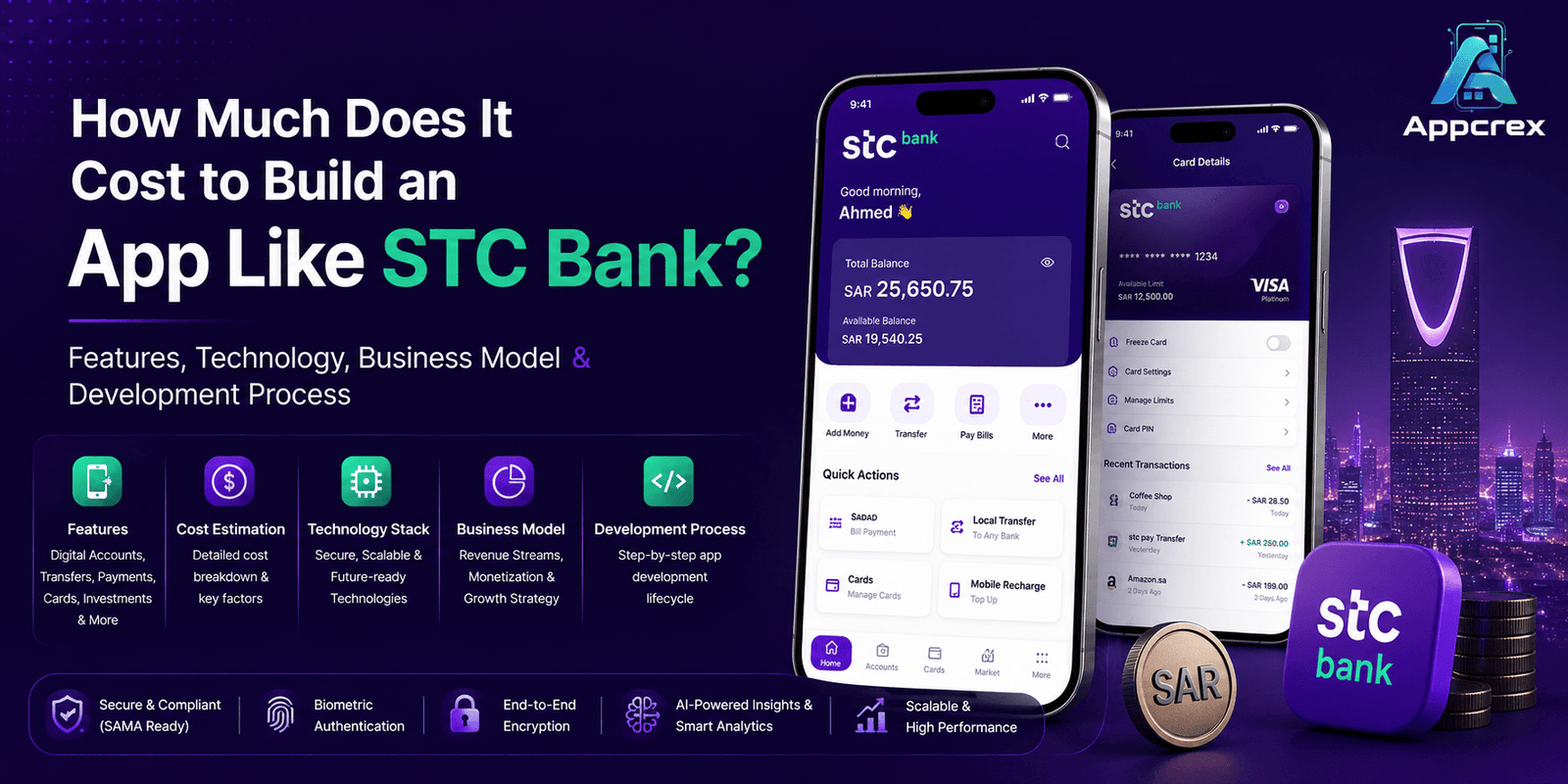
- An STC Bank-like platform is much more than a money-transfer app; it combines banking, cards, savings, payments and digital financial services.
- A fintech MVP can start around $50,000–$80,000, while a complete digital banking ecosystem can exceed $200,000.
- KYC, security, financial integrations and regulatory planning are major parts of the development process.
- AI can differentiate a new fintech product through financial assistants, spending insights, fraud detection and personalised experiences.
- For Saudi Arabia, Arabic UX, local integrations and market-specific compliance planning should be built into the project from the beginning.
Introduction
Saudi Arabia’s fintech market has changed significantly in recent years. Digital banking is no longer limited to traditional banks, and users increasingly expect banking services to be available through a fast, mobile-first experience.
STC Bank is a good example of this shift. The platform has evolved from the former stc pay wallet into a digital bank and now offers services such as money transfers, savings, cards, spending analytics, marketplace features and digital financial products. It is regulated and supervised by the Saudi Central Bank.
For entrepreneurs and financial businesses, this raises an important question:
How much does it cost to build an app like STC Bank?
A realistic answer depends on whether you want a simple fintech MVP, a digital wallet, or a complete digital banking ecosystem.
How Much Does It Cost to Build an App Like STC Bank?
For a fintech platform inspired by STC Bank, development can typically fall into these ranges:
| App Type | Estimated Cost | Timeline |
|---|---|---|
| Basic Fintech MVP | $50,000–$80,000 | 4–6 months |
| Digital Wallet + Payments | $80,000–$130,000 | 6–9 months |
| Advanced Digital Banking App | $130,000–$220,000 | 8–14 months |
| Enterprise Fintech Platform | $220,000–$400,000+ | 12–20+ months |
These are development estimates, not banking licensing or operational costs.
The final budget depends on features, integrations, security requirements, regulatory requirements, AI functionality, transaction volume and the number of platforms you want to launch.
A startup does not necessarily need to build everything STC Bank offers from day one. A focused MVP can launch with accounts, transfers, cards, KYC, notifications and a secure admin system before expanding.
Just Read : AI Agent Development Company Saudi Arabia: Services, Use Cases, Cost & Development Process
What Makes an App Like STC Bank Different?
The interesting part about STC Bank is that it isn’t simply a money-transfer application.
Its current platform combines financial services, cards, savings, transfers, spending insights, marketplace functionality and business services. Its official website also highlights contact transfers, local and international transfers, expense sharing, savings accounts and spending analytics.
Its card ecosystem includes digital and physical cards, Apple Pay and Mada Pay support, payment controls and spending information.
This means that a business planning a similar product should think of it as a digital financial ecosystem, not just a banking app.
Key Features You Need
A successful STC Bank-like platform would normally have several layers.
Digital Account
Users should be able to create and manage their accounts digitally, view balances and access financial services from one dashboard.
Money Transfers
Transfer functionality can include:
- Transfers between users
- Local bank transfers
- International transfers
- Beneficiary management
- Transaction history
- Transfer status
STC Bank currently promotes transfers to contacts as well as local and international banks.
Digital & Physical Cards
A fintech platform can offer:
- Virtual cards
- Physical cards
- Debit cards
- Card controls
- Card activation
- Transaction history
- Spending limits
- Card freezing
STC Bank currently offers both digital and physical cards, with payment options including Apple Pay and Mada Pay.
Savings and Financial Management
Modern fintech users expect more than a simple balance screen.
You can add:
- Savings accounts
- Saving goals
- Spending categories
- Financial analytics
- Monthly reports
- Budget tracking
STC Bank’s platform currently includes savings products and spending analytics.
Bill Payments
A banking platform can integrate supported bill-payment services so users can manage recurring financial obligations directly from the app.
Marketplace
A marketplace can create an additional ecosystem around the financial platform.
STC Bank currently promotes a marketplace connecting customers with products, services and gaming experiences.
For a new fintech business, the marketplace could eventually become an additional revenue channel.
AI Features Can Make the App More Competitive
This is where a new fintech platform can go beyond simply copying an existing banking experience.
AI can be used for:
- Customer-service assistants
- Spending insights
- Personalised financial recommendations
- Fraud detection
- Transaction monitoring
- Lead qualification
- Document processing
- Financial education
- Automated support
For example, an AI assistant could answer:
“How much did I spend on restaurants last month?”
The system could retrieve authorised transaction data and provide a simple breakdown.
Another example:
“Help me save SAR 10,000 in six months.”
An AI-powered financial assistant could generate a budgeting plan based on the user’s permitted financial information.
Sensitive financial decisions should remain subject to appropriate controls and regulatory requirements.
Also Read : AI App Development Guide: Features, Cost & Process (2026)
KYC and Security Are Critical
A fintech app cannot be developed like an ordinary e-commerce application.
The architecture needs strong identity, security and transaction controls.
Important components can include:
- Digital KYC
- Identity verification
- OTP
- Biometric authentication
- Device verification
- Transaction authentication
- Encryption
- Fraud monitoring
- Role-based access
- Audit logs
- Secure API architecture
The exact KYC and compliance architecture depends on the financial services being offered and the applicable Saudi regulations.
This is one reason why fintech app development costs more than a standard mobile application.
Saudi Arabia-Specific Requirements
If your target market is Saudi Arabia, localization should be considered from the beginning.
The platform may need:
- Arabic and English interfaces
- RTL support
- Saudi payment integrations
- Local banking integrations
- Saudi identity/KYC workflows
- Local regulatory considerations
- Secure financial-data handling
- Saudi Central Bank requirements where applicable
STC Bank itself states that it operates under the oversight and supervision of the Saudi Central Bank.
So if the business model involves regulated banking or financial services, licensing and compliance cannot simply be added after the application has been developed.
Technology Stack
The technology stack depends on the product architecture, but a modern fintech platform could use:
Mobile
- Flutter
- React Native
- Swift
- Kotlin
For startups launching both iOS and Android, Flutter or React Native can reduce duplicated development work.
Backend
- Node.js
- Python
- Java
- .NET
For a transaction-heavy platform, backend architecture should be designed for reliability, scalability and security.
Database
Possible technologies include:
- PostgreSQL
- MySQL
- MongoDB
- Redis
AI
For intelligent features:
- LLM APIs
- Machine learning
- RAG
- Fraud-detection models
- Recommendation engines
- AI agents
Cloud
Depending on architecture and regulatory requirements:
- AWS
- Microsoft Azure
- Google Cloud
APIs and Integrations You’ll Need
This is one of the biggest factors affecting development cost.
A banking-style fintech application may require integrations with:
- Payment gateways
- Banks
- KYC providers
- Identity verification
- Card processors
- SMS/OTP providers
- Notification services
- Fraud detection systems
- Accounting systems
- CRM
- Analytics platforms
For example, STC Bank’s merchant e-commerce services include API integration, Apple Pay, Mada, Visa, Mastercard and American Express acceptance, along with merchant dashboards and reporting tools.
Your exact integrations will depend on your business model.
Development Process
The smartest approach is to build the product in stages.
1. Define the Fintech Model
First decide whether you’re building:
- Digital wallet
- Neobank
- Payment app
- Money-transfer platform
- Digital banking platform
- Personal finance app
- Business banking platform
The regulatory and technical requirements can vary considerably between these models.
2. Plan the MVP
Don’t start with 50 features.
A practical MVP might include:
Registration → KYC → Account → Transfers → Cards → Notifications → Transaction history → Admin dashboard
Then you can add savings, marketplace, AI, financing and other features.
3. Design the User Experience
The interface should be:
- Simple
- Fast
- Trustworthy
- Arabic/English
- Mobile-first
Financial applications should make balances, transactions and important actions easy to understand.
4. Build the Backend
The backend handles:
- Users
- Accounts
- Transactions
- Payments
- Cards
- Notifications
- Security
- Integrations
5. Add Security and Compliance
Before launch, test:
- Authentication
- Data encryption
- API security
- Transaction security
- Access control
- Fraud scenarios
- Data privacy
6. Integrate Financial Services
Connect the required payment, banking, identity and other financial systems.
7. Test Everything
Fintech testing should cover both normal and unusual scenarios.
For example:
- Failed transactions
- Duplicate payments
- Incorrect OTP
- Network interruption
- Suspicious activity
- Account lockouts
- API failures
8. Launch the MVP
Launch with a controlled customer group, collect feedback and gradually expand.
Also Read : Banking App Development Company: Complete Guide to Features, Cost & Process (2026)
How Does an App Like STC Bank Make Money?
A digital banking platform can have several revenue streams.
Transaction Fees
Revenue can come from eligible transfer or payment services.
Card Revenue
Depending on the product and regulatory structure, cards can generate revenue through applicable fees and commercial partnerships.
Financial Products
Products such as financing, savings or other financial services can create additional revenue opportunities.
STC Bank currently offers personal finance and smart finance products through its digital experience.
Marketplace Commission
A marketplace can generate commission from participating merchants.
Merchant Services
Businesses can pay for payment acceptance and related services.
Premium Services
Advanced financial-management features can potentially be offered through premium plans.
How Long Does It Take to Build?
The development timeline depends on the scope.
MVP: around 4–6 months
Digital wallet + payments: around 6–9 months
Advanced digital banking: around 8–14 months
Enterprise ecosystem: 12–20+ months
The timeline can increase significantly when banking integrations, KYC, card processing, compliance testing and complex financial workflows are involved.
How to Build a Better App Than Existing Fintech Platforms?
You don’t necessarily need to copy every STC Bank feature.
Instead, identify a specific customer problem.
For example:
AI-first Banking
Make the app feel like a personal financial assistant rather than just a transaction tool.
Better Expense Management
Help users understand where their money goes and create practical savings goals.
SME Banking
Build tools specifically for Saudi small and medium-sized businesses.
Cross-border Payments
Focus on fast and convenient international transfers for users who regularly send money abroad.
Personalised Financial Products
Use customer-approved data to provide more relevant financial products and recommendations.
This type of differentiation can create a stronger business proposition than simply building another digital wallet.
Also Read : What Is an MVP in App Development? A Complete Guide
Why Choose a Fintech App Development Company Saudi Arabia?
If you’re targeting the Saudi market, your development partner should understand more than mobile app development.
You need experience across:
- Fintech
- Payment integration
- Digital wallets
- Banking APIs
- KYC
- AI
- Cybersecurity
- Cloud infrastructure
- Arabic/RTL UX
- Admin dashboards
A Fintech App Development Company Saudi Arabia can help structure the product around the local market instead of adapting a generic global fintech template at the end.
For businesses looking for broader technology support, a Mobile App Development Company Saudi Arabia can also handle the mobile application, backend, APIs, dashboards and ongoing maintenance under one development roadmap.
Why Choose AppCrex?
AppCrex can help businesses build custom fintech and digital banking solutions based on their specific business model.
Our services include:
- Fintech App Development
- Digital Wallet Development
- Banking App Development
- Payment Gateway Integration
- AI Fintech Development
- AI Agent Development
- KYC Integration
- API Integration
- Flutter App Development
- React Native App Development
- iOS & Android Development
- Cloud Backend Development
- Admin Dashboard Development
- App Maintenance and Support
For a Saudi fintech project, we can plan the product around Arabic/English UX, secure architecture, financial integrations, AI capabilities and scalable infrastructure.
Final Thoughts
Building an app like STC Bank is a major fintech project. The cost isn’t determined by the mobile interface alone—the real investment goes into financial infrastructure, integrations, security, compliance, backend architecture and reliability.
A focused fintech MVP can start around $50,000–$80,000, while a sophisticated digital banking ecosystem can move beyond $200,000.
The better strategy for a startup is usually to identify one strong financial use case, launch an MVP and then expand.
Wallet → Payments → Cards → Financial Management → AI → Marketplace
That approach gives you room to validate the market before committing to a much larger banking ecosystem.
FAQs
How much does it cost to build an app like STC Bank?
A basic fintech MVP may cost around $50,000–$80,000, while a more advanced digital banking platform can cost $130,000–$220,000+.
How long does it take?
A focused MVP may take 4–6 months, while a sophisticated platform can take 8–14 months or longer.
Can I build a digital banking app in Saudi Arabia?
Yes, but the regulatory and licensing requirements depend on the financial services your business intends to provide. Professional legal and regulatory guidance should be obtained before launch.
What features should an STC Bank-like app have?
Core features can include digital accounts, money transfers, cards, KYC, transaction history, notifications, savings, financial analytics, payments and an admin dashboard.
Can AI be added to a fintech app?
Yes. AI can support customer service, spending analysis, fraud detection, personalised recommendations and financial assistants.
Should the app support Arabic?
Yes. For Saudi Arabia, Arabic and RTL support should be considered during UX and product planning.
Can I integrate payment gateways and banking APIs?
Yes. The integrations depend on your financial model, chosen providers and applicable regulatory requirements.
Can AppCrex develop a fintech app for Saudi Arabia?
Yes. AppCrex can build custom fintech, digital wallet, payment, AI and mobile banking solutions for businesses targeting Saudi Arabia.
Ready to Build a Fintech App in Saudi Arabia?
Have an idea for a digital wallet, payment app, neobank or AI-powered fintech platform?
AppCrex can help you plan the MVP, design the product architecture and develop the mobile app, backend, integrations and AI capabilities.
Talk to AppCrex about your fintech app idea and get a development roadmap for the Saudi market.