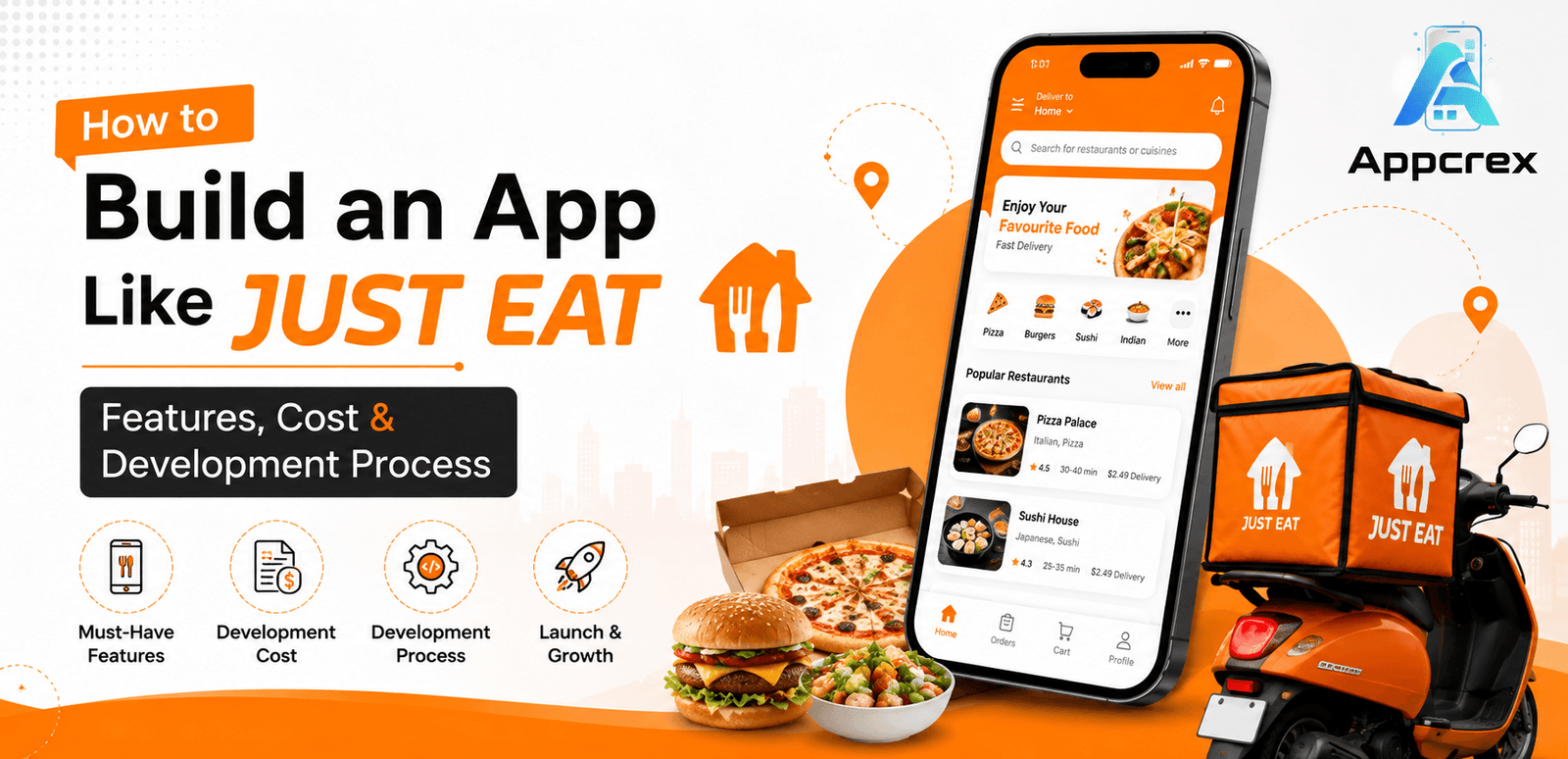
📌 Key Takeaways
- A Just Eat-style app is a multi-sided marketplace connecting customers, restaurants and delivery partners.
- A basic MVP can cost around $40,000–$70,000, while an advanced platform can exceed $120,000.
- Restaurant commissions, delivery fees, advertising, featured listings and subscriptions can create multiple revenue streams.
- AI, real-time tracking and smart delivery assignment can significantly improve the user experience.
- Starting with one UK city or niche is often a better strategy than trying to compete across the entire market immediately.
Introduction
Ordering food has become a normal part of everyday life in the UK. Whether someone wants a quick lunch at work, dinner after a long day, or groceries delivered to their doorstep, people increasingly expect the entire experience to happen from their phone.
That is where food delivery platforms such as Just Eat have built a strong position.
Just Eat started in the UK in 2006 and has evolved from a takeaway-ordering marketplace into a broader convenience platform connecting consumers with restaurants and retail partners. Its UK platform now offers more than 100,000 choices, while its wider business combines marketplace ordering with delivery services.
For entrepreneurs, this creates an interesting opportunity.
You don’t necessarily need to build another generic food delivery app. You can create a more focused platform for a particular city, cuisine, customer segment, restaurant category, grocery market, or delivery model.
But what does it actually take to build an app like Just Eat?
How much does it cost? Which features are essential? How does the business make money? And what technology is required to manage customers, restaurants, orders and delivery partners?
This guide explains the complete food delivery app development process.
What Is a Just Eat-Like App?
At its core, a Just Eat-style platform is a multi-sided marketplace.
It connects several groups:
- Customers
- Restaurants
- Delivery partners
- Admin teams
- Retail and grocery businesses
The customer searches for a restaurant, selects food, places an order and pays through the platform.
The restaurant receives the order and prepares it.
Depending on the delivery model, the restaurant may handle delivery itself or the platform may assign a courier.
This hybrid approach is important. Just Eat describes its marketplace as combining partners that handle their own deliveries with delivery services for partners that need fulfilment support.
So, if you are planning a similar product, your first major decision is not the app design.
It is deciding how your marketplace will operate.
How Much Does It Cost to Build an App Like Just Eat?
The cost depends heavily on the scope.
A basic food ordering app with a limited number of restaurants is much cheaper than a full marketplace with real-time delivery tracking, restaurant management, courier logistics, AI and advanced analytics.
| App Type | Estimated Cost | Development Time |
|---|---|---|
| Basic Food Delivery MVP | $40,000–$70,000 | 3–5 months |
| Multi-Restaurant Platform | $70,000–$120,000 | 5–7 months |
| Advanced Just Eat-Like Platform | $120,000–$220,000 | 7–11 months |
| Enterprise Delivery Ecosystem | $220,000–$350,000+ | 11–18+ months |
These are estimated software-development ranges rather than fixed quotations.
The final investment can increase because of:
- Third-party API costs
- Maps and location services
- Payment gateways
- Cloud infrastructure
- SMS and email services
- Restaurant onboarding
- Courier operations
- Security
- Customer support
- Marketing
- Legal and compliance requirements
For a startup, building an MVP first is usually a more practical approach than attempting to reproduce every feature of a mature platform.
Why Build an App Like Just Eat?
The food delivery market has moved beyond simply delivering restaurant meals.
Just Eat has expanded into grocery and retail, and the company says its platform now includes restaurants, grocery, health and beauty, and electronics offerings.
That gives entrepreneurs several possible directions.
You could build an app for:
- Restaurant delivery
- Grocery delivery
- Pharmacy delivery
- Local takeaway delivery
- Healthy food delivery
- Corporate lunch delivery
- Cloud kitchens
- Ethnic cuisine
- Premium restaurants
- Late-night food
- Student food delivery
- Hyperlocal retail delivery
The strongest idea may be the one that solves a specific problem better than a general marketplace.
Just Read : How to Build a Food Delivery App Like HungerStation: Complete Development Guide (2026)
Core Features of a Just Eat-Like App
A successful platform normally requires more than one app.
You should think in terms of an entire ecosystem.
Customer App
For ordering and tracking food.
Restaurant App or Dashboard
For receiving and managing orders.
Delivery Partner App
For accepting and completing deliveries.
Admin Panel
For controlling the entire marketplace.
Let’s look at the major features.
1. Customer Registration
Customers should be able to create accounts using:
- Mobile number
- OTP
- Google or Apple login
The account can store:
- Delivery addresses
- Order history
- Favourite restaurants
- Favourite dishes
- Payment preferences
- Saved offers
A smooth onboarding process is important because users don’t want to spend several minutes filling out forms before ordering dinner.
2. Location Detection
The app should detect the customer’s location or allow them to enter an address manually.
Location determines:
- Which restaurants are available
- Delivery distance
- Estimated delivery time
- Delivery charges
- Available offers
You can integrate mapping and geolocation APIs to make this process automatic.
3. Restaurant Discovery
The home screen should help users quickly find what they want.
You can organize restaurants by:
- Cuisine
- Rating
- Distance
- Delivery time
- Price
- Offers
- Popularity
Examples:
Indian | Chinese | Pizza | Burgers | Sushi | Desserts | Healthy Food
You can also create personalised sections such as:
Recommended for you
Order again
Popular near you
4. Search and Filters
Search should allow customers to find restaurants or specific dishes.
Filters can include:
- Cuisine
- Rating
- Delivery time
- Price
- Dietary preference
- Offers
- Distance
- Restaurant type
Advanced search can also understand natural-language queries.
For example:
“Find me vegetarian Indian food under £20.”
This is an area where AI can eventually make the experience much more conversational.
5. Restaurant Profile
Every restaurant needs a detailed profile.
It can include:
- Restaurant name
- Logo
- Photos
- Cuisine
- Rating
- Reviews
- Opening hours
- Delivery time
- Delivery fee
- Minimum order
- Menu
- Offers
The restaurant page should make the decision-making process quick.
Also Read : Restaurant Management Software Development Company: Complete Guide to Features, Cost & Development Process
6. Digital Menu
Restaurants need an easy way to manage menus.
Each item can include:
- Name
- Description
- Price
- Image
- Ingredients
- Allergens
- Vegetarian/non-vegetarian status
- Customisation options
- Add-ons
For example:
Burger
- Extra cheese
- Double patty
- Fries
- Soft drink
This increases average order value while giving customers more control.
7. Cart and Checkout
The checkout process should be simple.
Users should see:
- Selected items
- Quantity
- Item price
- Delivery fee
- Taxes where applicable
- Discounts
- Total amount
The customer can then select the delivery address and payment method.
8. Multiple Payment Options
A modern food delivery platform can support:
- Debit cards
- Credit cards
- Apple Pay
- Google Pay
- Digital wallets
- Other local payment methods
The payment architecture should be secure and designed around the markets where the platform operates.
9. Order Tracking
Once an order is placed, users want to know what is happening.
A typical status flow can be:
Order Placed → Restaurant Confirmed → Preparing → Picked Up → On the Way → Delivered
If you operate your own courier network, GPS tracking can show the courier’s approximate location in real time.
This can significantly improve the customer experience.
10. Delivery Partner App
The courier application is one of the most technically important parts of the platform.
A courier should be able to:
- Register
- Complete verification
- Go online/offline
- Receive delivery requests
- Accept or reject orders
- Navigate to restaurants
- Confirm pickup
- Navigate to customers
- Confirm delivery
- View earnings
- Check delivery history
Just Eat says its UK marketplace uses a hybrid model and works with registered self-employed couriers, making courier operations and technology an important part of its delivery ecosystem.
11. Smart Delivery Assignment
When an order is ready, the system needs to determine which courier should receive it.
The algorithm can consider:
- Courier location
- Restaurant location
- Customer location
- Current workload
- Estimated travel time
- Vehicle type
- Delivery zone
- Order priority
A basic MVP can use distance-based assignment.
A more advanced platform can use machine learning to predict delivery time and optimize assignments.
Also Read : What Is an MVP in App Development? A Complete Guide
12. Restaurant Dashboard
Restaurants need their own management interface.
They should be able to:
- Accept orders
- Reject orders
- Update preparation time
- Manage menus
- Change prices
- Add offers
- Pause orders
- View sales
- Check customer reviews
A good restaurant dashboard reduces operational friction.
13. Restaurant Analytics
Restaurant owners should be able to see:
- Orders received
- Revenue
- Average order value
- Popular dishes
- Customer ratings
- Cancellation rate
- Delivery performance
- Peak ordering times
This transforms your platform from a simple ordering channel into a useful business tool.
14. Promotions and Discounts
Discounts can help attract new users.
Examples include:
- First-order discount
- Free delivery
- Percentage discount
- Restaurant-specific offers
- Buy-one-get-one offers
- Loyalty rewards
- Referral bonuses
The admin should be able to control promotional campaigns from the dashboard.
15. Ratings and Reviews
After delivery, customers can rate:
- Restaurant
- Food
- Delivery experience
Reviews can help other customers make decisions.
The platform should also include moderation tools to identify inappropriate or fraudulent reviews.
16. Push Notifications
Notifications can be used for:
- Order confirmation
- Restaurant acceptance
- Preparation updates
- Courier assignment
- Delivery tracking
- Offers
- New restaurants
- Abandoned carts
Personalised notifications can increase repeat orders, but excessive notifications can have the opposite effect.
17. Customer Support
Food delivery can involve problems.
For example:
- Missing item
- Late delivery
- Incorrect order
- Payment issue
- Restaurant cancellation
- Courier issue
The platform should provide:
- Help centre
- FAQs
- Chat support
- Ticket system
- Refund workflow
AI-powered support can handle simple questions before passing complicated cases to human agents.
18. AI-Powered Food Recommendations
AI can learn from customer behaviour.
It can consider:
- Previous orders
- Favourite cuisines
- Average spending
- Ordering time
- Location
- Dietary preferences
Then it can recommend relevant restaurants or dishes.
For example:
“You usually order Indian food on Friday evenings. Here are five highly rated options near you.”
This creates a more personalised experience.
19. AI Voice Ordering
Voice ordering is becoming another interesting direction in food delivery.
Just Eat announced an AI voice assistant for iOS and Android in the UK in January 2026, showing how voice interfaces are becoming part of the company’s technology strategy.
A new platform could allow customers to say:
“Order my usual chicken biryani from my favourite restaurant.”
The system could confirm the order before payment.
Also Read : Voice AI Integration: Complete Guide to Benefits, Use Cases, Cost & Implementation (2026)
20. Grocery and Retail Delivery
Once the food delivery infrastructure is established, the same technology can support other categories.
You could add:
- Groceries
- Pharmacy products
- Flowers
- Pet supplies
- Electronics
- Convenience products
Just Eat has already expanded its marketplace beyond traditional takeaway orders into grocery and retail categories.
This can increase order frequency and revenue opportunities.
How Does a Just Eat-Like App Make Money?
A food delivery marketplace can use several revenue streams.
Restaurant Commission
The platform can charge restaurants a commission based on orders generated through the marketplace.
Just Eat Takeaway.com states that commissions charged to partners based on gross transaction value are its primary revenue source, alongside other services.
Delivery Fees
Customers can pay a delivery fee depending on:
- Distance
- Restaurant
- Order value
- Time
- Delivery model
Featured Restaurant Placement
Restaurants can pay to receive greater visibility.
For example:
Sponsored Restaurants
Featured Near You
Top Picks
Advertising
Restaurants and brands can pay for:
- Banner advertising
- Sponsored search results
- Featured menus
- Promotional campaigns
Subscription Plans
You can create a customer membership program offering benefits such as:
- Free delivery
- Exclusive discounts
- Special offers
- Priority support
B2B Delivery Services
Another opportunity is offering delivery infrastructure to businesses that already have their own customer-facing apps.
Just Eat’s JET Go initiative is an example of a delivery-as-a-service direction, allowing partner businesses to use its delivery network through their own channels.
A startup could eventually build a similar B2B model.
How to Build an App Like Just Eat?
Step 1: Define the Market
Don’t start by trying to serve an entire country.
Choose:
- One city
- One customer segment
- One restaurant category
- One delivery niche
For example:
Premium food delivery for central London.
Or:
Indian restaurant delivery across Birmingham.
A focused launch makes restaurant acquisition and marketing easier.
Step 2: Build the Marketplace Strategy
Decide who handles delivery.
Model 1: Restaurant Delivery
Restaurants deliver their own orders.
Lower operational complexity.
Model 2: Platform Delivery
Your couriers handle delivery.
More control but higher operational complexity.
Model 3: Hybrid
Restaurants can deliver themselves while your courier network handles selected orders.
This can provide greater flexibility and is similar to the hybrid approach described by Just Eat.
Step 3: Build the MVP
Your first version doesn’t need everything.
Customer
- Registration
- Location
- Restaurant search
- Menu
- Cart
- Checkout
- Payment
- Order tracking
- Reviews
Restaurant
- Registration
- Menu management
- Order management
- Order status
- Basic analytics
Courier
- Registration
- Delivery requests
- Navigation
- Pickup confirmation
- Delivery confirmation
- Earnings
Admin
- User management
- Restaurant management
- Courier management
- Orders
- Payments
- Promotions
- Reports
Step 4: Test With Real Restaurants
Before expanding, onboard a limited number of restaurants.
Monitor:
- Order completion
- Delivery time
- Cancellation
- Customer complaints
- Restaurant response time
- Courier performance
This data will tell you what needs improvement.
Step 5: Add Advanced Features
After validating the business model, introduce:
- AI recommendations
- Voice ordering
- Smart courier assignment
- Loyalty programs
- Advanced analytics
- Grocery delivery
- Subscription plans
- Restaurant advertising
- Predictive delivery estimates
This approach reduces initial development risk.
Technology Stack for a Food Delivery App
A typical architecture may include:
Mobile Apps
- Flutter
- React Native
- Swift
- Kotlin
Backend
- Node.js
- Python
- Java
- .NET
Database
- PostgreSQL
- MySQL
- MongoDB
- Redis
Real-Time Technology
- WebSockets
- Firebase
- Real-time event systems
These can support order status and courier tracking.
Maps & Location
Map APIs can support:
- GPS tracking
- Routes
- Distance calculation
- Delivery zones
- Estimated arrival time
Cloud
Possible platforms include:
- AWS
- Microsoft Azure
- Google Cloud
The architecture should be designed for scalability because food delivery platforms can experience large demand spikes during lunch, dinner, weekends and major events.
How Long Does It Take to Develop a Just Eat-Like App?
A realistic timeline could look like this:
| Development Stage | Estimated Time |
|---|---|
| Market Research | 2–4 weeks |
| UI/UX Design | 4–6 weeks |
| Customer App | 8–12 weeks |
| Restaurant Dashboard | 5–8 weeks |
| Courier App | 6–9 weeks |
| Backend & APIs | 10–16 weeks |
| Admin Panel | 4–7 weeks |
| Payment & Maps | 3–6 weeks |
| Testing | 4–7 weeks |
| Deployment | 1–3 weeks |
Some activities can happen simultaneously, so the overall development timeline for a strong MVP can be around 4–6 months.
A feature-rich platform with AI, advanced logistics, grocery integration and enterprise infrastructure can take 8–14 months or longer.
How to Make Your Food Delivery App Stand Out?
The market already has large players, so copying their interface is unlikely to be enough.
Instead, choose a clear competitive advantage.
Hyperlocal Delivery
Focus on smaller towns or neighbourhoods where large platforms have limited coverage.
Niche Food
Build around:
- Vegan food
- Halal food
- Healthy meals
- Indian cuisine
- Organic food
- Premium restaurants
Better Restaurant Economics
Offer transparent pricing or flexible commission models to attract independent restaurants.
Faster Delivery
Use intelligent logistics to improve estimated delivery times.
Personalisation
Make the home screen different for every customer.
AI Ordering
Allow users to describe what they want rather than browsing hundreds of menus.
Restaurant Tools
Give restaurants better analytics and marketing tools.
The best food delivery startup doesn’t necessarily need the largest restaurant catalogue.
It needs a clear reason for customers and restaurants to choose it.
Why Choose a Mobile App Development Company UK?
If you’re launching a food delivery platform in Britain, working with a Mobile App Development Company UK can help you build the product around the requirements of the UK market.
A professional development team can help with:
- Food delivery app development
- Restaurant marketplace development
- iOS and Android apps
- Courier app development
- Payment integration
- GPS and map integration
- Real-time order tracking
- Restaurant dashboards
- Admin panels
- AI integration
- Cloud infrastructure
- API development
- App maintenance
For a marketplace business, the technology needs to connect all sides of the ecosystem rather than treating the customer app as the entire product.
Why Choose AppCrex?
AppCrex provides custom app development services for startups and businesses looking to build marketplace and on-demand platforms.
Our development capabilities include:
- Food Delivery App Development
- Restaurant App Development
- On-Demand Delivery App Development
- Grocery Delivery App Development
- Courier App Development
- iOS App Development
- Android App Development
- Cross-Platform App Development
- AI App Development
- Payment Gateway Integration
- GPS & Map Integration
- Real-Time Tracking
- Backend & API Development
- Admin Dashboard Development
- UI/UX Design
- App Maintenance & Support
Whether you want a local food delivery marketplace or a broader UK on-demand delivery platform, the product can be planned around your target market, budget and growth strategy.
Final Thoughts
Building an app like Just Eat is not simply about creating a food ordering interface.
It is about building an ecosystem where customers, restaurants and delivery partners can interact efficiently.
The basic technology can be built relatively quickly, but the real challenge is creating a marketplace with enough restaurant supply, customer demand and reliable delivery capacity.
A basic MVP may cost around $40,000–$70,000, while a more advanced Just Eat-style platform can reach $120,000–$220,000 or more, depending on the features, integrations and logistics infrastructure.
For a startup, the smarter approach is usually to launch in a focused market, validate the ordering and delivery experience, and then expand.
You can start with restaurants.
Then add grocery.
Then introduce subscriptions, advertising, AI recommendations and B2B delivery.
That creates a path from a simple food ordering product to a broader on-demand delivery platform.
And as Just Eat’s recent investment in AI voice ordering, delivery infrastructure and retail shows, the future of food delivery is moving beyond simply answering the question:
“What do you want to eat?”
The next generation of platforms will try to understand what customers need, when they need it and how to deliver it with as little friction as possible.
FAQs
Q. How much does it cost to build an app like Just Eat?
A basic MVP can cost around $40,000–$70,000. A larger platform with restaurant management, courier tracking, advanced logistics and AI can cost $120,000–$220,000+.
Q. How long does it take to build a food delivery app?
A focused MVP can take around 4–6 months, while a full-featured platform may take 8–14 months or longer.
Q. What are the main features of a Just Eat-like app?
Restaurant search, menus, cart, payments, order tracking, delivery management, ratings, promotions, restaurant dashboards, courier apps and admin management are the core features.
Q. How does a food delivery app make money?
Common revenue streams include restaurant commissions, delivery fees, advertising, sponsored listings, subscriptions and B2B delivery services.
Q. Do I need a separate courier app?
If your business operates its own delivery network, a dedicated courier app is strongly recommended for order assignment, navigation, tracking and delivery confirmation.
Q. Can AI be added to a food delivery app?
Yes. AI can be used for personalised recommendations, conversational search, voice ordering, customer support, demand prediction and delivery optimisation.
Q. Can I build a food delivery app for the UK?
Yes. You can launch a UK-focused platform targeting a particular city, cuisine, restaurant category or customer segment.
Q. Can the platform include grocery delivery?
Yes. The same marketplace and logistics infrastructure can be extended to grocery, retail and other local delivery categories.