📌 Key Takeaways
- A Deliveroo-like MVP can start from approximately $40,000–$70,000.
- Customer, restaurant, driver, and admin systems form the core platform.
- Real-time GPS, APIs, cloud infrastructure, and payment integration are essential technical components.
- AI can improve recommendations, search, support, forecasting, and delivery optimization.
- An MVP-first approach helps control cost while creating a scalable foundation.
Introduction
Food delivery has evolved from a simple restaurant-ordering service into a technology-driven marketplace connecting customers, restaurants, delivery partners, and businesses in real time. Platforms like Deliveroo demonstrate how mobile technology, location services, cloud infrastructure, online payments, and data analytics can work together to create a scalable on-demand delivery ecosystem.
If you are planning to launch a similar platform, building an app like Deliveroo can be a strong opportunity in markets where customers increasingly prefer ordering food through smartphones.
But a Deliveroo-like platform is not simply a single mobile app. It typically includes a customer app, restaurant dashboard, delivery partner app, admin panel, backend APIs, database, payment gateway, real-time tracking, push notifications, and analytics infrastructure.
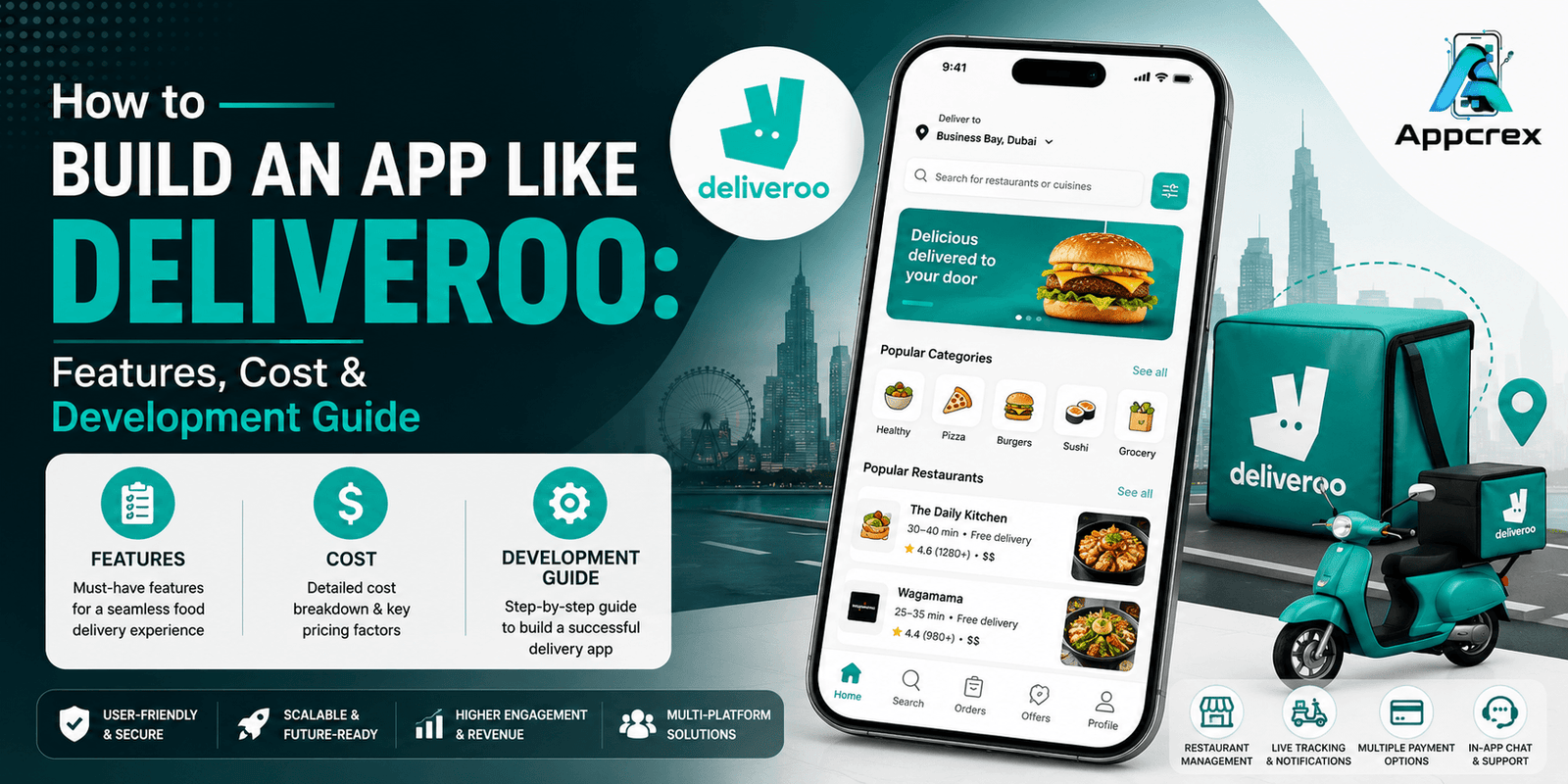
The estimated cost to build an app like Deliveroo can range from $40,000 to $70,000 for a basic MVP and can exceed $150,000–$200,000 for an advanced platform with sophisticated logistics, AI, real-time systems, and multi-location support.
This guide explains the key features, technical architecture, development cost, technology stack, business model, development process, and AI opportunities for building a Deliveroo-like food delivery platform.
Just Read : How Much Does It Cost to Build an AI-Powered App in Dubai? Complete Pricing Guide (2026)
How Much Does It Cost to Build an App Like Deliveroo?
The development cost depends on the number of platforms, features, integrations, design complexity, and technical infrastructure.
| Development Type | Estimated Cost | Approx. Timeline |
|---|---|---|
| Basic Food Delivery MVP | $40,000–$70,000 | 4–6 months |
| Standard Delivery Platform | $70,000–$120,000 | 6–9 months |
| Advanced Deliveroo-Like App | $120,000–$200,000+ | 9–14 months |
| Large Multi-Service Platform | $200,000–$350,000+ | 14–20+ months |
These are approximate ranges. The final cost depends on whether the business requires native iOS and Android apps, cross-platform development, advanced logistics, AI integration, third-party APIs, and scalable cloud infrastructure.
Just Read : Car Rental App Development Company Dubai: Complete Guide to Features, Cost & Development Process
What Is a Deliveroo-Like App?
A Deliveroo-style platform is an on-demand food delivery marketplace that connects customers with restaurants and delivery partners.
The basic workflow is:
Customer → Restaurant → Order → Delivery Partner → Customer
Behind this simple flow is a complex technical ecosystem responsible for:
- User authentication
- Restaurant discovery
- Menu management
- Cart and checkout
- Payment processing
- Order management
- Driver assignment
- GPS tracking
- Route optimization
- Notifications
- Reviews
- Analytics
A modern version can also use AI and machine learning for recommendations, demand forecasting, customer support, fraud detection, and delivery optimization.
Why Build an App Like Deliveroo?
The food delivery model offers several opportunities for entrepreneurs.
A well-designed platform can provide customers with:
- Convenient restaurant discovery
- Fast ordering
- Digital payments
- Real-time tracking
- Personalized recommendations
- Discounts and loyalty rewards
For restaurants, the platform provides an additional sales channel and customer acquisition opportunity.
For delivery partners, it creates a flexible system for receiving and completing delivery orders.
This makes the business a three-sided marketplace supported by a centralized technology platform.
Core Features of a Deliveroo-Like App
1. Customer Registration and Authentication
The customer app should provide a fast onboarding experience.
Users can register through:
- Mobile number
- OTP verification
- Apple
A secure authentication system can use token-based authentication and role-based access to protect user accounts and APIs.
2. Location Detection
Location is one of the most important components of a food delivery application.
The app can use GPS and location APIs to determine:
- Customer location
- Nearby restaurants
- Delivery zones
- Estimated delivery distance
- Delivery availability
Users should also be able to manually enter or select an address.
3. Restaurant Discovery
Customers should be able to discover restaurants based on:
- Cuisine
- Distance
- Rating
- Delivery time
- Price
- Offers
- Popularity
A backend search service can make restaurant discovery faster as the number of listings increases.
4. Advanced Search and Filters
Users can search for:
- Restaurant names
- Dishes
- Cuisine
- Categories
Filters may include:
- Vegetarian
- Vegan
- Halal
- Price range
- Rating
- Delivery time
- Offers
- Distance
For larger platforms, technologies such as Elasticsearch or OpenSearch can be used to improve search performance.
5. Restaurant Profile
Each restaurant should have a detailed profile containing:
- Restaurant name
- Images
- Rating
- Delivery time
- Delivery fee
- Menu
- Opening hours
- Reviews
- Offers
Customers can explore the restaurant before adding items to their cart.
Also Read : Restaurant Management Software Development Company: Complete Guide to Features, Cost & Development Process
6. Digital Menu
The restaurant menu should support:
- Categories
- Food images
- Descriptions
- Prices
- Add-ons
- Variations
- Availability
- Special instructions
For example:
Burger → Large → Extra Cheese → Add Fries
This requires a flexible menu and product data structure on the backend.
7. Smart Cart
The cart should dynamically calculate:
- Item price
- Quantity
- Add-ons
- Subtotal
- Delivery fee
- Taxes
- Discount
- Final amount
The pricing engine should validate the order on the server before payment to prevent manipulation of prices or discounts.
8. Secure Online Payments
A Deliveroo-like app can integrate:
- Credit cards
- Debit cards
- Digital wallets
- Apple Pay
- Google Pay
- Cash on delivery where supported
Payment processing should be handled through secure payment gateways rather than storing sensitive card information directly in the application backend.
9. Order Management System
After checkout, the order moves through multiple states:
Placed → Accepted → Preparing → Ready → Picked Up → On the Way → Delivered
The backend order-management system should maintain the current status and synchronize updates between customers, restaurants, drivers, and administrators.
10. Real-Time Order Tracking
Real-time tracking is a major feature of food delivery platforms.
Customers can see:
- Driver location
- Restaurant location
- Delivery route
- Estimated arrival time
- Order status
Technically, this can be implemented using WebSockets, real-time databases, location APIs, and event-driven backend services.
11. Delivery Partner App
The driver application is responsible for delivery operations.
Drivers can:
- Register
- Upload documents
- Go online/offline
- Receive delivery requests
- Accept orders
- Navigate to restaurants
- Confirm pickup
- Navigate to customers
- Complete deliveries
- View earnings
The driver app should continue functioning reliably even when network connectivity fluctuates.
12. Smart Driver Assignment
The platform can automatically assign delivery orders based on:
- Driver location
- Distance
- Availability
- Restaurant preparation time
- Delivery zone
- Current workload
More advanced platforms can use machine learning models to improve driver-order matching.
13. Restaurant Dashboard
Restaurants need their own dashboard to manage operations.
They can:
- Accept orders
- Reject orders
- Update preparation time
- Manage menus
- Change item availability
- View order history
- Track sales
- Manage promotions
A restaurant dashboard can be web-based, tablet-based, or integrated into a dedicated restaurant app.
14. Push Notifications
Push notifications can inform users about:
- Order confirmation
- Restaurant acceptance
- Food preparation
- Driver assignment
- Pickup
- Delivery
- Offers
Firebase Cloud Messaging and Apple Push Notification service can be used for mobile notifications.
15. In-App Chat
An in-app communication system can connect:
- Customer and support
- Driver and support
- Restaurant and support
Real-time messaging can be implemented using WebSockets or managed real-time communication services.
16. Reviews and Ratings
Customers can rate:
- Restaurant
- Food
- Delivery experience
Reviews can help users make decisions while giving restaurants valuable feedback.
A moderation system can automatically detect spam or inappropriate content.
17. Coupons and Promotions
The platform can support:
- Percentage discounts
- Fixed discounts
- Free delivery
- First-order promotions
- Restaurant-specific offers
- Time-limited campaigns
A centralized promotion engine can validate coupon eligibility during checkout.
18. Loyalty Program
A loyalty system can reward customers through:
- Points
- Cashback
- Free delivery
- Exclusive discounts
- Membership benefits
This can encourage repeat orders and improve customer retention.
Also Read : AI Training App Development Guide: How Enterprises Can Upskill Employees with AI
AI Features for a Deliveroo-Like App
AI can help a new food delivery platform differentiate itself from traditional competitors.
AI-Powered Food Recommendations
AI can analyze:
- Previous orders
- Favorite cuisines
- Spending patterns
- Search behavior
- Time of day
- Location
It can then recommend restaurants and dishes based on individual preferences.
AI-Powered Search
Instead of requiring customers to apply multiple filters, an AI search system could understand natural-language requests such as:
“Find me a healthy dinner under AED 50 near Dubai Marina.”
The system can interpret the request and return relevant restaurants.
This combines natural language processing, search APIs, structured restaurant data, and recommendation logic.
AI Customer Support
An AI chatbot can handle common questions about:
- Order status
- Delivery time
- Refunds
- Restaurant availability
- Coupons
- Payments
Complex issues can be transferred to human support agents.
AI Delivery Optimization
Machine learning can analyze:
- Driver locations
- Traffic conditions
- Restaurant preparation time
- Order density
- Delivery distances
The system can use these signals to improve delivery assignment and ETA prediction.
AI Demand Forecasting
Predictive analytics can estimate future demand based on:
- Historical orders
- Time
- Location
- Day of week
- Weather
- Events
Restaurants and delivery operations can use these insights to prepare for busy periods.
Also Read : AI App Development Guide: Features, Cost & Process (2026)
Technical Architecture of a Deliveroo-Like App
A scalable food delivery platform can use a layered architecture.
Frontend Layer
- iOS app
- Android app
- Restaurant portal
- Driver app
- Admin dashboard
API Layer
The API layer handles communication between frontend applications and backend services.
Possible technologies include:
- REST APIs
- GraphQL
- WebSockets
Backend Layer
Backend services can manage:
- Authentication
- Users
- Restaurants
- Orders
- Payments
- Drivers
- Promotions
- Notifications
For a larger platform, a microservices architecture can separate major systems such as order management, payments, user management, delivery, and notifications.
Database Layer
Potential technologies include:
- PostgreSQL
- MySQL
- MongoDB
- Redis
Redis can be useful for caching and high-speed temporary data.
Cloud Infrastructure
Cloud services can provide:
- Application hosting
- Database infrastructure
- Object storage
- Load balancing
- Auto-scaling
- Monitoring
AWS, Google Cloud, or Azure can be considered depending on project requirements.
Technology Stack for a Deliveroo-Like App
| Technology Area | Possible Technologies |
|---|---|
| iOS Development | Swift |
| Android Development | Kotlin |
| Cross-Platform | Flutter, React Native |
| Backend | Node.js, Python, Java, Go |
| Database | PostgreSQL, MySQL, MongoDB |
| Cache | Redis |
| APIs | REST, GraphQL |
| Real-Time | WebSockets |
| Search | Elasticsearch, OpenSearch |
| Cloud | AWS, Azure, Google Cloud |
| Maps | Google Maps / Mapping APIs |
| AI/ML | Python, ML frameworks, AI APIs |
| Notifications | Firebase Cloud Messaging, APNs |
| Analytics | Firebase, cloud analytics tools |
The best technology stack depends on the expected user base, performance requirements, development budget, and long-term scalability.
Development Process for an App Like Deliveroo
Step 1: Define the Business Model
Determine whether you want to build:
- Restaurant marketplace
- Food delivery platform
- Hyperlocal delivery service
- Multi-service delivery app
Also identify your target city and customer segment.
Step 2: Conduct Market Research
Analyze:
- Competitors
- Restaurant requirements
- Customer expectations
- Delivery operations
- Pricing
- Delivery fees
- Local regulations
This research helps define the right MVP.
Step 3: Create the MVP Feature List
Start with essential features:
- Customer registration
- Restaurant discovery
- Menu
- Cart
- Checkout
- Payments
- Order management
- Driver app
- GPS tracking
- Admin dashboard
Advanced AI functionality can be introduced after validating the core marketplace.
Step 4: UI/UX Design
Create separate interfaces for:
- Customers
- Restaurants
- Drivers
- Administrators
The design should prioritize fast restaurant discovery and a simple checkout process.
Step 5: Backend & API Development
Develop the backend services and APIs for:
- Authentication
- Restaurant management
- Orders
- Drivers
- Payments
- Notifications
- Reviews
- Promotions
API documentation should be maintained throughout development to make future integrations easier.
Step 6: Third-Party Integrations
Integrate required services such as:
- Payment gateways
- Maps
- GPS
- SMS
- Push notifications
- Analytics
- AI services
Only integrate services that are actually required for the MVP to avoid unnecessary development costs.
Step 7: Security Implementation
Security should cover:
- Authentication
- API authorization
- Encryption
- Secure payment processing
- Data protection
- Role-based access
- Rate limiting
- Fraud monitoring
Security should be considered during development rather than added only before launch.
Step 8: Testing
QA teams should test:
- Registration
- Restaurant search
- Checkout
- Payments
- Order status
- Driver assignment
- GPS tracking
- Notifications
- Chat
- Admin operations
Load and performance testing are particularly important because food delivery platforms may experience large traffic spikes during lunch and dinner hours.
Step 9: Launch the MVP
Instead of immediately launching across an entire country, start with a defined service area.
This makes it easier to:
- Onboard restaurants
- Manage drivers
- Test delivery operations
- Collect customer feedback
- Improve the product
Step 10: Scale the Platform
After validating the business model, introduce:
- More cities
- More restaurants
- Subscription plans
- Loyalty programs
- AI recommendations
- Grocery delivery
- Pharmacy delivery
- Retail delivery
Deliveroo App Development Cost Breakdown
| Development Component | Estimated Cost |
|---|---|
| UI/UX Design | $7,000–$15,000 |
| Customer App | $20,000–$40,000 |
| Driver App | $15,000–$30,000 |
| Restaurant Portal/App | $12,000–$25,000 |
| Backend & APIs | $25,000–$50,000 |
| Admin Dashboard | $10,000–$20,000 |
| GPS & Real-Time Tracking | $7,000–$15,000 |
| Payment Integration | $5,000–$12,000 |
| AI Features | $10,000–$30,000 |
| Testing & Security | $10,000–$20,000 |
These figures are indicative rather than fixed development quotations.
How Long Does It Take to Build an App Like Deliveroo?
A basic MVP can take approximately 4–6 months.
A standard food delivery marketplace may take 6–9 months, while an advanced platform with AI, sophisticated delivery optimization, multiple integrations, and scalable infrastructure can require 9–14 months or more.
| Development Stage | Estimated Time |
|---|---|
| Market Research | 2–4 weeks |
| UI/UX Design | 4–6 weeks |
| Backend Development | 8–14 weeks |
| Mobile Development | 10–18 weeks |
| Integrations | 3–6 weeks |
| Testing | 4–8 weeks |
| Deployment | 1–2 weeks |
Some stages can run simultaneously, so the total project duration should not simply be calculated by adding every row.
Business Model of a Deliveroo-Like App
A food delivery marketplace can generate revenue through multiple channels.
Restaurant Commission
The platform can charge restaurants a commission on completed orders based on their partnership agreement.
Delivery Fees
Customers can pay delivery fees based on factors such as:
- Distance
- Location
- Order value
- Delivery speed
Sponsored Listings
Restaurants can pay to promote their listings within the platform.
Subscription Plans
A premium membership can offer:
- Free delivery
- Exclusive discounts
- Special promotions
- Priority benefits
Advertising
Restaurants and food brands can purchase advertising placements within the platform.
How to Make Your Deliveroo-Like App Different?
Entering the market with another generic food delivery app can be challenging.
Instead, consider a focused value proposition.
AI-First Food Discovery
Use AI to understand what customers actually want instead of relying entirely on traditional filters.
Healthy Food Marketplace
Focus on:
- Healthy meals
- Nutrition information
- Calorie tracking
- Personalized recommendations
Local Restaurant Delivery
Help independent restaurants compete with larger food brands through affordable delivery and marketing tools.
Premium Food Delivery
Target customers looking for:
- Premium restaurants
- Faster delivery
- Exclusive menus
- Concierge-style service
Multi-Service Delivery
Once food delivery is established, the platform can expand into:
- Grocery
- Pharmacy
- Convenience products
- Retail
How to Reduce the Cost of Building a Deliveroo-Like App?
The most effective way to control development costs is to launch an MVP.
Phase 1 — MVP
Build:
- Customer app
- Restaurant portal
- Driver app
- Admin panel
- Ordering
- Payment
- GPS tracking
Phase 2 — Growth
Add:
- Loyalty
- Coupons
- Subscriptions
- Reviews
- Chat
- Advanced analytics
Phase 3 — AI & Automation
Add:
- AI recommendations
- AI chatbot
- Natural-language search
- Demand forecasting
- Smart driver assignment
- Predictive ETA
This phased approach allows you to validate the business before making major investments in advanced technology.
Why Choose AppCrex for Food Delivery App Development?
AppCrex can help businesses build customized food delivery and on-demand platforms for Dubai, UAE, and international markets.
Development services can include:
- Food Delivery App Development
- Restaurant App Development
- Delivery Partner App Development
- On-Demand Delivery App Development
- AI App Development
- AI Integration Services
- GPS Tracking Integration
- Real-Time Tracking
- Payment Gateway Integration
- API Integration
- iOS App Development
- Android App Development
- Cross-Platform App Development
- Admin Dashboard Development
- Cloud Backend Development
- Custom Software Development
Businesses can also hire mobile app developers for dedicated development projects, including MVP development, backend engineering, AI integration, API development, and ongoing maintenance.
Build a Food Delivery App Like Deliveroo With AppCrex
The cost to build an app like Deliveroo can start at around $40,000–$70,000 for an MVP and exceed $150,000–$200,000 for an advanced platform.
The final cost depends on the number of apps, backend complexity, real-time tracking, payment systems, restaurant management tools, delivery optimization, AI functionality, and third-party integrations.
A successful Deliveroo-like platform requires a strong technical foundation. Customer experience is important, but the backend infrastructure is equally critical because orders, drivers, restaurants, payments, and location data must remain synchronized in real time.
AI can further improve the platform through personalized recommendations, intelligent search, customer support, demand forecasting, predictive ETA, and smart delivery assignment.
If you are planning to launch a food delivery platform, starting with a focused MVP can help reduce the initial investment while providing a foundation for future expansion.
Have an idea for a food delivery or on-demand delivery platform? AppCrex can help you define the product architecture, features, technology stack, development timeline, and estimated budget.
FAQs
Q. How much does it cost to build an app like Deliveroo?
A basic Deliveroo-like MVP can cost approximately $40,000–$70,000, while an advanced platform can cost $120,000–$200,000+.
Q. How long does it take to develop a Deliveroo-like app?
A basic MVP may take 4–6 months, while a feature-rich platform can take 9–14 months or longer.
Q. What are the main features of a Deliveroo-like app?
The core features include restaurant discovery, search, menus, cart, checkout, online payments, order management, GPS tracking, driver management, notifications, reviews, and an admin dashboard.
Q. Can AI be integrated into a food delivery app?
Yes. AI can be used for personalized food recommendations, natural-language search, customer support, demand forecasting, predictive ETA, and delivery optimization.
Q. What technology is used to build a food delivery app?
Technologies can include Flutter or React Native for cross-platform apps, Swift and Kotlin for native development, Node.js/Python/Java for backend systems, PostgreSQL or MongoDB for databases, Redis for caching, WebSockets for real-time communication, and cloud platforms such as AWS, Azure, or Google Cloud.
Q. Can I hire mobile app developers to build a Deliveroo-like app?
Yes. You can hire mobile app developers with experience in food delivery, real-time tracking, payment integration, API development, cloud infrastructure, and AI-powered applications.
Q. How does a Deliveroo-like app make money?
Common revenue sources include restaurant commissions, delivery fees, sponsored listings, subscriptions, and advertising.
Q. Can the same platform support grocery delivery?
Yes. A scalable on-demand delivery architecture can later be expanded to grocery, pharmacy, convenience, and other categories.
Q. Is real-time GPS tracking necessary?
For a modern food delivery marketplace, real-time tracking is highly valuable because customers and operations teams need visibility into delivery progress and estimated arrival times.
Q. Can AppCrex develop a Deliveroo-like app?
Yes. AppCrex can develop the customer app, restaurant system, driver app, backend APIs, admin dashboard, payment integrations, GPS tracking, AI functionality, and other components required for an on-demand food delivery platform.