Introduction
Music streaming has transformed the way people discover, listen to, and share music. Instead of downloading individual songs or purchasing physical albums, users can access large digital music libraries through smartphones, tablets, desktops, smart TVs, and connected devices.
Spotify is one of the best-known examples of this model, combining music streaming with playlists, recommendations, podcasts, personalized discovery, social features, and premium subscriptions.
For entrepreneurs, startups, and media companies, this creates an opportunity to build a music streaming app like Spotify with a unique catalog, target audience, monetization strategy, and user experience.
But how much does it cost to build an app like Spotify?
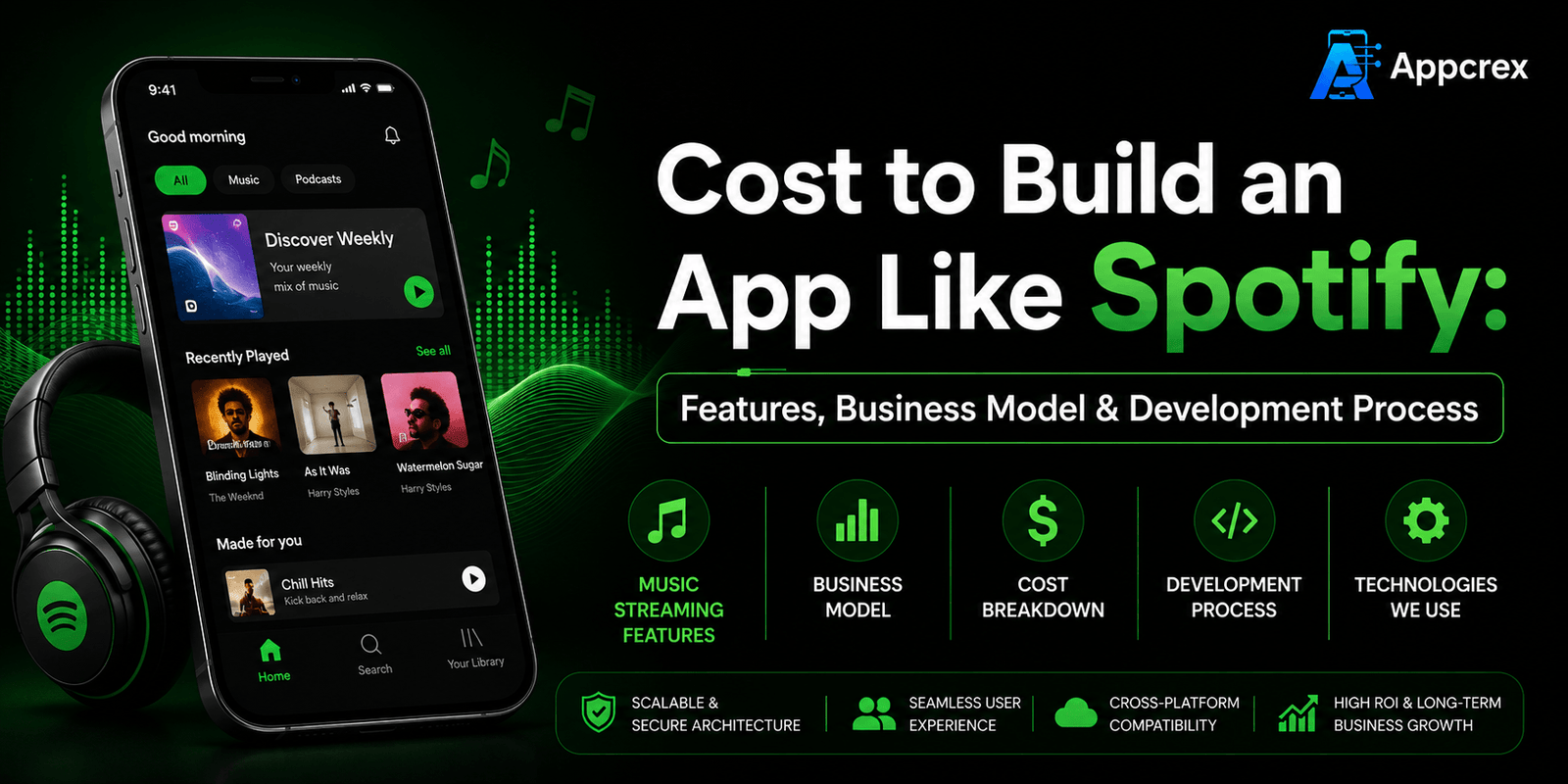
A basic music streaming MVP can cost approximately $50,000–$80,000, while a medium-complexity platform may require $80,000–$150,000. A large-scale streaming platform with advanced recommendations, multiple platforms, real-time infrastructure, creator tools, advertising, sophisticated analytics, and extensive content management can cost $150,000–$300,000+.
The biggest difference between a normal mobile app and a Spotify-like platform is that you’re not simply developing an interface. You are building a content streaming ecosystem that requires audio infrastructure, licensing, content management, search, recommendations, subscriptions, payments, analytics, and scalable backend systems.
This guide explains the cost to build an app like Spotify, including features, development stages, technology stack, business model, revenue streams, timeline, and major cost factors.
How Much Does It Cost to Build an App Like Spotify?
The development cost depends on how ambitious the product is.
| App Type | Estimated Cost |
|---|---|
| Basic Music Streaming MVP | $50,000–$80,000 |
| Medium-Complexity Streaming App | $80,000–$150,000 |
| Advanced Music Platform | $150,000–$300,000+ |
| Large-Scale Streaming Ecosystem | $300,000+ |
These are broad development estimates. Actual pricing depends on the number of platforms, streaming architecture, content-management requirements, recommendation engine, integrations, subscription system, and other features.
Why Does a Spotify-Like App Cost So Much?
A music streaming app involves several systems working together.
A typical platform may require:
- Customer mobile applications
- Web application
- Admin dashboard
- Artist/creator dashboard
- Audio storage
- Streaming infrastructure
- Content management
- Search engine
- Recommendation engine
- Subscription management
- Payment integration
- Advertising system
- Analytics
- Notifications
- Copyright and licensing workflows
The cost therefore comes from the complete ecosystem, not just the mobile application.
Cost Breakdown of a Spotify-Like App
A rough budget can be divided into the following components.
| Component | Estimated Cost |
|---|---|
| UI/UX Design | $5,000–$15,000 |
| iOS App | $15,000–$35,000 |
| Android App | $15,000–$35,000 |
| Backend | $20,000–$50,000 |
| Web Platform | $10,000–$30,000 |
| Admin Dashboard | $10,000–$25,000 |
| Streaming Infrastructure | $15,000–$40,000+ |
| Recommendation System | $10,000–$40,000+ |
| Payment & Subscription | $5,000–$15,000 |
| Testing & QA | $5,000–$15,000 |
| DevOps & Deployment | $5,000–$20,000 |
Not every project needs all of these components in the first release.
What Is a Spotify-Like Music Streaming App?
A Spotify-like application allows users to discover and consume audio content digitally.
Depending on the business model, the platform can offer:
- Music streaming
- Albums
- Artists
- Playlists
- Podcasts
- Audio shows
- Personalized recommendations
- Search
- Favorites
- Downloads
- Premium subscriptions
- Advertisements
- Social sharing
A startup doesn’t need to launch with the same scale as Spotify.
Instead, you can build a focused platform around:
- Independent artists
- Regional music
- Podcasts
- Religious audio
- Educational audio
- Audiobooks
- Fitness audio
- Niche genres
- Local-language content
This can make the initial product more manageable.
Also Read : How to Build an App Like WePlay: A Complete 2026 Guide
Key Features of an App Like Spotify
1. User Registration
Users can create accounts through:
- Mobile number
- OTP
- Social login
The account can be used to synchronize playlists, favorites, listening history, subscriptions, and preferences.
2. Music Discovery
Discovery is one of the most important parts of a streaming application.
Users can browse:
- New releases
- Popular songs
- Trending artists
- Albums
- Genres
- Moods
- Curated playlists
- Personalized recommendations
A well-designed discovery experience can increase listening time and user retention.
3. Search Functionality
Users should be able to search for:
- Songs
- Artists
- Albums
- Playlists
- Podcasts
- Genres
Search should provide fast results even when the platform contains millions of records.
This requires an efficient search architecture rather than relying only on a traditional database query.
4. Audio Player
The audio player is the core component of the application.
It can include:
- Play
- Pause
- Next
- Previous
- Seek
- Volume control
- Repeat
- Shuffle
- Queue
- Playback progress
- Background playback
A modern player should also maintain playback state when users navigate between screens.
5. Playlist Creation
Users can create and manage their own playlists.
Features may include:
- Create playlist
- Add songs
- Remove songs
- Reorder songs
- Rename playlist
- Share playlist
- Public/private settings
Playlists can become an important engagement mechanism.
6. Favorites & Personal Library
Users can save:
- Songs
- Albums
- Artists
- Podcasts
- Playlists
A personalized library gives users a central place to access their preferred content.
7. Listening History
The application can maintain a history of previously played content.
This can also help power recommendation algorithms.
For example:
Listening history → User preferences → Recommendation engine → Personalized content
8. Personalized Recommendations
Recommendation technology can become one of the most valuable features of a music streaming platform.
The system can analyze signals such as:
- Listening history
- Favorite artists
- Genres
- Skip behavior
- Playlist activity
- Search behavior
- Session duration
It can then generate recommendations.
Possible recommendation sections include:
- Recommended for You
- Because You Listened to…
- New Music
- Similar Artists
- Personalized Mixes
A sophisticated recommendation engine can significantly increase development complexity.
9. Offline Listening
Premium users may be allowed to download selected content for offline listening.
This requires:
- Secure local storage
- Download management
- Encryption
- Subscription verification
- Playback restrictions
- Content expiration controls
Offline playback is significantly more complex than ordinary audio streaming.
10. Audio Quality Controls
The application can offer different streaming quality levels.
For example:
- Low
- Standard
- High
- Very High
This allows users to balance audio quality and data consumption.
11. Lyrics
A music application can display synchronized or static lyrics where properly licensed.
Features can include:
- Lyrics display
- Synchronized lyrics
- Lyrics search
- Translation
Licensing considerations apply to lyrics just as they do to music.
12. Artist Profiles
Artists can have dedicated profiles containing:
- Profile image
- Biography
- Songs
- Albums
- Popular tracks
- Playlists
- Followers
This creates a direct connection between creators and listeners.
13. Podcast Support
A Spotify-like platform doesn’t have to focus exclusively on music.
You can also support:
- Podcasts
- Episodes
- Shows
- Categories
- Hosts
- Subscriptions
Podcast functionality can create another content and revenue channel.
14. Social Sharing
Users can share music or playlists through:
- Social media
- Messaging apps
- Copyable links
- In-app sharing
Social functionality can help increase organic discovery.
15. Push Notifications
Notifications can inform users about:
- New releases
- Favorite artists
- New episodes
- Playlist updates
- Subscription status
- Promotions
Personalized notifications can also be triggered by listening activity.
Artist & Creator Dashboard
A large streaming platform may require a dedicated creator interface.
Artists can use it to:
- Upload music
- Manage albums
- Update profiles
- View streams
- Monitor listeners
- Review revenue
- Manage releases
A creator dashboard turns the application into a broader music ecosystem rather than simply a player.
Admin Panel Features
The admin dashboard controls the entire platform.
User Management
Administrators can manage:
- User accounts
- Subscriptions
- Reports
- Account status
- Support requests
Content Management
Admin users can manage:
- Songs
- Albums
- Artists
- Podcasts
- Playlists
- Genres
- Categories
Subscription Management
The system can monitor:
- Active subscriptions
- Expired subscriptions
- Upgrades
- Cancellations
- Payments
Analytics
Business owners can monitor:
- Total users
- Active users
- Listening hours
- Popular content
- Subscription revenue
- Churn
- Geographic distribution
Also Read : Mobile App Development Company India: Custom Android, iOS & AI App Development Services
Music Streaming Architecture
The backend architecture is one of the most important parts of a Spotify-like application.
A simplified architecture could look like:
Mobile/Web App → API Layer → Backend → Content Database → Audio Storage/CDN → Streaming
The audio files should generally not be delivered directly from a basic application server.
A scalable architecture can use:
- Object storage
- CDN
- Streaming services
- Load balancing
- Caching
- Database clusters
This helps deliver audio efficiently to users across different locations.
CDN for Music Streaming
A Content Delivery Network can distribute audio content through geographically distributed servers.
This can improve:
- Streaming speed
- Latency
- Reliability
- Scalability
CDN requirements can become significant as the number of users and audio hours increases.
Recommendation Engine Development
A basic recommendation system might use:
- Genre
- Artist
- Listening history
- User preferences
An advanced recommendation engine can use machine learning to identify patterns across large amounts of user behavior.
For example:
User Behavior → Data Processing → ML Model → Recommendation Score → Personalized Feed
Developing such a system requires additional data engineering and machine-learning expertise.
Also Read : DeepTech & AI App Development in Cambridge: Technologies, Use Cases, Cost & Development Guide
AI Features for a Music Streaming App
AI can introduce additional capabilities.
AI Music Recommendations
AI can analyze user preferences and generate personalized recommendations.
AI Search
Users could search using natural language.
For example:
“Play relaxing songs for a late-night drive.”
AI Playlist Generation
Users could describe a mood or activity and receive a generated playlist.
AI Voice Assistant
Users could control playback using voice commands.
AI Content Discovery
AI can summarize podcast episodes or help users discover relevant audio content where appropriate.
These features can increase the development budget but also provide opportunities for differentiation.
Also Read : AI & SaaS App Development in Bengaluru: Startup, Technology & Business Guide
Music Streaming App Business Model
There are several ways to monetize a Spotify-like platform.
Freemium Model
Users can access basic streaming for free while premium subscribers receive additional benefits.
Possible premium features include:
- Ad-free listening
- Offline downloads
- Better audio quality
- Unlimited skips
- Exclusive content
Advertising Model
Free users can generate revenue through advertisements.
Possible formats include:
- Audio ads
- Display ads
- Sponsored playlists
- Sponsored content
An advertising platform requires additional systems for:
- Campaign management
- Targeting
- Reporting
- Billing
- Analytics
Subscription Model
Subscription plans can be:
- Individual
- Family
- Student
- Business
Different plans can offer different limits and benefits.
Artist & Creator Monetization
A platform can also generate revenue through creator services such as:
- Premium promotion
- Distribution
- Analytics
- Creator subscriptions
- Sponsored content
The exact model depends on the business strategy and applicable agreements.
How Does a Spotify-Like App Make Money?
A diversified platform could use:
Free Users → Advertising Revenue
Premium Users → Subscription Revenue
Artists/Creators → Platform Services
Businesses → Advertising & Partnerships
This reduces dependency on one revenue source.
Technology Stack for a Spotify-Like App
Mobile Development
Possible choices include:
iOS: Swift
Android: Kotlin
Cross-platform: Flutter or React Native
Cross-platform development can be useful for an MVP, depending on performance and platform-specific requirements.
Backend
Possible technologies:
- Node.js
- Python
- Java
- Go
- .NET
The backend should be designed for high concurrency and scalable media delivery.
Database
Possible technologies:
- PostgreSQL
- MySQL
- MongoDB
- Redis
Different databases can serve different purposes.
For example, Redis can support caching and fast session or queue operations.
Cloud Infrastructure
Potential options include:
- AWS
- Google Cloud
- Microsoft Azure
Cloud infrastructure can provide scalable storage, computing, databases, CDN services, monitoring, and security tools.
Also Read : Cross-Platform App Development Cost: Complete Pricing Guide (2026)
Development Process
Step 1: Market Research
Before development, determine:
- Target audience
- Music category
- Geographic market
- Competitors
- Content strategy
- Pricing
Step 2: Define MVP
Decide which features are essential for the first release.
A basic MVP could include:
- Registration
- Search
- Music catalog
- Audio player
- Playlists
- Favorites
- Subscription
- Payments
- Admin panel
Step 3: UI/UX Design
Design:
- Home screen
- Search
- Player
- Library
- Playlist
- Artist profile
- Subscription screens
Step 4: Backend Development
Develop:
- Authentication
- APIs
- User management
- Content management
- Streaming architecture
- Subscription system
Step 5: Mobile Development
Develop iOS and Android applications or use a suitable cross-platform framework.
Step 6: Streaming Infrastructure
Set up:
- Audio storage
- CDN
- Encoding
- Delivery
- Caching
- Playback services
Step 7: Payment Integration
Integrate appropriate payment providers for subscriptions.
Step 8: Testing
Testing should cover:
- Playback
- Network interruptions
- Audio quality
- Authentication
- Payments
- Subscription status
- Device compatibility
- Performance
- Security
Step 9: Deployment
Deploy the backend infrastructure and prepare mobile applications for the relevant app stores.
Step 10: Post-Launch Optimization
After launch, analyze:
- User retention
- Listening behavior
- Popular content
- Subscription conversion
- Churn
- App performance
Then introduce improvements based on actual user behavior.
How Long Does It Take to Build an App Like Spotify?
| Project Type | Estimated Timeline |
|---|---|
| Basic MVP | 4–6 months |
| Medium Platform | 6–9 months |
| Advanced Streaming Platform | 9–15+ months |
| Large-Scale Ecosystem | 15+ months |
The timeline depends on the number of platforms, streaming architecture, content management, recommendation engine, creator tools, and integrations.
Factors That Affect Spotify-Like App Development Cost
Number of Platforms
iOS + Android + Web requires more development than a single-platform MVP.
Audio Infrastructure
Streaming requires specialized infrastructure.
Content Library
A large catalog requires sophisticated storage and management systems.
Recommendations
AI-powered personalization increases complexity.
Offline Mode
Offline playback requires additional security and content-management systems.
Subscriptions
Subscription management adds payment and billing complexity.
Creator Dashboard
Artist and creator tools require another layer of functionality.
Advertising
An advertising system adds campaign management, targeting, billing, and analytics.
Music Licensing: A Critical Consideration
One of the biggest differences between building a normal media app and building a commercial music streaming service is content rights.
You cannot simply upload copyrighted music and stream it commercially because you have built the technical platform.
A real music service may need appropriate agreements and licenses for:
- Sound recordings
- Musical compositions
- Lyrics
- Podcasts
- Other copyrighted content
The exact requirements vary by country, content type, and business model, so legal advice should be obtained before launch.
This is also why building a Spotify-like technology platform and launching a Spotify-like commercial music catalog are two different challenges.
Can You Use Spotify APIs to Build a Spotify Competitor?
This is an important distinction.
Spotify provides developer APIs and SDKs for certain integrations. Its Web API can provide access to metadata and certain playback-related functionality, while its Web Playback SDK supports playback experiences tied to Spotify.
However, Spotify’s developer documentation states that its platform cannot be used to develop commercial streaming applications, and its Web Playback SDK has specific terms and requirements.
Therefore, if your goal is to launch your own commercial music streaming service, you should not assume that Spotify’s APIs can simply provide your music catalog and streaming infrastructure. You would need to build your own platform and secure the appropriate content rights.
How to Reduce the Cost of Building a Spotify-Like App?
Start With a Niche
Instead of competing with every music platform, focus on a specific audience.
Build an MVP
Start with:
- Music catalog
- Search
- Player
- Playlists
- Favorites
- Subscription
Use Cross-Platform Development
Flutter or React Native can be considered where appropriate.
Avoid Building Everything at Once
Advanced AI recommendations, social functionality, podcasts, advertising, and creator monetization can be added later.
Use Scalable Cloud Infrastructure
Start with an architecture that can grow without overengineering the first version.
Why Choose AppCrex for Music Streaming App Development?
AppCrex provides custom music streaming app development company for startups, media companies, entertainment businesses, and entrepreneurs.
Our services can include:
- Music Streaming App Development
- Audio Streaming App Development
- Podcast App Development
- OTT App Development
- iOS App Development
- Android App Development
- Flutter App Development
- React Native App Development
- AI Recommendation Integration
- Subscription Development
- Payment Integration
- Admin Dashboard Development
- Creator/Artist Dashboard
- Cloud & Backend Development
- API Integration
- Testing & QA
- Maintenance & Support
We can help define an MVP, select the right technology stack, design the streaming architecture, develop the applications, and prepare the platform for future growth.
Build Your Music Streaming App With AppCrex
The cost to build an app like Spotify can range from approximately $50,000 for a focused MVP to $300,000+ for an advanced streaming ecosystem.
The biggest factors are not just mobile development. Audio infrastructure, content management, streaming delivery, recommendations, subscriptions, creator tools, advertising, security, and content licensing can all significantly affect the total investment.
For startups, the most practical approach is usually to begin with a focused music streaming MVP. Once the platform attracts users and establishes its content strategy, advanced capabilities such as AI recommendations, offline listening, podcasts, creator tools, advertising, and social features can be introduced.
The objective should not be to copy Spotify feature-for-feature. Instead, build a unique streaming platform around a specific audience, content catalog, and business model.
Have an idea for a music streaming platform? Contact AppCrex to discuss your features, technology requirements, development timeline, and estimated budget.
FAQs
Q. How much does it cost to build an app like Spotify?
A basic music streaming MVP can cost approximately $50,000–$80,000. A medium platform may cost $80,000–$150,000, while an advanced platform can reach $150,000–$300,000+.
Q. How long does it take to develop a Spotify-like app?
A basic MVP can take around 4–6 months, while a larger platform with advanced streaming, recommendations, creator tools, and multiple platforms can take 9–15+ months.
Q. What are the most important features of a music streaming app?
Core features include user registration, music discovery, search, audio playback, playlists, favorites, listening history, subscriptions, payments, notifications, and an admin dashboard.
Q. Can I build a music streaming app using Flutter?
Yes. Flutter can be suitable for many iOS and Android music applications. However, the final architecture should consider audio playback, background processing, device integration, and any platform-specific requirements.
Q. How does a music streaming app make money?
Common models include subscriptions, advertising, premium plans, partnerships, and creator-focused services.
Q. Do I need music licenses to launch a Spotify-like service?
If your platform streams copyrighted music commercially, you generally need the appropriate rights and licenses. The exact requirements depend on the content and target markets, so legal advice is important before launch.
Q. Can Spotify APIs be used to create a commercial Spotify competitor?
Spotify’s developer documentation says its platform cannot be used to develop commercial streaming applications. Its APIs and SDKs also operate under specific developer terms and restrictions.
Q. Can AI be integrated into a music streaming app?
Yes. AI can support personalized recommendations, natural-language search, playlist generation, voice controls, content discovery, and other features.