
📌 Key Takeaways
- A Zerodha-like trading app can cost around $60,000–$250,000+ depending on complexity.
- Real-time market data and order processing are among the most important technical components.
- Security, KYC, compliance, and financial integrations must be considered from the beginning.
- Starting with a focused trading MVP can reduce initial development costs and time.
- Advanced features such as AI analytics, derivatives, and sophisticated portfolio tools can be added as the platform grows.
Introduction
Zerodha is one of the most recognized examples of a technology-driven brokerage platform in India. Its success has also created interest among entrepreneurs and financial businesses looking to build their own stock trading and investment apps.
But building an app like Zerodha is much more than developing a mobile interface. A serious trading platform needs real-time market data, order management, portfolio tracking, authentication, payment systems, security, regulatory workflows, analytics, and reliable backend infrastructure.
So, how do you build an app like Zerodha, and how much does it cost?
A basic stock trading app MVP can cost approximately $60,000–$100,000, while a feature-rich trading and investment platform can cost around $120,000–$250,000+. A highly sophisticated platform with advanced trading infrastructure, algorithmic trading, extensive analytics, multiple financial products, and enterprise-grade infrastructure can require considerably more investment.
This guide explains the features, development process, technology stack, business model, security requirements, timeline, and cost to build an app like Zerodha.
What Is a Zerodha-Like Trading App?
A Zerodha-like application is essentially a digital investment and brokerage platform that allows users to access financial markets through web and mobile interfaces.
Depending on the business model and regulatory permissions, a platform may support:
- Stock trading
- Mutual funds
- ETFs
- IPOs
- Bonds
- Portfolio management
- Market watchlists
- Investment analytics
- Real-time market data
- Order management
- Trading charts
- Notifications
- Fund management
The exact services available depend on the jurisdiction, licenses, broker/dealer arrangements, and financial products supported by the platform.
For a startup, it is usually better to begin with a focused investment product rather than attempting to replicate every feature of a mature brokerage platform.
Just Read : Cost to Develop a FinTech App: Complete Development Guide, Features & Pricing (2026)
How Much Does It Cost to Build an App Like Zerodha?
The development cost varies according to the scope and level of trading functionality.
| App Type | Estimated Cost |
|---|---|
| Basic Trading MVP | $60,000–$100,000 |
| Standard Stock Trading Platform | $100,000–$180,000 |
| Advanced Trading App | $180,000–$250,000+ |
| Enterprise Trading Ecosystem | $250,000+ |
These are broad software development estimates. They do not necessarily include brokerage licenses, exchange fees, market-data subscriptions, legal expenses, compliance costs, or other financial-industry expenses.
Why Is a Trading App More Expensive Than a Normal App?
A conventional mobile app might mainly process user accounts, content, and transactions.
A trading platform has to process financial actions where reliability and security are critical.
The architecture may need to handle:
- Real-time market data
- Buy/sell orders
- Portfolio calculations
- Account balances
- Transaction history
- Trade confirmations
- Notifications
- Risk controls
- Authentication
- Audit logs
A short interruption in a normal application may be inconvenient. In a trading environment, system reliability can be significantly more important.
Also Read : How Secure Is Trading Software Development in 2026?
Key Features of an App Like Zerodha
1. User Registration & KYC
The onboarding process can include:
- Mobile verification
- Email verification
- Identity verification
- KYC workflows
- Bank-account verification
- Document upload
- Digital signatures
The exact KYC process depends on the country and financial regulations applicable to the business.
2. User Dashboard
The dashboard should give users a quick overview of their financial activity.
It may display:
- Portfolio value
- Available balance
- Investments
- Today’s P&L
- Overall P&L
- Open positions
- Orders
- Watchlists
The interface should present complex financial information in a simple way.
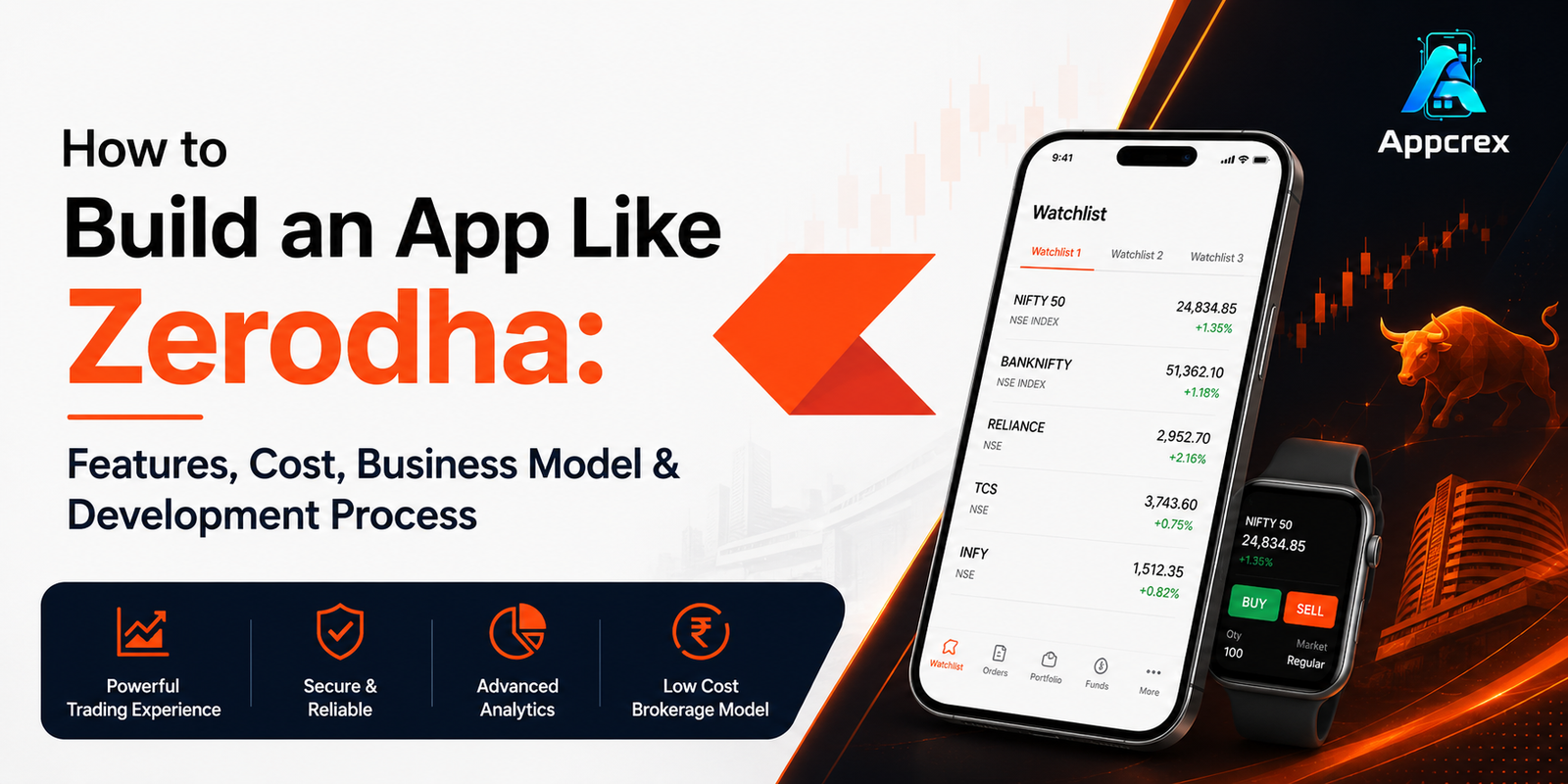
3. Market Watch
A watchlist allows users to monitor selected securities.
Users can add:
- Stocks
- ETFs
- Indices
- Other supported instruments
The watchlist can display:
- Current price
- Price change
- Percentage change
- Trading volume
- Market status
4. Real-Time Market Data
Real-time market information is a critical component of a trading platform.
Depending on the market, users may need:
- Bid price
- Ask price
- Last traded price
- Volume
- Price movement
- Market depth
- Index data
Real-time market data generally requires appropriate data agreements or licensed feeds.
5. Stock Search
Users should be able to search for financial instruments quickly.
Search can support:
- Company name
- Ticker/symbol
- Exchange
- Sector
- Instrument type
A fast search experience becomes increasingly important as the number of supported securities grows.
6. Stock Details
Each security can have a dedicated information screen.
Possible information includes:
- Current price
- Historical price
- Daily change
- Market statistics
- Company information
- Trading volume
- Charts
- Relevant financial metrics
The amount of information can be customized according to the target investor segment.
7. Trading Charts
Charts help users analyze market movements.
Possible chart functionality includes:
- Intraday charts
- Daily charts
- Weekly charts
- Monthly charts
- Historical price data
- Volume
Advanced platforms may also offer technical indicators.
8. Buy & Sell Orders
The core trading functionality allows users to place orders.
Depending on the market and brokerage model, order types can include:
- Market orders
- Limit orders
- Stop orders
- Stop-limit orders
The application should clearly communicate order status to users.
9. Order Management
Users need to track their orders.
Possible statuses include:
- Pending
- Open
- Executed
- Partially executed
- Cancelled
- Rejected
A robust order-management system must keep the status synchronized with the underlying brokerage or exchange infrastructure.
10. Portfolio Management
The portfolio dashboard can show:
- Holdings
- Average purchase price
- Current value
- Profit/loss
- Portfolio allocation
- Historical performance
Users should be able to understand their overall investment position without navigating through multiple screens.
11. Transaction History
Users can review previous:
- Orders
- Trades
- Deposits
- Withdrawals
- Dividends
- Other supported transactions
A detailed history is also important for reporting and account management.
12. Fund Management
A trading platform may allow users to:
- Add funds
- Withdraw funds
- View available balance
- View transaction history
Payment and banking integrations should be implemented according to applicable financial regulations.
13. IPO Investment
If supported by the business model, users can discover and apply for IPOs through the platform.
The feature may include:
- IPO listings
- Issue details
- Price range
- Application process
- Application status
14. Mutual Fund Investment
A broader investment platform can also support mutual funds.
Features can include:
- Fund discovery
- Fund comparison
- Investment
- SIP management
- Portfolio tracking
- Returns analysis
This is particularly useful if you want to build an investment platform rather than a stock-only trading application.
15. Push Notifications
Notifications can inform users about:
- Order execution
- Price alerts
- Portfolio changes
- Corporate actions
- IPO updates
- Fund transactions
- Security events
Notifications should be carefully designed because financial alerts can contain sensitive information.
16. Price Alerts
Users can create alerts based on specific conditions.
For example:
Notify me when a stock reaches a particular price.
The backend continuously monitors the relevant market information and triggers the notification when the condition is met.
17. Watchlists
Users can create multiple watchlists based on their interests.
For example:
- Long-term stocks
- Technology stocks
- Banking
- ETFs
- Dividend stocks
This improves organization and engagement.
18. Advanced Trading Features
An advanced platform can offer:
- Technical indicators
- Advanced charts
- Market depth
- Multiple order types
- Options chain
- Derivatives data
- Strategy tools
- Advanced portfolio analytics
These features increase both development complexity and ongoing infrastructure requirements.
19. Educational Content
A trading platform can also provide educational material.
Examples include:
- Investment guides
- Market terminology
- Beginner tutorials
- Financial explainers
- Video lessons
Educational content can help new investors understand the platform and financial products.
20. Admin Dashboard
The admin panel is one of the most important parts of the system.
Administrators may manage:
- Users
- KYC
- Accounts
- Transactions
- Orders
- Support requests
- Notifications
- Reports
- Compliance workflows
Role-based access controls should ensure that administrators only access the information necessary for their responsibilities.
Broker & Operations Dashboard
If the platform operates with a brokerage infrastructure, internal teams may need additional tools for:
- Account management
- Order monitoring
- Risk management
- Transaction reconciliation
- Customer support
- Compliance
- Reporting
This back-office functionality is often overlooked when estimating development costs.
How Does a Trading App Work?
A simplified trading architecture can look like this:
User → Mobile/Web App → API → Trading Backend → Broker/Exchange Infrastructure → Order Execution
At the same time:
Market Data Feed → Market Data Service → Backend → Mobile/Web App
This means the application has two major flows:
Trading Flow
User places order → Backend validates request → Order routed → Execution response → Order status updated.
Market Data Flow
Market data received → Processed → Distributed → User interface updated.
Both systems need to work reliably.
Technology Stack for a Zerodha-Like App
Mobile App Development
Possible technologies include:
- Flutter
- React Native
- Swift
- Kotlin
For a trading platform, the technology should be selected based on performance, platform requirements, real-time data handling, and long-term maintainability.
Frontend
Possible technologies include:
- React
- Next.js
- TypeScript
A web trading platform may require a highly responsive interface capable of displaying continuously changing market information.
Backend
Possible technologies:
- Node.js
- Python
- Java
- Go
- .NET
The final choice depends on architecture, integrations, performance requirements, and the development team’s expertise.
Database
Possible technologies include:
- PostgreSQL
- MySQL
- MongoDB
- Redis
A trading system may use multiple data stores for different workloads.
Redis, for example, can be useful for caching and fast-access data.
APIs & Financial Integrations
A trading application usually depends on multiple external systems.
These can include:
- Brokerage APIs
- Market-data APIs
- Payment APIs
- KYC services
- Banking services
- Identity verification
- Notification services
The exact integrations depend on the country and operating model.
Security Requirements
Security should be considered from the beginning of the project.
A financial application may require:
- Encryption
- Secure authentication
- Multi-factor authentication
- Device verification
- Session management
- API security
- Role-based access control
- Audit logs
- Fraud monitoring
- Secure data storage
Sensitive financial data should be protected both during transmission and at rest.
Two-Factor Authentication
Two-factor authentication can provide an additional security layer.
A user may need:
Password/PIN + OTP or another authentication factor
For high-risk actions, additional verification may be appropriate depending on the platform’s security architecture and regulatory requirements.
Also Read : Smart Device & IoT App Development in Noida: Industry, Features, Cost & Business Guide
Regulatory & Compliance Considerations
This is one of the most important differences between a stock trading app and an ordinary fintech application.
If your platform facilitates actual securities trading, you may need to comply with financial regulations applicable to your target market.
For India, businesses should understand the requirements of relevant regulators and market institutions, including SEBI, exchanges, depositories, and applicable KYC/AML frameworks.
The exact regulatory obligations depend on whether your business is:
- A technology provider
- A broker
- An investment platform
- A financial intermediary
- A partner of a regulated entity
A software development company can build the technology, but licensing and regulatory approval are separate business requirements.
Business Model of a Zerodha-Like App
There are several possible revenue models.
Brokerage Revenue
Depending on the business model and applicable regulations, revenue may come from brokerage or transaction-related services.
Subscription Plans
Premium plans can offer:
- Advanced analytics
- Research tools
- Premium charts
- Portfolio insights
- Educational content
Advisory Services
If appropriately licensed, businesses may provide investment-related advisory services.
Partner Services
Revenue can potentially come from partnerships involving:
- Financial products
- Insurance
- Lending
- Wealth services
The exact monetization model should be designed around the company’s regulatory structure.
Also Read : How to Build an App Like Groww: Features, Cost, Business Model & Development Process
Development Process
Step 1: Define Your Business Model
Before development, decide:
- Target users
- Target market
- Financial products
- Revenue model
- Regulatory structure
- Brokerage partnership
Step 2: Regulatory Assessment
Determine what licenses, partnerships, registrations, and compliance requirements apply to your business.
This step should happen before building the production trading infrastructure.
Step 3: Define the MVP
A basic MVP might include:
- Registration
- KYC workflow
- Market watch
- Stock search
- Stock details
- Trading charts
- Buy/sell
- Orders
- Portfolio
- Funds
- Notifications
- Admin panel
Also Read : What Is an MVP in App Development? A Complete Guide
Step 4: UI/UX Design
Design a clean trading experience that avoids unnecessary complexity.
Important screens include:
- Home
- Watchlist
- Stock details
- Chart
- Order screen
- Portfolio
- Orders
- Funds
- Profile
Step 5: Backend Development
Develop:
- Authentication
- User management
- Trading APIs
- Portfolio services
- Order management
- Notification services
- Transaction services
Step 6: Integrate Market Data
Connect the appropriate licensed market-data provider.
Real-time data requirements should be planned before finalizing the system architecture.
Step 7: Integrate Trading Infrastructure
Connect the application with the relevant broker/order-management infrastructure.
Step 8: Security Testing
Test:
- Authentication
- APIs
- Data protection
- Session management
- Authorization
- Fraud scenarios
- Penetration vulnerabilities
Step 9: Load Testing
Trading applications should be tested under high traffic.
The team should simulate:
- Large numbers of users
- High-frequency market updates
- Simultaneous orders
- Market-open traffic spikes
Step 10: Launch & Monitor
After deployment, continuously monitor:
- API performance
- Order processing
- Market-data latency
- Server health
- Failed transactions
- Security events
- User activity
Also Read : How Much Does It Cost to Develop an App in 2026? Complete Pricing Guide
How Long Does It Take to Build an App Like Zerodha?
| Project | Estimated Timeline |
|---|---|
| Basic Trading MVP | 4–6 months |
| Standard Trading Platform | 6–9 months |
| Advanced Trading Platform | 9–15 months |
| Large Financial Ecosystem | 15+ months |
The timeline depends on the number of financial products, integrations, regulatory workflows, platforms, and advanced trading features.
Cost Breakdown
A typical development budget may look like this:
| Development Component | Estimated Cost |
|---|---|
| UI/UX Design | $7,000–$15,000 |
| Mobile App | $20,000–$50,000 |
| Web Trading Platform | $15,000–$40,000 |
| Backend | $25,000–$60,000 |
| Trading Integration | $15,000–$40,000 |
| Market Data Integration | $8,000–$20,000 |
| Admin/Back Office | $10,000–$30,000 |
| Security & Testing | $10,000–$25,000 |
| DevOps | $5,000–$20,000 |
These figures are development estimates rather than regulatory or operational costs.
What Increases the Development Cost?
Multiple Platforms
Building iOS, Android, and web applications increases development effort.
Real-Time Trading
Real-time market data and order processing require specialized architecture.
Advanced Charts
Technical analysis tools add frontend and data-processing complexity.
Options & Derivatives
Supporting derivatives requires additional financial logic and data integrations.
AI Features
AI-powered recommendations or portfolio analysis introduce additional infrastructure.
Security
Financial applications require more extensive security testing than many standard apps.
Regulatory Workflows
KYC, AML, reporting, audit trails, and compliance features can increase project complexity.
AI Features for a Modern Trading App
AI can help differentiate a new investment platform.
Possible features include:
- AI-powered market summaries
- Portfolio insights
- Natural-language stock search
- Personalized educational content
- Risk insights
- Financial document summarization
- AI investment assistants
However, AI-generated financial information should be carefully evaluated and presented with appropriate disclosures and controls. AI should not be positioned as a substitute for regulated financial advice unless the business has the appropriate authorization and framework.
Also Read : AI App Development Guide: Features, Cost & Process (2026)
How to Reduce the Cost of Building a Trading App?
Start With One Product
Instead of supporting stocks, options, mutual funds, bonds, IPOs, and other products immediately, start with one focused category where appropriate.
Partner With Regulated Infrastructure
A technology business may be able to work with an existing regulated broker or financial institution rather than building every regulated component itself.
Build an MVP
Launch essential functionality first.
Use Cross-Platform Development
Flutter or React Native can potentially reduce duplicate mobile development.
Add Advanced Features Later
Features such as AI analytics, advanced charting, social investing, and algorithmic tools can be introduced after product-market validation.
Why Choose AppCrex for Trading App Development?
AppCrex can help businesses develop custom stock trading and investment platforms with the technology and integrations required for their specific business model.
Services can include:
- Stock Trading App Development
- Investment App Development
- Fintech App Development
- Portfolio Management App Development
- Wealth Management App Development
- Trading Dashboard Development
- Payment Integration
- API Integration
- KYC Integration
- Real-Time Data Integration
- AI Integration
- Cloud & Backend Development
- Admin Dashboard Development
- UI/UX Design
- Testing & Security
- Maintenance & Support
The development approach can be customized according to your target market, financial products, integrations, and regulatory structure.
Build Your Trading App Like Zerodha With AppCrex
Building an app like Zerodha requires much more than creating screens for buying and selling stocks. A successful trading platform needs real-time market data, reliable order processing, portfolio management, secure authentication, financial integrations, compliance workflows, and scalable infrastructure.
A basic trading MVP may cost approximately $60,000–$100,000, while an advanced platform can cost $180,000–$250,000+ depending on its features and infrastructure.
For startups, the best strategy is usually to identify a specific target audience, choose the right financial products, establish the appropriate regulatory and partnership structure, and then develop an MVP around the most important user journeys.
Once the platform gains traction, you can expand into mutual funds, IPOs, derivatives, advanced analytics, AI tools, wealth management, and other financial products.
Have an idea for a stock trading or investment platform? Contact AppCrex to discuss your product requirements, technology stack, development roadmap, and estimated budget.
FAQs
Q. How much does it cost to build an app like Zerodha?
A basic trading MVP can cost around $60,000–$100,000. A standard platform may cost $100,000–$180,000, while an advanced trading ecosystem can exceed $180,000–$250,000+.
Q. How long does it take to build a stock trading app?
A basic MVP can take approximately 4–6 months, while an advanced trading platform may require 9–15 months or more.
Q. What are the main features of a Zerodha-like app?
Important features include user onboarding, KYC, market watchlists, real-time market data, stock search, charts, buy/sell orders, order tracking, portfolio management, funds, notifications, and an admin dashboard.
Q. Can I build a trading app using Flutter?
Yes, Flutter can be considered for iOS and Android development. However, real-time market data, native device functionality, performance, and security requirements should be considered when selecting the technology.
Q. Do I need a license to launch a stock trading app?
If your platform facilitates regulated securities trading, licensing and regulatory requirements may apply. The exact requirements depend on the country, business model, financial products, and whether you operate directly or through a regulated partner.
Q. Can AI be added to a stock trading app?
Yes. AI can be used for market summaries, portfolio analytics, natural-language search, educational assistance, and other features. Financial AI functionality should be designed with appropriate compliance and risk controls.
Q. Can AppCrex build a Zerodha-like trading platform?
Yes. AppCrex can develop custom trading, investment, portfolio, and wealth-management platforms based on the required features, integrations, target market, and business model.
