📌 Key Takeaways
- AI app costs vary based on features, AI complexity, integrations, and platforms.
- Generative AI and AI agents can create advanced automation and personalized experiences.
- FinTech, healthcare, eCommerce, logistics, and education are strong AI use cases in the UK.
- MVP development can help businesses validate AI ideas before making a larger investment.
- Scalable architecture, data security, and AI cost management should be planned from the beginning.
Artificial intelligence is rapidly becoming part of how UK businesses build products, automate operations, and interact with customers. From financial services and healthcare to retail, logistics, education, and professional services, companies are adding AI capabilities to mobile apps to make them more intelligent and personalized.
An AI-powered app can do much more than display information. It can understand user behavior, automate repetitive tasks, generate content, provide recommendations, analyze data, communicate through voice or text, and even take actions through connected systems.
This has created growing demand for AI app development companies in the UK that can combine mobile engineering with machine learning, Generative AI, automation, and modern cloud technologies.
But developing an AI-powered mobile product is different from developing a conventional app.
The cost, architecture, development process, data requirements, and ongoing infrastructure all need to be considered before development begins.
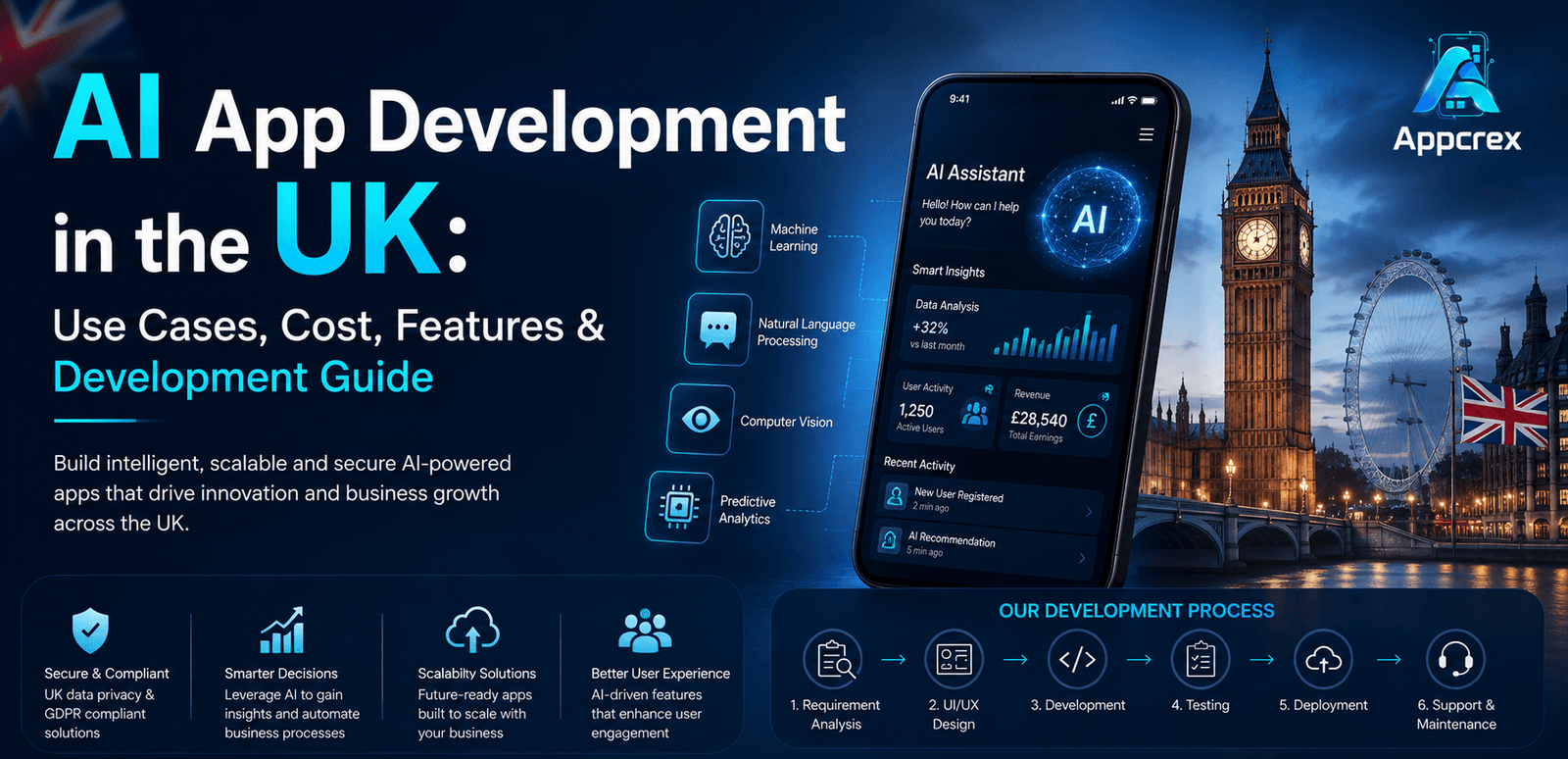
This guide explains AI app development in the UK, including development costs, essential features, use cases, technologies, Generative AI integration, AI agents, development timelines, and how businesses can plan a successful AI mobile product.
What Is an AI-Powered Mobile App?
An AI-powered mobile app uses artificial intelligence or machine learning technologies to perform tasks that traditionally required predefined rules or manual interaction.
A conventional application might work like this:
User selects option → App follows predefined logic → Result appears
An AI-powered application can work more dynamically:
User provides information → AI understands context → AI analyzes data → System generates or predicts a result
For example, an eCommerce app can use AI to understand customer behavior and recommend products rather than simply showing the same products to every user.
Similarly, a healthcare platform can use AI to organize information, while a logistics app can use predictive models to identify potential delivery delays.
How Much Does AI App Development Cost in the UK?
There is no universal price because AI can range from a simple API integration to a sophisticated proprietary machine learning platform.
For initial planning, businesses can consider the following ranges:
| AI App Type | Estimated Cost | Development Timeline |
|---|---|---|
| Basic AI Integration | $20,000–$35,000 | 2–4 months |
| AI-Powered Business App | $35,000–$60,000 | 3–6 months |
| Advanced AI Mobile App | $60,000–$100,000 | 5–8 months |
| Generative AI Platform | $70,000–$120,000+ | 6–10 months |
| AI Agent / Enterprise Platform | $90,000–$150,000+ | 8–12+ months |
These are planning estimates rather than fixed quotations.
The actual cost depends on factors such as:
- AI model requirements
- Mobile platforms
- Backend architecture
- Data requirements
- UI/UX complexity
- API integrations
- AI training
- RAG implementation
- AI agents
- Security
- Cloud infrastructure
- Admin dashboards
- Third-party services
A simple chatbot integrated through an API and a custom AI platform trained around proprietary business data are completely different projects.
Where AI Creates Real Business Value?
AI shouldn’t be added to an app simply because it is trending.
The strongest AI applications solve a specific problem better, faster, or more efficiently than traditional software.
Customer Experience
AI can provide personalized recommendations, conversational support, intelligent search, and automated assistance.
Business Automation
AI can reduce repetitive manual tasks such as document processing, data classification, content generation, and customer communication.
Decision Intelligence
Predictive models can help businesses identify patterns and make more informed operational decisions.
Personalization
AI can adapt products and services according to individual user preferences and behavior.
Productivity
AI assistants can help employees summarize information, retrieve knowledge, generate content, and automate workflows.
Also Read : AI App Development Guide: Features, Cost & Process (2026)
Popular AI App Development Use Cases in the UK
The UK has a diverse technology ecosystem, which makes AI suitable for many industries.
1. AI-Powered FinTech Apps
Financial services are one of the strongest areas for AI adoption.
A FinTech app can use AI for:
- Fraud detection
- Transaction analysis
- Personalized financial insights
- Customer support
- Risk analysis
- Spending categorization
- Financial recommendations
- Document processing
For example, an AI system can analyze transaction patterns and flag unusual activity for further review.
A financial application also requires strong authentication, encryption, access control, monitoring, and appropriate regulatory considerations.
Also Read : FinTech API Integration Services: Complete Guide to Banking APIs, Payments & Security
2. AI Healthcare Apps
Healthcare applications can use AI to improve patient engagement and operational efficiency.
Possible capabilities include:
- Intelligent appointment assistance
- Patient information organization
- AI-powered search
- Medical document summarization
- Personalized reminders
- Virtual assistants
- Healthcare knowledge assistants
- Predictive analytics
AI should not automatically be treated as a replacement for professional medical judgment. Its implementation needs to account for the application’s specific clinical and regulatory context.
3. AI eCommerce Apps
AI can significantly improve the shopping experience.
An intelligent eCommerce app could provide:
- Product recommendations
- AI shopping assistants
- Personalized offers
- Intelligent search
- Product description generation
- Customer support
- Demand forecasting
- Customer segmentation
Instead of asking users to browse hundreds of products, an AI assistant can understand natural-language requirements and help narrow the selection.
4. AI Logistics Apps
Logistics businesses can combine mobile applications with AI and predictive analytics.
Potential use cases include:
- Route optimization
- Delivery predictions
- Demand forecasting
- Fleet analytics
- Driver behavior analysis
- Maintenance prediction
- Shipment risk detection
For logistics companies operating across major UK business hubs such as London, Manchester, Birmingham, Liverpool, and Leeds, AI can become part of a broader digital transformation strategy.
5. AI Travel & Tourism Apps
Travel applications can use AI to make planning more personalized.
A user could provide:
- Destination
- Budget
- Travel dates
- Interests
- Preferred activities
The AI system could then create a customized itinerary.
Additional features may include:
- AI travel assistants
- Personalized recommendations
- Intelligent hotel search
- Destination discovery
- Conversational booking assistance
- Multilingual support
6. AI Education Apps
AI is also changing digital learning experiences.
An education app can provide:
- Personalized learning paths
- AI tutors
- Automated explanations
- Question generation
- Progress analysis
- Content recommendations
- Learning assessments
- Conversational assistance
Rather than presenting the same content to every learner, AI can adapt the experience based on performance and learning behavior.
Generative AI App Development in the UK
Generative AI has expanded the possibilities of mobile applications.
Traditional applications usually operate using predefined workflows.
Generative AI allows users to interact using natural language and receive dynamically generated responses.
Examples include:
AI Chat Assistants
Users can ask questions and receive conversational responses.
AI Content Generation
Applications can generate descriptions, summaries, reports, emails, or other content.
AI Document Processing
Users can upload documents and receive summaries, extracted information, or answers based on their contents.
Intelligent Search
Users can search using natural language rather than exact keywords.
AI Personalization
The system can generate recommendations based on user context.
Also Read : AI Chatbot Integration Services: Benefits, Cost, Process & Business Use Cases (2026)
What Is RAG and Why Is It Important?
Retrieval-Augmented Generation (RAG) is particularly useful when businesses want an AI assistant to work with their own information.
Instead of relying only on a general-purpose AI model, a RAG system can retrieve relevant information from a company’s knowledge base before generating a response.
A simplified workflow is:
User question → Search knowledge base → Retrieve relevant information → AI generates response
This can be useful for:
- Internal company assistants
- Product knowledge systems
- Customer support
- Legal information systems
- Employee portals
- Healthcare information platforms
- Enterprise documentation
RAG can help make AI responses more relevant to a specific business context.
AI Agent Development: The Next Step
An AI chatbot primarily provides information.
An AI agent development can potentially go further by interacting with tools and systems to complete tasks.
For example:
User: “Book my appointment for tomorrow afternoon.”
An AI agent could potentially:
- Understand the request
- Check available slots
- Access the booking system
- Select an appropriate slot
- Complete the booking
- Send confirmation
This requires more than simply connecting a chatbot to an LLM.
The architecture may involve:
- LLMs
- APIs
- Business rules
- Databases
- Authentication
- Tool calling
- Workflow orchestration
- Monitoring
- Permission controls
AI agents are therefore particularly interesting for businesses looking to automate operational workflows.
Essential Features of an AI Mobile App
The features depend on the use case, but a modern AI application may include several layers.
User Features
- Registration
- Login
- Profiles
- Personalized dashboards
- Search
- Notifications
- Chat
- Voice interaction
- File upload
AI Features
- AI assistant
- Recommendations
- Natural-language search
- Content generation
- Predictive analytics
- Document analysis
- Personalization
- AI agents
Business Features
- Admin dashboard
- User management
- Analytics
- Reports
- Role-based access
- API integrations
- Subscription management
Security Features
- Secure authentication
- Encryption
- Access controls
- Activity monitoring
- Data protection
- Secure API communication
Voice AI Is Another Growing Opportunity
AI doesn’t have to be limited to text.
Voice AI allows users to communicate naturally through speech.
A mobile app can use voice technology for:
- Customer service
- Search
- Navigation
- Booking
- Personal assistants
- Accessibility
- Hands-free workflows
For example, a delivery management app could allow a driver to interact with certain functions using voice rather than repeatedly touching the screen.
Voice functionality becomes particularly valuable when the user’s hands are occupied or when speed is important.
AI Technology Stack for Mobile Apps
An AI mobile application typically combines several technologies rather than relying on one framework.
Mobile Layer
- Flutter
- React Native
- Swift
- Kotlin
Backend
- Node.js
- Python
- Java
- .NET
AI / ML
- Machine Learning
- Deep Learning
- Large Language Models
- Generative AI
- Recommendation Engines
- Predictive Analytics
- Computer Vision
- Natural Language Processing
Data
- PostgreSQL
- MySQL
- MongoDB
- Vector databases
Cloud
- AWS
- Microsoft Azure
- Google Cloud
The right stack depends on the application’s scale, data requirements, performance expectations, AI functionality, and security requirements.
Also Read : Cloud Application Development Company: Complete Guide to Services, Cost & Development Process
How Long Does AI App Development Take?
AI development often requires more time than a conventional application because AI functionality needs additional testing, integration, data preparation, and monitoring.
A rough timeline could look like:
Discovery & AI Strategy: 2–4 weeks
UX/UI Design: 3–6 weeks
Mobile & Backend Development: 8–16 weeks
AI Integration: 4–12+ weeks
Testing & Optimization: 3–6 weeks
Deployment: 1–2 weeks
The stages can overlap, so the total project duration depends on the scope.
A relatively simple AI integration may launch within a few months, while an enterprise AI platform can require a year or longer.
Build an MVP Before a Large AI Platform
Businesses don’t always need to begin with the most advanced AI architecture.
An MVP could include:
- Mobile application
- User accounts
- Core business workflow
- Basic AI assistant
- Simple analytics
- Admin dashboard
After launch, businesses can evaluate:
- AI usage
- User engagement
- Conversion
- Customer feedback
- Operational savings
Then additional capabilities can be introduced.
This approach reduces the risk of investing heavily in AI features that users may not actually need.
What Makes AI App Development More Expensive?
Several factors can significantly affect the budget.
Custom AI Models
Training or fine-tuning custom models requires additional data and engineering.
Proprietary Data
Preparing, cleaning, structuring, and securing company data can require substantial work.
RAG
Enterprise knowledge systems may require document pipelines and vector search infrastructure.
AI Agents
Agents require tool integrations, workflow logic, permissions, and monitoring.
Computer Vision
Image and video processing can require specialized models and infrastructure.
Voice AI
Speech recognition and voice generation introduce additional technologies and API costs.
High User Volume
Large-scale AI applications require scalable cloud infrastructure and usage management.
How to Control AI Development Costs?
AI can become expensive when the scope isn’t controlled.
A practical strategy is:
Start With One Strong Use Case
Don’t attempt to solve ten problems with AI in version one.
Use Existing Models When Appropriate
A third-party AI API may be more practical than training a model from scratch.
Build a Proof of Concept
Validate whether the AI actually produces useful results.
Measure AI Usage
Monitor API calls, tokens, latency, and infrastructure costs.
Protect Sensitive Data
Data security should be part of the architecture rather than an afterthought.
Design for Scale
Use an architecture that allows additional AI features to be added later.
How to Choose an AI App Development Company in the UK?
Choosing an AI development partner requires looking beyond a mobile development portfolio.
Look for experience in:
- Mobile app development
- Backend engineering
- Cloud architecture
- Machine learning
- Generative AI
- LLM integration
- RAG
- AI agents
- API integration
- Data engineering
- Security
Also ask potential partners:
Have you built AI-powered products before?
Can you integrate AI into an existing mobile application?
How will AI usage costs be controlled?
How will sensitive business data be handled?
Will the architecture support future AI capabilities?
A strong AI app development company in the UK should be able to discuss both the AI technology and the underlying business problem.
UK Locations With Strong Opportunities for AI App Development
AI development isn’t limited to London.
The UK has multiple technology and business centers that can support digital product development.
London
Strong opportunities across FinTech, enterprise software, eCommerce, AI startups, and digital services.
Manchester
Growing opportunities across technology, healthcare, eCommerce, media, and enterprise solutions.
Birmingham
Suitable for business applications, logistics, healthcare, retail, and professional services.
Cambridge
Strong technology and research ecosystem with opportunities for AI, machine learning, healthcare, and deep-tech products.
Oxford
Potential opportunities across healthcare, education, research, and AI-driven technology.
Edinburgh
Important for financial services, technology, data, and AI-related innovation.
Glasgow
Opportunities across healthcare, business services, education, and technology.
These locations also give you natural opportunities to internally link your existing App Development Company London, Manchester, Birmingham, Edinburgh, Glasgow, Cambridge, Oxford and other location pages where relevant.
AI App Development Roadmap
Instead of following a generic mobile development process, AI projects benefit from a dedicated roadmap.
Stage 1 — Identify the AI Opportunity
Determine the business problem AI should solve.
Stage 2 — Define the Data Strategy
Identify what data is available and how it can be used.
Stage 3 — Build a Proof of Concept
Test whether the selected AI approach works.
Stage 4 — Design the Product
Create the mobile UX around the AI functionality.
Stage 5 — Develop the Application
Build mobile, backend, database, APIs, and admin functionality.
Stage 6 — Integrate AI
Connect models, RAG, AI agents, recommendation engines, or other AI capabilities.
Stage 7 — Test
Evaluate accuracy, usability, security, performance, and edge cases.
Stage 8 — Launch & Monitor
Track AI performance, user behavior, infrastructure usage, and ongoing costs.
Why AppCrex for AI App Development in the UK?
AppCrex combines mobile application development with emerging technologies to help businesses build intelligent digital products.
Our capabilities include:
- AI app development
- Custom mobile app development
- Android app development
- iOS app development
- Flutter development
- React Native development
- Generative AI integration
- AI agent development
- Machine learning solutions
- Predictive analytics
- AI recommendation engines
- Voice AI integration
- API integration
- Cloud solutions
- UI/UX design
- Enterprise application development
- App maintenance and support
Whether you’re developing an AI MVP, an enterprise assistant, a recommendation platform, or a completely new AI-powered mobile product, AppCrex can help structure the technology around your business objectives.
FAQs
Q. How much does AI app development cost in the UK?
AI app development can range from approximately $20,000 to $150,000+, depending on AI complexity, mobile functionality, data requirements, integrations, and infrastructure.
Q. Is AI app development more expensive than normal app development?
Usually, yes. AI introduces additional requirements such as model integration, data processing, testing, monitoring, and potentially recurring AI infrastructure costs.
Q. Can I add AI to an existing mobile app?
Yes. AI can be integrated into an existing application through APIs, machine learning models, Generative AI, recommendation engines, voice AI, or AI agents.
Q. What is the difference between an AI chatbot and an AI agent?
A chatbot primarily communicates with users. An AI agent can potentially use tools, APIs, and connected systems to perform tasks based on user instructions.
Q. Is Generative AI suitable for eCommerce apps?
Yes. It can support product discovery, AI shopping assistants, personalized recommendations, content generation, and customer support.
Q. Can AI work with company-specific data?
Yes. Approaches such as RAG can allow AI systems to retrieve information from business-specific knowledge bases.
Q. How long does it take to build an AI mobile app?
A relatively simple AI application may take a few months, while advanced or enterprise AI platforms can require 8–12+ months.
Q. Should startups build a complete AI platform immediately?
Not necessarily. An MVP or proof of concept can help validate the business value before making a larger investment.
Final Thoughts
AI app development in the UK is moving beyond simple chatbot integrations.
Businesses are increasingly exploring Generative AI, machine learning, predictive analytics, recommendation engines, voice AI, intelligent search, and AI agents to improve customer experiences and automate operations.
The right approach isn’t to add every available AI technology.
Instead, start with a clear business problem, identify where AI can create measurable value, build a focused MVP, and then expand the product based on real-world usage.
For startups, this can mean launching an AI-powered MVP first. For established businesses, AI can become an additional intelligence layer across existing mobile applications, enterprise systems, customer platforms, and operational workflows.
Build an AI-Powered App With AppCrex
Planning an AI-powered mobile product for the UK market?
AppCrex can help take your idea from AI strategy and product planning through UI/UX design, mobile development, backend engineering, AI and Generative AI integration, API development, testing, deployment, and ongoing optimization.
Whether your business needs an AI assistant, recommendation engine, predictive analytics solution, Generative AI application, AI agent, or intelligent mobile platform, the architecture can be designed around your specific use case and growth strategy.
Talk to AppCrex about building your next AI-powered mobile product for the UK market.