📌 Key Takeaways
- Real-time tracking is the core of a railway app, requiring reliable GPS/location data, APIs, backend processing, and interactive maps.
- Essential features include live train location, train status, ETA, route information, station details, delay alerts, notifications, and optional PNR/ticketing integration.
- AI can make railway apps smarter by supporting predictive ETA, delay forecasting, personalized alerts, route analysis, and operational analytics.
- Railway tracking app development can cost around ₹6 lakh to ₹50 lakh+, depending on features, integrations, platforms, AI capabilities, and infrastructure.
- Choosing the right development company is critical—evaluate real-time tracking expertise, API/GIS capabilities, security, scalability, portfolio, development process, and post-launch support.
Introduction
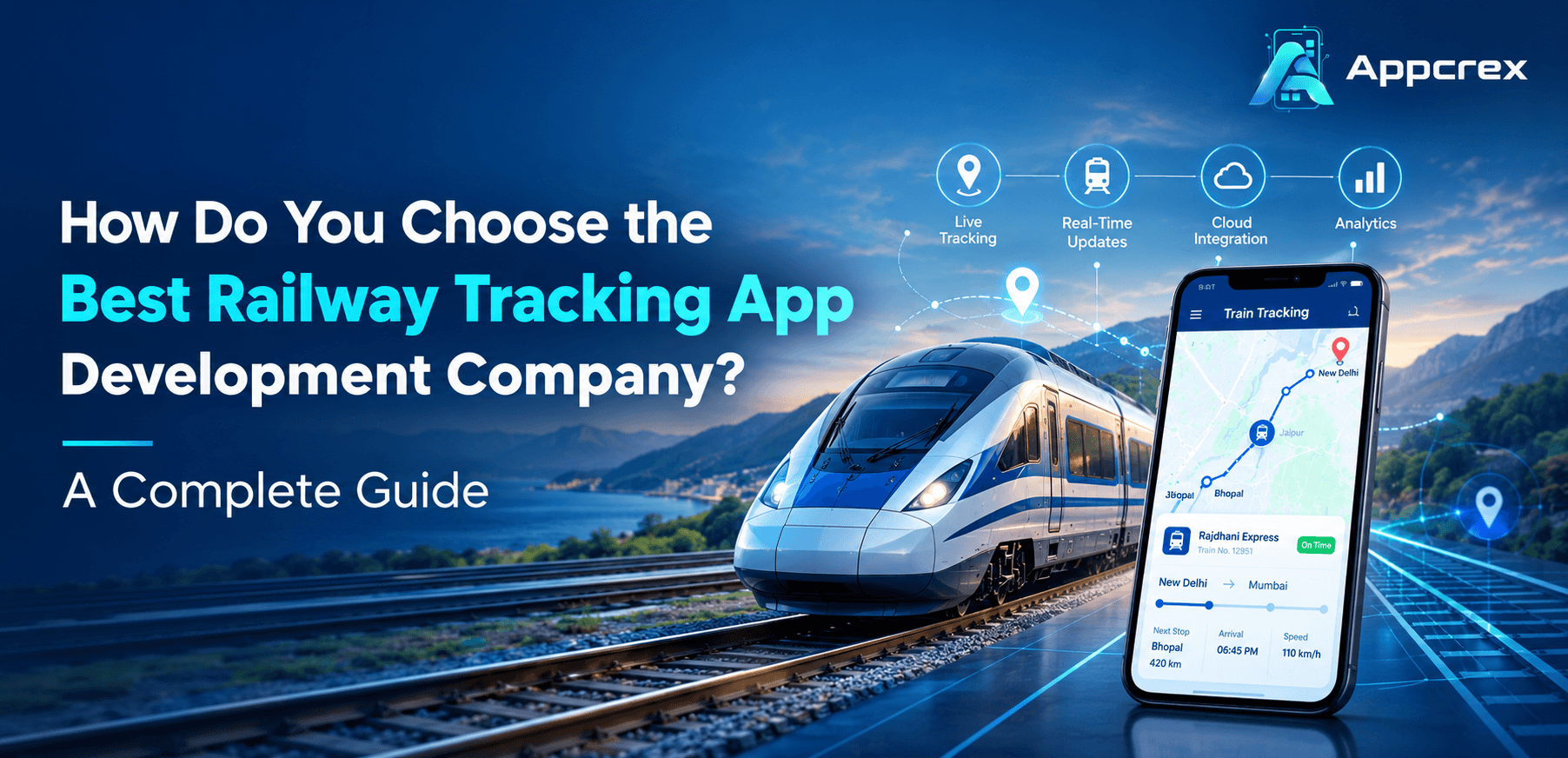
A railway tracking app development company builds mobile and web applications that provide real-time train locations, running status, estimated arrival times, routes, station information, alerts, and other railway services. The right development partner combines GPS, GIS maps, APIs, cloud infrastructure, mobile technologies, analytics, and AI to create a reliable railway tracking platform.
Modern railway tracking applications are no longer limited to showing the current location of a train. They can provide passengers with live journey information, platform updates, route maps, delay notifications, PNR or booking integrations, personalized alerts, and predictive travel information.
For businesses entering the transportation technology market, choosing an experienced railway tracking app development company is important because real-time transportation applications require high scalability, accurate data processing, strong APIs, and reliable infrastructure.
How Do You Choose the Best Railway Tracking App Development Company?
You should choose a railway tracking app development company based on its experience with real-time applications, GPS/GIS technology, API integrations, mobile development, cloud infrastructure, security, scalability, and post-launch support. The company should also understand your target railway market, whether it is India, the UK, USA, UAE, Canada, Australia, or multiple regions.
Before hiring a development company, evaluate the following:
1. Railway and Transportation Experience
Check whether the company has experience building transportation, navigation, logistics, GPS, mobility, or tracking applications.
2. Real-Time Tracking Expertise
The development team should understand real-time location updates, event-driven systems, WebSockets, location APIs, and live data processing.
3. GPS and GIS Capabilities
Railway tracking depends heavily on geolocation and mapping technology. Developers should be able to integrate GPS, GIS, route maps, geofencing, and mapping APIs.
4. API Integration Experience
Your application may require railway data APIs, station information APIs, maps, weather services, payments, booking systems, notifications, and third-party platforms.
5. Scalable Architecture
Railway applications can experience large traffic spikes during holidays, festivals, weekends, and peak travel periods. The backend should therefore be designed for scalability.
6. Security and Privacy
The company should implement secure authentication, encrypted communication, API security, role-based access, monitoring, backups, and secure cloud infrastructure.
7. Global Market Experience
If the app targets multiple countries, choose developers who understand localization, currencies, languages, transportation ecosystems, data regulations, and regional user expectations.
Just Read : How Much Does It Cost to Build an App Like Delhi Metro Sarthi? Features, Development Process & Cost
What Features Should a Railway Tracking App Include?
A railway tracking application should include live train tracking, train search, route maps, station information, estimated arrival times, alerts, schedules, journey management, and administrative tools. Advanced platforms can also include AI predictions, personalized recommendations, booking integrations, analytics, multilingual support, and offline capabilities.
Essential Features
| Feature | Purpose |
|---|---|
| Live Train Tracking | Shows the current train location |
| Train Search | Helps users find trains quickly |
| Real-Time Running Status | Displays current operational status |
| Interactive Map | Shows train routes and locations |
| ETA | Provides estimated arrival information |
| Station Information | Shows arrivals, departures, and facilities |
| Train Schedule | Provides timetable information |
| Route Information | Displays complete train routes |
| Platform Updates | Provides station/platform information where available |
| Push Notifications | Sends real-time travel alerts |
| Delay Alerts | Notifies passengers about disruptions |
| Saved Journeys | Stores frequently used routes |
| Multi-Language Support | Supports international audiences |
| Admin Dashboard | Manages users, data, content, and analytics |
How Does Live Train Tracking Work?
Live train tracking works by collecting location and operational data from GPS, railway systems, APIs, or other approved data sources and sending that information to a backend server. The server processes the data and delivers updated train positions, estimated arrival times, and status information to users through the mobile or web application.
A simplified architecture looks like this:
Train/Data Source → GPS/API → Backend → Real-Time Processing → Database → Mobile/Web App
Technologies such as WebSockets, event-driven architecture, cloud computing, geospatial databases, and caching can help deliver frequent updates with low latency.
The quality of the final application depends heavily on the accuracy, availability, and licensing of the underlying railway data.
Can GPS Be Used in Railway Tracking App Development?
Yes. GPS can be used to provide real-time location information for trains and improve route visualization, estimated arrival times, geofencing, and location-based notifications. GPS is especially useful when combined with mapping and railway data APIs.
GPS-based features can include:
- Real-time train location
- Distance to destination
- Current station
- Upcoming station
- Estimated arrival
- Route visualization
- Geofencing
- Location-based notifications
- Journey progress
For better reliability, developers can combine GPS information with other operational data sources rather than depending on a single location signal.
Can AI Be Used in Railway Tracking App Development?
Yes. AI can make railway tracking applications more predictive and personalized by analyzing historical and real-time transportation data. AI can be used for ETA prediction, delay forecasting, personalized alerts, route recommendations, chatbot assistance, anomaly detection, and passenger behavior analysis.
AI Features for Railway Apps
Predictive ETA:
AI models can analyze historical and real-time information to improve arrival predictions.
Delay Prediction:
Machine learning can identify patterns that may indicate potential delays.
Smart Notifications:
Users can receive relevant alerts based on their saved journeys.
AI Travel Assistant:
An AI chatbot can answer questions about routes, stations, train schedules, and journeys.
Personalized Recommendations:
The application can recommend routes or journeys based on user preferences.
Anomaly Detection:
AI can help identify unusual operational patterns from large datasets.
For enterprise railway platforms, AI can become an important layer on top of traditional tracking functionality.
What APIs Are Required for a Railway Tracking App?
Railway tracking applications may require APIs for train locations, schedules, stations, routes, maps, geolocation, notifications, payments, booking, and other third-party services. The exact APIs depend on the country, railway operator, data provider, and business model.
Common API categories include:
- Train location APIs
- Railway schedule APIs
- Station information APIs
- Route APIs
- GPS/location APIs
- Mapping APIs
- Geocoding APIs
- Weather APIs
- Payment APIs
- Booking APIs
- PNR or reservation APIs where legally and technically available
- Push notification services
- Analytics APIs
- Authentication APIs
Before development begins, businesses should verify API availability, licensing, data accuracy, rate limits, commercial usage rights, and regional restrictions.
What Technology Is Used to Build a Railway Tracking App?
A railway tracking platform typically uses mobile technologies such as Flutter, React Native, Kotlin, or Swift; backend technologies such as Node.js, Python, Java, or similar frameworks; databases such as PostgreSQL, MySQL, or MongoDB; and cloud platforms such as AWS, Microsoft Azure, or Google Cloud.
Recommended Technology Stack
Mobile App
- Flutter
- React Native
- Kotlin
- Swift
Backend
- Node.js
- Python
- Java
- REST APIs
- WebSockets
Database
- PostgreSQL
- MySQL
- MongoDB
- Redis for caching
Cloud
- AWS
- Microsoft Azure
- Google Cloud
Maps & Location
- GIS
- GPS
- Mapping APIs
- Geolocation
- Geofencing
AI & Analytics
- Machine learning
- Predictive analytics
- Data processing
- Recommendation systems
The final stack should be selected according to the required scale, budget, data sources, platform requirements, and expected traffic.
How Much Does It Cost to Develop a Railway Tracking App?
The cost of railway tracking app development generally ranges from ₹6 lakh to ₹50 lakh or more, depending on application complexity, real-time tracking requirements, APIs, AI functionality, platforms, integrations, security, and infrastructure.
These are indicative estimates, not fixed development quotes.
| App Type | Estimated Cost |
|---|---|
| Basic Railway Tracking MVP | ₹6–10 Lakh |
| Mid-Level Railway Tracking App | ₹10–18 Lakh |
| Advanced Railway Tracking Platform | ₹18–30 Lakh+ |
| AI-Powered Enterprise Platform | ₹30–50 Lakh+ |
For international projects, the equivalent budget can vary substantially based on local development rates, compliance requirements, data providers, integrations, and project scope.
What Is the Railway Tracking App Development Cost in Different Countries?
Development costs can vary significantly between markets because developer rates, project management costs, compliance requirements, infrastructure, and integration complexity differ by region.
| Location | Typical Project Positioning |
|---|---|
| India | Often cost-effective for scalable custom development |
| UK | Higher development and compliance costs |
| USA | Higher engineering and enterprise development costs |
| UAE | Cost varies based on smart mobility and enterprise requirements |
| Canada | Costs depend on platform complexity and transportation integrations |
| Australia | Costs vary based on integrations, localization, and project scale |
Instead of selecting a company solely based on the lowest price, businesses should compare technical expertise, deliverables, infrastructure, security, APIs, support, and long-term scalability.
What Factors Affect Railway Tracking App Development Cost?
Several factors influence the total development budget.
App Complexity
A basic train status application costs less than an enterprise platform with real-time tracking, AI, booking, analytics, and multiple integrations.
Number of Platforms
Developing for Android and iOS can increase development and testing requirements compared with a single-platform MVP.
Real-Time Infrastructure
Frequent location updates require scalable backend architecture, data processing, caching, and potentially real-time communication systems.
API Integrations
The number and complexity of external APIs directly influence development and maintenance costs.
AI Features
Predictive ETA, intelligent recommendations, chatbots, and machine learning systems require additional development and data infrastructure.
Admin Dashboard
A sophisticated dashboard for managing users, routes, alerts, analytics, and operational information adds to the overall scope.
Security
Enterprise authentication, encryption, monitoring, auditing, and compliance requirements can increase project complexity.
How Long Does It Take to Develop a Railway Tracking App?
A basic railway tracking MVP can take approximately 3–5 months, while an advanced platform may require 6–12 months or more. The timeline depends on the number of features, API integrations, real-time infrastructure, AI functionality, platforms, testing, and regulatory requirements.
| Development Stage | Approximate Timeline |
|---|---|
| Discovery & Planning | 2–4 weeks |
| UI/UX Design | 3–6 weeks |
| MVP Development | 8–14 weeks |
| API & Tracking Integration | 4–10 weeks |
| Testing & QA | 3–6 weeks |
| Deployment | 1–3 weeks |
| Advanced/Enterprise Development | 6–12+ months |
These stages may overlap depending on the development methodology.
How Can Railway Tracking Apps Make Money?
A railway tracking app can generate revenue through advertisements, premium subscriptions, booking commissions, travel partnerships, sponsored listings, enterprise licensing, and B2B transportation solutions.
Popular Monetization Models
Advertising:
Display relevant travel and transportation advertisements.
Premium Subscription:
Offer ad-free tracking, advanced alerts, personalized features, or additional travel tools.
Booking Commission:
Earn revenue from eligible ticket or travel bookings.
Travel Partnerships:
Partner with hotels, transportation providers, travel agencies, or tourism businesses.
Enterprise Licensing:
Provide tracking technology to transportation organizations.
Sponsored Listings:
Allow relevant businesses to promote services inside the platform.
How Can a Railway Tracking App Improve Passenger Experience?
A railway tracking app improves passenger experience by reducing uncertainty around train locations, delays, schedules, routes, and arrival times. Real-time alerts allow passengers to make better travel decisions and reduce the need to repeatedly check railway information manually.
Important benefits include:
- Real-time train visibility
- Better journey planning
- Delay awareness
- Automated alerts
- Station information
- Route visualization
- Personalized travel information
- Reduced waiting uncertainty
- Better accessibility
- Multilingual support
For international markets, localization can make the application more relevant to regional users.
Railway Tracking App Development for India
A railway tracking application targeting India should be designed for high passenger volumes, extensive routes, multiple languages, diverse device conditions, and potentially inconsistent network connectivity.
Important considerations include:
- Real-time train status
- Station information
- Route maps
- PNR or reservation integrations where permitted
- Hindi, English and regional language support
- Push notifications
- Low-bandwidth optimization
- Scalable infrastructure
- Mobile-first UX
Railway Tracking App Development for the UK
For the UK, railway tracking applications can focus on real-time train information, journey planning, station updates, delays, cancellations, route information, and commuter-focused notifications.
The application should provide a clean and fast interface for users who frequently travel between stations and cities.
Railway Tracking App Development for the USA
In the USA, railway tracking applications can support passenger rail, commuter transportation, route discovery, station information, real-time status, and travel notifications.
The application can also integrate broader mobility services to create a more complete transportation experience.
Target keyword: Railway Tracking App Development Company USA
Railway Tracking App Development for the UAE
For the UAE, railway and smart mobility applications can focus on modern transportation experiences, location-based services, multilingual interfaces, real-time updates, and integration with digital mobility ecosystems.
A UAE-focused solution can also be designed with enterprise-grade cloud infrastructure and analytics for smart transportation initiatives.
Railway Tracking App Development for Canada
A railway tracking application for Canada can provide live train information, routes, stations, alerts, estimated arrivals, and journey management.
Weather-aware notifications and reliable mobile performance can also be valuable depending on the application’s use case and geographic coverage.
Railway Tracking App Development for Australia
In Australia, railway tracking applications can focus on commuter rail, station information, live train locations, route planning, service notifications, and transportation integrations.
A scalable architecture is important for supporting users across different cities and transportation networks.
What Security Features Should a Railway Tracking App Have?
A railway tracking application should use secure authentication, encrypted data transmission, protected APIs, role-based access control, secure cloud infrastructure, monitoring, logging, backups, and appropriate privacy controls.
Important security measures include:
- Secure user authentication
- API authentication
- HTTPS/TLS encryption
- Data encryption
- Role-based access
- Secure payment processing
- Database security
- Cloud security
- Regular security testing
- Monitoring and logging
- Backup and disaster recovery
- Privacy controls
Security requirements may differ depending on the application’s country, data sources, integrations, and business model.
What Should You Ask Before Hiring Railway App Developers?
Before signing a development contract, ask the company:
- Do you have experience developing real-time tracking applications?
- Have you worked with GPS and GIS technologies?
- Can you integrate railway APIs and third-party data providers?
- Can the application support real-time updates?
- How will you design the backend for high traffic?
- Can you develop Android, iOS, and web applications?
- How will you secure railway and user data?
- Can you integrate AI-based prediction features?
- What is included in the development cost?
- What is the estimated development timeline?
- Will you provide post-launch maintenance?
- How will API and cloud infrastructure costs be handled?
- Can the application support multiple countries and languages?
- Who owns the source code and intellectual property?
These questions help businesses compare development companies beyond their quoted price.
What Are the Common Mistakes in Railway Tracking App Development?
Some common mistakes can reduce application reliability and increase long-term costs.
Depending on One Data Source
If the application depends entirely on one data source, outages or inaccuracies can affect the user experience.
Ignoring Scalability
A system that works for a few thousand users may fail during major travel periods if the infrastructure is not designed for high traffic.
Poor API Planning
Choosing APIs without checking licensing, rate limits, reliability, and commercial usage can create problems after launch.
Complicated User Interface
Passengers usually need information quickly. The interface should prioritize train status, location, ETA, route, and alerts.
Ignoring Localization
A global railway application should account for local languages, transportation systems, currencies where relevant, time zones, and regional user expectations.
Underestimating Maintenance
Real-time transportation apps require ongoing monitoring, API updates, infrastructure management, bug fixes, security updates, and feature improvements.
Railway Tracking App MVP vs Advanced Platform
| Feature | MVP | Advanced Platform |
|---|---|---|
| Train Search | ✓ | ✓ |
| Train Status | ✓ | ✓ |
| Live Location | ✓ | ✓ |
| Route Map | ✓ | ✓ |
| ETA | ✓ | ✓ |
| Push Notifications | ✓ | ✓ |
| User Accounts | ✓ | ✓ |
| Saved Journeys | — | ✓ |
| AI Predictions | — | ✓ |
| AI Chatbot | — | ✓ |
| Booking Integration | — | ✓ |
| Advanced Analytics | — | ✓ |
| Multi-Country Support | — | ✓ |
| Enterprise Dashboard | Basic | Advanced |
| Predictive Analytics | — | ✓ |
For startups, launching an MVP first can help validate the business model before investing in an enterprise-scale platform.
FAQs
Q. How much does it cost to build a railway tracking app?
A basic railway tracking MVP can cost approximately ₹6–10 lakh, while advanced applications can range from ₹18–30 lakh+ and AI-powered enterprise platforms can exceed ₹30–50 lakh, depending on scope and integrations.
Q. How long does it take to build a railway tracking app?
A basic MVP may take around 3–5 months, while a sophisticated railway tracking platform can require 6–12 months or more.
Q. Can AI predict train delays?
Yes. AI and machine learning can analyze historical and real-time data to identify patterns and generate predictive ETA or delay insights.
Q. Can GPS provide real-time train tracking?
Yes. GPS can provide location information that can be processed and displayed through a mobile or web application. Accuracy depends on the underlying data source and system architecture.
Q. What is the best technology for railway tracking apps?
Flutter or React Native can be used for cross-platform mobile development, while Node.js, Python, Java, PostgreSQL, cloud infrastructure, WebSockets, GPS, and GIS technologies can support the backend and tracking system.
Q. Can one railway tracking app support multiple countries?
Yes. A properly designed platform can support multiple countries through localization, regional APIs, different railway data sources, multiple languages, time zones, currencies where applicable, and configurable infrastructure.
Q. Is railway tracking app development suitable for startups?
Yes. Startups can begin with an MVP containing train search, live status, tracking, routes, ETA, and notifications before adding AI, booking, analytics, and enterprise functionality.
Conclusion
Choosing the right railway tracking app development company is critical for building a reliable, scalable, and user-friendly transportation platform. A successful application requires much more than a simple map and train location feature. It needs real-time data processing, GPS/GIS integration, reliable APIs, scalable cloud infrastructure, strong security, intuitive UX, and continuous technical support.
Whether your target market is India, the UK, USA, UAE, Canada, or Australia, the development strategy should be adapted to local railway systems, data sources, passenger requirements, languages, and transportation ecosystems.
For businesses planning a new railway tracking platform, Appcrex can help transform the concept into a scalable mobile and web solution with real-time tracking, API integrations, AI capabilities, cloud infrastructure, analytics, and customized features.
The right development partner should not only build the app but also help you create a railway tracking platform that can scale across markets and evolve with changing transportation needs.