📌 Key Takeaways
- Choose CRM features based on your business needs, not simply the number of features available.
- Lead capture, tracking, scoring, and pipeline management are essential for an effective sales process.
- Automation and follow-up tools help sales teams save time and reduce missed opportunities.
- Reporting, analytics, and forecasting provide valuable insights for better sales decisions.
- Ease of use, integrations, customization, scalability, and security should be considered before choosing a CRM.
Introduction
Choosing the right lead management and CRM software can make a significant difference in how efficiently a business captures, tracks, nurtures, and converts leads. The right platform should do more than store contact information—it should help sales teams organize leads, automate repetitive tasks, monitor the sales pipeline, and make better decisions using real-time data.
The most important CRM features include lead capture, lead tracking, lead scoring, contact management, pipeline management, automation, follow-up reminders, reporting, integrations, customization, mobile access, and security.
But which features actually matter for your business?
This guide explains the essential features to look for when evaluating lead management and CRM software.
Quick Answer: What Features Should a CRM Have?
A good lead management and CRM system should include:
- Lead capture and management
- Lead tracking
- Contact and customer management
- Lead scoring
- Sales pipeline management
- Follow-up reminders
- Workflow automation
- Email and communication integration
- Reporting and analytics
- Sales forecasting
- Team collaboration
- Mobile access
- Third-party integrations
- Customization
- Security and user permissions
The best CRM isn’t necessarily the platform with the most features. It is the one that provides the right features for your sales process, team size, industry, and growth goals.
Just Read : AI CRM Integration Services: Complete Guide to Intelligent Customer Management
What Is Lead Management and CRM Software?
Lead management software helps businesses capture, organize, track, qualify, and nurture potential customers throughout the sales process.
CRM (Customer Relationship Management) software goes further by managing interactions with prospects and existing customers, including contact information, communication history, sales activities, opportunities, and customer relationships.
When combined, lead management and CRM software can give sales and marketing teams a centralized system for managing the entire customer journey.
For example, a new lead may enter the system through a website form. The CRM can automatically assign the lead to a salesperson, score it based on predefined criteria, schedule a follow-up, and track every subsequent interaction.
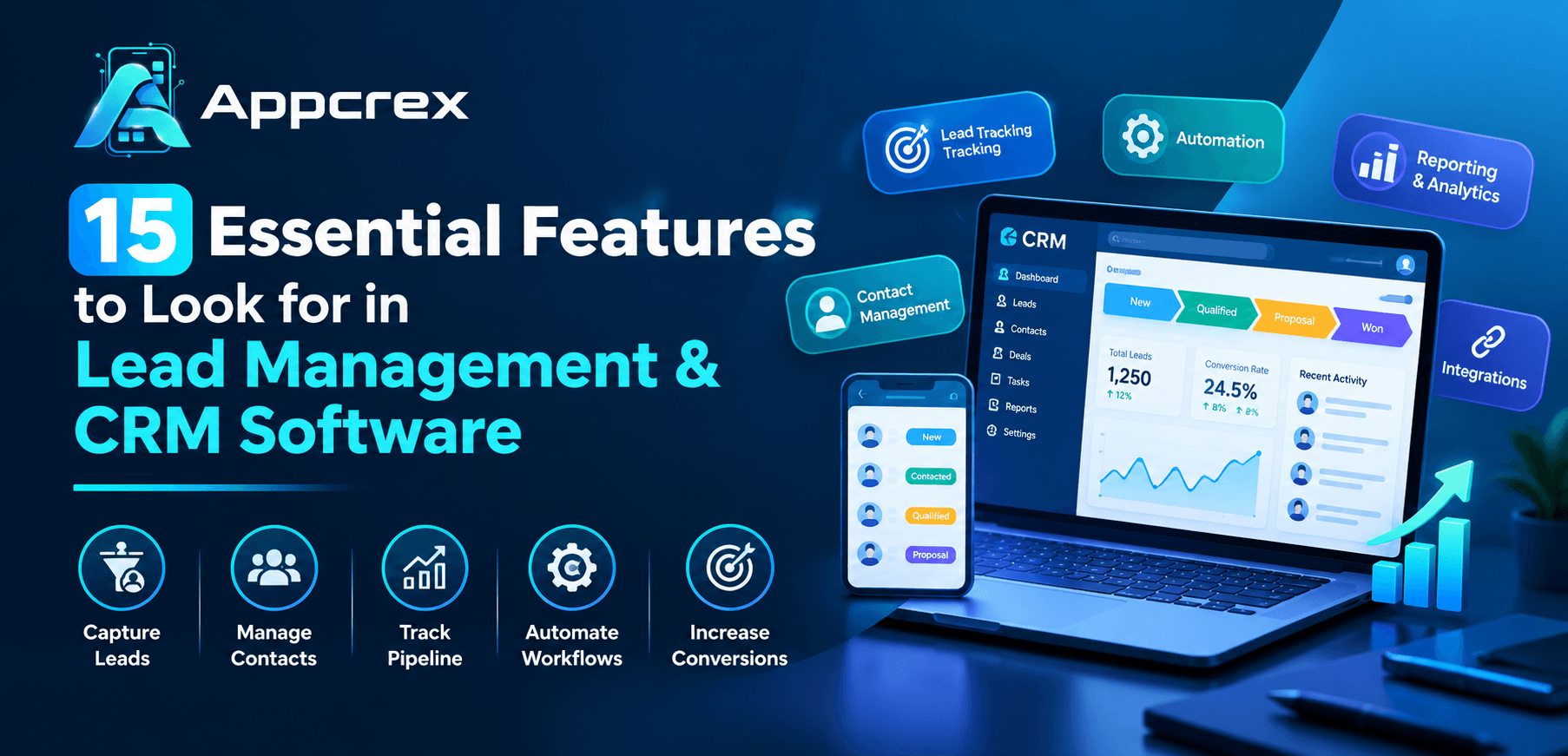
15 Essential Lead Management & CRM Software Features
1. Lead Capture
The CRM should make it easy to capture leads from multiple sources.
Important lead sources may include:
- Website forms
- Landing pages
- Social media
- Email campaigns
- Phone calls
- Live chat
- Advertisements
- Referrals
- Manual entries
A centralized lead capture system prevents leads from getting lost across different platforms.
Why it matters:
The faster and more accurately you capture leads, the easier it becomes for sales teams to follow up and convert them.
2. Lead Tracking
Lead tracking is one of the most important CRM capabilities.
A good system should show:
- Where each lead came from
- Current lead status
- Previous interactions
- Assigned salesperson
- Follow-up history
- Last contact date
- Next scheduled action
- Conversion status
Instead of searching through emails or spreadsheets, sales representatives can see the complete lead history from one dashboard.
3. Contact Management
CRM software should provide a centralized database for contacts and companies.
You should be able to store information such as:
- Name
- Company
- Email address
- Phone number
- Job title
- Industry
- Location
- Previous interactions
- Notes
- Purchase history
A strong contact management system helps sales teams understand who they’re communicating with and what happened during previous interactions.
4. Lead Scoring
Not every lead has the same value.
Lead scoring assigns a score to prospects based on characteristics or behaviors that indicate buying intent.
For example, a CRM could assign higher scores to leads that:
- Request a demo
- Visit pricing pages
- Download product information
- Open multiple emails
- Interact with sales representatives
- Match your ideal customer profile
This helps sales teams prioritize high-quality prospects instead of treating every lead equally.
5. Sales Pipeline Management
A visual sales pipeline helps teams understand where prospects are in the buying journey.
Typical stages might include:
New Lead → Qualified → Contacted → Proposal → Negotiation → Won/Lost
The CRM should allow businesses to customize these stages according to their sales process.
A pipeline view can help managers identify:
- Stalled opportunities
- High-value deals
- Upcoming follow-ups
- Sales bottlenecks
- Expected revenue
6. Follow-Up Reminders
One of the simplest but most valuable CRM features is automated follow-up management.
The software should allow salespeople to schedule:
- Calls
- Emails
- Meetings
- Tasks
- Follow-up reminders
Automated reminders reduce the risk of forgetting important prospects.
This is particularly useful for businesses with long sales cycles where a lead may require several interactions before making a purchase.
7. Workflow Automation
CRM automation can eliminate many repetitive sales and administrative tasks.
For example:
New lead submitted → CRM creates contact → Lead assigned to salesperson → Welcome email sent → Follow-up task created → Manager notified.
Other automation possibilities include:
- Automatic lead assignment
- Email notifications
- Task creation
- Lead status updates
- Follow-up sequences
- Internal alerts
- Customer onboarding workflows
Automation allows sales teams to spend more time selling and less time performing repetitive administrative work.
8. Email and Communication Integration
A CRM should ideally integrate with the communication tools your sales team already uses.
Useful integrations may include:
- Calendar
- Phone systems
- SMS
- Live chat
- Video conferencing
- Marketing automation platforms
Having communication history inside the CRM gives salespeople a complete picture of their interactions with each prospect.
9. Reporting and Analytics
CRM reporting helps businesses understand what’s actually happening in their sales process.
Important reports include:
- Number of new leads
- Lead conversion rate
- Sales by representative
- Revenue by source
- Pipeline value
- Lost opportunities
- Average sales cycle
- Follow-up performance
For example, if a company discovers that leads from one marketing channel convert significantly better than leads from another channel, it can adjust its marketing budget accordingly.
10. Sales Forecasting
Sales forecasting helps businesses estimate future revenue based on current opportunities and historical performance.
A CRM can use pipeline data to help answer questions such as:
- How much revenue could close this month?
- Which deals are most likely to close?
- Which sales representatives are on target?
- How large is the current pipeline?
- Are sales targets likely to be achieved?
Accurate forecasting can help management make better hiring, marketing, and budgeting decisions.
11. Team Collaboration
Sales rarely happens through one person alone.
CRM software should allow team members to share:
- Notes
- Tasks
- Customer information
- Deal updates
- Documents
- Communication history
Managers should also be able to assign leads and monitor team activity without relying on spreadsheets or separate communication channels.
Also Read : Healthcare CRM Software Development: Complete Guide to Features, Benefits, Cost & AI Integration (2026)
12. Mobile Access
Sales teams aren’t always working from a desktop.
A mobile-friendly CRM or dedicated mobile application allows salespeople to:
- Check lead information
- Update opportunities
- Add notes
- Make calls
- Schedule follow-ups
- Review tasks
- Update deal stages
Mobile access becomes especially important for field sales teams and businesses with distributed employees.
13. Third-Party Integrations
Your CRM shouldn’t operate as an isolated system.
Look for integrations with the tools your business already uses, such as:
- Accounting software
- Email platforms
- Marketing automation
- E-commerce platforms
- Customer support systems
- Communication tools
- Analytics platforms
Good integrations reduce duplicate data entry and create a more connected business workflow.
14. Customization
Every business has a different sales process.
A CRM should allow you to customize elements such as:
- Lead fields
- Pipeline stages
- User roles
- Workflows
- Dashboards
- Reports
- Notifications
For example, a real estate company may need property-specific fields, while a SaaS company may need subscription, trial, and product-usage information.
Customization allows the CRM to adapt to your business rather than forcing your team to change its entire workflow.
15. Security and User Permissions
CRM systems contain sensitive business and customer information, so security should be a major consideration.
Look for capabilities such as:
- Role-based access
- User permissions
- Data encryption
- Secure authentication
- Activity logs
- Backup and recovery
- Access controls
Different employees should only have access to the information they need to perform their jobs.
How to Choose the Right CRM Software for Your Business
Choosing CRM software shouldn’t be based solely on the number of features.
Before selecting a platform, consider these factors:
1. Define Your Sales Process
Map out how a lead moves from initial contact to customer.
Then identify which CRM features are required at each stage.
2. Consider Your Team Size
A small business may only need lead tracking, contact management, pipeline management, and automation.
A larger organization may require advanced reporting, forecasting, integrations, permissions, and customization.
3. Check Integration Requirements
List the software your team already uses and verify whether the CRM integrates with those platforms.
4. Evaluate Ease of Use
A powerful CRM is not useful if your team doesn’t actually use it.
Look for a clean interface, simple workflows, and an onboarding process that your employees can understand quickly.
5. Compare Total Cost
Don’t only compare the monthly subscription price.
Consider:
- Per-user costs
- Setup costs
- Customization
- Integration costs
- Training
- Maintenance
- Support
6. Test Before You Buy
Whenever possible, use a free trial or product demo.
Ask your sales team to perform real-world tasks such as:
- Adding a lead
- Assigning a lead
- Creating an opportunity
- Scheduling follow-ups
- Generating reports
This provides a better indication of whether the software fits your workflow.
CRM Features by Business Size
| Business Type | Most Important Features |
|---|---|
| Small business | Contact management, lead tracking, pipeline, reminders |
| Growing business | Automation, lead scoring, reporting, integrations |
| Mid-sized business | Advanced workflows, analytics, forecasting, customization |
| Enterprise | Security, permissions, integrations, scalability, advanced analytics |
The key is to avoid paying for complex features your business doesn’t currently need.
Common Mistakes When Choosing CRM Software
Businesses often make CRM selection harder than necessary.
Choosing too many features
More features don’t automatically mean a better CRM.
Ignoring user experience
If the software is difficult to use, adoption will suffer.
Not considering integrations
A CRM that doesn’t connect with your existing systems can create additional manual work.
Focusing only on price
The cheapest CRM may become expensive if it requires significant customization or creates inefficiencies.
Failing to define requirements
Without clearly defined business requirements, companies can end up purchasing software that doesn’t solve their actual problems.
FAQs
Q. What is the most important feature of CRM software?
For most businesses, centralized contact and lead management is one of the most important CRM capabilities. However, the ideal feature set depends on the company’s sales process, team size, and business objectives.
Q. What is lead management in CRM?
Lead management is the process of capturing, organizing, qualifying, tracking, and nurturing potential customers until they convert or are determined to be unsuitable.
Q. What are the five main functions of CRM?
The core functions of CRM typically include contact management, lead and opportunity management, sales pipeline management, communication tracking, and reporting/analytics.
Q. What features should a small business look for in CRM software?
Small businesses should generally prioritize ease of use, contact management, lead tracking, sales pipeline management, follow-up reminders, basic automation, reporting, and affordable pricing.
Q. Is CRM software useful for lead generation?
Yes. CRM software can help capture and organize leads from websites, marketing campaigns, forms, referrals, and other sources. However, CRM primarily manages and nurtures leads; lead generation itself may require separate marketing tools and strategies.
Q. How much does CRM software cost?
CRM pricing varies considerably depending on the provider, number of users, features, customization, integrations, and deployment model. Businesses should evaluate total cost of ownership rather than comparing subscription prices alone.
Final Checklist: Choosing Lead Management & CRM Software
Before choosing a CRM, make sure it can:
- Capture leads from multiple sources
- Track every lead interaction
- Manage contacts and companies
- Score and qualify leads
- Manage the sales pipeline
- Automate repetitive workflows
- Schedule follow-ups
- Integrate communication channels
- Provide useful reports and analytics
- Support sales forecasting
- Enable team collaboration
- Work on mobile devices
- Integrate with existing software
- Support business-specific customization
- Protect customer and business data
Conclusion
The right lead management and CRM software should give your business a centralized way to capture, organize, qualify, nurture, and convert leads.
The most valuable features aren’t necessarily the most advanced ones. Businesses should prioritize features that directly support their sales process, improve follow-up, reduce manual work, provide actionable data, and help sales teams close more opportunities.