📌 Key Takeaways
- Custom LMS development helps businesses, schools, and enterprises deliver scalable digital learning experiences.
- A successful LMS includes learner, instructor, and admin portals with course management, assessments, and analytics.
- AI-powered features like personalized learning paths and automated assessments improve engagement and learning outcomes.
- LMS development costs typically range from $20,000 to $150,000+, depending on features and complexity.
- Partnering with an experienced LMS development company ensures a secure, scalable, and future-ready platform.
Why Learning Management System (LMS) Development Is Transforming Digital Learning
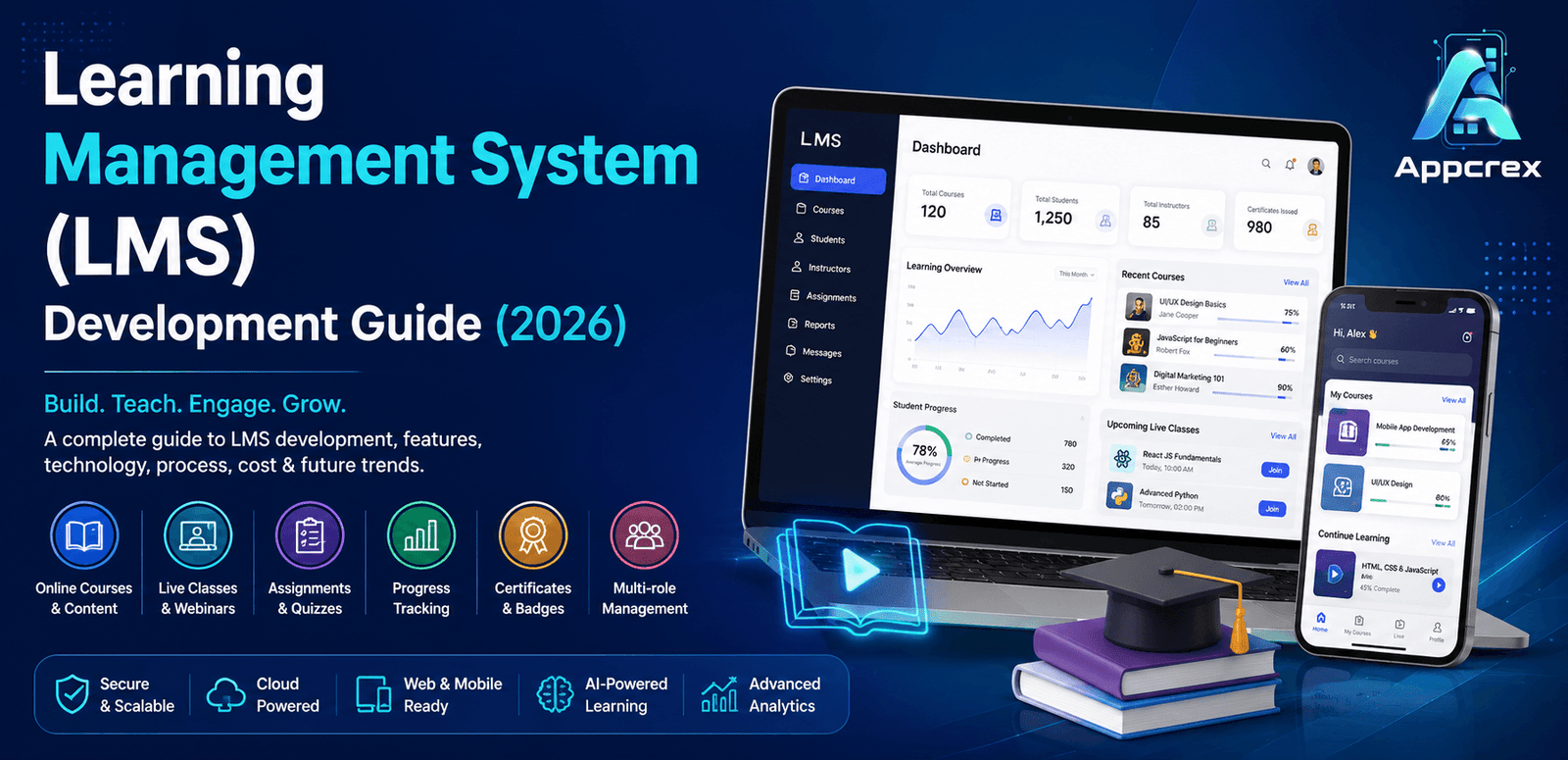
The rapid growth of digital education and remote workforce training has made Learning Management System (LMS) development a top priority for educational institutions, businesses, and training organizations. Whether it’s a university delivering online courses, a company onboarding employees, or a coaching institute managing virtual classes, an LMS provides a centralized platform to create, manage, and track learning activities efficiently.
Unlike traditional learning methods, modern LMS platforms offer interactive features such as online courses, live virtual classrooms, quizzes, certifications, progress tracking, and performance analytics. These capabilities help educators and organizations deliver engaging learning experiences while improving productivity and learner outcomes.
The increasing adoption of cloud technology, mobile learning, and Artificial Intelligence has further accelerated the demand for LMS software development. Today’s platforms are designed to support multiple devices, enable self-paced learning, automate administrative tasks, and provide personalized learning paths for users. As a result, businesses are investing in custom LMS development to build scalable solutions tailored to their unique training and educational requirements.
A well-designed LMS is no longer limited to schools and universities. Corporate organizations, healthcare providers, government agencies, and professional training institutes are using Learning Management System software to train employees, manage certifications, and ensure compliance with industry standards.
In this comprehensive guide, we’ll explore everything you need to know about Learning Management System development, including essential features, technology stack, development process, estimated cost, AI integration, monetization strategies, and the latest trends shaping the future of digital learning platforms in 2026.
What Is a Learning Management System (LMS)?
A Learning Management System (LMS) is a software platform that helps organizations create, deliver, manage, and monitor online learning programs from a single dashboard. It enables educational institutions, businesses, and training providers to offer digital courses, conduct assessments, track learner progress, and generate performance reports efficiently.
Modern LMS platforms support a wide range of learning activities, including self-paced courses, live virtual classes, quizzes, assignments, certifications, discussion forums, and progress tracking. Learners can access training materials anytime and from any device, while instructors and administrators can easily manage content, users, and learning outcomes.
Today, Learning Management System software is widely used across schools, universities, corporate organizations, healthcare institutions, and government agencies. Whether it’s employee onboarding, compliance training, professional certification, or academic education, an LMS simplifies the learning process and improves overall efficiency.
With the growing demand for digital education, many organizations are investing in custom LMS development to build platforms tailored to their specific business needs, branding, and training workflows.
LMS vs E-Learning Platform: What’s the Difference?
Although Learning Management Systems and e-learning platforms are often used interchangeably, they serve different purposes. An e-learning platform mainly focuses on delivering educational content, while an LMS provides complete management, tracking, and administration capabilities for online learning programs.
Understanding the difference helps businesses choose the right solution based on their training and education requirements.
| Learning Management System (LMS) | E-Learning Platform |
|---|---|
| Focuses on managing and tracking learning activities | Focuses mainly on delivering courses and content |
| Includes user management, reports, and analytics | Provides access to learning materials |
| Used by schools, universities, and enterprises | Commonly used by individual learners and course creators |
| Supports assessments, certifications, and progress tracking | Mainly focuses on videos, lessons, and resources |
| Offers admin and instructor dashboards | Usually provides learner-focused features |
A Learning Management System is designed for organizations that need complete control over training, user management, performance tracking, and reporting. For example, companies use LMS solutions for employee onboarding, compliance training, and professional development.
On the other hand, an e-learning platform is more focused on providing educational content directly to learners. Platforms offering online courses, tutorials, and skill-based training generally fall into this category.
For businesses looking to build a scalable education solution, custom LMS development provides greater flexibility by combining course delivery with advanced management features, analytics, automation, and integrations.
Why Invest in Custom LMS Development?
As organizations continue to embrace digital transformation, traditional training methods are no longer enough to meet modern learning needs. Businesses and educational institutions require flexible, scalable, and secure platforms that can support remote learning, employee development, and continuous skill enhancement. This is why Learning Management System development has become a valuable investment across multiple industries.
Unlike off-the-shelf solutions, custom LMS development allows businesses to build a platform with features that align with their specific goals. From personalized dashboards and custom branding to third-party integrations and advanced reporting, a custom LMS provides greater flexibility, better security, and complete control over the learning experience.
Investing in LMS software development also offers long-term business benefits, including reduced training costs, improved learner engagement, centralized content management, automated assessments, and detailed performance analytics. Whether you’re launching an online education platform or a corporate training portal, a custom LMS can streamline learning operations while supporting future growth.
As technologies like AI and cloud computing continue to evolve, organizations that invest in a modern LMS today will be better equipped to deliver engaging, data-driven, and scalable learning experiences in the years ahead.
Types of Learning Management Systems (LMS)
Not all Learning Management Systems are built for the same purpose. Depending on your business objectives, target audience, and training requirements, you can choose different types of LMS solutions. Selecting the right LMS ensures better learner engagement, simplified administration, and long-term scalability.
| LMS Type | Best For |
|---|---|
| Academic LMS | Schools, Colleges & Universities |
| Corporate LMS | Employee Training & Development |
| Cloud-Based LMS | SaaS Businesses & Enterprises |
| Mobile LMS | Learning on Smartphones & Tablets |
| AI-Powered LMS | Personalized & Adaptive Learning |
Academic LMS platforms are widely used by educational institutions to manage online classes, assignments, exams, and student progress. Corporate LMS solutions focus on employee onboarding, compliance training, and professional development. Cloud-based LMS platforms provide scalability and remote accessibility, making them ideal for growing businesses. Mobile LMS applications allow learners to access courses anytime, while AI-powered LMS platforms deliver personalized learning paths, automated assessments, and intelligent recommendations. Choosing the right type of Learning Management System development depends on your organization’s goals and future growth plans.
Essential Features Every Learning Management System (LMS) Should Have
The success of a Learning Management System depends on its ability to provide a seamless experience for learners, instructors, and administrators. A well-designed LMS should simplify course management, improve learner engagement, and automate training processes. During Learning Management System development, it’s important to include features that make learning interactive, scalable, and easy to manage.
Learner Features
The learner portal should provide everything users need to access courses, complete assessments, and monitor their progress from a single dashboard.
Key Learner Features:
- Secure Sign-Up & Login
- Personalized Dashboard
- Course Catalog & Search
- Video Lessons & Live Classes
- Assignments & Online Quizzes
- Progress Tracking
- Certificates & Badges
- Discussion Forums
- Push Notifications
- Multi-Device Access
These features help improve engagement and create a better learning experience across web and mobile platforms.
Instructor Features
Instructors need powerful yet easy-to-use tools to create, manage, and evaluate courses. A feature-rich instructor panel improves productivity while ensuring smooth course delivery.
Key Instructor Features:
- Course Creation & Management
- Video & Document Upload
- Live Class Scheduling
- Quiz & Assignment Management
- Student Performance Tracking
- Attendance Management
- Discussion & Q&A
- Course Analytics
- Certificate Generation
- Revenue Dashboard (for paid courses)
These capabilities are essential for LMS software development, allowing educators and trainers to efficiently manage online learning programs.
Admin Panel Features
The admin dashboard controls the entire LMS platform, helping businesses manage users, courses, subscriptions, and platform performance from one place.
Key Admin Features:
- User & Role Management
- Course & Category Management
- Instructor Approval
- Subscription & Payment Management
- Reports & Analytics
- Notification Management
- Content Moderation
- CMS & Blog Management
- Security & Access Control
- System Settings
A robust admin panel ensures smooth platform operations while supporting future growth and customization through custom LMS development.
Feature Overview
| Learner Features | Instructor Features | Admin Features |
|---|---|---|
| Course Enrollment | Course Management | User Management |
| Video Lessons | Live Class Scheduling | Course Management |
| Quizzes & Assignments | Student Tracking | Payment Management |
| Progress Tracking | Attendance Management | Reports & Analytics |
| Certificates | Course Analytics | Content Moderation |
| Discussion Forums | Certificate Generation | Notification Management |
This combination of learner, instructor, and admin features forms the foundation of a scalable and user-friendly Learning Management System software, making it suitable for schools, universities, enterprises, and corporate training organizations.
Benefits of Learning Management System Development
A custom Learning Management System provides much more than online course delivery. It helps organizations streamline training, improve learner engagement, and manage educational content efficiently from a centralized platform. Whether you’re an educational institution or an enterprise, investing in custom LMS development offers long-term operational and financial benefits.
Some of the key benefits include:
- Centralized course and content management
- Personalized learning experiences
- Reduced employee training costs
- Real-time learner progress tracking
- Automated assessments and certifications
- Improved collaboration between learners and instructors
- Secure cloud-based access from anywhere
- Easy integration with third-party business tools
- Scalable infrastructure for future growth
By implementing a modern LMS, organizations can deliver consistent training experiences while improving productivity, knowledge retention, and overall learning outcomes.
Just Read : How to Build School Management Software: Features, Cost & Tech Stack (2026 Guide)
AI-Powered Features for Modern Learning Management Systems
Artificial Intelligence is transforming digital education by making learning more personalized, efficient, and data-driven. Modern Learning Management System development is no longer limited to course management—it now includes AI capabilities that improve learner engagement, automate repetitive tasks, and provide valuable insights for educators and administrators.
Integrating AI into your LMS can significantly enhance the learning experience while reducing manual effort.
Key AI Features Include:
- AI-powered course recommendations
- Personalized learning paths
- AI chatbot for learner support
- Automated quiz and assignment grading
- Smart progress tracking
- Learning behavior analytics
- AI-generated course summaries
- Speech-to-text and text-to-speech
- Multilingual content translation
- Predictive performance analysis
These features help organizations build intelligent learning platforms that deliver better educational outcomes and improve user satisfaction.
Technology Stack for LMS Development
Choosing the right technology stack is essential for building a secure, scalable, and high-performing Learning Management System. A modern LMS should support thousands of users, live classes, assessments, and third-party integrations without compromising speed or reliability.
| Component | Recommended Technologies |
|---|---|
| Mobile App | Flutter, React Native |
| Frontend | React.js, Next.js |
| Backend | Node.js, Python |
| Database | PostgreSQL, MongoDB |
| Cloud | AWS, Google Cloud, Azure |
| Video Streaming | Zoom SDK, Agora, Twilio |
| AI Integration | OpenAI, TensorFlow |
| Notifications | Firebase, OneSignal |
Selecting a reliable technology stack ensures your LMS software development project remains scalable, secure, and future-ready.
Learning Management System Development Process
Developing a successful LMS requires careful planning, user-focused design, and continuous testing. A structured development process ensures the platform meets business objectives while providing a seamless learning experience.
Step 1: Requirement Analysis
Identify your target audience, learning goals, required features, and business model before starting development.
Step 2: UI/UX Design
Create intuitive interfaces for learners, instructors, and administrators to ensure smooth navigation and engagement.
Step 3: LMS Development
Build the platform by developing core modules such as course management, user authentication, assessments, dashboards, and reporting using modern Learning Management System development practices.
Step 4: Third-Party Integrations
Integrate video conferencing, payment gateways, email services, cloud storage, analytics, and notification systems to enhance platform functionality.
Step 5: Testing & Quality Assurance
Perform functional, security, performance, and compatibility testing to deliver a reliable and bug-free learning platform.
Step 6: Deployment & Maintenance
Launch the LMS on cloud infrastructure, monitor performance, release regular updates, and continuously improve the platform with new features, security patches, and AI enhancements.
This structured approach helps businesses build a scalable, secure, and feature-rich LMS that supports long-term growth and delivers an exceptional learning experience.
Industries That Use Learning Management Systems
Learning Management Systems are no longer limited to educational institutions. Today, businesses across multiple industries rely on LMS platforms to train employees, manage certifications, and deliver digital learning experiences.
Some of the major industries using LMS software include:
- Education: Schools, colleges, universities, and coaching institutes use LMS platforms for online learning, examinations, and student performance tracking.
- Corporate Enterprises: Businesses use LMS solutions for employee onboarding, compliance training, leadership development, and skill enhancement.
- Healthcare: Hospitals and healthcare organizations utilize LMS platforms for medical training, certification management, and regulatory compliance.
- Banking & Finance: Financial institutions provide employee training, compliance programs, and professional certification through secure LMS platforms.
- Manufacturing: Manufacturing companies train employees on workplace safety, operational procedures, and technical skills.
- Government & Public Sector: Government organizations use Learning Management Systems for employee development, policy training, and public service education.
The growing adoption of digital learning across industries continues to increase the demand for scalable LMS software development solutions.
How Much Does Learning Management System (LMS) Development Cost?
The cost of Learning Management System development varies depending on the platform’s complexity, features, technology stack, and third-party integrations. A basic LMS with course management and assessments requires a smaller investment, while an enterprise-grade platform with AI capabilities, live classes, and advanced analytics costs significantly more.
Here’s a general cost estimate for developing an LMS in 2026:
| LMS Version | Estimated Cost |
|---|---|
| Basic LMS | $20,000 – $40,000 |
| Standard LMS | $40,000 – $70,000 |
| Enterprise AI-Powered LMS | $70,000 – $150,000+ |
The final cost depends on your business requirements, customization level, supported platforms, and scalability needs.
Factors That Influence LMS Development Cost
Several factors affect the overall budget of an LMS project. Understanding these helps businesses plan development more efficiently.
Key Cost Factors:
- Number of features and modules
- Custom UI/UX design
- Web, Android, and iOS platform support
- AI-powered learning capabilities
- Live video conferencing integration
- Third-party API integrations
- Cloud hosting and infrastructure
- Security and compliance requirements
- Ongoing maintenance and support
Choosing the right development approach and technology stack can optimize costs while ensuring long-term scalability.
Future Trends in Learning Management System Development
The future of Learning Management System development is being shaped by emerging technologies that make digital learning more engaging, intelligent, and personalized. Organizations are increasingly adopting innovative solutions to improve learner experiences and maximize training effectiveness.
Some of the biggest LMS trends in 2026 include:
- AI-powered tutors and virtual assistants
- Personalized learning paths using Artificial Intelligence
- Gamification with badges, rewards, and leaderboards
- Microlearning through short interactive lessons
- AR and VR-based immersive learning experiences
- Voice-enabled learning assistants
- Blockchain-based digital certificates
- Advanced learning analytics and predictive reporting
As technology continues to evolve, businesses investing in next-generation LMS platforms will be better positioned to deliver interactive, scalable, and future-ready learning experiences while staying competitive in the rapidly growing EdTech market.
How Can an LMS Generate Revenue?
A Learning Management System can generate recurring revenue through multiple business models, making it a profitable investment for educational institutions and enterprises.
Popular Monetization Models:
- Monthly or yearly subscription plans
- Paid online courses
- Corporate training packages
- Certification fees
- In-app purchases
- White-label LMS licensing
- Enterprise SaaS subscriptions
Using a combination of these models helps maximize revenue while offering flexible pricing options for different user groups.
Why Choose AppCrex for Learning Management System Development?
At AppCrex, we specialize in building secure, scalable, and feature-rich Learning Management Systems tailored to your business needs. Whether you’re developing an LMS for schools, universities, corporate training, or online learning platforms, our team delivers custom solutions that combine modern design, advanced technology, and seamless user experiences.
Our expertise includes custom LMS development, AI-powered learning solutions, mobile app development, cloud integration, payment gateway implementation, and ongoing maintenance. From planning and design to deployment and support, we help businesses build future-ready learning platforms that drive engagement and business growth.
(FAQs)
1. What is a Learning Management System (LMS)?
A Learning Management System is a software platform used to create, manage, deliver, and track online learning and training programs.
2. How much does LMS development cost?
The cost typically ranges from $20,000 to $150,000+, depending on features, customization, and platform complexity.
3. How long does it take to build a custom LMS?
A basic LMS usually takes 3–5 months, while an enterprise-level platform with AI features may require 6–9 months.
4. Which industries use Learning Management Systems?
LMS platforms are widely used in education, healthcare, corporate training, government organizations, finance, manufacturing, and professional certification programs.
5. Can AI be integrated into an LMS?
Yes. AI can power personalized learning paths, intelligent recommendations, automated grading, AI chatbots, and learning analytics to improve user engagement.
Conclusion
The demand for Learning Management System development continues to grow as organizations embrace digital learning and workforce training. A modern LMS enables businesses, educational institutions, and training providers to deliver engaging, scalable, and personalized learning experiences while streamlining course management and performance tracking.
By investing in custom LMS development, organizations gain complete control over features, branding, integrations, and scalability. Whether you’re building an academic platform, a corporate training portal, or an enterprise learning solution, partnering with an experienced development company like AppCrex ensures you receive a secure, future-ready, and high-performing LMS tailored to your business goals.