📌 Key Takeaways
- Automate School Operations: Manage admissions, attendance, fees, exams, and communication from one centralized platform.
- Choose the Right Tech Stack: Build scalable software using React, Flutter, Node.js, and cloud platforms like AWS.
- Leverage AI Features: Improve efficiency with AI chatbots, smart attendance, predictive analytics, and automated reports.
- Plan Your Budget: Development costs typically range from $15,000 to $150,000+, depending on features and complexity.
- Invest in Custom Software: A custom solution offers better scalability, security, flexibility, and long-term value than off-the-shelf software.
Introduction
The education industry is rapidly embracing digital transformation, and schools are investing in technology to streamline operations, improve communication, and enhance the learning experience. Traditional methods of managing admissions, attendance, examinations, fee collection, and academic records are no longer sufficient for modern educational institutions. As schools grow, manual processes become inefficient, time-consuming, and prone to errors.
This is where school management software plays a vital role. It centralizes academic and administrative operations into a single platform, allowing administrators, teachers, students, and parents to collaborate seamlessly. Whether it’s tracking attendance, managing online classes, generating report cards, or collecting fees, a well-designed school management system simplifies everyday tasks while improving productivity.
The demand for custom education software has increased significantly over the past few years. Schools, colleges, universities, coaching institutes, and online learning platforms are looking for scalable, cloud-based, and AI-powered solutions tailored to their unique requirements. Instead of relying on off-the-shelf software with limited flexibility, many institutions now prefer custom-built systems that integrate with their existing workflows and support future growth.
If you’re planning to build a school management platform, this guide covers everything you need to know—from essential features and technology stack to development costs, timelines, and best practices. Whether you’re an educational institution, EdTech startup, or entrepreneur, you’ll gain valuable insights into creating a secure, scalable, and user-friendly solution.
What Is School Management Software?
School management software is a digital platform designed to automate and manage the day-to-day operations of educational institutions. It brings together various administrative, academic, and communication processes into one centralized system, reducing paperwork and improving operational efficiency.
Instead of maintaining separate systems for attendance, fee management, admissions, examinations, transport, and communication, schools can access everything through a unified dashboard.
A modern school management solution typically supports multiple users, including:
- School administrators
- Principals
- Teachers
- Students
- Parents
- Accountants
- HR staff
- Librarians
- Transport managers
Each user receives role-based access, ensuring secure and organized management of school data.
Why Is School Management Software Important?
Educational institutions generate large volumes of data every day. Managing this information manually often results in delays, duplicate records, and administrative challenges.
School management software helps institutions:
- Automate routine administrative tasks
- Improve communication between teachers, students, and parents
- Reduce paperwork and operational costs
- Track student performance in real time
- Simplify fee collection and financial reporting
- Improve attendance management
- Manage online learning and examinations
- Enhance data security
- Increase staff productivity
- Deliver a better educational experience
With cloud-based access, authorized users can securely manage school operations from anywhere, making it especially useful for institutions with multiple campuses.
School Management Software vs. School ERP
Many people use the terms School Management Software and School ERP interchangeably, but there are important differences.
| School Management Software | School ERP |
|---|---|
| Focuses on managing academic and administrative tasks | Integrates every department into one centralized system |
| Ideal for small and medium-sized schools | Best for large schools, colleges, universities, and multi-campus institutions |
| Includes core modules like attendance, fees, exams, and communication | Includes all core modules plus HR, payroll, finance, procurement, inventory, hostel, transport, and analytics |
| Easier to implement | More comprehensive and scalable |
A School ERP is essentially an advanced school management system that connects all departments through a single platform, improving collaboration and data visibility across the institution.
Types of School Management Software
Different educational institutions have different operational needs. Choosing the right type of software depends on the size of the institution, the number of users, and the services offered.
1. School Management Software for K-12 Schools
Designed for primary and secondary schools, this solution manages admissions, attendance, examinations, homework, fee collection, report cards, and parent communication.
Best For:
- Public schools
- Private schools
- International schools
2. College and University Management Software
Higher education institutions require more advanced capabilities such as semester management, course registration, faculty scheduling, research management, hostel administration, placement tracking, and alumni management.
Best For:
- Colleges
- Universities
- Technical institutes
3. Coaching Institute Management Software
Coaching centers need software to manage student enrollments, batch scheduling, online classes, assignments, attendance, and payment tracking.
Best For:
- Coaching centers
- Training institutes
- Skill development centers
4. Online Education Platform
As digital learning continues to grow, many institutions are building platforms that support virtual classrooms, video lectures, quizzes, live sessions, and course management.
Key capabilities include:
- Live video classes
- Learning Management System (LMS)
- Assignment submissions
- Online assessments
- Progress tracking
- Certificates
These platforms are ideal for EdTech companies and institutions offering remote learning.
5. Multi-Campus School ERP
Educational organizations with multiple campuses need centralized management to maintain consistency across locations.
Multi-campus solutions enable administrators to:
- Manage multiple branches
- Generate consolidated reports
- Standardize academic processes
- Monitor finances
- Track staff and student performance across campuses
Who Should Invest in School Management Software?
Custom school management software is suitable for:
- Schools
- Colleges
- Universities
- Coaching institutes
- EdTech startups
- Online learning platforms
- Corporate training providers
- International schools
- Educational NGOs
- Vocational training centers
Regardless of the institution’s size, a customized solution can improve efficiency, reduce manual work, and support long-term digital transformation.
Current Market Trends
The education technology (EdTech) industry continues to expand as institutions invest in digital infrastructure. Several trends are driving the adoption of school management software:
- Increased demand for cloud-based solutions
- Hybrid and online learning models
- AI-powered student performance analytics
- Mobile-first learning experiences
- Digital fee payment systems
- Real-time parent-teacher communication
- Automated attendance using facial recognition and QR codes
- Data-driven academic decision-making
- Enhanced cybersecurity for student records
- Integration with third-party learning tools
These trends highlight the growing importance of scalable, secure, and intelligent school management platforms.
Why Build Custom School Management Software?
While ready-made software may meet basic requirements, it often lacks the flexibility to support unique workflows and future expansion.
Custom development offers several advantages:
- Tailored features for your institution
- Easy integration with existing systems
- Scalable architecture for future growth
- Enhanced data security and compliance
- Better user experience for administrators, teachers, students, and parents
- Branding and customization options
- Full ownership of the software
- Ongoing feature enhancements
For institutions looking to differentiate themselves and improve operational efficiency, custom software provides a long-term competitive advantage.
Essential Features & Modules of School Management Software
The success of any school management software depends on the features it offers. A modern solution should simplify administration, improve communication, enhance learning, and automate repetitive tasks. Whether you’re developing software for a school, college, university, or online education platform, choosing the right modules is essential.
Below are the must-have features every custom school management software should include.
Admin Dashboard
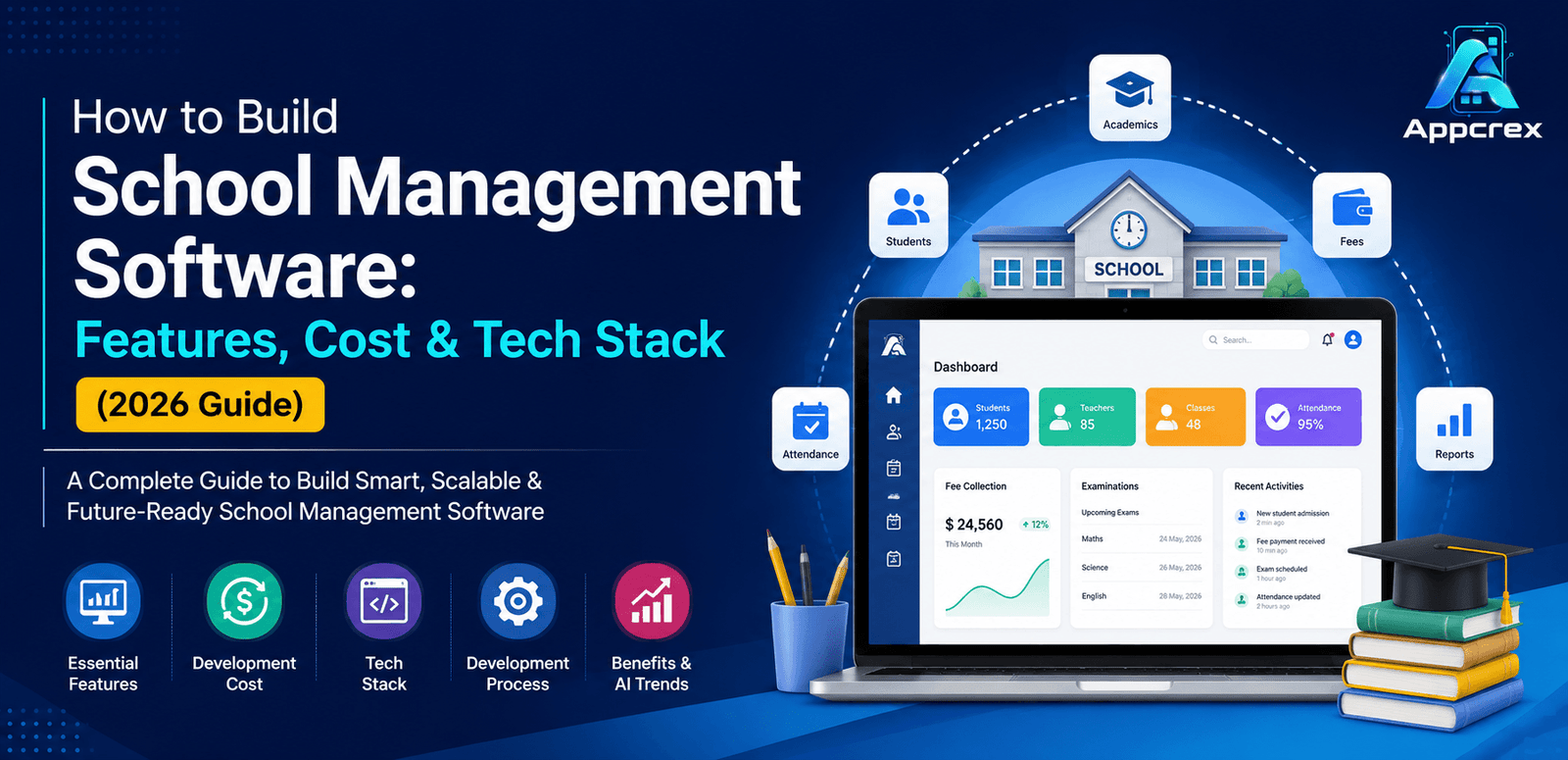
The admin dashboard acts as the control center of the entire system. It provides administrators with a real-time overview of school operations and helps them monitor key activities from a single interface.
Key Features
- School overview
- Student and staff statistics
- Attendance reports
- Fee collection summary
- Upcoming events
- Examination schedules
- Notifications
- User management
- Reports and analytics
Benefits
- Centralized management
- Faster decision-making
- Better operational visibility
2. Student Information Management
Managing student records manually can be challenging. This module stores and organizes all student-related information in one secure location.
Features
- Student registration
- Personal profiles
- Academic history
- Medical records
- Document uploads
- Class allocation
- Promotion records
- Transfer certificates
Benefits
- Easy access to student information
- Reduced paperwork
- Improved data accuracy
3. Online Admission Management
The admission process becomes much easier with an online system.
Features
- Online application forms
- Document uploads
- Application tracking
- Entrance examination management
- Admission approval workflow
- Automatic enrollment
This reduces administrative workload while providing a seamless experience for parents and students.
4. Attendance Management
Attendance tracking is one of the most frequently used modules in school management software.
Features
- Daily attendance
- QR code attendance
- RFID attendance
- Biometric integration
- Facial recognition attendance
- Leave management
- Attendance reports
AI Enhancement
AI-powered attendance systems can automatically detect student presence using facial recognition, reducing manual intervention.
5. Teacher Management
Teachers need dedicated tools to manage classes, assignments, schedules, and student performance.
Features
- Teacher profiles
- Class assignments
- Subject allocation
- Lesson planning
- Homework management
- Performance reports
- Leave requests
Benefits include better productivity and simplified academic management.
6. Parent Portal
Parents expect real-time updates about their child’s academic progress.
Features
- Attendance tracking
- Fee payment
- Homework updates
- Exam schedules
- Report cards
- Teacher communication
- School announcements
A dedicated parent portal improves transparency and strengthens parent-school relationships.
7. Student Portal
Students can manage their academic activities through a secure dashboard.
Features
- Homework
- Assignments
- Timetable
- Attendance
- Grades
- Course materials
- Online classes
- Certificates
The portal encourages self-learning and keeps students informed.
8. Fee Management System
Fee collection is often one of the most time-consuming administrative tasks.
Features
- Fee structure management
- Online payment gateway integration
- Automatic reminders
- Invoice generation
- Receipt downloads
- Scholarship management
- Fine calculation
- Financial reports
Supported payment methods may include:
- Credit/Debit Cards
- UPI
- Net Banking
- Stripe
- Razorpay
- PayPal
9. Examination Management
Managing examinations manually can be complex, especially for large institutions.
Features
- Exam scheduling
- Online exams
- Question bank
- Automatic grading
- Result generation
- Report cards
- Performance analytics
Benefits include reduced administrative effort and faster result processing.
10. Homework & Assignment Management
Teachers can create and distribute assignments digitally.
Features
- Assignment uploads
- Due date reminders
- Student submissions
- Online grading
- Feedback system
This supports both classroom and remote learning environments.
11. Timetable Management
Creating schedules manually often leads to conflicts.
Features
- Automated timetable generation
- Teacher scheduling
- Classroom allocation
- Subject planning
- Holiday management
Benefits include efficient resource utilization and better organization.
12. Library Management
Schools can digitize library operations through an integrated module.
Features
- Book catalog
- Issue and return tracking
- Barcode scanning
- Fine calculation
- Book availability
- Digital library integration
13. Transport Management
Transportation is a critical service for many schools.
Features
- Route planning
- Driver management
- Vehicle tracking
- GPS integration
- Pickup notifications
- Transport fee management
Parents can receive real-time updates about school buses.
14. Hostel Management
Educational institutions with residential facilities require hostel administration features.
Features
- Room allocation
- Hostel fees
- Visitor management
- Attendance
- Maintenance requests
15. HR & Payroll Management
Managing teaching and non-teaching staff becomes much easier with an integrated HR system.
Features
- Employee records
- Payroll processing
- Salary slips
- Attendance
- Leave management
- Performance tracking
- Tax calculations
Also Read : HR Management Software Development: Complete Guide to Features, Cost, Benefits & Development Process (2026)
16. Communication Module
Effective communication is essential for educational institutions.
Features
- SMS notifications
- Email alerts
- Push notifications
- In-app messaging
- Parent-teacher chat
- Emergency announcements
This keeps everyone informed in real time.
17. Learning Management System (LMS)
Modern schools increasingly integrate Learning Management Systems (LMS) into their software.
Features
- Online courses
- Video lectures
- Assignments
- Quizzes
- Certificates
- Discussion forums
- Learning progress tracking
An LMS is especially valuable for hybrid and online education models.
18. Reports & Analytics
Data-driven insights help school administrators make informed decisions.
Features
- Academic reports
- Financial reports
- Attendance reports
- Admission reports
- Teacher performance
- Student progress
- Custom dashboards
Advanced analytics can identify trends and support strategic planning.
19. AI-Powered Features
Artificial Intelligence is transforming education by automating tasks and delivering personalized experiences.
AI Capabilities
- AI chatbot for student and parent support
- Personalized learning recommendations
- Predictive performance analytics
- Smart attendance with facial recognition
- Automated report generation
- AI-based timetable optimization
- Intelligent fee reminders
- Early identification of at-risk students
These features improve efficiency while enhancing the overall educational experience.
20. Security & Compliance
Educational institutions handle sensitive student and staff data, making security a top priority.
Essential Security Features
- Role-based access control
- Multi-factor authentication (MFA)
- Data encryption
- Secure cloud storage
- Regular backups
- Audit logs
- GDPR/FERPA compliance (where applicable)
- Disaster recovery planning
A secure platform builds trust and ensures regulatory compliance.
Why Choose Custom Development?
While off-the-shelf software may offer basic functionality, custom school management software provides:
- Tailored workflows
- Better scalability
- Seamless integration with third-party systems
- Custom branding
- Higher security
- Long-term flexibility
- Easier feature expansion
- Competitive differentiation
For institutions with unique requirements or growth plans, custom development is often the most cost-effective long-term investment.
School Management Software Development Process & Best Technology Stack
Building school management software requires much more than coding. A successful platform should be scalable, secure, user-friendly, and capable of supporting thousands of students, teachers, parents, and administrators simultaneously. Whether you’re developing software for a school, university, coaching institute, or EdTech startup, following a structured development process helps reduce risks, control costs, and deliver a high-quality product.
Step 1: Define Business Goals & Requirements
Every successful software project starts with understanding the institution’s goals.
Ask questions such as:
- What problems should the software solve?
- Who will use the system?
- Will it support multiple campuses?
- Is mobile access required?
- Should online learning be included?
- Will AI features be integrated?
Stakeholders
- School Administrators
- Principals
- Teachers
- Students
- Parents
- HR Team
- Finance Department
- IT Team
Deliverables
- Functional Requirements Document (FRD)
- User Stories
- Business Requirements
- Software Scope
- Project Roadmap
A clear planning phase minimizes costly changes later in development.
Step 2: Conduct Market & Competitor Research
Analyze existing school management platforms to identify strengths, weaknesses, and opportunities.
Study popular solutions such as:
- PowerSchool
- Blackboard
- Moodle
- Fedena
- OpenEduCat
- Teachmint
- MyClassCampus
Research areas include:
- User experience
- Features
- Pricing models
- Mobile applications
- AI capabilities
- Customer reviews
- Security practices
This research helps you build a product that stands out in the competitive EdTech market.
Step 3: Finalize Features & Modules
Prioritize features based on business needs.
Core Modules
- Student Management
- Admissions
- Attendance
- Fees
- Examinations
- Timetable
- Parent Portal
- Teacher Portal
Advanced Modules
- HR & Payroll
- Hostel Management
- Transport Tracking
- Library Management
- Inventory
- AI Analytics
- Learning Management System (LMS)
- Multi-Campus Management
Starting with an MVP (Minimum Viable Product) allows faster launch and continuous improvement based on user feedback.
Step 4: UI/UX Design
An intuitive interface is essential because the platform will be used daily by users with different technical abilities.
Design Process
- User Flow
- Wireframes
- Interactive Prototypes
- Visual Design
- Accessibility Review
- Responsive Layout
Best Practices
- Simple navigation
- Mobile-friendly design
- Clean dashboard
- Fast loading pages
- Consistent branding
- Easy-to-read typography
A great user experience improves adoption and reduces training time.
Step 5: Choose the Right Technology Stack
Selecting the right technology stack directly affects performance, scalability, security, and future maintenance.
Frontend Technologies
These technologies create the user interface.
- React.js
- Angular
- Vue.js
React is widely used because of its component-based architecture and excellent performance.
Mobile App Development
Many institutions also require Android and iOS applications.
Popular frameworks include:
- Flutter
- React Native
These cross-platform technologies reduce development time while maintaining a native-like user experience.
Backend Development
The backend manages business logic, authentication, APIs, and databases.
Popular choices include:
- Node.js
- Laravel (PHP)
- Django (Python)
- ASP.NET Core
- Spring Boot (Java)
Choose a backend based on project complexity, team expertise, and scalability requirements.
Database
Educational institutions generate a large amount of structured data.
Recommended databases include:
- PostgreSQL
- MySQL
- MongoDB
- Microsoft SQL Server
For enterprise-level projects, PostgreSQL is often preferred due to its reliability and scalability.
Cloud Infrastructure
Cloud hosting ensures high availability and scalability.
Popular cloud providers:
- Amazon Web Services (AWS)
- Microsoft Azure
- Google Cloud Platform (GCP)
Cloud deployment provides:
- Automatic backups
- Disaster recovery
- Auto-scaling
- High availability
- Secure storage
API Integrations
Third-party integrations extend the software’s capabilities.
Common integrations include:
Payment Gateways
- Stripe
- Razorpay
- PayPal
Communication
- Twilio (SMS)
- SendGrid (Email)
- Firebase Cloud Messaging (Push Notifications)
Video Conferencing
- Zoom
- Google Meet
- Microsoft Teams
Maps
- Google Maps API
Authentication
- Google Login
- Microsoft Login
- Single Sign-On (SSO)
Step 6: Software Development
Development is typically divided into multiple sprints using Agile methodology.
Backend Development
Developers build:
- APIs
- Authentication
- Business logic
- Database architecture
- Security controls
Frontend Development
Developers create:
- Admin dashboard
- Student portal
- Teacher portal
- Parent dashboard
- Mobile interfaces
Integration
Frontend and backend are connected through secure APIs to ensure smooth communication.
Step 7: Testing & Quality Assurance
Testing ensures the software is stable, secure, and user-friendly before launch.
Types of Testing
- Functional Testing
- Performance Testing
- Security Testing
- Integration Testing
- API Testing
- Mobile Testing
- Usability Testing
- Regression Testing
Automated testing can speed up releases while maintaining software quality.
Step 8: Deployment
After successful testing, deploy the software to a production environment.
Deployment options include:
- Cloud Hosting
- Dedicated Servers
- On-Premise Infrastructure
- Hybrid Cloud
Deployment also includes:
- Domain setup
- SSL certificates
- Database migration
- Backup configuration
- Monitoring tools
Step 9: Ongoing Maintenance & Updates
Software development doesn’t end after launch. Continuous maintenance keeps the platform secure and relevant.
Maintenance activities include:
- Bug fixes
- Feature enhancements
- Performance optimization
- Security patches
- Database maintenance
- Cloud monitoring
- User support
Regular updates help the platform adapt to changing educational needs and technology trends.
Best Technology Stack at a Glance
| Layer | Recommended Technologies |
|---|---|
| Frontend | React.js, Angular, Vue.js |
| Mobile | Flutter, React Native |
| Backend | Node.js, Laravel, Django, ASP.NET Core |
| Database | PostgreSQL, MySQL, MongoDB |
| Cloud | AWS, Azure, Google Cloud |
| Payments | Stripe, Razorpay, PayPal |
| Notifications | Firebase Cloud Messaging, Twilio |
| Video | Zoom API, Google Meet API, Microsoft Teams |
| Authentication | OAuth 2.0, JWT, SSO |
| Analytics | Google Analytics, Power BI |
Security Best Practices
Since educational software stores sensitive information, security should be built into every stage of development.
Recommended Measures
- End-to-end encryption
- Multi-factor authentication (MFA)
- Role-based access control (RBAC)
- Secure APIs
- Data backups
- SSL/TLS encryption
- Audit logs
- Regular penetration testing
- Compliance with privacy regulations (such as GDPR or FERPA, where applicable)
A secure platform protects student records, financial data, and institutional information while building trust among users.
Why Work with a Professional Development Company?
Building enterprise-grade school management software requires expertise in education workflows, cloud infrastructure, security, mobile development, and UI/UX design.
An experienced development partner can help you:
- Define the right feature set
- Build scalable architecture
- Integrate third-party services
- Ensure data security
- Deliver faster with Agile methodologies
- Provide ongoing maintenance and support
Partnering with a specialized development company reduces technical risks and helps create a future-ready platform.
School Management Software Development Cost, Timeline, Benefits & AI Trends
One of the first questions educational institutions and EdTech startups ask is, “How much does it cost to build school management software?” The answer depends on several factors, including the number of features, platform compatibility, technology stack, integrations, security requirements, and the complexity of the project.
Whether you’re building a basic school management system or a full-featured School ERP, understanding the cost and development timeline helps you plan your budget effectively.
How Much Does It Cost to Build School Management Software?
The cost of developing custom school management software varies based on project scope and business requirements.
| Software Type | Estimated Cost | Development Time |
|---|---|---|
| Basic School Management Software | $15,000–$30,000 | 3–4 Months |
| Medium Complexity Solution | $30,000–$70,000 | 5–7 Months |
| Advanced School ERP | $70,000–$150,000+ | 8–12 Months |
Note: These are estimated ranges. Actual costs depend on the chosen features, technology stack, integrations, and development team.
Factors That Affect Development Cost
1. Number of Features
The more features you include, the higher the development effort.
Examples include:
- Student Management
- Attendance
- Online Admissions
- Fee Management
- Examinations
- Parent Portal
- AI Chatbot
- Multi-Campus Support
- Learning Management System (LMS)
A phased rollout with an MVP (Minimum Viable Product) can help reduce the initial investment.
2. Platform Selection
Decide whether you need:
- Web Application
- Android App
- iOS App
- Cross-Platform Mobile App
- Desktop Application
Supporting multiple platforms increases both development time and cost.
3. UI/UX Design Complexity
A well-designed interface improves usability but requires additional design effort.
Factors include:
- Custom dashboards
- Interactive reports
- Responsive layouts
- Accessibility
- Brand customization
- Dark mode support
4. Third-Party Integrations
Integrating external services can expand functionality but also adds complexity.
Common integrations:
- Payment Gateways
- SMS Services
- Email Platforms
- Video Conferencing
- Maps
- Cloud Storage
- Accounting Software
- Biometric Attendance Devices
5. AI Integration
Artificial Intelligence is becoming a key differentiator in education software.
Examples include:
- AI Chatbots
- Predictive Student Analytics
- Personalized Learning Recommendations
- Automated Attendance
- Smart Report Generation
Adding AI features generally increases development costs but can provide significant long-term value.
6. Security & Compliance
Educational institutions handle sensitive student and financial data.
Security measures include:
- Data Encryption
- Multi-Factor Authentication (MFA)
- Role-Based Access Control (RBAC)
- Secure APIs
- Audit Logs
- Cloud Security
- Regular Security Testing
Investing in security protects your platform and builds user trust.
Development Timeline
A typical project follows these phases:
| Phase | Duration |
|---|---|
| Discovery & Planning | 2–3 Weeks |
| UI/UX Design | 3–4 Weeks |
| Development | 10–20 Weeks |
| Testing & Quality Assurance | 3–5 Weeks |
| Deployment | 1–2 Weeks |
| Post-Launch Support | Ongoing |
Agile development allows features to be delivered incrementally, enabling faster feedback and continuous improvement.
Benefits of Custom School Management Software
Custom software offers long-term advantages over generic, off-the-shelf solutions.
Benefits for School Administrators
- Centralized data management
- Automated administrative tasks
- Better reporting and analytics
- Reduced paperwork
- Improved operational efficiency
Benefits for Teachers
- Easy attendance tracking
- Digital lesson planning
- Online assignment management
- Faster grading
- Improved communication with parents and students
Benefits for Students
- Access to study materials
- Assignment submissions
- Attendance tracking
- Online examinations
- Real-time academic progress
Benefits for Parents
- Fee payment reminders
- Attendance notifications
- Exam results
- School announcements
- Direct communication with teachers
Benefits for Educational Institutions
- Increased productivity
- Better resource utilization
- Enhanced student engagement
- Improved decision-making through analytics
- Scalable infrastructure for future growth
AI Trends in School Management Software
Artificial Intelligence is reshaping education by automating processes and supporting personalized learning experiences.
AI Chatbots
Chatbots can answer common questions about admissions, fees, schedules, and academic policies, reducing the workload for administrative staff.
Predictive Analytics
AI can analyze historical data to identify students who may need additional academic support, helping institutions take proactive action.
Personalized Learning
By analyzing learning patterns, AI can recommend study materials, assignments, and learning paths tailored to individual students.
Smart Attendance
Facial recognition, QR codes, and biometric systems can automate attendance tracking, improving accuracy and saving time.
Automated Report Generation
AI can compile attendance, academic performance, and fee data into reports for administrators, teachers, and parents.
Intelligent Timetable Optimization
AI can create class schedules that minimize conflicts while making efficient use of classrooms and faculty.
Future Trends in Education Technology
As technology continues to evolve, educational institutions are adopting new innovations to enhance learning and administration.
Key trends include:
- Cloud-Based School ERP
- Mobile-First Education Platforms
- Hybrid Learning Models
- Learning Analytics
- Internet of Things (IoT) for Smart Campuses
- Blockchain-Based Academic Certificates
- Virtual Reality (VR) and Augmented Reality (AR) Learning
- Voice-Enabled Learning Assistants
- AI-Powered Administrative Automation
- Cybersecurity Enhancements
These innovations will shape the next generation of school management systems.
Tips for Reducing Development Costs
You can optimize your budget without compromising quality by following these best practices:
- Start with an MVP and add advanced features later.
- Prioritize high-impact modules such as admissions, attendance, and fee management.
- Use cross-platform frameworks like Flutter or React Native for mobile apps.
- Adopt cloud infrastructure to reduce hardware costs.
- Integrate trusted third-party services instead of building every feature from scratch.
- Plan for scalability to avoid expensive redesigns in the future.
Measuring Success After Launch
Launching the software is only the beginning. Track key performance indicators (KPIs) to evaluate its effectiveness:
- User adoption rate
- Student and parent engagement
- Attendance accuracy
- Fee collection efficiency
- Administrative time savings
- System uptime
- Customer satisfaction
- Support ticket volume
Monitoring these metrics helps you identify opportunities for improvement and maximize the return on your investment.
Why Choose AppCrex?
Developing school management software is more than creating a digital platform—it’s about building a reliable ecosystem that simplifies administration, enhances communication, and supports better learning outcomes. The right development partner can help you transform your vision into a secure, scalable, and future-ready solution tailored to your institution’s needs.
At AppCrex, we specialize in building custom education technology solutions for schools, colleges, universities, coaching institutes, and EdTech startups. Whether you need a basic school management system, a comprehensive School ERP, or an AI-powered learning platform, our team can deliver a solution designed around your goals.
Why Choose AppCrex for School Management Software Development?
Choosing an experienced development company is essential for the long-term success of your project. At AppCrex, we combine technical expertise with industry knowledge to create solutions that improve efficiency, security, and user experience.
Custom-Built Solutions
Every educational institution has unique workflows and requirements. We design and develop software tailored to your specific operational needs instead of relying on generic templates.
Experienced Development Team
Our team includes:
- Business Analysts
- UI/UX Designers
- Frontend Developers
- Backend Developers
- Mobile App Developers
- QA Engineers
- DevOps Specialists
- Project Managers
This multidisciplinary approach ensures a smooth development process from planning to deployment.
Scalable Architecture
Our solutions are built to grow with your institution. Whether you’re managing a single school or multiple campuses, we design systems that can scale as your student base and operational requirements increase.
Advanced Technology Stack
We use modern technologies such as:
- React.js
- Flutter
- React Native
- Node.js
- Laravel
- Django
- PostgreSQL
- AWS
- Microsoft Azure
- Google Cloud Platform
This ensures high performance, security, and maintainability.
AI-Powered Education Solutions
We can integrate advanced AI capabilities such as:
- AI Chatbots
- Personalized Learning Recommendations
- Predictive Analytics
- Automated Reporting
- Smart Attendance
- Intelligent Timetable Optimization
These features improve efficiency while delivering a better experience for administrators, teachers, students, and parents.
Enterprise-Grade Security
Security is built into every stage of development with features including:
- Data Encryption
- Role-Based Access Control (RBAC)
- Multi-Factor Authentication (MFA)
- Secure API Development
- Cloud Security Best Practices
- Regular Security Testing
Protecting sensitive educational data is always a priority.
Ongoing Maintenance & Support
Our relationship doesn’t end after deployment. We provide:
- Regular Updates
- Performance Optimization
- Bug Fixes
- Security Patches
- Feature Enhancements
- Technical Support
This helps ensure your software remains secure, reliable, and up to date.
(FAQs)
1. What is school management software?
School management software is a digital platform that automates administrative and academic tasks such as admissions, attendance, fee management, examinations, communication, and reporting.
2. How much does it cost to build school management software?
Development costs generally range from $15,000 to $150,000+, depending on the project’s complexity, feature set, technology stack, integrations, and customization requirements.
3. How long does it take to develop school management software?
A basic solution can take 3–4 months, while an advanced School ERP with AI capabilities and multiple integrations may require 8–12 months.
4. What is the difference between school management software and a School ERP?
School management software focuses on core academic and administrative tasks, while a School ERP integrates additional departments such as HR, payroll, finance, inventory, transport, and hostel management into a single system.
5. Which technologies are best for developing school management software?
Popular technologies include:
- Frontend: React.js, Angular, Vue.js
- Mobile: Flutter, React Native
- Backend: Node.js, Laravel, Django, ASP.NET Core
- Database: PostgreSQL, MySQL, MongoDB
- Cloud: AWS, Azure, Google Cloud Platform
The ideal stack depends on your project’s requirements.
6. Can AI be integrated into school management software?
Yes. AI can support features such as chatbots, attendance automation, predictive analytics, personalized learning recommendations, timetable optimization, and automated report generation.
7. Is cloud-based school management software better than on-premise software?
Cloud-based solutions offer benefits such as remote access, automatic backups, easier maintenance, and better scalability. However, some institutions may choose on-premise deployments due to specific security or compliance requirements.
8. Can the software support multiple campuses?
Yes. A multi-campus architecture allows centralized management of admissions, attendance, staff, finances, and reports across multiple branches from a single platform.
9. Can payment gateways be integrated?
Absolutely. Secure payment gateways such as Stripe, Razorpay, and PayPal can be integrated to enable online fee collection and automated payment tracking.
10. Why should I choose custom school management software instead of ready-made software?
Custom software is tailored to your institution’s unique processes, offers greater flexibility, integrates with existing systems, supports future growth, and gives you full ownership of the platform.
11. Is a mobile app necessary for school management software?
A mobile app is highly recommended because it allows students, parents, teachers, and administrators to access important information, receive notifications, submit assignments, and communicate conveniently from anywhere.
12. How can AppCrex help with school management software development?
AppCrex provides end-to-end development services, including business analysis, UI/UX design, web and mobile development, AI integration, cloud deployment, testing, maintenance, and ongoing support to help educational institutions build scalable and secure digital solutions.
Final Thoughts
The education sector is undergoing rapid digital transformation, and institutions that invest in modern technology are better positioned to improve efficiency, enhance communication, and deliver exceptional learning experiences.
Building custom school management software enables schools to automate daily operations, reduce administrative overhead, improve collaboration among stakeholders, and make data-driven decisions. By incorporating modern technologies such as cloud computing, AI, and mobile applications, institutions can create a flexible platform that supports both current needs and future growth.
Whether you’re developing software for a school, college, university, coaching institute, or online learning platform, success depends on careful planning, selecting the right technology stack, and partnering with an experienced development company.
Ready to Build Your School Management Software?
If you’re looking to develop a secure, scalable, and feature-rich School Management Software, School ERP, or Education Management Platform, AppCrex can help.
Our team specializes in creating custom education software solutions with advanced features, cloud-native architecture, mobile applications, AI integration, and enterprise-grade security. From idea validation and UI/UX design to development, deployment, and long-term support, we deliver solutions that empower educational institutions to succeed in a digital-first world.
Contact AppCrex today to discuss your project and start building a future-ready school management solution tailored to your institution’s goals.