📌 Key Takeaways
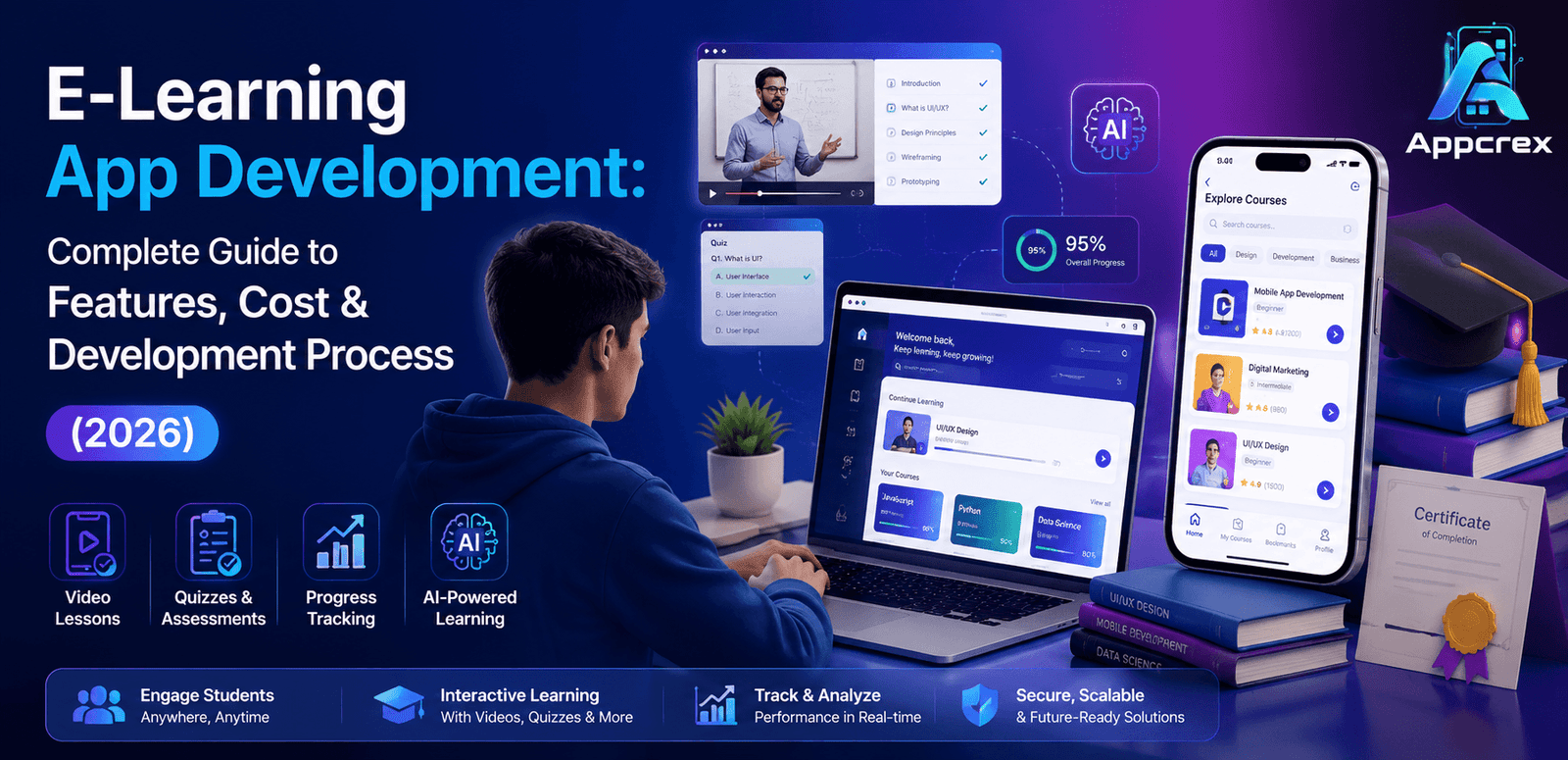
- E-learning apps help schools, businesses, and educators deliver flexible digital learning experiences.
- Essential features include live classes, video lessons, quizzes, certificates, and progress tracking.
- AI features like personalized learning and smart assessments improve user engagement.
- Development costs typically range from $15,000 to $120,000+, depending on features and complexity.
- Partnering with an experienced development company ensures a scalable, secure, and future-ready e-learning platform.
The Growing Demand for E-Learning App Development
The education industry has undergone a significant digital transformation over the past few years. Schools, universities, coaching institutes, and businesses are increasingly adopting digital learning platforms to provide flexible and accessible education. As smartphones and high-speed internet become more widespread, learners now expect interactive, on-demand learning experiences that they can access anytime and anywhere. This shift has made e-learning app development one of the fastest-growing segments in the EdTech industry.
Modern e-learning applications offer much more than online courses. They include live classes, recorded video lectures, quizzes, assignments, AI-powered learning recommendations, progress tracking, certificates, and collaborative learning features. Whether it’s K-12 education, higher education, corporate training, or professional skill development, educational apps are helping organizations deliver engaging and personalized learning experiences.
For startups and enterprises, investing in education app development presents a valuable business opportunity. The increasing demand for online learning has created a growing market for platforms that provide high-quality educational content, virtual classrooms, and interactive learning tools. Businesses can also generate recurring revenue through subscriptions, certifications, premium courses, and enterprise training solutions.
Building a successful e-learning platform requires more than just uploading educational content. It involves strategic mobile app development, intuitive UI/UX design, scalable cloud infrastructure, secure payment integration, and advanced analytics to ensure a seamless learning experience across Android, iOS, and web platforms.
With the rapid adoption of Artificial Intelligence, many organizations are also investing in AI-powered learning apps that deliver personalized course recommendations, automated assessments, and intelligent learning paths. These innovations are making digital education more engaging, efficient, and accessible for learners worldwide.
What Is an E-Learning App?
An e-learning app is a digital platform that enables users to access educational content, attend live or recorded classes, complete assignments, take quizzes, and track their learning progress using smartphones, tablets, or computers. These applications are designed to make learning more flexible, interactive, and accessible, allowing students and professionals to study at their own pace from anywhere in the world.
Today’s e-learning apps serve a wide range of users, including schools, universities, coaching institutes, corporate organizations, training centers, and independent educators. They support various learning formats such as video lectures, live virtual classrooms, downloadable study materials, assessments, certifications, discussion forums, and AI-powered personalized learning experiences.
As the EdTech industry continues to expand, online learning app development has become a strategic investment for businesses looking to deliver engaging digital education solutions. Whether you’re building a language learning platform, a corporate training solution, or an educational marketplace similar to Udemy or Coursera, a well-designed application can significantly improve learner engagement and knowledge retention.
Modern educational software development also incorporates advanced technologies like Artificial Intelligence, cloud computing, and data analytics to create personalized learning journeys. Features such as adaptive learning paths, AI tutors, automated assessments, and real-time performance tracking help learners achieve better outcomes while enabling educators to monitor progress more effectively.
Just Read : How to Build School Management Software: Features, Cost & Tech Stack (2026 Guide)
Why Invest in E-Learning App Development?
The demand for online education has grown rapidly as learners seek flexible, affordable, and accessible ways to acquire new skills. From academic education to professional certifications and corporate training, digital learning platforms have become an essential part of the modern education ecosystem. This shift has created tremendous opportunities for businesses investing in e-learning app development.
Educational institutions are increasingly adopting digital platforms to enhance classroom learning, while companies use e-learning applications to train employees, onboard new hires, and upskill their workforce. This growing demand has made Learning Management System (LMS) development and custom education platforms valuable investments for startups, enterprises, and training providers.
Investing in mobile app development for the education sector also opens multiple revenue opportunities. Businesses can monetize their platforms through paid courses, monthly or annual subscriptions, certification programs, in-app purchases, corporate licensing, and premium learning content. These recurring revenue models make e-learning platforms highly scalable and sustainable.
As technology continues to evolve, integrating AI, gamification, and personalized learning experiences will become essential for staying competitive. Organizations that invest in innovative education platforms today can build long-term customer relationships while establishing a strong presence in the rapidly growing global EdTech market.
Essential Features Every E-Learning App Should Have
The success of an e-learning platform depends on its ability to deliver an engaging, user-friendly, and interactive learning experience. Whether you’re building an app for schools, universities, coaching institutes, or corporate training, the right features play a crucial role in improving learner engagement and retention. During e-learning app development, it’s important to design features that benefit students, instructors, and administrators alike.
Student Features
Students are the primary users of an e-learning application, so the platform should provide everything they need to learn efficiently and track their progress.
Key Student Features:
- Secure Sign-Up & Login
- Personalized User Profile
- Course Search & Categories
- Video Lessons & Live Classes
- Downloadable Study Materials
- Quizzes & Online Assessments
- Progress Tracking Dashboard
- Certificates After Course Completion
- Wishlist & Bookmarked Courses
- Push Notifications for Classes & Assignments
- Course Reviews & Ratings
- Multi-Language Support
These features create a seamless learning experience and encourage students to stay active on the platform.
Instructor Features
An effective e-learning platform should also simplify course creation and student management for educators. Providing instructors with easy-to-use tools helps them focus on delivering high-quality educational content.
Key Instructor Features:
- Instructor Registration & Verification
- Course Creation & Management
- Video Upload & Content Management
- Live Class Scheduling
- Assignment & Quiz Creation
- Student Performance Tracking
- Discussion Forums & Q&A
- Course Analytics & Reports
- Earnings Dashboard
- Certificate Management
These capabilities are essential for online learning app development, allowing educators to manage courses efficiently while delivering an engaging learning experience.
Admin Panel Features
The admin panel serves as the backbone of the platform, allowing administrators to monitor operations, manage users, and ensure the application runs smoothly.
Key Admin Features:
- User & Role Management
- Course & Category Management
- Instructor Approval
- Content Moderation
- Payment & Subscription Management
- Analytics & Reporting Dashboard
- Notification Management
- Coupon & Promotion Management
- Security & Access Control
- CMS & Blog Management
A robust admin panel enables businesses to efficiently manage their platform while supporting future growth. Combined with modern educational software development practices and scalable architecture, these features help create a secure, reliable, and high-performing e-learning application that delivers value to learners and educators alike.
AI-Powered Features for Modern E-Learning Apps
Artificial Intelligence is transforming the education industry by making learning more personalized, interactive, and efficient. Integrating AI into e-learning app development helps educational platforms improve student engagement, automate repetitive tasks, and deliver customized learning experiences. Whether you’re developing an app for schools, universities, or corporate training, AI-powered features can significantly enhance the overall user experience.
Some of the most valuable AI features include:
- Personalized course recommendations based on user interests
- AI-powered learning paths
- Smart quizzes and automated assessments
- AI chatbot for instant student support
- Speech-to-text and text-to-speech functionality
- Automated assignment evaluation
- Learning progress analytics
- AI-generated study summaries
- Predictive performance analysis
- Multilingual content translation
By incorporating these capabilities, businesses can build intelligent education platforms that improve learning outcomes while reducing administrative workload.
Also Read : Custom Software Development Company: Complete Guide to Services, Process, Cost & Benefits (2026)
Technology Stack for E-Learning App Development
Choosing the right technology stack is essential for building a secure, scalable, and high-performing education platform. The technology should support live classes, video streaming, payment processing, AI integration, and thousands of concurrent users without compromising performance.
| Component | Recommended Technologies |
|---|---|
| Mobile App | Flutter, React Native, Kotlin, Swift |
| Frontend | React.js, Next.js |
| Backend | Node.js, Python, Java |
| Database | PostgreSQL, MongoDB, Firebase |
| Cloud | AWS, Google Cloud, Microsoft Azure |
| Video Streaming | Zoom API, Agora, Twilio |
| AI Integration | OpenAI, TensorFlow, Google Vertex AI |
| Payments | Stripe, Razorpay, PayPal |
| Notifications | Firebase Cloud Messaging, OneSignal |
Selecting a modern technology stack ensures your online learning app development project remains scalable, secure, and future-ready.
E-Learning App Development Process
Developing a successful e-learning application requires careful planning, user-centric design, and continuous testing. Following a structured development process helps businesses launch reliable and scalable education platforms.
Step 1: Research & Planning
Define your target audience, business goals, course categories, and monetization strategy before starting development.
Step 2: UI/UX Design
Design intuitive interfaces that make it easy for students and instructors to navigate courses, attend live classes, and track learning progress.
Step 3: App Development
Build the Android, iOS, or cross-platform application with core features such as video lessons, quizzes, assignments, and user authentication using best mobile app development practices.
Step 4: Third-Party Integration
Integrate video conferencing, payment gateways, push notifications, cloud storage, and analytics tools to enhance platform functionality.
Step 5: Testing & Quality Assurance
Perform functional, security, performance, and usability testing to ensure a smooth learning experience across all devices.
Step 6: Deployment & Maintenance
Launch the application on the App Store and Google Play Store, monitor user feedback, release regular updates, and continuously improve the platform with new features and security enhancements.
How Much Does E-Learning App Development Cost?
The cost of e-learning app development depends on several factors, including the app’s complexity, feature set, supported platforms, UI/UX design, third-party integrations, and development team location. A basic learning app with essential features requires a lower investment, while a feature-rich platform with AI capabilities, live classes, and advanced analytics demands a higher budget.
Below is a general cost estimate for developing an e-learning application in 2026:
| App Type | Estimated Cost |
|---|---|
| Basic MVP | $15,000 – $30,000 |
| Standard E-Learning App | $30,000 – $60,000 |
| Advanced AI-Powered E-Learning Platform | $60,000 – $120,000+ |
If you’re planning to build a platform similar to Udemy or Coursera with live streaming, AI-powered recommendations, certification management, and Learning Management System (LMS) development features, the overall cost may increase based on project requirements.
Factors That Affect E-Learning App Development Cost
Several technical and business factors influence the overall development budget. Understanding these factors helps businesses plan their investment more effectively.
The major cost factors include:
- Number of app features
- Android, iOS, or cross-platform mobile app development
- Custom UI/UX design
- Live video streaming integration
- AI-powered learning features
- Payment gateway integration
- Cloud infrastructure and hosting
- Third-party API integrations
- Security and data protection
- Ongoing maintenance and feature updates
Choosing the right technology stack and experienced development team can help optimize costs while ensuring long-term scalability.
Monetization Strategies for E-Learning Apps
A well-designed education platform offers multiple revenue opportunities beyond course sales. Businesses can adopt different monetization models depending on their target audience and business goals.
Some of the most effective monetization strategies include:
- Subscription Plans – Monthly or annual memberships for unlimited course access.
- Paid Courses – Charge users for individual courses or learning programs.
- Freemium Model – Offer free basic content while unlocking premium features through paid upgrades.
- Certification Fees – Charge learners for verified certificates after course completion.
- Corporate Training Packages – Provide custom training solutions for businesses and organizations.
- In-App Purchases – Sell study materials, mock tests, eBooks, or premium learning resources.
- Advertisements & Sponsorships – Generate additional revenue through educational partnerships and relevant advertising.
Combining multiple monetization models helps create a sustainable and scalable EdTech business.
Why Choose AppCrex for E-Learning App Development?
At AppCrex, we build secure, scalable, and feature-rich education platforms tailored to the needs of schools, universities, coaching institutes, startups, and enterprises. Our team specializes in e-learning app development, mobile app development, and educational software development, helping businesses deliver engaging digital learning experiences across Android, iOS, and web platforms.
From intuitive UI/UX design and LMS integration to AI-powered learning features and cloud deployment, we provide end-to-end development services that ensure your platform is future-ready, secure, and scalable. Whether you’re planning to launch a custom online learning app or a complete Learning Management System, AppCrex can turn your vision into a high-performing EdTech solution.
(FAQs)
1. How long does it take to develop an e-learning app?
A basic e-learning app typically takes 3–5 months, while an advanced platform with AI features, live classes, and LMS functionality may require 6–9 months.
2. How much does e-learning app development cost?
The development cost generally ranges from $15,000 to $120,000+, depending on the app’s features, complexity, and technology stack.
3. Which technologies are best for building an e-learning app?
Popular technologies include Flutter, React Native, Node.js, React.js, Firebase, PostgreSQL, AWS, and AI frameworks like OpenAI and TensorFlow.
4. Can AI improve an e-learning application?
Yes. AI can provide personalized learning paths, smart assessments, AI tutors, automated grading, and intelligent course recommendations, improving learner engagement and outcomes.
5. Can I build an app similar to Udemy or Coursera?
Absolutely. With the right strategy and development team, you can create a custom platform featuring video courses, live classes, certifications, subscriptions, and instructor management.
Conclusion
The rapid growth of digital education has made e-learning app development one of the most promising opportunities in the EdTech industry. As learners increasingly prefer flexible and interactive online learning experiences, businesses have the chance to build platforms that deliver real value while generating recurring revenue.
A successful e-learning application goes beyond video lessons by combining intuitive design, AI-powered learning, live classes, secure payments, and scalable technology. By investing in professional mobile app development and modern educational software development, organizations can create engaging learning platforms that support students, educators, and businesses alike.
Whether you’re launching an online course marketplace, a corporate training platform, or a custom Learning Management System, partnering with an experienced development company like AppCrex can help you build a secure, scalable, and future-ready solution that stands out in the competitive EdTech market.