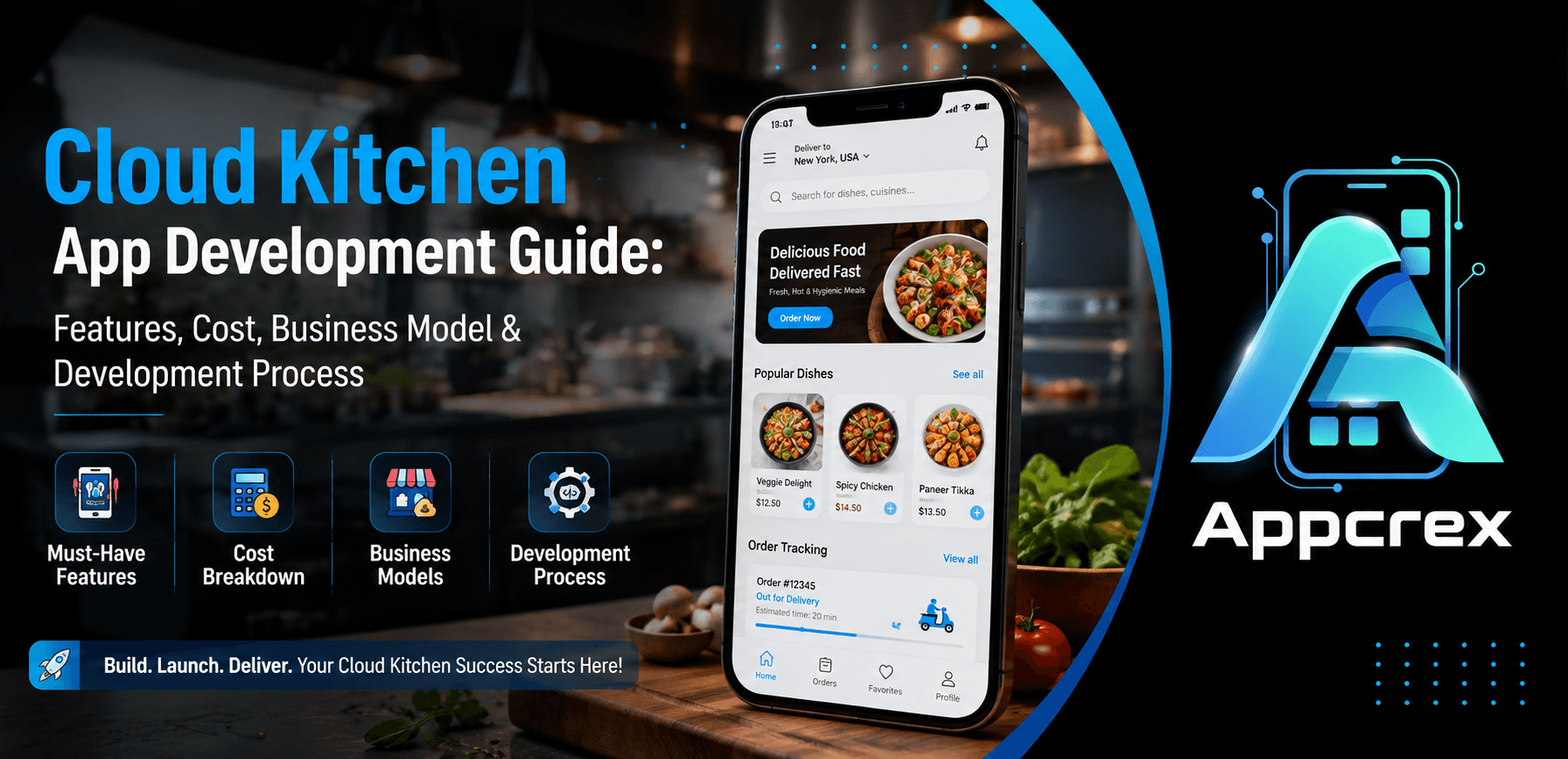
📌 Key Takeaways
- Cloud kitchen apps connect food ordering with kitchen and delivery operations.
- A multi-brand architecture can support several virtual restaurants from one kitchen.
- AI can improve forecasting, recommendations, inventory, and customer support.
- Development cost depends on features, platforms, integrations, and scalability.
- An MVP is a practical starting point before adding advanced automation.
Introduction
The cloud kitchen model has changed the traditional restaurant business. Instead of investing heavily in dining spaces, businesses can operate professional kitchens focused entirely on online food orders and delivery.
But launching a cloud kitchen is not just about renting a kitchen and listing food on delivery platforms. As the business grows, managing orders, menus, kitchen operations, inventory, delivery, customers, payments, and multiple food brands can become difficult without the right technology.
This is where cloud kitchen app development comes into the picture.
A dedicated cloud kitchen application can bring ordering, kitchen management, inventory, delivery, customer engagement, analytics, and administration into one connected ecosystem.
This guide explains how to build a cloud kitchen app, what features it should include, how the business model works, what technology can be used, how AI can improve operations, and how much development may cost.
What Is a Cloud Kitchen App?
A cloud kitchen app is a digital platform designed to manage online food ordering and the operational processes behind a delivery-focused kitchen.
Unlike a traditional restaurant app, a cloud kitchen platform often has several interconnected components.
These can include:
- Customer mobile application
- Kitchen management system
- Delivery partner application
- Admin dashboard
- Inventory management
- Order management
- Payment processing
- Analytics
- Customer support
- Multi-brand management
For a small business, the first version may only require customer ordering and basic kitchen management.
For a larger operation, the application can support multiple kitchens, virtual restaurant brands, delivery teams, warehouses, and advanced automation.
Why Build a Cloud Kitchen App?
Cloud kitchens depend heavily on technology because customers usually discover, order, pay for, and track their food digitally.
A custom application can provide more control over these operations.
Centralized Order Management
Orders from different channels can be brought into one system, making it easier for kitchen staff to manage preparation.
Better Kitchen Efficiency
Digital kitchen workflows can reduce manual communication and help employees prioritize incoming orders.
Inventory Visibility
Businesses can monitor ingredients, consumption, wastage, and stock levels from a centralized system.
Direct Customer Relationship
A dedicated app allows businesses to interact directly with customers instead of depending entirely on third-party food marketplaces.
Multiple Brand Management
One physical kitchen can operate several virtual food brands. A centralized backend can manage these brands from one platform.
Better Business Analytics
Businesses can track:
- Best-selling dishes
- Order volumes
- Revenue
- Customer retention
- Delivery performance
- Peak ordering periods
- Marketing performance
This information can support better operational decisions.
Cloud Kitchen App Business Models
The development approach depends heavily on the business model.
1. Single-Brand Cloud Kitchen
This is the simplest model.
One business operates one food brand from a dedicated kitchen and accepts orders through its application.
The platform may include:
- Digital menu
- Online ordering
- Payments
- Kitchen management
- Delivery tracking
- Customer management
2. Multi-Brand Cloud Kitchen
A single kitchen can operate multiple virtual brands.
For example, one physical location could run separate brands for:
- Burgers
- Pizza
- Asian food
- Desserts
The technology platform needs to keep their menus, pricing, promotions, and analytics organized while allowing the business to manage everything centrally.
3. Multi-Kitchen Platform
Businesses with kitchens in different locations can use a centralized platform to manage each kitchen.
Orders can be routed according to:
- Customer location
- Kitchen availability
- Delivery radius
- Menu availability
- Kitchen capacity
4. Cloud Kitchen Marketplace
A marketplace can connect customers with multiple independent cloud kitchens.
Revenue can come from:
- Order commissions
- Delivery charges
- Advertising
- Featured listings
- Subscription plans
5. Cloud Kitchen SaaS
Instead of operating a food marketplace, a technology company can provide cloud kitchen management software to businesses through a subscription model.
This model may include different plans based on:
- Number of kitchens
- Number of orders
- Users
- Features
- Integrations
How to Build a Cloud Kitchen App?
Building a cloud kitchen platform requires more planning than a standard food ordering application because the system has to manage both customer-facing and operational workflows.
Step 1: Define the Business Requirements
Start by determining what the application actually needs to accomplish.
Ask questions such as:
- Will there be one or multiple kitchens?
- Will the business operate multiple brands?
- Who will handle delivery?
- Will third-party delivery services be integrated?
- Will customers order directly through the app?
- Will the system connect with POS software?
- Is inventory management required?
- Will AI features be introduced?
The answers will influence the architecture and development budget.
Step 2: Research the Target Market
Study your target customers and competitors.
Research:
- Ordering habits
- Popular cuisines
- Average order values
- Delivery expectations
- Payment preferences
- Competitor features
- Customer complaints
The objective is not to copy another application but to identify gaps that your platform can solve.
Step 3: Plan the MVP
Instead of launching every possible feature at once, start with the core functionality.
An MVP may include:
- Customer registration
- Menu
- Search
- Cart
- Checkout
- Payment
- Order tracking
- Kitchen dashboard
- Admin panel
Advanced analytics, AI, loyalty programs, and automation can be added later.
Step 4: Design the UI/UX
The customer interface should make ordering simple.
At the same time, kitchen staff need a completely different interface focused on speed and order visibility.
The delivery application should prioritize:
- Order information
- Pickup details
- Navigation
- Delivery status
Good UX design should therefore be created separately for different users.
Step 5: Develop the Backend
The backend manages:
- Users
- Restaurants
- Virtual brands
- Menus
- Orders
- Payments
- Inventory
- Delivery
- Notifications
- Analytics
For a large platform, the architecture should be designed for scalability from the beginning.
Step 6: Integrate APIs
Depending on the project, developers may integrate:
- Payment gateways
- Google Maps
- Mapbox
- SMS services
- Email services
- Push notifications
- POS systems
- CRM systems
- Accounting platforms
- Analytics tools
Step 7: Test the Application
Testing should cover:
- Customer ordering
- Payment processing
- Order routing
- Kitchen status updates
- Delivery tracking
- Inventory synchronization
- Push Notifications
- Security
- Performance
Step 8: Launch
After testing, the mobile applications and backend infrastructure can be deployed.
The platform should then be monitored for crashes, performance problems, payment issues, and user feedback.
Step 9: Improve and Scale
Post-launch data can reveal which features need improvement.
Future updates may include:
- AI recommendations
- Demand forecasting
- Loyalty programs
- Advanced analytics
- Multi-kitchen support
- Automated inventory
- Route optimization
Essential Features of a Cloud Kitchen App
The features should be designed around different users rather than putting everything into one application.
Customer App Features
User Registration
Customers should be able to register through phone numbers, email, OTP, or supported social authentication.
Digital Menu
The menu should support:
- Categories
- Images
- Prices
- Descriptions
- Add-ons
- Variations
- Availability
- Dietary information
Search and Filters
Customers should be able to quickly find dishes using search and filtering options.
Food Customization
Customers may want to change ingredients, toppings, portion sizes, or spice levels.
Shopping Cart
The cart should clearly show:
- Items
- Quantity
- Add-ons
- Taxes
- Delivery fee
- Discounts
- Total amount
Online Payments
The app can support multiple payment methods depending on the target market.
Order Tracking
Customers should receive real-time updates as the order moves through different stages.
Ratings and Reviews
Customers can rate food, delivery, and overall experience.
Offers and Loyalty
Businesses can use:
- Coupons
- Referral rewards
- Loyalty points
- Membership programs
- Personalized promotions
to improve retention.
Kitchen Management Features
The kitchen side is one of the most important components of the platform.
Kitchen Order Display
Incoming orders should appear automatically on the kitchen dashboard.
Staff can view:
- Order number
- Items
- Quantity
- Customization
- Special instructions
- Preparation time
Order Status Management
Kitchen staff can update statuses such as:
New → Accepted → Preparing → Ready → Picked Up
Preparation Time Tracking
The system can monitor preparation times and identify operational delays.
Inventory Integration
When an order is processed, the relevant ingredient quantities can be updated automatically where inventory integration is implemented.
Menu Availability
If an ingredient becomes unavailable, staff can temporarily disable related menu items.
Delivery Partner Features
If the business manages its own delivery network, a separate delivery application can be developed.
Important features include:
- Delivery requests
- Order details
- Pickup location
- Customer address
- GPS navigation
- Delivery status
- Earnings
- Delivery history
- Availability status
Real-time location tracking can also be added where operationally required.
Admin Dashboard Features
The admin panel provides centralized control.
Administrators can manage:
Customer Management
View customer accounts, order history, activity, and support requests.
Order Management
Monitor orders across kitchens and brands.
Menu Management
Create and update categories, dishes, prices, add-ons, and availability.
Kitchen Management
Manage multiple kitchens, operating hours, capacity, and performance.
Delivery Management
Monitor delivery partners and order assignments.
Payment Management
Track payments, refunds, commissions, and transaction information.
Analytics
Reports can cover:
- Revenue
- Orders
- Average order value
- Customer retention
- Popular products
- Kitchen performance
- Delivery performance
Advanced Features for a Scalable Cloud Kitchen Platform
Once the basic platform is operational, advanced functionality can improve efficiency.
Multi-Brand Management
Businesses can operate several virtual brands from one backend while keeping their individual menus and branding separate.
Multi-Kitchen Routing
Orders can automatically be assigned to the most suitable kitchen based on predefined rules.
Automated Inventory
Inventory can be connected to order activity so stock levels are updated as sales occur.
Demand Forecasting
Historical order data can be used to estimate future demand.
Automated Promotions
The system can create targeted offers based on customer activity and purchasing patterns.
Advanced Analytics
Businesses can analyze customer behavior, menu performance, kitchen productivity, and delivery efficiency.
AI in Cloud Kitchen App Development
AI can become particularly useful once a business has enough operational data.
AI Demand Forecasting
Machine learning can analyze historical orders, seasonality, holidays, locations, and other variables to estimate demand.
This can help businesses prepare inventory and staff more effectively.
Personalized Food Recommendations
AI can recommend dishes based on:
- Previous orders
- Browsing behavior
- Favorite cuisines
- Order frequency
- Time of day
AI Inventory Prediction
AI can estimate future ingredient requirements and help reduce unnecessary waste.
AI Customer Support
An AI chatbot can answer routine questions related to:
- Order status
- Delivery
- Refunds
- Menu items
- Promotions
More complicated cases can be transferred to support staff.
AI Delivery Prediction
AI models can use delivery history, distance, traffic, and order volume to improve estimated delivery times.
Fraud Detection
AI can help identify unusual payment, refund, coupon, or account activity.
Technology Stack for Cloud Kitchen App Development
The technology stack depends on the project’s requirements, expected scale, integrations, and budget.
| Technology Layer | Possible Technologies |
|---|---|
| iOS | Swift |
| Android | Kotlin |
| Cross-platform | Flutter, React Native |
| Backend | Node.js, Python, Java |
| Database | PostgreSQL, MySQL, MongoDB |
| Cloud | AWS, Google Cloud, Azure |
| API | REST, GraphQL |
| Maps | Google Maps, Mapbox |
| Notifications | Firebase Cloud Messaging |
| AI/ML | Python, TensorFlow, PyTorch |
| Analytics | Firebase Analytics, Google Analytics |
For businesses expecting rapid growth, architecture and infrastructure should be planned for scalability rather than only the initial user base.
How Much Does It Cost to Build a Cloud Kitchen App?
The cost depends on the number of applications, features, integrations, platforms, design requirements, and development team.
A broad estimate can look like this:
| Development Level | Estimated Cost |
|---|---|
| Basic MVP | $25,000 – $50,000 |
| Mid-Level Platform | $50,000 – $90,000 |
| Advanced Multi-Brand Platform | $90,000 – $150,000+ |
| Enterprise Platform | $150,000+ |
These figures are general estimates. A final quotation requires a detailed project scope.
Factors Affecting Development Cost
Number of Platforms
Developing for iOS and Android separately can increase development effort.
Number of Applications
A customer app, delivery app, kitchen application, and admin panel require considerably more work than one application.
Feature Complexity
AI, real-time tracking, automated routing, multi-brand management, advanced analytics, and inventory automation increase complexity.
Integrations
Payment gateways, POS systems, maps, CRM systems, and third-party delivery services can add development effort.
UI/UX
A highly customized design requires additional design and frontend work.
Security
Authentication, payment security, role-based access, data protection, and secure APIs are important for production systems.
Scalability
A platform intended for multiple cities or countries needs stronger infrastructure than a local MVP.
How to Monetize a Cloud Kitchen App?
If you are developing a marketplace or SaaS platform, several monetization options are available.
Commission
Charge restaurants or kitchens a percentage of each order.
Delivery Fee
Charge customers based on delivery distance, location, or order value.
Subscription
Offer premium memberships with benefits such as free delivery or special discounts.
Advertising
Businesses can pay for sponsored listings or promotional placements.
SaaS Subscription
If the platform is sold as software, businesses can pay monthly or annual subscription fees.
Featured Listings
Cloud kitchens can pay to appear prominently in search results or promotional sections.
Challenges to Consider Before Building a Cloud Kitchen App
Technology can solve many operational problems, but the application must be designed around real business workflows.
Managing High Order Volumes
The backend should be able to handle traffic spikes during lunch, dinner, weekends, and promotional campaigns.
Keeping Menu and Inventory Data Synchronized
A dish should not remain available when its ingredients are unavailable.
Delivery Delays
Delivery tracking and accurate status updates are important because delays directly affect customer experience.
Multiple Brand Complexity
Managing multiple virtual brands requires a backend architecture that separates brand-level information while allowing centralized administration.
Data Security
Customer information, addresses, payment-related data, and business information need appropriate security controls.
Cloud Kitchen App vs Food Delivery Marketplace
These two models are related but not identical.
| Area | Cloud Kitchen App | Food Delivery Marketplace |
|---|---|---|
| Primary focus | Kitchen/business operations | Connecting restaurants and customers |
| Kitchen management | Major component | Usually limited |
| Inventory | Important | Usually restaurant-managed |
| Multiple virtual brands | Common | Less central |
| Delivery management | Important | Important |
| Customer ordering | Yes | Yes |
| Marketplace model | Optional | Core model |
| AI forecasting | Highly useful | Useful |
A business should choose the architecture according to its actual operating model rather than simply copying an existing food delivery platform.
Future Trends in Cloud Kitchen Technology
The next phase of cloud kitchen technology is likely to focus on automation and data-driven operations.
Important areas include:
- AI demand forecasting
- Automated inventory planning
- Smart kitchen systems
- Robotics
- Computer vision
- Personalized menus
- Voice-based ordering
- Predictive delivery
- Automated customer support
- Advanced business intelligence
The value of these technologies comes from solving operational problems rather than adding features simply for the sake of innovation.
FAQs
Q. How much does it cost to build a cloud kitchen app?
A basic MVP may cost around $25,000–$50,000, while advanced multi-brand and enterprise platforms can cost $90,000–$150,000 or more.
Q. How long does it take to develop a cloud kitchen app?
A basic MVP can take several months. The timeline increases when the project includes multiple applications, complex integrations, AI, advanced analytics, or multi-kitchen functionality.
Q. Can one cloud kitchen manage multiple food brands?
Yes. A multi-brand platform can allow one physical kitchen to operate and manage several virtual restaurant brands.
Q. What features should a cloud kitchen MVP include?
An MVP can include customer registration, menu browsing, cart, checkout, payment, order tracking, kitchen management, delivery management, and an admin dashboard.
Q. Can AI be integrated into a cloud kitchen app?
Yes. AI can be used for demand forecasting, recommendations, inventory prediction, customer support, delivery estimation, and fraud detection.
Q. Can the app integrate with POS software?
Yes. API-based integrations can connect the cloud kitchen platform with compatible POS, inventory, accounting, CRM, and other business systems.
Q. Should I build a native or cross-platform app?
The choice depends on the project’s requirements. Native development provides platform-specific optimization, while technologies such as Flutter and React Native can support both platforms from a shared codebase.
Conclusion
Building a cloud kitchen app requires more than creating a digital menu and online checkout. The application needs to connect customers with kitchen operations, inventory, delivery, payments, and business analytics.
The right approach is to first define the business model, identify the core operational requirements, and build an MVP around those needs. Once the platform starts generating real usage data, advanced capabilities such as AI forecasting, automated inventory, multi-brand management, and intelligent delivery can be introduced.
For businesses planning to enter the cloud kitchen market, a scalable technology foundation can make it easier to manage growing order volumes and expand into new kitchens, brands, or locations.
Build Your Cloud Kitchen App with AppCrex
AppCrex can help businesses develop custom cloud kitchen and food-tech solutions with customer ordering, kitchen management, inventory, delivery tracking, payment integration, analytics, multi-brand functionality, and AI-powered features.
Whether you are launching a single cloud kitchen or building a larger food-tech platform, AppCrex can help you plan, design, develop, and scale your application with experienced mobile app developers.