
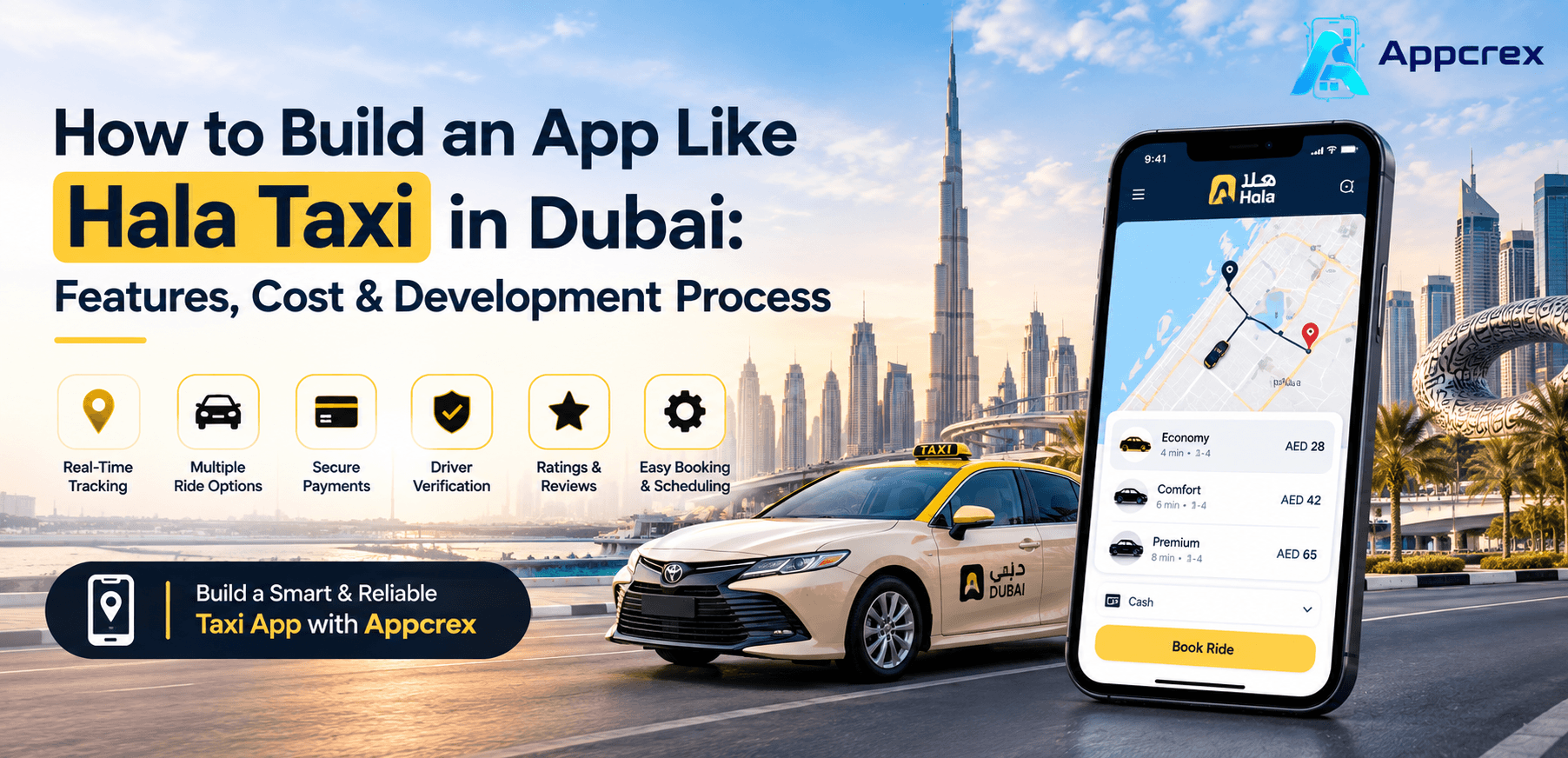
📌 Key Takeaways
- A Hala-style app needs passenger, driver and admin systems.
- GPS, dispatch, payments and real-time tracking are core technologies.
- Dubai-specific transportation and regulatory requirements should be planned early.
- AI can improve driver matching, demand forecasting and customer support.
- An MVP can be launched first and expanded with advanced mobility features.
Introduction
Dubai has one of the most digitally connected transportation ecosystems in the world. From app-based bookings and GPS tracking to cashless payments and smart mobility services, technology has become an important part of how people move around the city.
Hala is a strong example of this shift. The service was launched through a partnership between Dubai’s Roads and Transport Authority (RTA) and Careem, bringing taxi booking and e-hailing into a digital experience. RTA has described features such as fare visibility, driver information, live tracking, digital payments and ride ratings as part of the Hala experience.
For businesses looking to enter Dubai’s transportation market, this creates an opportunity to develop a taxi booking app like Hala with its own business model, branding, technology and customer experience.
But building such an application is much more than creating a booking screen. A successful platform needs passenger and driver applications, fleet management, real-time location services, dispatch logic, payments, notifications, analytics and a carefully planned regulatory approach.
This guide explains how to build an app like Hala Taxi in Dubai, what features you need, how much development can cost, the technology involved and what the development process typically looks like.
What Is a Hala-Style Taxi Booking App?
A Hala-style application connects passengers with taxi or licensed transportation services through a digital booking platform.
Instead of calling a taxi dispatch centre or searching for a vehicle on the street, users can enter their pickup location, select a destination, choose an appropriate vehicle or taxi category and request a ride through the application.
The basic ecosystem usually contains three major components:
- Passenger mobile application
- Driver or captain application
- Admin and fleet management dashboard
Behind these interfaces is a backend system responsible for dispatching, location tracking, payments, pricing, notifications, user accounts and operational analytics.
In Dubai, the transportation ecosystem also involves RTA requirements and approved channels, so businesses should validate applicable licensing, integration and operational requirements before launching a commercial service. RTA’s current taxi service information lists multiple taxi categories and digital booking channels, including partner applications.
Why Build an App Like Hala in Dubai?
Dubai’s transportation market provides an interesting environment for technology-driven mobility businesses.
Residents, tourists, business travellers and airport passengers regularly need reliable transportation across different parts of the city. At the same time, users are increasingly comfortable with mobile booking, digital payments and real-time tracking.
A Hala-style platform can provide a centralized digital experience around these expectations.
1. Growing Demand for App-Based Booking
Users expect to see available transportation options, estimated arrival times and trip information directly on their smartphones.
RTA itself promotes digital taxi booking through applications such as S’hail and Careem.
2. Better Fleet Utilization
A digital dispatch system can help operators understand where vehicles are located and where demand is increasing.
This can reduce unnecessary driving and improve vehicle utilization.
3. Real-Time Customer Experience
GPS tracking allows passengers to follow the vehicle, while drivers can receive navigation and trip information through the driver application.
4. Multiple Payment Options
A modern taxi application can support cash as well as digital payment methods depending on the business model and applicable local requirements.
5. Opportunities Beyond Basic Taxi Booking
A new platform does not necessarily need to compete as a direct copy of Hala.
It could focus on:
- Airport transfers
- Corporate transportation
- Family transportation
- Premium rides
- Accessible transportation
- Hotel transportation
- Scheduled rides
- Fleet management
- Business accounts
- Tourism transportation
The important point is to create an independently branded product rather than simply reproducing another company’s interface or proprietary implementation.
Just Read : Top 10 Taxi Apps in Dubai for Tourists & Residents (2026 Guide)
How to Build an App Like Hala Taxi in Dubai?
Building a taxi application requires coordination between product strategy, UX design, mobile development, backend engineering, maps, payments, dispatch technology and operations.
A practical development process can be divided into the following stages.
1. Define the Business Model
Before writing code, decide what type of transportation business the application will support.
For example, you could build a platform for:
- Licensed taxi operators
- Private transportation companies
- Corporate fleets
- Airport transfer businesses
- Multi-fleet transportation providers
- Specialized mobility services
The business model determines the application architecture, fleet management requirements, pricing logic and administrative workflows.
2. Research the Dubai Transportation Ecosystem
Dubai requires more than a generic taxi-booking concept.
The development team should understand the applicable transportation regulations, licensing requirements, payment requirements, vehicle categories and integration possibilities before development begins.
RTA currently lists several taxi categories, including regular, family, female, People of Determination and Safe Hands services.
For a commercial launch, regulatory and integration requirements should be confirmed with the relevant authorities and authorized partners because these requirements can change.
3. Design the User Experience
The passenger should be able to book a ride with minimal friction.
A typical booking journey could be:
Open App → Detect Location → Enter Destination → Select Taxi → Review Fare/Trip Details → Confirm Ride → Track Driver → Complete Trip → Pay → Rate
The driver journey is different:
Go Online → Receive Request → Accept Ride → Navigate to Pickup → Start Trip → Navigate to Destination → Complete Ride → View Earnings
The interface should be designed around these real-world workflows rather than adding unnecessary screens.
Essential Features of an App Like Hala
Passenger App Features
The passenger application is the customer-facing component of the platform.
User Registration
Users should be able to register through:
- Mobile number
- Social login where appropriate
- OTP verification
GPS-Based Pickup
The application should automatically detect the passenger’s current location and allow the user to adjust the pickup point manually.
Destination Search
Users can enter a destination using:
- Address
- Place name
- Map selection
- Saved location
Taxi Category Selection
Depending on the business model, users could choose from available categories such as:
- Standard taxi
- Family taxi
- Premium vehicle
- Airport transfer
- Accessible vehicle
- Corporate ride
Fare Estimation
Before confirming the booking, the platform can display an estimated fare or relevant trip pricing information.
The exact fare calculation should follow the business model and applicable local transportation rules.
Driver Information
Once a ride is assigned, the passenger can see relevant driver and vehicle information.
Live Ride Tracking
GPS tracking lets passengers see:
- Driver location
- Estimated arrival
- Route
- Trip progress
Ride History
Users should be able to view previous trips, receipts and booking information.
Multiple Payment Options
Depending on the market and approved payment setup, the application may support:
- Credit/debit cards
- Digital wallets
- Cash
- In-app payment
- Other supported payment methods
RTA’s current taxi service information lists payment methods including cash, credit cards, nol card, Careem Pay, Apple Pay, Samsung Pay, Alipay and QR-based payment for relevant services.
Ratings and Reviews
After completing a trip, passengers can rate their experience and provide feedback.
Trip Sharing
Users can share trip information with family members, friends or colleagues for additional visibility during travel.
Emergency Assistance
A safety module can provide quick access to emergency contacts, support and relevant safety workflows.
Also Read : Vehicle Tracking Software Development Company: Complete Guide to Features, Cost & Development Process
Driver App Features
The driver application is equally important because it controls the operational side of the ride.
Driver Registration
The onboarding system can collect required driver information and documents for verification.
Depending on the operating model, this can include:
- Identity information
- Driving credentials
- Vehicle details
- Required permits
- Insurance information
- Other compliance documents
Driver Availability
Drivers should be able to switch between:
- Online
- Offline
- Busy
- On trip
This information is used by the dispatch engine to determine available vehicles.
Ride Request Management
Drivers can receive:
- Pickup location
- Passenger information
- Estimated route
- Trip information
- Request status
They can then accept or reject requests according to the platform’s operational rules.
The driver application should integrate mapping and navigation capabilities to help drivers reach pickup and destination points.
Earnings Dashboard
Drivers can monitor:
- Completed trips
- Daily earnings
- Weekly earnings
- Incentives
- Bonuses
- Payment history
Driver Ratings
Drivers can view customer feedback and ratings where the business model supports two-way ratings.
Admin and Fleet Management Dashboard
A Hala-style platform also needs a powerful backend dashboard.
The admin panel can manage:
User Management
- Passenger accounts
- Driver accounts
- Account verification
- Suspended accounts
- Customer support
Fleet Management
- Vehicles
- Vehicle categories
- Driver assignments
- Vehicle status
- Maintenance information
Booking Management
Administrators can monitor active, completed, cancelled and scheduled rides.
Dispatch Management
The dispatch system can assign ride requests based on factors such as:
- Driver availability
- Distance
- Vehicle category
- Current trip status
- Service area
- Demand levels
Pricing Management
Depending on the business model, administrators can configure pricing rules, commissions, service charges or other approved pricing parameters.
Analytics
Useful dashboards can include:
- Total bookings
- Completed trips
- Cancellation rate
- Average trip value
- Driver activity
- Revenue
- Customer retention
- Peak demand areas
Dubai-Specific Features to Consider
A taxi application designed for Dubai should not simply be a generic global ride-hailing application with a Dubai label.
The product needs to consider the local transportation ecosystem.
RTA and Regulatory Planning
RTA plays a central role in Dubai’s transportation ecosystem. Its current taxi service pages describe digital booking workflows, different vehicle categories and multiple payment options.
Therefore, before development, businesses should identify:
- Required business licenses
- Transportation permissions
- Driver requirements
- Vehicle requirements
- Data and payment obligations
- Approved integration possibilities
- Operational restrictions
- Applicable RTA processes
These should be confirmed with the relevant authorities or authorized partners before launch.
Airport Transportation
Dubai’s airports represent an important transportation use case.
A taxi platform can support airport-focused workflows such as:
- Airport pickup
- Terminal selection
- Scheduled booking
- Flight information
- Driver assignment
- Pickup instructions
Multilingual Experience
Dubai serves an international population, so multilingual UX can be valuable.
Arabic and English should generally be considered during product planning, while additional languages can be added based on the target customer base.
Salik and Route-Related Logic
Transportation applications operating in Dubai also need to account for route-related charges and local transportation rules where applicable.
RTA’s current taxi information notes additional fares associated with Salik gates and other conditions.
The application should therefore be designed so that applicable pricing logic can be configured and updated rather than hard-coded into the mobile app.
Also Read : Smart Parking App Development Company Dubai: Features, Cost, Technology & Development Process
AI Features for a Hala-Style Taxi App
AI can make a taxi platform more efficient when it is applied to specific operational problems.
AI-Based Driver Matching
The system can analyze:
- Passenger location
- Driver location
- Vehicle type
- Current availability
- Estimated arrival time
- Traffic conditions
It can then recommend an appropriate driver.
Demand Prediction
Machine learning models can identify patterns in booking activity and help operators understand where demand may increase.
Possible factors include:
- Time of day
- Day of week
- Events
- Airport traffic
- Historical bookings
- Geographic demand
Dynamic Fleet Positioning
Predictive analytics can help fleet managers decide where available vehicles should be positioned.
AI Customer Support
An AI chatbot can answer common questions about:
- Bookings
- Payments
- Cancellations
- Lost items
- Ride history
- Account issues
Complex cases can be transferred to human support.
Fraud Detection
AI can also help identify unusual booking, payment or account activity.
Technology Stack for a Taxi App Like Hala
The technology stack depends on the application’s scale and required integrations.
| Component | Possible Technologies |
|---|---|
| iOS App | Swift |
| Android App | Kotlin |
| Cross-Platform | Flutter / React Native |
| Backend | Node.js / Python / Java |
| Database | PostgreSQL / MySQL |
| Real-Time Communication | WebSockets |
| Maps | Google Maps / Mapbox |
| Cloud | AWS / Google Cloud / Azure |
| Notifications | Firebase Cloud Messaging |
| Analytics | Firebase / Custom Analytics |
| AI/ML | Python / TensorFlow / PyTorch |
| Admin Panel | React / Next.js |
| API Layer | REST / GraphQL |
For an MVP, cross-platform development can reduce initial development effort. For a large-scale mobility platform, the final architecture should be selected based on performance, integrations, expected booking volume and long-term maintenance.
How Much Does It Cost to Build an App Like Hala in Dubai?
The cost depends heavily on the application’s complexity.
A simple MVP with basic booking and tracking functionality will require a different budget from a production-grade platform with advanced dispatching, fleet management, AI, multiple payment methods and complex integrations.
A rough development range can be:
| App Type | Estimated Cost |
|---|---|
| Basic Taxi App MVP | $25,000–$45,000 |
| Mid-Level Taxi Platform | $45,000–$80,000 |
| Advanced Hala-Style Platform | $80,000–$150,000+ |
| Enterprise Mobility Platform | $150,000+ |
These are development estimates rather than fixed Dubai market prices. The final quotation depends on the required features, technology stack, integrations, design complexity, development team location and post-launch support.
Also Read : Transport Management Software (TMS) Development Company: Features, Cost & Process
Factors That Affect Development Cost
The biggest cost drivers include:
- Number of mobile applications
- Passenger and driver features
- Admin dashboard complexity
- Real-time GPS tracking
- Dispatch algorithm
- Payment integration
- Maps and navigation
- AI functionality
- Third-party APIs
- Multilingual support
- Security requirements
- Cloud infrastructure
- Testing
- Regulatory integrations
- Maintenance and support
If you are starting a new transportation business, an MVP can be launched first and advanced features can be added after validating demand.
Development Timeline
A basic taxi booking MVP may take around 3–5 months, while a more sophisticated Hala-style platform can take 5–9 months or longer depending on integrations and regulatory requirements.
A typical process can look like this:
| Stage | Approximate Duration |
|---|---|
| Business & Technical Planning | 2–3 weeks |
| UI/UX Design | 3–5 weeks |
| Mobile App Development | 8–14 weeks |
| Backend & APIs | 8–14 weeks |
| Admin Dashboard | 4–7 weeks |
| Integrations | 3–6 weeks |
| Testing & Security | 3–5 weeks |
| Deployment | 1–2 weeks |
Some stages can run simultaneously, so the overall timeline is not simply the sum of every activity.
How Does a Taxi App Like Hala Make Money?
A transportation platform can use several revenue models.
Commission Per Ride
The platform takes a percentage or agreed fee from completed rides.
Booking or Service Fee
A fixed service charge can be applied to eligible bookings.
Corporate Accounts
Businesses can receive centralized transportation management and billing.
Fleet Software
If the platform also provides fleet management software, operators can pay a recurring software fee.
Premium Services
The business can introduce premium transportation categories, airport services or scheduled rides where permitted.
The monetization model should be designed around the target transportation operation and applicable local rules.
Also Read : Top 10 Taxi Apps in Dubai for Tourists & Residents (2026 Guide)
Challenges of Building a Taxi App in Dubai
Developing the application is only one part of the project.
Regulatory Compliance
Transportation services are regulated, so the business must understand applicable requirements before launch.
Real-Time Accuracy
A taxi application depends heavily on accurate location and trip information.
GPS inaccuracies, weak network connections and mapping issues can negatively affect the customer experience.
Driver Supply
Even a technically strong application will struggle if enough drivers are not available in important service areas.
Peak Demand
Events, airport traffic, weekends and peak travel periods can create sudden demand spikes.
The backend needs to scale accordingly.
Payment Security
Payment data must be handled securely using appropriate payment providers and security practices.
Customer Support
Taxi businesses deal with cancellations, lost belongings, payment issues, driver disputes and other real-world problems. A support system should therefore be part of the product from the beginning.
Hala-Style Taxi App vs Generic Taxi App
A generic taxi application usually focuses on the standard booking workflow.
A Hala-style Dubai solution can go further by considering:
- Local transportation ecosystem
- Licensed fleet operations
- Dubai-specific service categories
- Real-time dispatch
- Local payment requirements
- Airport transportation
- Multilingual UX
- Fleet analytics
- Demand prediction
- Regulatory and integration planning
This doesn’t mean reproducing Hala’s exact application. Instead, businesses can use the Hala model as market inspiration and build an independently designed transportation platform around their own target customers and operations.
How to Start Your Taxi App Development Project?
Before hiring a mobile app development company, prepare a clear product scope.
Start with these questions:
- Who will use the platform?
- Will you operate your own fleet or connect multiple operators?
- Which areas of Dubai will you serve?
- Will you offer airport transportation?
- Which vehicle categories will you support?
- What payment methods are required?
- Do you need scheduled rides?
- Will you offer corporate accounts?
- What admin and fleet controls are required?
- Which RTA or other regulatory requirements apply?
Once these decisions are clear, the development team can prepare the product architecture, UI/UX, technology stack, timeline and cost estimate.
FAQs
Q. How much does it cost to build an app like Hala Taxi in Dubai?
A basic taxi app MVP can start around $25,000–$45,000, while an advanced Hala-style platform can reach $80,000–$150,000 or more depending on features, integrations, technology and complexity.
Q. How long does it take to develop a taxi app like Hala?
A basic MVP may take around 3–5 months. A larger platform with advanced dispatch, fleet management, AI and integrations may require 5–9 months or longer.
Q. What features are required for a Hala-style taxi app?
Core features include passenger registration, GPS pickup, destination search, taxi selection, booking, driver matching, live tracking, payments, ride history, ratings, notifications, driver management and an admin dashboard.
Q. Can I build a taxi app specifically for Dubai?
Yes. The platform can be designed around Dubai-specific customer requirements, transportation workflows, fleet operations and applicable regulatory and integration requirements.
Q. Can AI be added to a taxi booking application?
Yes. AI can support driver matching, demand prediction, customer support, fraud detection and fleet optimization.
Q. Do I need separate apps for passengers and drivers?
For a full-scale taxi platform, separate passenger and driver experiences are generally useful because their workflows, permissions and interfaces are different.
Q. Can I add airport taxi booking?
Yes. Airport pickup and scheduled airport transportation can be included depending on the business model, operational permissions and applicable airport requirements.
Q. Can the app support multiple taxi categories?
Yes. A platform can be designed to support different categories such as standard, family, premium, airport or accessibility-focused transportation, subject to the applicable local operating framework.
Conclusion
Building an app like Hala Taxi in Dubai requires more than creating a taxi-booking interface. The platform needs reliable GPS, real-time dispatch, driver management, secure payments, fleet controls, customer support and a scalable backend.
Dubai’s transportation ecosystem also makes local planning particularly important. RTA currently provides digital taxi-booking options and supports multiple taxi categories and payment methods, showing how closely transportation and digital services are connected in the market.
For businesses entering this space, the better approach is to take inspiration from the Hala-style model while creating an original product with its own brand, user experience, business model and technology architecture.
With the right product strategy, a taxi booking app development company can build the passenger app, driver application, dispatch system, admin dashboard, AI capabilities and supporting backend as one scalable mobility platform.
Build Your Taxi Booking App with AppCrex
Looking to build an app like Hala Taxi in Dubai? AppCrex can help you plan and develop a customized taxi booking platform with passenger and driver apps, GPS tracking, real-time dispatch, payment integration, fleet management, AI-powered features and scalable backend architecture.
Whether you are starting with an MVP or planning a complete ride-hailing platform, you can hire mobile app developers to turn your transportation idea into a production-ready application.