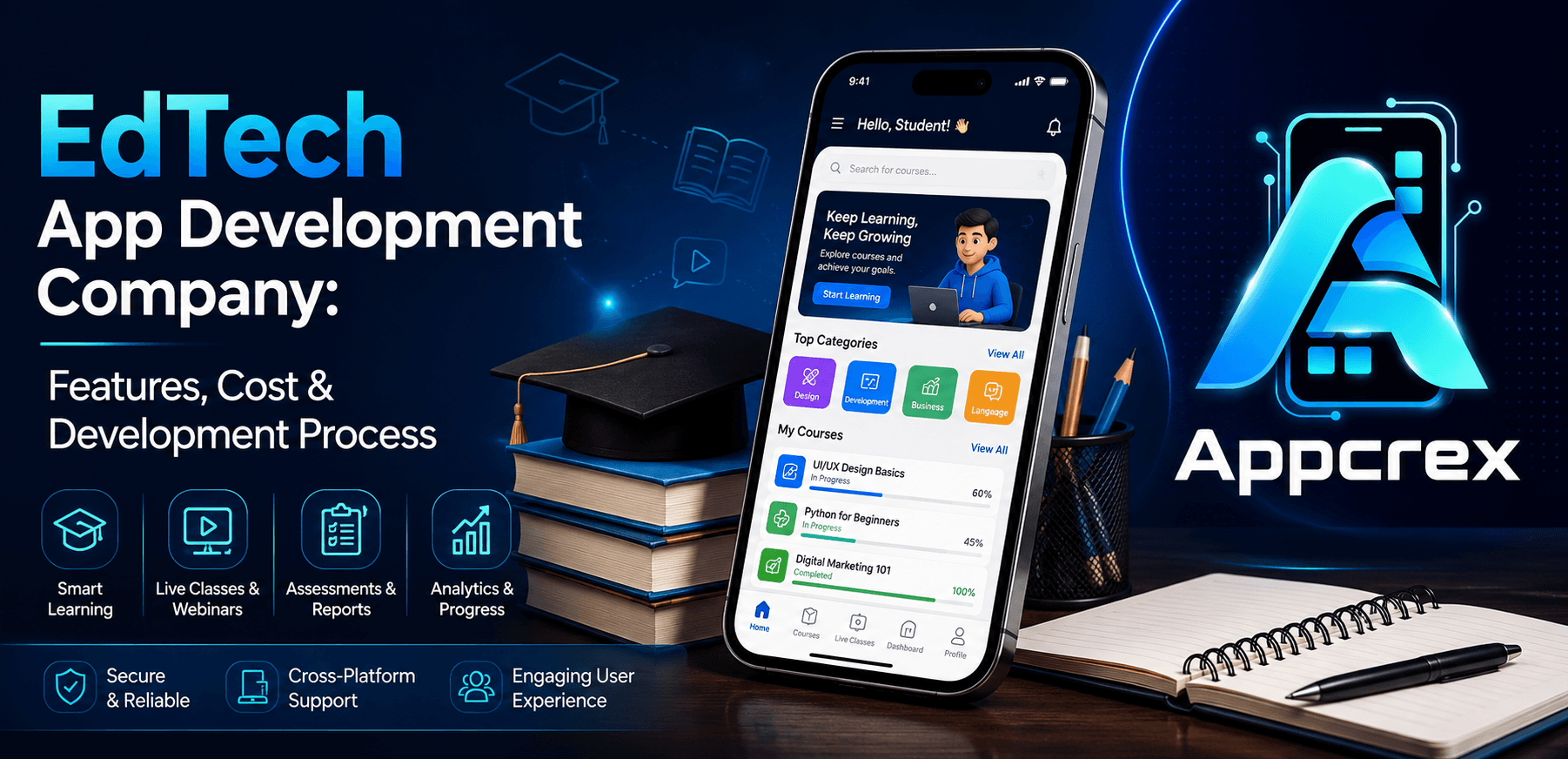
📌 Key Takeaways
- EdTech app development can support online courses, tutoring, schools, exams, and professional learning.
- eLearning app development requires reliable content, video, payments, assessments, and user management.
- AI can add personalization, tutoring, recommendations, and intelligent learning support.
- Development cost depends on features, platforms, integrations, AI, video, and scalability.
- A focused MVP can help validate an education product before adding advanced functionality.
Introduction
Education has moved far beyond traditional classrooms. Students now learn through mobile apps, online courses, live classes, digital assessments, interactive content, and AI-powered learning tools. For schools, universities, coaching institutes, tutors, education startups, and corporate training businesses, this shift has created new opportunities to deliver learning through digital platforms.
An EdTech app development company can help turn an education business idea into a mobile or web-based learning platform that connects students, teachers, administrators, and educational content.
A modern EdTech application may include video courses, live classes, quizzes, assignments, subscriptions, online payments, progress tracking, certificates, teacher dashboards, analytics, and AI-powered learning assistance. The required features depend on the target audience and business model.
If you are planning eLearning app development or an education app development project, the first step is understanding what type of platform you want to build, who will use it, what problem it will solve, and how it will generate revenue.
This guide covers the major aspects of EdTech app development, including features, types of education apps, AI capabilities, technology stack, development process, estimated cost, timeline, monetization, and considerations for businesses targeting the USA, UK, Canada, UAE, Dubai, or India.
What Is EdTech App Development?
EdTech app development is the process of designing and developing software applications that use technology to support education, learning, training, teaching, assessment, and academic management.
An EdTech application can be as simple as a mobile app for recorded courses or as complex as a complete learning ecosystem connecting students, teachers, institutions, content providers, and administrators.
Depending on the business model, an EdTech platform can provide:
- Online courses
- Live classes
- Video lessons
- Online tutoring
- Digital textbooks
- Quizzes and examinations
- Assignments
- Learning management
- Student progress tracking
- Certificates
- AI tutoring
- Personalized learning
- Educational games
- Teacher management
- Parent dashboards
- Institutional analytics
The development approach should therefore start with the educational use case rather than with a list of technologies.
EdTech App vs eLearning App vs Education App
These terms are often used interchangeably, but they can represent slightly different product scopes.
EdTech app is the broader category. It can include learning, teaching, assessment, school management, educational marketplaces, tutoring, AI learning, and other technology-driven education services.
eLearning app generally focuses on digital learning experiences such as online courses, video lessons, live classes, assessments, and learner progress.
Education app is a broader consumer-facing term that can describe applications for schools, universities, students, parents, teachers, exams, tutoring, or academic management.
For example, a business developing an online course platform may primarily use the term eLearning app development, while a company building an AI-powered personalized learning platform may position itself as an EdTech product.
Why Build an EdTech App?
The value of an education application depends on the problem it solves.
For an education business, a mobile application can create a direct digital relationship with learners instead of relying entirely on physical classrooms or third-party platforms.
Reach More Learners
Digital learning platforms can serve students beyond a single physical location.
An education company can potentially expand from one city to multiple regions or countries without opening a physical classroom in every location.
Flexible Learning
Students can access lessons, assessments, and learning resources through smartphones, tablets, or computers depending on the platform.
Personalized Learning
Applications can use learner activity and performance data to recommend relevant content or practice.
Interactive Education
Quizzes, gamification, live classes, discussions, and progress tracking can make digital learning more engaging.
Multiple Revenue Streams
An EdTech platform can generate revenue through subscriptions, course purchases, tutoring, institutional packages, certification, and other models.
Education Analytics
Administrators and instructors can use data to understand course completion, student engagement, assessment performance, and learning patterns.
Types of EdTech Apps You Can Build
The first major decision in an education app development project is choosing the product category.
1. Online Learning App
An online learning application allows users to access courses and educational content through digital devices.
Typical features include:
- Course catalog
- Video lessons
- Documents
- Quizzes
- Assignments
- Progress tracking
- Certificates
- Payments
2. Online Tutoring App
A tutoring application connects learners with instructors for one-to-one or group learning.
It can include:
- Tutor profiles
- Search and filters
- Availability
- Scheduling
- Video calls
- Chat
- Payments
- Ratings
- Reviews
3. Exam Preparation App
Exam preparation platforms can provide:
- Practice questions
- Mock tests
- Question banks
- Timed examinations
- Performance reports
- Explanations
- Study plans
4. Language Learning App
Language learning applications can combine:
- Vocabulary
- Grammar
- Listening
- Speaking
- Pronunciation
- Interactive exercises
- AI conversation
- Progress tracking
5. School Management App
A school-focused application can connect students, teachers, parents, and administrators.
Features may include:
- Attendance
- Timetables
- Assignments
- Results
- School announcements
- Fees
- Parent communication
6. Corporate Learning App
Businesses can use learning applications for employee training, onboarding, professional development, compliance training, and internal knowledge sharing.
7. Kids Learning App
Children’s learning platforms can use interactive stories, games, animation, audio, quizzes, and age-appropriate educational activities.
Essential Features of an EdTech App
The feature set should be based on the target users. A student needs a different interface from a teacher or administrator.
Student Registration and Profile
Users should be able to create accounts through:
- Mobile number
- OTP
- Social login where appropriate
The profile can contain enrolled courses, learning history, certificates, saved content, progress, and preferences.
Course Discovery
A well-organized course catalog helps users quickly find relevant content.
Courses can be categorized by:
- Subject
- Skill
- Level
- Instructor
- Language
- Duration
- Price
- Rating
Search and filters become increasingly important as the content library grows.
Video Learning
Video is a core component of many eLearning applications.
The platform can support:
- Recorded lectures
- HD streaming
- Captions
- Playback speed
- Resume watching
- Video progress
- Content protection
- Offline access where appropriate
The video architecture should be designed to handle the expected number of concurrent viewers.
Live Classes
Live learning can bring teacher-student interaction into the application.
Depending on the product, live classes can include:
- Video conferencing
- Audio
- Chat
- Screen sharing
- Attendance
- Question and answer
- Class scheduling
- Session recordings
Quizzes and Assessments
Assessment features can support:
- Multiple-choice questions
- True/false questions
- Subjective answers
- Timed tests
- Randomized questions
- Instant scoring
- Explanations
- Performance analysis
Assignments
Teachers can create assignments while students can submit their work through the platform.
The system can track submissions, deadlines, grades, and teacher feedback.
Progress Tracking
Students should be able to see how they are progressing through a course or learning program.
A progress dashboard can display:
- Lessons completed
- Course percentage
- Test scores
- Learning streaks
- Assignment status
- Certificates
Notifications
Push notifications can remind users about:
- Upcoming classes
- New courses
- Assignment deadlines
- Test schedules
- Subscription renewals
- Course updates
Notifications should be relevant and controlled to avoid overwhelming users.
Online Payments
If the platform sells courses or subscriptions, secure payment integration is required.
Depending on the target market, businesses can integrate appropriate payment gateways and payment methods.
Certificates
A platform can automatically generate certificates when learners complete defined courses or assessments.
Administrators should be able to configure certificate templates and eligibility conditions.
Ratings and Reviews
Course and instructor reviews can help learners evaluate educational content and provide feedback to providers.
Features for Teachers and Instructors
Teachers require their own dashboard to manage educational content and interact with students.
Important instructor features can include:
- Course creation
- Lesson management
- Video uploads
- Quiz creation
- Assignment management
- Student management
- Live class scheduling
- Attendance
- Student feedback
- Performance reports
- Messaging
- Earnings dashboard
For a course marketplace, instructors can also receive sales and payout information.
Admin Dashboard for EdTech Platforms
The admin panel acts as the control center for the platform.
Administrators can manage users, educational content, payments, instructors, subscriptions, reports, and system settings.
User Management
The dashboard can manage:
- Students
- Teachers
- Parents
- Institutions
- Administrators
Course Management
Admins can:
- Approve courses
- Organize categories
- Set pricing
- Manage instructors
- Review educational content
- Publish or unpublish courses
Payment Management
The dashboard can provide information about:
- Transactions
- Course purchases
- Subscriptions
- Refunds
- Instructor payouts
- Revenue
Analytics
Useful metrics can include:
- Active learners
- Course enrollments
- Completion rate
- Student engagement
- Revenue
- Popular courses
- Assessment performance
AI in EdTech App Development
AI is becoming an important part of modern AI app development for education.
Instead of adding AI simply because it is a popular technology, businesses should identify where it can solve a real learning or operational problem.
AI-Powered Learning Recommendations
AI can analyze learning activity and recommend:
- Courses
- Lessons
- Practice exercises
- Revision material
- Related subjects
AI Tutor
An AI tutor can provide conversational learning support.
It can potentially:
- Explain concepts
- Answer questions
- Provide examples
- Generate practice exercises
- Help with revision
- Guide learners through educational content
For specialized or high-stakes subjects, human review and appropriate safeguards should remain part of the product strategy.
Personalized Learning Paths
Different learners may progress at different speeds.
AI can use performance and learning activity to help create personalized learning paths.
For example, a student struggling with a particular topic could receive additional practice before moving to more advanced content.
AI Question Generation
AI can assist educators by generating practice questions based on selected subjects, topics, difficulty levels, and learning objectives.
Teachers can review and modify generated questions before publishing them.
AI Language Learning
Speech recognition and conversational AI can support language learning through:
- Pronunciation practice
- Speaking exercises
- Vocabulary conversations
- Grammar assistance
- Interactive dialogue
AI Customer Support
An AI chatbot can handle common questions about:
- Course access
- Enrollment
- Payments
- Class schedules
- Account problems
- Certificates
More complex issues can be transferred to human support.
Technology Stack for Education App Development
The technology stack depends on the application’s scale, user count, content type, integrations, and performance requirements.
| Technology Area | Common Options |
|---|---|
| iOS | Swift |
| Android | Kotlin |
| Cross-Platform | Flutter, React Native |
| Backend | Node.js, Python, Java |
| Database | PostgreSQL, MySQL |
| Cloud | AWS, Azure, Google Cloud |
| Admin Panel | React, Next.js |
| Real-Time Features | WebSockets |
| Video | WebRTC and cloud video infrastructure |
| AI/ML | Python, TensorFlow, PyTorch |
| Notifications | Firebase |
| API | REST, GraphQL |
| Analytics | Firebase, custom analytics |
For an MVP, a cross-platform approach can be considered when the product needs to launch on both Android and iOS while maintaining a controlled development scope.
For larger platforms, architecture should be planned around scalability, security, concurrent users, content delivery, integrations, and long-term maintenance.
How to Build an EdTech App?
A successful eLearning app development project starts with product planning rather than coding.
Step 1: Define the Target Audience
Identify who will use the application.
For example:
- School students
- College students
- Working professionals
- Teachers
- Parents
- Corporate employees
- Exam candidates
The audience determines the product’s features, content, pricing, and user experience.
Step 2: Define the Business Model
Decide whether users will:
- Buy individual courses
- Pay subscriptions
- Book tutors
- Purchase certifications
- Access free content
- Use an institutional package
Step 3: Create the MVP
Start with the features necessary to deliver the core learning experience.
A basic MVP could include:
- Registration
- Course catalog
- Video lessons
- Quizzes
- Progress tracking
- Payments
- Push Notifications
- Admin dashboard
Advanced AI, gamification, social learning, and complex analytics can be introduced after validating the initial product.
Step 4: Design UI/UX
Create separate experiences for students, teachers, and administrators.
The student journey should make it easy to:
Discover → Enroll → Learn → Practice → Track Progress → Complete
Step 5: Develop Backend and APIs
The backend handles:
- Authentication
- User management
- Course data
- Payments
- Progress
- Assessments
- Notifications
- Analytics
Step 6: Develop Mobile Applications
The team can build native Android and iOS applications or use cross-platform technology depending on project requirements.
Step 7: Integrate Third-Party Services
Common integrations include:
- Payment gateways
- Video platforms
- Cloud storage
- Authentication services
- Analytics
- Notifications
- AI APIs
Step 8: Test the Platform
Testing should cover:
- Functional performance
- Mobile compatibility
- Video playback
- Payments
- Security
- API performance
- User experience
- Different network conditions
Step 9: Launch and Improve
After launch, analytics and user feedback can guide future releases.
This makes it possible to improve the product based on actual learner behavior rather than assumptions.
How Much Does It Cost to Build an EdTech App?
The EdTech app development cost depends on the number of features, platforms, integrations, design complexity, AI requirements, development team, and infrastructure.
A broad planning estimate is:
| Development Level | Estimated Cost |
|---|---|
| Basic EdTech MVP | $25,000–$45,000 |
| Medium-Complexity Platform | $45,000–$80,000 |
| Advanced EdTech Platform | $80,000–$150,000+ |
| Enterprise Education Ecosystem | $150,000+ |
These are indicative software development estimates rather than fixed prices.
A basic application containing recorded courses, user accounts, quizzes, and payments will have a significantly different cost from a platform supporting live classes, instructor marketplaces, AI tutors, advanced analytics, multiple languages, and enterprise integrations.
What Affects EdTech App Development Cost?
Number of Platforms
Developing separate native Android and iOS applications can affect the budget compared with a cross-platform approach.
UI/UX Complexity
Highly interactive learning interfaces require more design and development effort.
Video Infrastructure
Large-scale video streaming requires storage, encoding, content delivery, and infrastructure planning.
Live Classes
Real-time video classes require additional technical architecture and infrastructure.
AI Features
AI tutors, recommendations, speech recognition, personalized learning, and intelligent analytics can increase development complexity.
Admin Features
Advanced dashboards and institutional management systems add backend and frontend development requirements.
Integrations
Payment gateways, LMS systems, CRM platforms, video services, analytics, and other third-party systems can increase development time.
How Long Does It Take to Develop an EdTech App?
A basic EdTech MVP can take approximately 3–5 months.
A more advanced platform containing live classes, multiple user roles, AI, advanced analytics, subscriptions, complex assessments, and third-party integrations can take 5–9 months or longer.
A typical project may include:
| Development Stage | Approximate Duration |
|---|---|
| Research & Planning | 2–3 weeks |
| UI/UX Design | 3–5 weeks |
| Backend Development | 8–14 weeks |
| Mobile Development | 8–14 weeks |
| Admin Dashboard | 4–7 weeks |
| Integrations | 3–6 weeks |
| Testing | 3–5 weeks |
| Deployment | 1–2 weeks |
These activities can overlap, so the overall project duration depends on team size and scope.
EdTech App Monetization Models
The business model should be established before development because it directly influences the product architecture.
Subscription
Users pay monthly or annually for access to premium content.
Individual Course Sales
Students purchase individual courses.
Freemium
Basic educational content is available for free while advanced courses or features require payment.
Tutoring Commission
A tutoring marketplace can earn a commission from teacher-student transactions.
Institutional Licensing
Schools, universities, and companies can purchase access for groups of users.
Certification
Businesses can charge for examinations or certification programs where appropriate.
Premium Features
Additional features such as advanced analytics, personalized learning, AI assistance, or premium learning resources can be offered as paid capabilities.
EdTech App Development for USA, UK, Canada, UAE and India
A global EdTech application should be localized according to its target audience.
The same core technology can serve different countries, but payment systems, language, accessibility, privacy expectations, content, pricing, and business workflows may differ.
EdTech App Development in USA
US-focused platforms can target:
- Online courses
- Professional training
- Tutoring
- Test preparation
- Corporate learning
- AI-powered education
Businesses should consider relevant privacy, accessibility, payment, content licensing, and institutional requirements for their specific product.
EdTech App Development in UK
A UK-focused education application can support:
- Academic education
- Online tutoring
- Professional development
- Language learning
- Exam preparation
- Corporate training
The product should be designed around the requirements of its specific users and educational use case.
EdTech App Development in Canada
Canadian education applications can target:
- Online courses
- Tutoring
- Professional learning
- Language education
- Academic preparation
- Corporate training
Depending on the audience, multilingual experiences and accessibility may be relevant product considerations.
EdTech App Development in UAE and Dubai
The UAE has an international user base, making mobile-first experiences and multilingual support valuable considerations for many education businesses.
Potential EdTech opportunities include:
- Professional training
- Language learning
- Corporate education
- School learning
- Online tutoring
- Skill development
For Dubai-focused products, businesses should also research applicable local requirements, payment infrastructure, and institutional partnerships before launch.
EdTech App Development in India
India’s diverse education market creates opportunities across:
- Competitive examinations
- School education
- Coding
- Language learning
- Vocational education
- Professional training
- Online tutoring
Businesses targeting India may need to consider different languages, device capabilities, pricing models, network conditions, and payment preferences.
Advanced Features for Future Expansion
Once the MVP has been validated, an EdTech application can be expanded with more sophisticated features.
Gamification
Gamification can include:
- Points
- Badges
- Streaks
- Leaderboards
- Rewards
- Achievement levels
Social Learning
Students can learn through:
- Discussion forums
- Communities
- Peer groups
- Q&A
- Group activities
Adaptive Learning
The platform can adjust learning material according to a student’s performance and progress.
Offline Learning
Selected educational content can be made available offline when content rights and technical requirements allow it.
Parent Dashboard
For children’s learning platforms, parents can monitor:
- Attendance
- Progress
- Assignments
- Results
- Learning activity
Security Considerations for an EdTech Application
Education platforms can process account information, payment information, learning history, academic results, communications, and other sensitive business or user data.
Security should therefore be considered from the beginning.
Important areas include:
- Secure authentication
- Role-based access control
- Data encryption
- Secure APIs
- Payment security
- Session management
- Regular security testing
- Secure cloud infrastructure
- Backup and recovery
- Monitoring and logging
The exact privacy and compliance requirements depend on the countries served, age groups, data collected, institutional relationships, and business model.
Challenges in EdTech App Development
Building an education platform involves several challenges beyond software development.
Keeping Students Engaged
Users may stop using an application if content is difficult to discover or the learning experience becomes repetitive.
Managing Large Content Libraries
As the number of courses and videos increases, content organization and search become more important.
Video Scalability
A large number of simultaneous learners can place significant demands on video infrastructure.
Maintaining Content Quality
Educational technology should support good teaching rather than replace educational expertise.
Supporting Multiple Devices
Users may access the platform from different smartphones, tablets, browsers, and network conditions.
Balancing AI and Human Teaching
AI can support personalization and automation, but businesses need to define where automated systems are appropriate and where educators should remain involved.
How to Choose an EdTech App Development Company?
Choosing the right development partner can have a major impact on the technical quality and scalability of an education platform.
Before selecting an app development company, evaluate its experience with:
- Mobile application development
- eLearning platforms
- Education software
- Video streaming
- Cloud infrastructure
- Payment integration
- AI development
- Backend systems
- Analytics
- Data security
You should also ask about:
- Development methodology
- Technology stack
- Project communication
- Testing process
- Post-launch support
- Maintenance
- Scalability planning
Instead of comparing companies only on price, compare the proposed architecture, scope, development approach, support, and long-term product requirements.
FAQs
Q. How much does it cost to build an EdTech app?
An EdTech app can cost approximately $25,000 to $150,000+, depending on its features, platforms, video infrastructure, AI capabilities, integrations, design, and complexity.
Q. How long does it take to build an EdTech app?
A basic MVP can take around 3–5 months, while a feature-rich EdTech platform may require 5–9 months or longer.
Q. What is included in eLearning app development?
eLearning app development can include course management, video learning, live classes, quizzes, assignments, progress tracking, certificates, payments, notifications, analytics, and user management.
Q. What is the difference between an EdTech app and an education app?
EdTech is a broad category covering technology-enabled education and training. An education app can be a specific type of EdTech product designed for students, teachers, schools, universities, tutoring, or academic services.
Q. Can I add AI to an education app?
Yes. AI can support tutoring, personalized recommendations, adaptive learning, question generation, language learning, student support, and learning analytics.
Q. Can an EdTech app support live classes?
Yes. Live video classes can be integrated using appropriate real-time communication and video infrastructure.
Q. Can I build an EdTech app for multiple countries?
Yes. A scalable architecture can support multiple markets, but localization may be required for language, payment methods, pricing, accessibility, privacy, content, and local business requirements.
Q. Which technology is best for EdTech app development?
There is no single technology that is best for every EdTech application. Flutter or React Native can be suitable for some cross-platform projects, while Swift and Kotlin may be selected for native iOS and Android applications. Backend, cloud, video, and AI technologies should be selected according to the product’s requirements.
Q. Can an EdTech app generate recurring revenue?
Yes. Subscription plans, institutional licensing, premium content, tutoring services, certification, and other recurring offerings can create ongoing revenue streams.
Q. Should I start with an MVP?
For many startups and new education businesses, starting with an MVP can reduce initial development scope and allow the product team to validate the learning experience before investing in advanced features.
Conclusion
The demand for digital learning continues to create opportunities for education businesses, startups, institutions, and training providers.
A successful EdTech platform is not simply a collection of videos inside a mobile application. It combines an intuitive learning experience with reliable content delivery, assessments, communication, payments, analytics, administration, and—where appropriate—AI-powered personalization.
Whether your target market is the USA, UK, Canada, UAE, Dubai, India, or a global audience, the product should be designed around the needs of its learners and educators.
The best starting point is usually a clearly defined business model, a focused MVP, and a scalable technical foundation. Once the platform gains users and generates learning data, advanced capabilities such as adaptive learning, AI tutoring, gamification, intelligent analytics, and personalized recommendations can be introduced.
For businesses planning education app development, working with an experienced development partner can simplify everything from product planning and UI/UX to mobile development, backend architecture, AI integration, testing, deployment, and long-term maintenance.
Build Your EdTech App with AppCrex
AppCrex provides EdTech app development, eLearning app development, and education app development services for startups, education companies, institutions, tutors, and businesses.
Our team can help you build student and teacher applications, admin dashboards, online course platforms, live learning systems, payment integrations, AI-powered learning features, analytics, and scalable backend infrastructure.
Whether you are planning an eLearning platform, online tutoring app, exam preparation application, school learning solution, or AI-powered education product, you can hire mobile app developers to transform your concept into a scalable digital learning platform.