
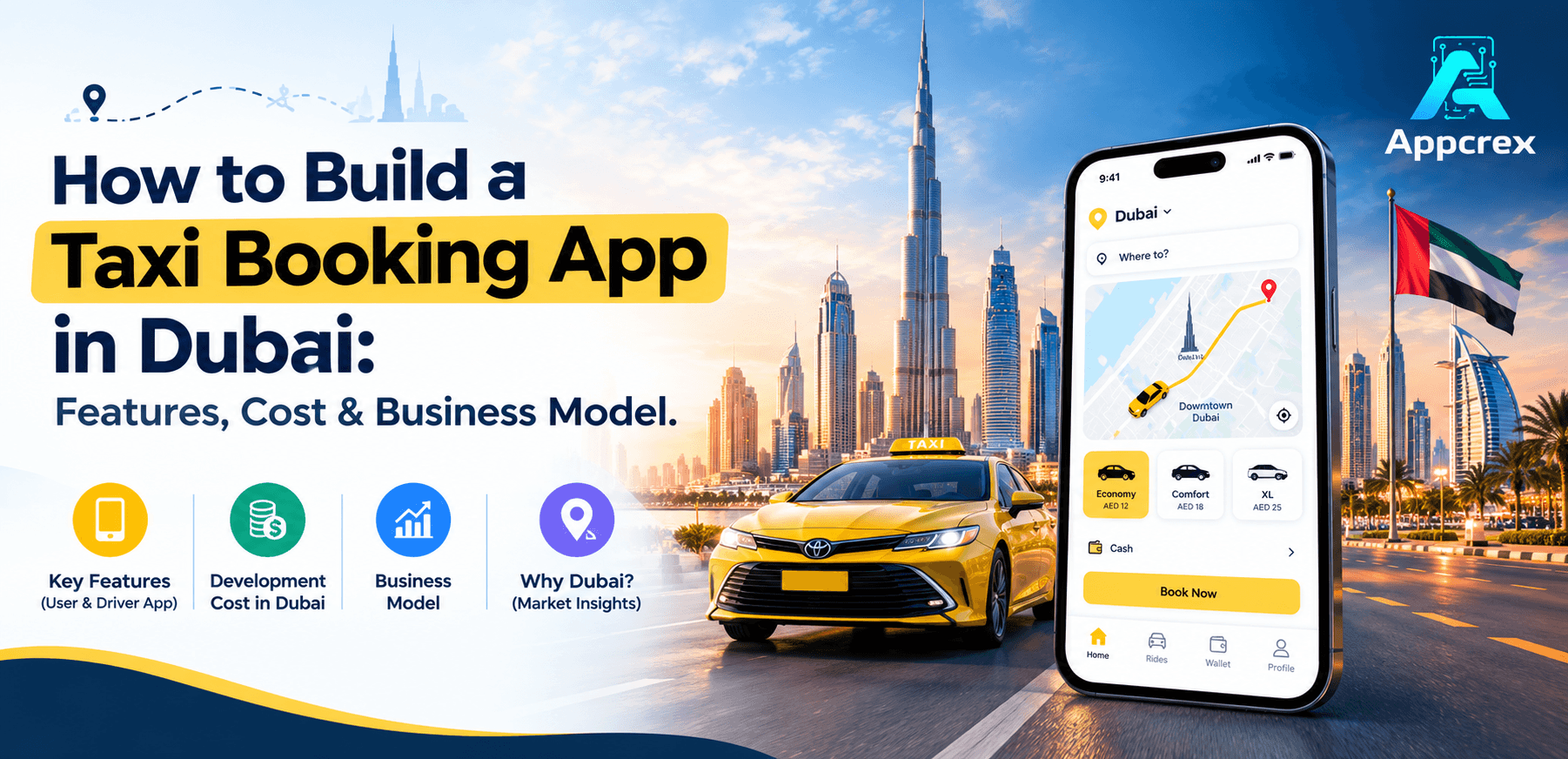
📌 Key Takeaways
- A taxi platform usually needs passenger, driver, and admin applications.
- GPS, dispatch, payments, notifications, and fare management form the core system.
- Arabic-English support can improve the experience for Dubai’s diverse user base.
- AI can improve driver matching, demand prediction, and fleet operations.
- A focused MVP can launch first, while advanced features can follow later.
Introduction
Dubai has one of the most connected urban transportation systems in the region. People can book taxis through mobile apps, track drivers, choose vehicle types, and make digital payments.
This shift has also created opportunities for businesses that want to build their own Dubai taxi app.
However, a modern taxi application needs more than a booking screen. It needs passenger and driver apps, real-time GPS, automated dispatch, payment integration, notifications, fleet management, analytics, and a reliable backend.
Dubai’s Roads and Transport Authority (RTA) currently supports taxi bookings through S’hail and partner apps. Its current taxi service information lists S’hail, Careem-Hala, Bolt, Zed, and Yango among the available digital channels.
So, if you plan to build a Dubai taxi application, this guide explains the main features, development process, technology, business models, and estimated cost.
Just Read : Top 10 Taxi Apps in Dubai for Tourists & Residents (2026 Guide)
What Is a Dubai Taxi App?
A Dubai taxi app connects passengers with available drivers through a digital booking platform.
A passenger enters a pickup location and destination. The system then finds suitable vehicles and sends the booking request to a driver.
After the driver accepts, the passenger can track the vehicle. Once the trip ends, the app calculates the final fare and processes the selected payment method.
A complete platform can include:
- Passenger mobile app
- Driver mobile app
- Admin dashboard
- Dispatcher panel
- GPS and maps
- Fare calculation
- Driver matching
- Payment gateway
- Push notifications
- Trip history
- Ratings and reviews
- Fleet management
- Analytics
- Customer support
Therefore, businesses should plan a taxi app as a complete mobility platform, not just a mobile application.
Dubai Taxi Apps: What Users Can Find Today
Before developing a new platform, it helps to understand the existing Dubai taxi apps ecosystem.
RTA currently lists S’hail as a taxi-booking channel. It also lists partner applications such as Careem-Hala, Bolt, Zed, and Yango for taxi bookings.
S’hail goes beyond taxi booking. RTA describes it as an integrated mobility app that supports taxi and luxury vehicle booking, ride-hailing, public transport information, journey planning, and other mobility services.
Dubai Taxi App Name: What Should You Search For?
People searching for a Dubai taxi app name may come across several options.
Some currently listed RTA taxi-booking channels include:
- S’hail
- Careem-Hala
- Bolt
- Zed
- Yango
The available service can vary by vehicle type and booking channel. RTA’s current service page should therefore be checked before making any service-specific claim.
This also shows an important point for businesses. A new taxi platform does not necessarily need to copy every feature offered by large mobility apps.
Instead, it can focus on a specific market segment.
For example:
- Airport transfers
- Corporate transportation
- Hotel transportation
- Premium rides
- Family transportation
- Fleet management
- Employee transportation
- Scheduled rides
- Tourism transportation
- Electric vehicle fleets
What Makes a Good Dubai Taxi App?
Users usually want a simple booking experience.
They want to enter their destination, see the estimated fare, find a driver, and track the ride without unnecessary steps.
A good Dubai taxi app should therefore focus on:
- Fast booking
- Accurate pickup locations
- Clear fare information
- Real-time tracking
- Reliable driver matching
- Multiple payment options
- Easy cancellation
- Trip history
- Customer support
- Safety features
At the same time, the business side needs strong tools for dispatch, driver management, pricing, payments, and reporting.
Essential Features of a Dubai Taxi Application
1. User Registration
Passengers should be able to create an account using:
- Mobile number
- OTP
- Social login
The profile can store saved addresses, payment preferences, trip history, and other basic information.
2. GPS Location Detection
The app should detect the user’s current location automatically.
Users should also be able to move the pickup point manually. This option helps when GPS accuracy is not perfect.
3. Destination Search
A map and location search system allows users to enter their destination quickly.
The app can then calculate:
- Distance
- Estimated travel time
- Suggested route
- Estimated fare
4. Fare Estimation
Fare estimation gives passengers an idea of the expected trip cost before booking.
The fare engine can consider:
- Distance
- Time
- Vehicle type
- Waiting time
- Service category
- Applicable fees
- Pricing rules
RTA currently lists a minimum fare of AED 12 for road pickup and AED 13 for e-hail. It also notes that fares can vary during peak periods and events.
For a commercial taxi platform, pricing rules should remain configurable. That way, the operator can update them without rebuilding the entire application.
5. Real-Time Driver Tracking
After booking, users should see the driver’s location on the map.
The screen can display:
- Driver location
- Estimated arrival time
- Driver name
- Vehicle information
- License or vehicle details
- Trip status
Real-time tracking can also reduce uncertainty during pickup.
6. Multiple Vehicle Categories
A taxi platform can support different vehicle categories.
For example:
- Standard taxi
- Family taxi
- Premium vehicle
- Airport transfer
- Accessible vehicle
- Electric vehicle
- Luxury vehicle
RTA currently provides several taxi categories, including regular, family, female, People of Determination, airport, and Safe Hands services.
7. Digital Payments
Payment is another important part of the application.
Depending on the business model and approved payment infrastructure, the platform can support:
- Credit cards
- Debit cards
- Digital wallets
- In-app wallet
- Cash
- Corporate billing
RTA currently lists payment methods such as cash, credit cards, nol card, Careem Pay, Apple Pay, Samsung Pay, Alipay, QR payments, and American Express for its taxi service.
8. Ride Scheduling
Users may want to book a ride in advance.
This feature works well for:
- Airport trips
- Business meetings
- Hotel transfers
- Employee transportation
- Early-morning travel
- Events
9. Ratings and Reviews
After every trip, passengers can rate their experience.
The admin can use this data to monitor:
- Driver performance
- Customer satisfaction
- Complaints
- Repeated service issues
10. Push Notifications
The app can send notifications for:
- Booking confirmation
- Driver assignment
- Driver arrival
- Trip start
- Trip completion
- Payment
- Scheduled ride reminders
- Promotional offers
Advanced Features for a Dubai Taxi App
Once the basic platform works well, businesses can add more advanced capabilities.
AI-Based Driver Matching
AI can analyze:
- Driver location
- Demand
- Traffic
- Historical trips
- Vehicle type
- Driver availability
The system can then recommend a suitable driver.
This approach can help reduce passenger waiting time and unnecessary driver movement.
Demand Prediction
The system can study historical booking patterns.
For example, it may identify higher demand around airports, business districts, hotels, events, or specific time periods.
Operators can then position drivers before demand increases.
Smart Route Optimization
The platform can use mapping and traffic data to recommend suitable routes.
As a result, drivers can reduce unnecessary travel time and improve trip efficiency.
Corporate Accounts
Corporate transportation can create another business channel.
A corporate module can include:
- Employee profiles
- Monthly billing
- Ride limits
- Department budgets
- Invoices
- Travel reports
- Admin controls
Fleet Management
Fleet operators can manage vehicles and drivers from one dashboard.
The system can track:
- Vehicle status
- Driver assignment
- Maintenance
- Insurance records
- Mileage
- Fuel usage
- Service history
- Vehicle utilization
Geofencing
Geofencing lets operators create virtual service zones.
Businesses can use it for:
- Airport zones
- Pickup areas
- Service boundaries
- Restricted zones
- Fleet allocation
- Pricing zones
Multi-Stop Booking
Some passengers need more than one destination.
A multi-stop feature lets users add multiple locations during one booking.
RTA’s current taxi service information confirms that multiple pickups and drop-offs are supported in its taxi service.
Driver Earnings Dashboard
Drivers should have a clear view of their earnings.
The dashboard can show:
- Completed trips
- Daily earnings
- Weekly earnings
- Bonuses
- Incentives
- Cash collections
- Digital payments
Arabic and English Support
Dubai has a highly diverse customer base.
Therefore, a Dubai-focused application can benefit from bilingual support.
The design should consider:
- English interface
- Arabic interface
- RTL layouts
- Arabic address search
- Bilingual notifications
- Localized help content
It is better to plan RTL support during UI/UX design. Adding it later can require changes across many screens.
Also Read : Arabic & English Mobile App Development in Kuwait: Features, RTL UX & Localization Guide
How to Build a Taxi Booking App in Dubai?
The development process normally follows several stages.
Step 1: Define the Business Model
First, decide what type of taxi platform you want to build.
Will you operate your own fleet?
Will you connect independent drivers?
Will you provide software to taxi operators?
Will you focus on corporate transportation?
These decisions will affect the features and technology.
Step 2: Research the Target Market
Study existing Dubai taxi apps and identify gaps.
Look at:
- Booking experience
- Vehicle categories
- Pricing
- Driver experience
- Corporate services
- Airport transfers
- Customer support
The goal is not to copy another app. Instead, identify a specific problem that your product can solve.
Step 3: Plan the MVP
Start with the most important features.
A taxi MVP can include:
- Registration
- Location detection
- Destination search
- Booking
- Driver matching
- GPS tracking
- Fare calculation
- Payments
- Notifications
- Ratings
- Driver app
- Admin dashboard
Later, you can add AI, loyalty, subscriptions, advanced analytics, and corporate tools.
Step 4: Design the UI/UX
Create separate experiences for passengers, drivers, and administrators.
The passenger journey should remain simple.
For example:
Open App → Enter Destination → Select Ride → Confirm → Track Driver → Pay → Rate
Step 5: Develop the Backend
The backend manages the core platform.
It handles:
- Users
- Drivers
- Vehicles
- Trips
- Payments
- Pricing
- Dispatch
- Notifications
- Reports
A scalable backend becomes important as the number of rides increases.
Step 6: Build Passenger and Driver Apps
The passenger app focuses on booking and trip management.
The driver app focuses on availability, ride requests, navigation, trip status, and earnings.
Both apps connect to the same backend.
Step 7: Add Third-Party Integrations
A taxi platform may need:
- Maps
- Payment gateways
- OTP
- Push notifications
- Analytics
- CRM
- Accounting
- Customer support tools
Step 8: Test the Platform
Testing should cover:
- GPS
- Booking
- Driver matching
- Payments
- Notifications
- Cancellation
- Network failures
- Security
- Performance
- Arabic RTL layouts
Real-world testing also matters because drivers use the app while moving across different parts of the city.
Technology Stack for a Dubai Taxi App
| Component | Recommended Options |
|---|---|
| Mobile Apps | Flutter, React Native, Swift, Kotlin |
| Backend | Node.js, Python, Java, .NET |
| Database | PostgreSQL, MySQL, MongoDB |
| Cloud | AWS, Azure, Google Cloud |
| Maps | Google Maps Platform or another suitable mapping provider |
| Real-Time Data | WebSockets, Firebase |
| Notifications | Firebase Cloud Messaging, APNs |
| Authentication | OTP, OAuth, JWT |
| Admin Panel | React, Angular, Vue |
| Analytics | Custom analytics dashboard, cloud analytics |
For an MVP, Flutter or React Native can reduce duplicate development work when a shared codebase fits the requirements.
How Much Does It Cost to Build a Taxi App in Dubai?
The cost depends on the scope.
A small MVP costs much less than a full ride-hailing platform with AI, fleet management, corporate accounts, advanced analytics, and multiple integrations.
A recent UAE market estimate published in September 2026 places taxi booking app development around AED 20,000–120,000, depending on scope and complexity.
For a custom AppCrex-style development plan, a broader planning range can look like this:
| Development Level | Estimated Cost | Approx. Timeline |
|---|---|---|
| Basic MVP | $25,000–$45,000 | 3–4 months |
| Standard Platform | $45,000–$80,000 | 4–6 months |
| Advanced Platform | $80,000–$150,000+ | 6–9 months |
| Enterprise Mobility Platform | $150,000–$300,000+ | 9–15+ months |
These figures are planning estimates, not fixed Dubai prices.
The final quote depends on:
- Number of apps
- Feature complexity
- UI/UX requirements
- Third-party APIs
- Payment integrations
- Backend architecture
- AI requirements
- Fleet size
- Compliance requirements
- iOS and Android support
- Post-launch maintenance
Dubai Taxi App Cheapest Option: What Does It Mean?
People searching for “Dubai taxi app cheapest” may mean two different things.
They may want:
- The lowest-cost taxi booking service for passengers.
- The lowest-cost way to develop a taxi application.
These are different questions.
For passengers, the final fare depends on the service, vehicle, booking channel, trip, and applicable charges. RTA publishes current taxi fare rules and notes that some charges can vary based on timing and circumstances.
For businesses, the cheapest development route usually means reducing the initial feature scope.
A focused MVP can cost less than a large custom platform.
However, cutting essential components such as security, payment handling, backend scalability, or testing can create larger costs later.
Therefore, the goal should be cost-efficient development, not simply the lowest initial quotation.
What Is the Best Dubai Taxi App?
The search phrase “best Dubai taxi app” is common, but “best” depends on what the user needs.
A tourist may care about airport booking.
A resident may care about daily pricing and availability.
A business traveler may want corporate billing.
A fleet operator may care more about dispatch and vehicle management.
For this reason, businesses should not build a taxi platform around a generic idea of the “best” app.
Instead, define the target customer first.
Then build features around that customer’s needs.
Dubai Taxi App Name: How Should You Choose One?
If you plan to launch your own taxi platform, the app name should be:
- Short
- Easy to pronounce
- Easy to remember
- Suitable for Arabic and English
- Available as a domain
- Available as a trademark where applicable
- Suitable for app-store branding
Avoid names that are too close to existing taxi or ride-hailing brands.
A unique brand makes future expansion easier.
Taxi App Business Models
A taxi application can generate revenue in several ways.
Commission Per Ride
The platform can charge a percentage of completed rides.
Booking Fee
A service fee can be applied to eligible bookings.
Corporate Subscription
Companies can pay recurring fees for employee transportation tools.
Premium Services
Businesses can offer higher-value options such as luxury vehicles and airport transfers.
RTA’s current luxury vehicle service notes that luxury transport/e-hail charges are at least 30% higher than regular taxi fares, showing how vehicle categories can support different pricing structures.
Fleet Management SaaS
Another model is to sell the software to fleet operators.
The business can charge:
- Monthly subscription
- Per-driver fee
- Per-vehicle fee
- Setup fee
- Premium feature fee
Advertising
Once the platform develops a significant user base, relevant businesses can promote offers inside the application.
Dubai Taxi App Regulatory Considerations
A taxi application operating in Dubai should consider the applicable RTA and UAE requirements before launch.
The exact requirements can depend on the business model.
For example, requirements may differ between:
- Taxi fleet operators
- E-hailing businesses
- Luxury transportation
- Software providers
- Corporate transportation
- Aggregator-style platforms
Therefore, compliance should form part of the planning process.
Do not wait until development ends to review regulatory requirements.
Common Challenges in Taxi App Development
Driver Availability
Users expect quick pickups.
The platform needs effective driver availability management to support this expectation.
GPS Accuracy
Incorrect pickup locations can cause delays.
The app should allow passengers to adjust their pickup point.
Peak-Time Demand
Demand can increase around airports, events, business districts, and busy travel periods.
Demand prediction can help operators prepare.
Payment Failures
Payment errors can interrupt a booking.
The platform should provide clear error handling and transaction reconciliation.
Scalability
The architecture should support growth.
An application that handles a few hundred rides can require major changes when usage reaches thousands or millions of trips.
Safety
The platform should support suitable identity, trip tracking, support, and emergency processes.
How to Reduce Taxi App Development Cost?
You can reduce the initial investment without removing the foundation of the product.
Start With an MVP
Build the core booking and driver system first.
Use Cross-Platform Development
Flutter or React Native can reduce duplicate development when suitable for the product.
Use Proven APIs
Maps, notifications, authentication, and payment services do not always need to be built from scratch.
Add AI in Phases
AI demand prediction needs historical data.
Therefore, it may make more sense to add advanced AI after the platform starts generating real trip data.
Keep the Architecture Scalable
Do not overbuild the first version.
At the same time, avoid creating a backend that cannot support future growth.
Why Choose AppCrex for Dubai Taxi App Development?
AppCrex can help businesses develop custom taxi and ride-hailing platforms based on their target market and operating model.
The development scope can include:
- Passenger app
- Driver app
- Admin dashboard
- Real-time GPS
- Smart dispatch
- Fare management
- Payment integration
- Fleet management
- Corporate accounts
- AI features
- Analytics
- Arabic-English support
- Cloud backend
- API integrations
- Maintenance and support
The focus should remain on the complete business workflow.
That includes passenger booking, driver onboarding, dispatch, payments, fleet operations, customer support, analytics, and future scalability.
FAQs
Q. What is the Dubai taxi app name?
Dubai has several digital taxi-booking channels. RTA currently lists S’hail and partner apps including Careem-Hala, Bolt, Zed, and Yango for taxi services.
Q. What are the main Dubai taxi apps?
Current RTA-listed taxi booking channels include S’hail, Careem-Hala, Bolt, Zed, and Yango. Availability can vary by service and vehicle category.
Q. Which is the best Dubai taxi app?
There is no single choice that fits every passenger. The right option depends on factors such as vehicle type, booking needs, payment method, location, and service requirements.
Q. What is the cheapest Dubai taxi app?
There is no universal cheapest option for every trip. Taxi fares depend on the service, trip, vehicle category, booking channel, and applicable charges. RTA publishes the current fare rules for its taxi services.
Q. How much does it cost to build a Dubai taxi app?
A custom taxi app can range from around $25,000 for a focused MVP to $150,000–$300,000+ for an advanced enterprise platform. The final cost depends on features, integrations, platforms, and backend complexity.
Q. How long does it take to develop a taxi app?
A basic MVP can take around 3–4 months. A standard platform may require 4–6 months, while an advanced platform can take 6–9 months or more.
Q. Can I build an Arabic and English taxi app?
Yes. The application can support Arabic RTL layouts and English interfaces. The architecture should support localization from the beginning.
Q. Can AI be added to a taxi application?
Yes. AI can support driver matching, demand forecasting, ETA prediction, route optimization, fraud detection, customer support, and fleet analytics.
Q. Can I build a taxi app for corporate customers?
Yes. Corporate transportation can include employee profiles, spending limits, invoices, monthly billing, and travel reports.
Q. Can AppCrex develop a taxi app for Dubai?
Yes. AppCrex can develop passenger and driver apps, admin dashboards, GPS tracking, payments, dispatch systems, fleet management, analytics, and custom integrations for a Dubai-focused taxi platform.
Conclusion
A Dubai taxi app can serve much more than basic ride booking.
With the right architecture, it can connect passengers, drivers, fleets, corporate customers, and administrators through one platform.
The strongest approach is to start with a focused MVP. Include booking, GPS, driver matching, payments, notifications, and administration. Then add AI, corporate accounts, fleet analytics, loyalty, and other advanced capabilities as the business grows.
Dubai’s mobility ecosystem is also moving toward more integrated digital services. RTA’s S’hail platform already combines taxi booking with public transport, journey planning, and other mobility services.
Therefore, businesses planning a new Dubai taxi application should think beyond a simple taxi-booking interface.
The real opportunity lies in building a reliable, scalable mobility platform around a specific customer need.
Build Your Dubai Taxi App With AppCrex
Planning to launch a Dubai taxi app?
AppCrex can help you build a custom passenger and driver platform with real-time tracking, smart dispatch, digital payments, fleet management, analytics, AI capabilities, and Arabic-English support.
Talk to AppCrex about your taxi app development project and get a development plan based on your features, budget, target customers, and business model.