📌 Key Takeaways
- Digital platforms connect users, services, businesses, data, or transactions through one ecosystem.
- A platform can include web applications, mobile apps, backend systems, APIs, and admin dashboards.
- AI can improve search, recommendations, automation, analytics, and customer support.
- Digital platform development cost depends heavily on features, integrations, architecture, and complexity.
- A scalable platform should be planned for security, performance, future users, and continuous development from the beginning.
Introduction
Businesses today are moving beyond traditional websites and standalone applications toward connected digital platforms that bring customers, businesses, services, data, transactions, and workflows together.
A digital platform can power an online marketplace, connect buyers with sellers, help businesses manage operations, provide financial services, support healthcare workflows, or create an entire ecosystem around a particular industry.
For businesses planning to build one, the challenge is not simply developing a website or mobile app. A successful platform requires the right business model, user experience, architecture, integrations, security, scalability, and technology strategy.
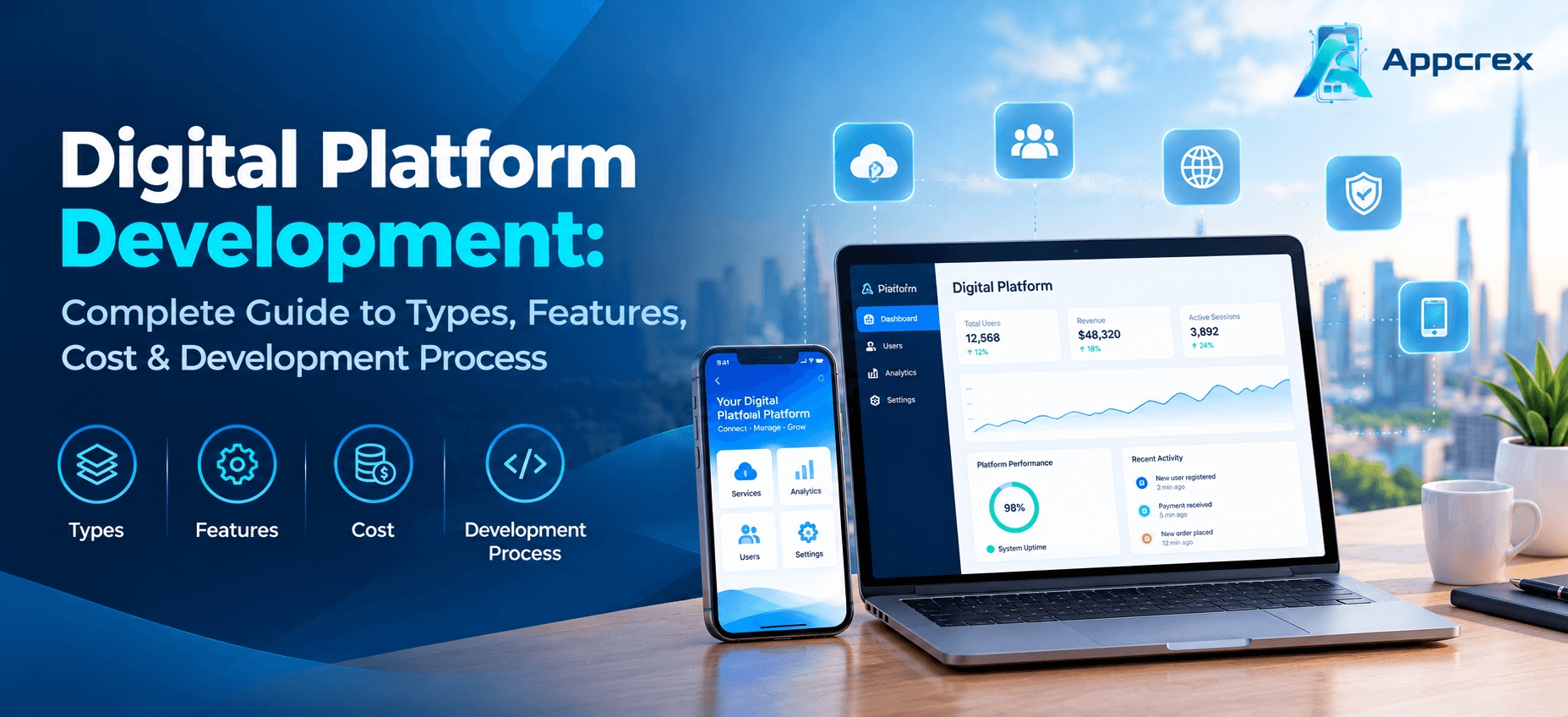
This guide explains digital platform development, including different types of platforms, essential features, technology architecture, development process, AI integration, cost, timeline, monetization models, and common challenges.
What Is a Digital Platform?
A digital platform is a technology-based ecosystem that connects different groups of users, businesses, services, products, data, or processes through a centralized system.
Unlike a simple website that mainly provides information, a digital platform usually enables users to interact, transact, communicate, create, manage, or exchange something.
For example:
- An e-commerce platform connects customers, merchants, products, payments, and logistics.
- A marketplace connects buyers with sellers or service providers.
- A healthcare platform can connect patients, doctors, clinics, appointments, and medical services.
- A logistics platform can connect customers, warehouses, drivers, and transportation operations.
- A B2B platform can connect businesses with suppliers, partners, and enterprise services.
A digital platform may include several components working together:
Web application + Mobile applications + Backend + Database + APIs + Admin panel + Third-party integrations
The exact structure depends on the business model and target users.
Digital Platform vs Website vs Mobile App vs SaaS
These terms are often used interchangeably, but they serve different purposes.
| Solution | Main Purpose | Typical Example |
|---|---|---|
| Website | Information and online presence | Corporate website |
| Web Application | Interactive online functionality | Online booking system |
| Mobile App | Mobile-first user experience | Delivery app |
| SaaS | Cloud-based software accessed through subscription or usage | CRM software |
| Digital Platform | Connects users, services, businesses, data, or transactions | Marketplace or business ecosystem |
A digital platform can actually contain several of these components.
For example, a marketplace may have a website, customer mobile app, vendor application, admin dashboard, payment system, APIs, and backend infrastructure—all operating as one digital platform.
Why Are Businesses Investing in Digital Platforms?
Digital platforms can help businesses create a centralized environment for customers, employees, partners, vendors, and internal operations.
Instead of maintaining separate systems for different activities, businesses can connect important processes through a common digital ecosystem.
Some common objectives include:
- Improving customer experience
- Creating new digital revenue channels
- Automating business workflows
- Connecting multiple user groups
- Managing transactions digitally
- Centralizing business data
- Improving operational visibility
- Supporting remote access
- Integrating third-party services
- Creating scalable digital products
For startups, a digital platform can become the core product. For established businesses, it can become a way to modernize existing operations and create new digital services.
Types of Digital Platforms
Digital platforms can be built for almost any industry. Their architecture and features depend heavily on who uses the platform and what interaction takes place.
1. Marketplace Platforms
Marketplace platforms connect buyers with sellers, customers with service providers, or businesses with vendors.
Typical features include:
- User registration
- Vendor onboarding
- Product or service listings
- Search and filters
- Payments
- Reviews and ratings
- Messaging
- Order or booking management
- Commission management
- Vendor dashboards
- Admin management
Examples include product marketplaces, freelance platforms, property marketplaces, and service marketplaces.
2. E-Commerce Platforms
E-commerce platforms allow businesses to sell products or services online.
They may include:
- Product catalogs
- Shopping carts
- Checkout
- Payment gateways
- Inventory management
- Order tracking
- Customer accounts
- Coupons
- Product reviews
- Shipping integrations
- Sales analytics
A large e-commerce platform may also include mobile apps and seller portals.
3. SaaS Platforms
SaaS platforms provide cloud-based software to customers, often through subscriptions.
Examples include:
- CRM platforms
- Project management systems
- HR software
- Accounting platforms
- Marketing tools
- Analytics platforms
- Collaboration software
SaaS platforms typically require subscription management, user permissions, billing, dashboards, integrations, and scalable cloud infrastructure.
4. B2B Platforms
B2B platforms are designed to facilitate interactions between businesses.
They can support:
- Supplier management
- Wholesale ordering
- Business accounts
- Procurement
- Quotations
- Contracts
- Invoicing
- Communication
- Business analytics
These platforms often require more advanced permissions and workflow management than consumer-facing applications.
5. Healthcare Platforms
Healthcare platforms can connect patients, doctors, hospitals, clinics, laboratories, pharmacies, and other healthcare providers.
Potential functionality includes:
- Appointment booking
- Doctor profiles
- Telemedicine
- Patient management
- Digital records
- Prescription management
- Payments
- Notifications
- Healthcare dashboards
Security and access control are particularly important for platforms handling sensitive information.
6. FinTech Platforms
FinTech platforms can support digital payments, financial management, investment services, lending, insurance, accounting, and other financial activities.
Depending on the use case, features may include:
- Account management
- Payment processing
- Transaction history
- Financial dashboards
- KYC workflows
- Fraud monitoring
- Notifications
- Reporting
- API integrations
FinTech platforms also require careful consideration of security and applicable regulatory requirements.
7. Logistics and Transportation Platforms
These platforms connect customers, logistics companies, drivers, warehouses, and other transportation stakeholders.
Common features include:
- Booking
- Dispatch management
- GPS tracking
- Route management
- Fleet management
- Driver management
- Delivery tracking
- Notifications
- Proof of delivery
- Analytics
8. Education Platforms
Education platforms can connect students, teachers, institutions, instructors, and learning content.
They can support:
- Course management
- Student profiles
- Instructor dashboards
- Video learning
- Live classes
- Assessments
- Certificates
- Subscription plans
- Progress tracking
- AI-powered learning
Essential Features of a Digital Platform
The features depend on the platform’s purpose, but most successful platforms require a combination of user, business, administrative, and technical functionality.
User Registration and Authentication
Users should be able to securely create accounts and access the appropriate platform functionality.
Options may include:
- Email and password
- Phone authentication
- OTP
- Social login
- Multi-factor authentication
- Biometric authentication for supported mobile applications
User and Role Management
Different users usually need different permissions.
For example, a marketplace may have:
- Customers
- Vendors
- Administrators
- Delivery partners
An enterprise platform may have employees, managers, department administrators, and super administrators.
Role-based access control helps ensure that users only access the functions and information relevant to them.
Dashboard
A dashboard provides users with an overview of their activities and important information.
Depending on the platform, it may display:
- Transactions
- Orders
- Bookings
- Revenue
- Tasks
- Reports
- Notifications
- Performance metrics
Search and Filtering
Platforms containing large amounts of products, services, properties, documents, or users need efficient search and filtering.
Advanced platforms can use AI-powered search to understand natural-language queries rather than relying only on exact keywords.
Payments
Transaction-based platforms may require payment functionality.
Possible capabilities include:
- Payment gateway integration
- Credit and debit cards
- Digital wallets
- Bank payments
- Recurring payments
- Payment links
- Refund management
- Transaction history
The payment architecture should be selected according to the target market and business model.
Notifications
Notifications can keep users informed about important activities.
These may include:
- Push notifications
- SMS
- In-app notifications
Analytics and Reporting
Analytics can help businesses understand how users interact with the platform.
Reports may cover:
- User activity
- Sales
- Revenue
- Orders
- Customer behavior
- Product performance
- Operational metrics
Advanced Digital Platform Features
Once the core platform is established, businesses can add advanced capabilities.
AI and Machine Learning
AI can be used for:
- Personalized recommendations
- Predictive analytics
- Intelligent search
- Chatbots
- Document processing
- Fraud detection
- Demand forecasting
- Automated support
- Workflow automation
Real-Time Communication
Platforms can include:
- Chat
- Video calls
- Voice communication
- Real-time alerts
- Live status updates
Geolocation
Location-based functionality can support:
- GPS tracking
- Nearby services
- Route optimization
- Delivery tracking
- Location-based recommendations
Multi-Language and Multi-Currency Support
Businesses operating across multiple countries may need different languages, currencies, tax configurations, and regional settings.
Automation
Business workflows can be automated to reduce repetitive manual work.
For example, a platform could automatically assign tasks, generate reports, send reminders, process documents, or trigger notifications based on predefined conditions.
How AI Is Changing Digital Platform Development?
AI is becoming an important component of modern digital platforms.
Instead of simply providing static functionality, platforms can use AI to understand users, automate processes, and support decision-making.
For example, an e-commerce platform could use AI to recommend products, while a logistics platform could use predictive analytics to forecast delivery demand.
Common AI use cases include:
AI Chatbots: Automated customer support and assistance.
AI Search: Natural-language search across products, services, documents, or data.
Recommendations: Personalized products, content, services, or listings.
Predictive Analytics: Forecasting demand, sales, customer behavior, or operational requirements.
Document Intelligence: Extracting and organizing information from business documents.
AI Automation: Automating repetitive workflows and business processes.
AI Agents: Performing multi-step tasks based on defined business rules and permissions.
AI should be selected according to a specific business use case rather than added simply because it is a current technology trend.
Digital Platform Architecture
A scalable digital platform generally consists of multiple technical layers.
Frontend
The frontend is the interface users interact with. Technologies may include React.js, Next.js, Angular, or Vue.js.
Backend
The backend manages business logic, authentication, APIs, transactions, workflows, and communication between different components.
Common technologies include Node.js, Python, Java, PHP, and .NET.
Database
The database stores user information, transactions, products, documents, configurations, and other platform data.
Common options include PostgreSQL, MySQL, MongoDB, and Redis.
APIs
APIs allow different systems to communicate with each other.
They can connect the platform with payment gateways, CRM systems, ERP software, AI services, shipping providers, analytics tools, and other applications.
Cloud Infrastructure
Cloud infrastructure allows businesses to deploy and scale the platform according to demand.
AWS, Microsoft Azure, and Google Cloud are commonly used cloud environments.
Technology Stack for Digital Platform Development
The right technology stack depends on the platform’s requirements.
| Layer | Common Technologies |
|---|---|
| Frontend | React.js, Next.js, Angular, Vue.js |
| Backend | Node.js, Python, Java, PHP, .NET |
| Mobile | Flutter, React Native, iOS, Android |
| Database | PostgreSQL, MySQL, MongoDB |
| Cloud | AWS, Azure, Google Cloud |
| Caching | Redis |
| DevOps | Docker, Kubernetes, CI/CD |
| AI | Python, AI APIs, ML frameworks |
There is no single technology stack that is suitable for every platform. Architecture should be selected according to expected users, data volume, integrations, security, performance, and future scalability.
How to Build a Digital Platform?
Building a digital platform requires more than writing code. The product, business model, technology, and user experience need to be planned together.
Step 1: Define the Business Objective
Start by identifying the problem the platform will solve.
Ask:
- Who are the users?
- What problem are they experiencing?
- What value will the platform provide?
- How will the business generate revenue?
- Which user groups need to interact?
Step 2: Identify the Target Users
Define each type of platform user.
For example, a marketplace may have customers, vendors, delivery partners, and administrators.
Each user group should have its own requirements and workflows.
Step 3: Plan the Core Features
Separate essential MVP functionality from features that can be added later.
This helps control development cost and allows businesses to validate the product before expanding it.
Step 4: Design the User Experience
Create wireframes and UI/UX designs before development.
The interface should make important actions easy to find and reduce unnecessary steps.
Step 5: Plan the Architecture
The development team defines:
- Database structure
- Backend architecture
- APIs
- Cloud infrastructure
- Security
- User permissions
- Integration requirements
- Scalability strategy
Step 6: Develop the Platform
Frontend, backend, database, APIs, dashboards, integrations, and other components are developed according to the approved specifications.
Step 7: Test the Platform
Testing should cover:
- Functionality
- Security
- Performance
- Usability
- Compatibility
- API behavior
- Payment workflows
- User permissions
Step 8: Deploy and Launch
After testing, the platform is deployed to the selected cloud infrastructure and made available to users.
Step 9: Monitor and Improve
Launch is not the end of development.
User feedback, analytics, performance data, and business requirements can be used to improve the platform over time.
Digital Platform Development Cost
The cost of developing a digital platform varies significantly because platforms can range from relatively simple MVPs to complex enterprise ecosystems.
A general estimate is:
| Platform Complexity | Estimated Development Cost |
|---|---|
| Basic MVP | $20,000 – $40,000 |
| Medium Platform | $40,000 – $80,000 |
| Advanced Platform | $80,000 – $150,000+ |
| Enterprise Platform | $150,000 – $300,000+ |
These are indicative estimates rather than fixed development quotes.
The actual cost depends on:
- Number of features
- User roles
- UI/UX complexity
- Web and mobile requirements
- Backend architecture
- API integrations
- AI functionality
- Payment systems
- Security requirements
- Cloud infrastructure
- Development team location
- Ongoing maintenance
A marketplace with multiple user types and payment workflows, for example, will generally require more development than a simple customer portal.
How Long Does It Take to Build a Digital Platform?
The development timeline depends on the platform’s scope and complexity.
Typical estimates are:
- Basic MVP: 3–5 months
- Medium platform: 5–8 months
- Advanced platform: 8–12+ months
- Enterprise platform: 12+ months
A clearly defined MVP can help businesses start with essential functionality and introduce more advanced features in later development phases.
Digital Platform Monetization Models
A digital platform needs a business model that matches its users and value proposition.
Common monetization approaches include:
Subscription
Users pay a recurring monthly or annual fee to access the platform.
Commission
The platform takes a percentage from transactions between users.
This is common in marketplaces and booking platforms.
Freemium
Basic functionality is available for free while advanced features require a paid plan.
Advertising
Businesses can generate revenue by displaying advertisements or sponsored content.
Transaction Fees
A fixed or percentage-based fee can be charged for specific transactions.
Enterprise Licensing
Large organizations can pay for customized access, additional features, integrations, or dedicated services.
A platform can also combine multiple monetization models.
Industries Using Digital Platforms
Digital platforms can be developed for almost every major business sector.
Some common industries include:
- FinTech
- Healthcare
- E-commerce
- Education
- Real Estate
- Logistics
- Travel
- Hospitality
- Insurance
- Automotive
- Retail
- Construction
- Manufacturing
- Media and Entertainment
- Professional Services
The platform architecture and feature set should be adapted to the operational requirements of each industry.
Also Read : Cloud Migration for Digital Transformation in UAE: Services, Benefits, Cost & Process
Common Challenges in Digital Platform Development
Digital platforms can become technically complex as the number of users, integrations, and business workflows increases.
Scalability
The architecture needs to handle increasing users and data without significant performance problems.
Security
Platforms handling payments, customer information, or business data need appropriate security controls.
Multiple User Roles
Different users may have different permissions, workflows, and dashboards.
Third-Party Dependencies
Payment providers, APIs, cloud services, and external systems can affect platform functionality.
Data Management
Large platforms need an organized approach to storing, processing, securing, and analyzing data.
User Experience
A platform with too many complicated workflows can become difficult to use. UX should remain a major consideration throughout development.
Continuous Development
Digital platforms usually require ongoing updates, optimization, security improvements, and new features after launch.
Digital Platform vs Traditional Software
Traditional software may be designed for a specific organization or workflow, while a digital platform often connects multiple users, services, or business entities.
For example, a company may develop internal inventory software for its employees. A digital inventory platform could go further by connecting suppliers, warehouses, retailers, logistics partners, and customers.
The distinction is not always absolute, but the ecosystem and interaction model are important characteristics of digital platforms.
How to Choose a Digital Platform Development Company?
Before selecting a development partner, businesses should evaluate several practical factors.
Technical Experience
Check whether the company has experience with the technologies and architecture required for your platform.
Relevant Projects
Look for experience with platforms that have similar user roles, workflows, integrations, or industry requirements.
Development Process
Understand how the company handles requirements, design, development, testing, deployment, and support.
Scalability
The development partner should consider future users, data, transactions, and integrations rather than focusing only on the initial launch.
Security
Ask how authentication, permissions, APIs, data protection, and infrastructure security will be handled.
Post-Launch Support
A platform requires maintenance and improvements after launch, so ongoing technical support should be considered during vendor selection.
Also Read : Digital Transformation: Complete Guide to Strategy, Benefits, Process & Trends (2026)
Why Businesses Choose Custom Digital Platform Development?
Pre-built software can work for standard business requirements, but it may become restrictive when a business has a unique workflow or wants to create a differentiated digital product.
Custom development allows businesses to control:
- Product functionality
- User experience
- Business workflows
- Integrations
- Data architecture
- Scalability
- Security
- Monetization
- Future expansion
For businesses planning a platform as a core digital product, custom development can provide greater control over the technology and product roadmap.
FAQs
Q. What is digital platform development?
Digital platform development is the process of creating a technology ecosystem that connects users, businesses, services, data, transactions, and workflows through software.
Q. How much does it cost to build a digital platform?
A basic platform MVP may cost around $20,000–$40,000, while advanced and enterprise platforms can range from $80,000 to $300,000 or more depending on complexity.
Q. Can a digital platform include a mobile app?
Yes. A digital platform can include iOS and Android applications connected to the same backend, database, APIs, and administrative systems.
Q. Can AI be integrated into a digital platform?
Yes. AI can be used for recommendations, chatbots, intelligent search, predictive analytics, automation, document processing, and AI agents.
Q. What is the difference between a digital platform and SaaS?
SaaS is generally software delivered through the cloud, often using a subscription model. A digital platform is a broader concept that can connect multiple users, services, businesses, transactions, and systems. A SaaS product can itself be a digital platform.
Q. How long does it take to develop a digital platform?
A basic MVP may take around 3–5 months, while medium, advanced, and enterprise platforms can take 5–12+ months depending on their requirements.
Q. Can an existing software system be converted into a digital platform?
Yes. Existing software can be modernized through cloud migration, API development, new user interfaces, database restructuring, integrations, mobile applications, and additional platform functionality.
Conclusion
Digital platform development has become an important approach for businesses looking to connect customers, services, partners, employees, data, and digital operations through a centralized ecosystem.
Whether you are planning a marketplace, SaaS product, healthcare platform, FinTech ecosystem, e-commerce solution, logistics platform, or enterprise digital system, the development strategy should start with the business model and user requirements.
The right architecture, technology stack, security approach, integrations, and development process can help create a platform that is not only ready for launch but also capable of evolving as the business grows.
For businesses planning a new platform, starting with a clearly defined MVP and building toward a scalable architecture can provide a practical path from initial concept to a larger digital ecosystem.
Build Your Digital Platform with AppCrex
AppCrex provides custom digital platform development services for startups, businesses, and enterprises. Our team can help with product strategy, UI/UX design, web and mobile development, backend architecture, APIs, AI integration, cloud solutions, testing, deployment, and ongoing support.
Have an idea for a digital platform? Contact AppCrex to discuss your requirements and start planning your custom digital platform.