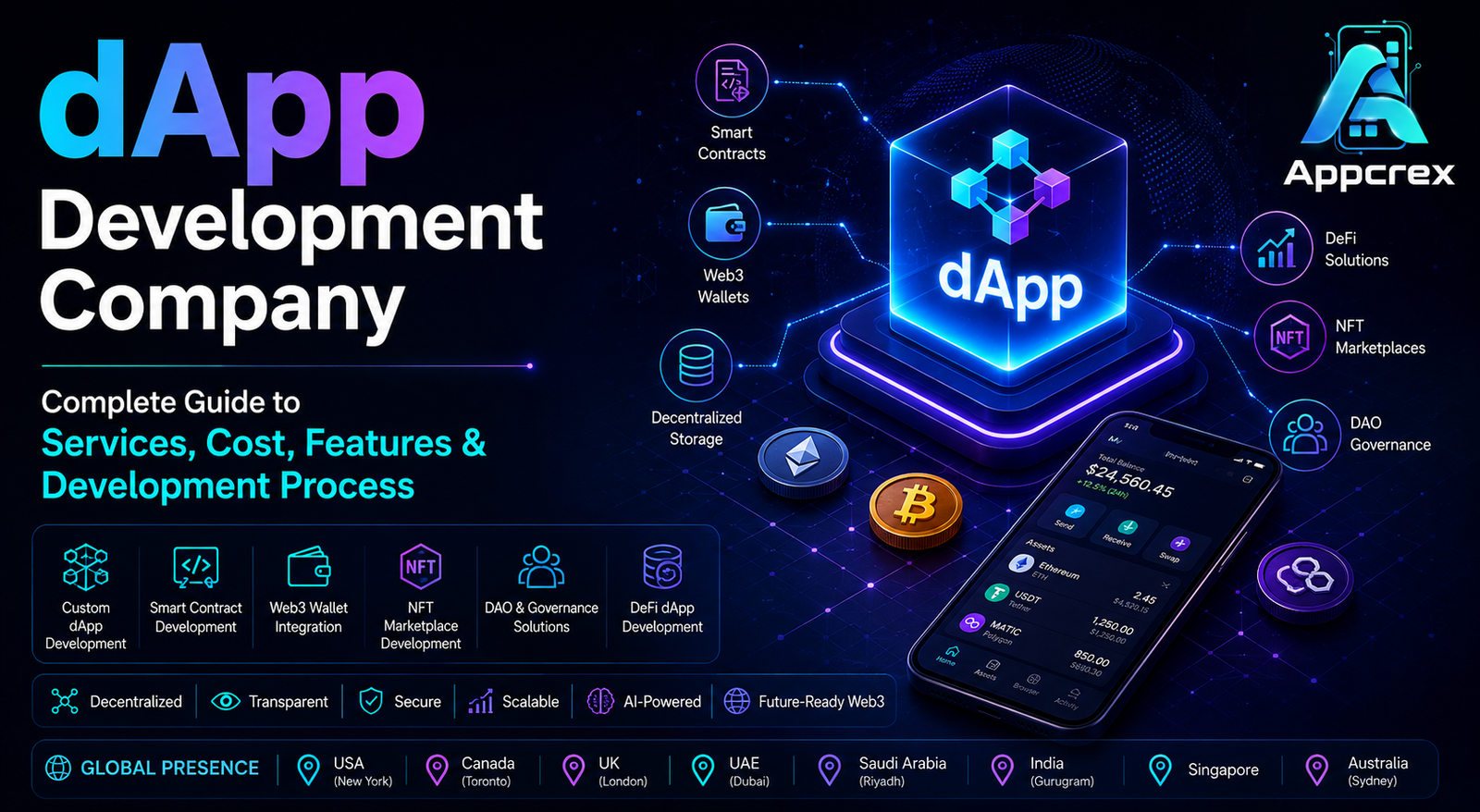
Decentralized applications, commonly known as dApps, are becoming an important part of the Web3 ecosystem. Unlike conventional applications that rely primarily on centralized servers, dApps can use blockchain networks, smart contracts, crypto wallets, and decentralized infrastructure to deliver specific functions with greater transparency and programmable ownership.
From DeFi and NFT marketplaces to blockchain gaming, tokenized assets, DAOs, supply-chain platforms, and Web3 communities, businesses are exploring dApps to create new digital experiences.
However, developing a successful dApp is not simply about connecting a website to a blockchain. It requires thoughtful architecture, smart contract development, wallet integration, blockchain infrastructure, security testing, intuitive UX, and often a combination of on-chain and off-chain technologies.
As AI and LLM technologies mature, they are also opening new possibilities for dApps. AI can support intelligent interfaces, natural-language blockchain interactions, analytics, recommendation systems, automated workflows, and AI-powered Web3 experiences.
What Is a dApp?
A decentralized application (dApp) is a software application that uses blockchain networks and smart contracts for some or all of its core functionality.
A typical dApp can combine:
- Blockchain networks
- Smart contracts
- Web3 wallets
- Frontend interfaces
- APIs and indexing services
- Decentralized storage
- Tokens or NFTs
- Off-chain databases
- AI and machine learning services
A simplified dApp architecture can look like:
User → dApp Interface → Wallet → Smart Contract → Blockchain
Additional backend and AI infrastructure can be connected where required.
The important point is that not every component of a dApp needs to be decentralized. Many modern Web3 products use hybrid architectures, putting transaction-critical or ownership-related operations on-chain while keeping other functions off-chain for better performance and flexibility.
Just Read : Blockchain Development Company: Complete Guide to Services, Cost & Development Process
What Is dApp Development?
dApp development is the process of designing and building decentralized applications that interact with blockchain networks and smart contracts.
A dApp development project may include:
- Business and Web3 strategy
- Blockchain selection
- Smart contract development
- Frontend development
- Wallet integration
- Token integration
- NFT functionality
- Blockchain APIs
- Decentralized storage
- AI/LLM integration
- Security testing
- Smart contract auditing
- Deployment
- Post-launch maintenance
The exact architecture depends on what the dApp is designed to accomplish.
Why Businesses Are Building dApps?
Traditional applications have made digital services convenient, but they often depend on centralized platforms to control data, accounts, transactions, and access.
dApps can introduce alternative models based on blockchain infrastructure.
Digital Ownership
Blockchain can provide verifiable ownership records for tokens, NFTs, and other digital assets.
Transparent Transactions
Depending on the blockchain and application design, transactions can be publicly verifiable.
Programmable Business Logic
Smart contracts can automatically execute predefined rules.
Web3 Connectivity
dApps can connect users with wallets, tokens, DeFi protocols, NFT marketplaces, and other blockchain ecosystems.
New Revenue Models
Depending on the business model, dApps can support transaction fees, marketplace fees, token-based services, subscriptions, and other monetization approaches.
dApp Development Services
A professional dApp development company can provide end-to-end development services.
Just Read : Mobile App Development Company India: Custom Android, iOS & AI App Development Services
Custom dApp Development
Custom dApp development focuses on building a decentralized application around a specific business model.
Services can include:
- dApp architecture
- UI/UX design
- Smart contracts
- Blockchain integration
- Wallet connectivity
- APIs
- Admin dashboard
- Analytics
- Security
- Deployment
This approach is suitable for businesses that need functionality beyond existing Web3 products.
Also Read : Smart Contract Development Company: Complete Guide to Services, Cost & Development Process
Smart Contract Development
Smart contracts provide programmable logic for many dApps.
They can manage:
- Payments
- Token transfers
- NFT ownership
- Marketplace transactions
- Staking
- Governance
- Lending
- Rewards
- Access control
Because smart contracts can directly interact with digital assets, testing and security review should be treated as essential parts of development.
Web3 Wallet Integration
Wallet integration allows users to connect their crypto wallets with the dApp.
Depending on the wallet and application, users can:
- Connect their wallet
- View balances
- Sign transactions
- Approve smart contracts
- Transfer assets
- Interact with decentralized services
Wallet connectivity is particularly important for DeFi, NFT, gaming, and marketplace dApps.
DeFi dApp Development
DeFi dApps provide decentralized financial functionality.
Examples include:
- Decentralized exchanges
- Lending platforms
- Borrowing platforms
- Staking platforms
- Liquidity pools
- Yield-related platforms
- Portfolio dashboards
DeFi development requires particularly careful consideration of smart contract logic, economic mechanisms, security, and external data dependencies.
NFT dApp Development
NFT-focused dApps can enable users to create, manage, buy, sell, or transfer digital assets.
Solutions can include:
- NFT marketplaces
- NFT minting platforms
- Digital collectibles
- Creator platforms
- NFT gaming ecosystems
- Membership-based NFT platforms
DAO dApp Development
DAO-based dApps can provide decentralized governance functionality.
Features may include:
- Proposal creation
- Voting
- Governance tokens
- Delegation
- Treasury management
- Proposal execution
AI and LLM Integration in dApps
One of the most interesting developments in the Web3 ecosystem is the combination of AI, Large Language Models (LLMs), and blockchain.
Rather than treating AI as a replacement for blockchain, businesses can use AI and blockchain for different purposes.
AI can provide intelligence. Blockchain can provide verifiable transactions, ownership, and programmable rules.
This combination can create more interactive dApps.
AI-Powered Web3 Assistants
An LLM-powered assistant can allow users to interact with a dApp using natural language.
For example, instead of navigating through multiple screens, a user could ask:
“Show my current token holdings.”
or:
“What transactions did I make this week?”
The AI layer can interpret the request and retrieve relevant information through permitted application services.
Natural Language Blockchain Interaction
LLMs can act as an interface between users and complex blockchain functionality.
For example, an AI-powered dApp could help users understand:
- Wallet balances
- Transaction history
- Gas fees
- Token information
- Protocol activity
- Smart contract functions
The system should still require appropriate confirmation before executing financial or blockchain transactions.
AI-Powered Analytics
AI can analyze large amounts of blockchain and application data to identify patterns and generate understandable insights.
Possible applications include:
- Portfolio analytics
- Transaction summaries
- User behavior analysis
- Market intelligence
- Risk indicators
- Fraud detection support
AI-generated insights should be treated as decision-support information rather than automatically assumed to be accurate financial advice.
AI Agents for Web3
AI agents can potentially automate selected workflows within a dApp.
For example, an agent could:
- Monitor blockchain events
- Summarize activity
- Trigger predefined workflows
- Assist with portfolio monitoring
- Respond to user questions
- Generate reports
For high-impact actions, appropriate permissions, transaction limits, confirmation steps, and security controls are important.
Also Read : Digital Wallet App Development: Complete Guide to Features, Cost, Security & Trends (2026)
Key Features of a Modern dApp
A modern dApp can contain a combination of Web3 and conventional application features.
Wallet Connection
Users can connect supported wallets to access blockchain functionality.
Smart Contract Interaction
The interface can communicate with smart contracts to perform permitted blockchain operations.
Multi-Chain Support
A dApp can support multiple blockchain networks depending on its architecture and business requirements.
Token Integration
The application can support native assets, tokens, stablecoins, or other digital assets.
NFT Support
NFT functionality can be incorporated into marketplaces, gaming platforms, communities, and digital ownership solutions.
Transaction History
Users can track:
- Transactions
- Blockchain confirmations
- Fees
- Asset transfers
- Smart contract interactions
User Dashboard
A dashboard can display:
- Wallet balances
- Tokens
- NFTs
- Transactions
- Rewards
- Activity
- Protocol positions
AI Assistant
An LLM-powered assistant can help users navigate complex Web3 functionality through conversational interfaces.
Analytics
Businesses can use analytics dashboards to understand users, transactions, assets, and platform activity.
How to Build a dApp?
Building a dApp requires both conventional software development and blockchain engineering.
1. Define the Business Model
Start by identifying:
- Target users
- Business problem
- Core functionality
- Blockchain requirements
- Revenue model
- Digital assets involved
- AI requirements
This prevents unnecessary blockchain complexity.
2. Select the Blockchain
The blockchain should be selected based on:
- Transaction fees
- Performance
- Security
- Ecosystem
- Developer tools
- Wallet support
- Smart contract capabilities
There is no single blockchain that is ideal for every dApp.
3. Design the Architecture
Developers determine which functions should be on-chain and which should remain off-chain.
A hybrid architecture can often provide a balance between decentralization, performance, cost, and scalability.
4. Develop Smart Contracts
Smart contracts are created according to the application’s business rules.
For example, a marketplace may require contracts for:
- Listings
- Purchases
- Payments
- Ownership
- Fees
A DeFi product may require considerably more complex contract logic.
5. Build the Frontend
The frontend provides the user experience.
Common screens include:
- Homepage
- Wallet
- Dashboard
- Transactions
- Marketplace
- Assets
- Staking
- Governance
- AI assistant
- Settings
6. Integrate Wallets and Blockchain Infrastructure
Wallet connectivity, blockchain nodes, APIs, indexing services, and other infrastructure are integrated to allow the application to interact with blockchain networks.
7. Integrate AI/LLM Where Required
For AI-powered dApps, the AI layer can be connected to:
- LLM APIs
- Retrieval systems
- Blockchain data
- Application databases
- Analytics
- AI agents
The AI layer should have clearly defined permissions and should not automatically receive unrestricted authority over users’ assets.
8. Test the dApp
Testing should cover both Web2 and Web3 components.
It can include:
- Functional testing
- Smart contract testing
- Wallet testing
- API testing
- AI response testing
- Security testing
- Performance testing
- Cross-device testing
9. Audit and Secure
Security reviews can identify vulnerabilities in smart contracts, access control, wallet interactions, dependencies, and application logic.
For applications handling significant digital assets, an independent smart contract audit may be appropriate.
10. Deploy and Maintain
After testing, the dApp can be deployed to the selected blockchain environment and application infrastructure.
Post-launch maintenance may include:
- Security updates
- Blockchain upgrades
- New wallet integrations
- New network support
- AI model improvements
- Performance optimization
- Bug fixes
dApp Technology Stack
The technology stack depends on the application’s requirements.
Blockchain
Potential ecosystems include:
- Ethereum
- Polygon
- BNB Chain
- Avalanche
- Solana
- Other blockchain networks
Smart Contracts
For EVM-based ecosystems:
- Solidity
- OpenZeppelin
- Hardhat
- Foundry
Frontend
- React
- Next.js
- TypeScript
- JavaScript
Web3
- Web3 libraries
- Blockchain APIs
- Wallet SDKs
- Indexing infrastructure
AI & LLM
Depending on the use case:
- Large Language Models
- AI APIs
- Retrieval-augmented systems
- AI agents
- Vector databases
- Analytics pipelines
The technology stack should be selected around the product—not simply because a particular technology is popular.
dApp Development Use Cases
dApps can be developed for many industries.
Finance & DeFi
- Decentralized exchanges
- Lending
- Staking
- Payments
- Asset management
Gaming & Metaverse
- Blockchain games
- Digital assets
- NFT ownership
- Player marketplaces
- Token economies
Real Estate
- Tokenization
- Digital ownership
- Investment platforms
- Property-related records
Supply Chain
- Product tracking
- Verification
- Digital records
- Asset provenance
Healthcare
Blockchain-based systems can support selected use cases involving verification, permissions, records, and data-sharing workflows, subject to applicable privacy and regulatory requirements.
Entertainment
- Digital collectibles
- Fan communities
- NFT memberships
- Creator platforms
dApp Development Cost
The cost of developing a dApp depends heavily on its complexity.
| dApp Type | Estimated Cost |
|---|---|
| Basic dApp | $15,000 – $30,000 |
| Custom Web3 dApp | $25,000 – $50,000 |
| NFT dApp | $30,000 – $70,000+ |
| DeFi dApp | $40,000 – $100,000+ |
| AI-Powered dApp | $40,000 – $100,000+ |
| Advanced Multi-Chain dApp | $60,000 – $150,000+ |
These are indicative ranges, not fixed quotes.
What Influences dApp Development Cost?
The final cost depends on:
- Blockchain network
- Smart contract complexity
- Number of contracts
- Wallet integrations
- Multi-chain requirements
- Token functionality
- NFT functionality
- AI/LLM integration
- Backend infrastructure
- UI/UX complexity
- APIs
- Analytics
- Security testing
- Smart contract auditing
- Admin dashboard
- Third-party integrations
- Maintenance requirements
An AI-enabled DeFi dApp, for example, will generally require a more complex architecture than a basic wallet-connected application.
Security Considerations for dApp Development
Security should be considered from the beginning of the project.
Smart Contract Security
Contracts should be tested thoroughly and reviewed before handling real assets.
Wallet Security
The dApp should never unnecessarily request or expose sensitive wallet credentials.
Access Control
Administrative functions should use appropriate authorization mechanisms.
AI Security
AI-powered dApps should implement safeguards against:
- Prompt injection
- Unauthorized tool execution
- Data leakage
- Malicious instructions
- Excessive permissions
AI should not be given unrestricted access to financial transactions.
Oracle and External Data Security
If the dApp relies on external data, the reliability and manipulation risks of those data sources should be evaluated.
How to Choose a dApp Development Company?
Before hiring a dApp development company, consider:
Blockchain Expertise
Check experience with the blockchain ecosystem required for your product.
Smart Contract Experience
Review previous smart contract projects and security practices.
Web3 Portfolio
Look for experience with:
- dApps
- DeFi
- NFTs
- DAOs
- Wallets
- Tokens
- Web3 marketplaces
AI & LLM Expertise
If you want an AI-powered dApp, check whether the development team understands:
- LLM integration
- AI agents
- AI APIs
- Retrieval systems
- AI security
- Blockchain data integration
End-to-End Capability
A strong development partner should be able to manage:
Strategy → Architecture → UI/UX → Smart Contracts → Frontend → Web3 Integration → AI → Testing → Security → Deployment → Maintenance
dApp Development Company for Global Businesses
Businesses looking for dApp development services are not limited to a single region. Web3 products can be developed for startups, enterprises, and technology companies across global markets.
AppCrex can serve businesses looking for dApp development services in:
USA
dApp solutions for startups, fintech businesses, Web3 companies, gaming platforms, and digital asset businesses.
Canada
Custom dApp development for businesses exploring blockchain, Web3, tokenization, and decentralized platforms.
UK
Web3 and dApp development solutions for fintech, marketplaces, gaming, and digital businesses.
Germany & Europe
Blockchain and dApp solutions for businesses exploring digital ownership, supply-chain applications, tokenization, and Web3 ecosystems.
UAE – Dubai & Abu Dhabi
dApp development for businesses working in fintech, real estate, gaming, digital assets, and emerging Web3 ecosystems.
Saudi Arabia – Riyadh
Custom blockchain and dApp solutions for businesses exploring digital transformation, fintech, tokenization, and Web3.
India – Gurugram & Other Technology Hubs
dApp development for startups and enterprises building blockchain, AI, Web3, and decentralized products.
Singapore
Web3 development for fintech, digital assets, blockchain startups, and technology businesses.
Australia – Sydney and Other Markets
Custom dApp development for businesses exploring blockchain-based platforms and digital asset solutions.
Note: These are target/service markets rather than a claim that AppCrex maintains a physical office in every listed location.
Also Read : Web3 Development Company: Complete Guide to Services, Cost & Development Process
Why Choose AppCrex for dApp Development?
AppCrex provides custom dApp development services combining blockchain, Web3, smart contracts, and modern application development.
Our services can include:
- Custom dApp development
- Smart contract development
- Web3 wallet integration
- DeFi dApp development
- NFT dApp development
- DAO development
- Token integration
- Multi-chain dApp development
- AI-powered dApp development
- LLM integration
- AI agent integration
- Blockchain API integration
- Security testing
- Deployment
- Post-launch maintenance
Our approach focuses on building practical Web3 products rather than adding blockchain or AI functionality where it is not necessary.
FAQs
Q. What is a dApp development company?
A dApp development company designs and develops decentralized applications using blockchain networks, smart contracts, wallets, Web3 technologies, and related infrastructure.
Q. How much does it cost to develop a dApp?
A basic dApp can start around $15,000, while advanced DeFi, AI-powered, or multi-chain dApps can exceed $100,000 depending on their functionality and security requirements.
Q. How long does it take to build a dApp?
A simple dApp can take several weeks, while complex DeFi, NFT, gaming, or AI-powered dApps may require several months.
Q. Can AI be integrated into a dApp?
Yes. AI and LLMs can be integrated for conversational assistants, blockchain analytics, recommendations, automation, natural-language interfaces, and selected AI-agent workflows.
Q. What is the difference between a dApp and a traditional app?
A traditional application generally relies on centralized infrastructure, while a dApp can use blockchain networks and smart contracts for selected functionality such as transactions, ownership, and governance.
Q. Which blockchain is best for dApp development?
There is no single best blockchain. The right network depends on transaction costs, scalability, security, ecosystem, developer tooling, wallet support, and project requirements.
Q. Can a dApp support multiple blockchains?
Yes. Multi-chain dApps can support multiple blockchain networks when the architecture and integrations are designed accordingly.
Q. Is dApp development secure?
Security depends on smart contract design, application architecture, wallet integration, testing, dependencies, and ongoing monitoring. Security should be built into the development process from the beginning.
Q. Can AppCrex build an AI-powered dApp?
Yes. AppCrex can combine dApp development with AI and LLM technologies to create conversational Web3 interfaces, intelligent analytics, automation features, and other AI-enabled decentralized experiences.
Conclusion
dApps are evolving beyond basic blockchain interfaces into sophisticated digital products combining smart contracts, Web3 wallets, decentralized infrastructure, AI, and LLM-powered experiences.
The strongest dApp strategies do not simply put everything on-chain. Instead, they determine which components genuinely benefit from blockchain while using conventional infrastructure and AI where those technologies provide better performance, usability, or intelligence.
Whether you want to build a DeFi dApp, NFT marketplace, Web3 gaming platform, DAO, tokenization platform, AI-powered dApp, or custom decentralized application, the right development architecture is critical.
A skilled dApp development company can help you move from idea and architecture to smart contracts, Web3 integration, AI capabilities, security testing, deployment, and long-term maintenance.
Build Your dApp with AppCrex
Have an idea for a decentralized application?
AppCrex can help you build a secure, scalable, and AI-ready dApp tailored to your business model.
From smart contracts and blockchain integration to Web3 wallets, DeFi, NFTs, AI, and LLM integration, our team can help turn your concept into a production-ready Web3 product.
Contact AppCrex today to discuss your dApp development project.