appcrex

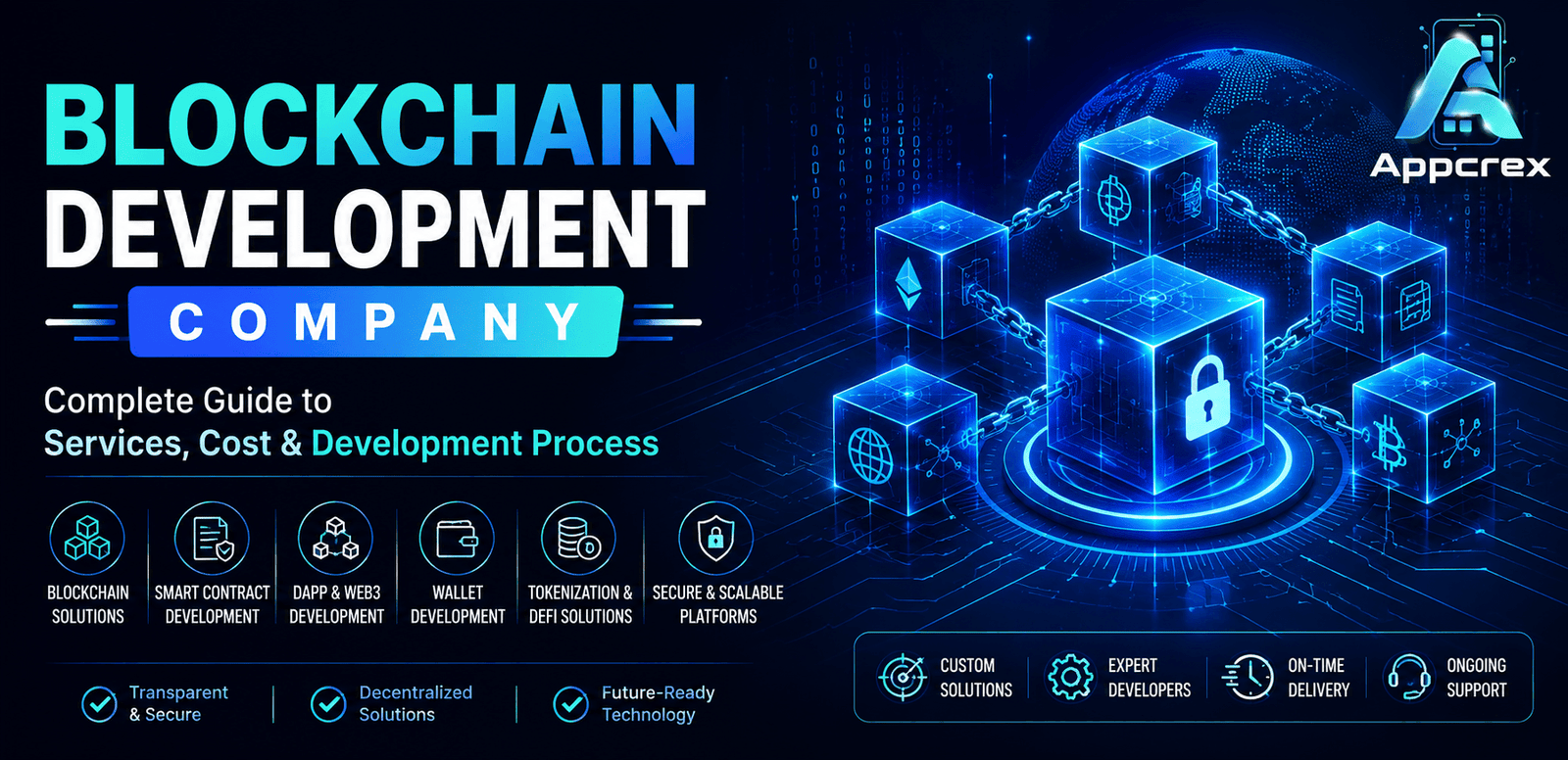
Blockchain Development Company: Complete Guide to Services, Cost & Development Process

📌 Key Takeaways

  • Blockchain development is not limited to cryptocurrency and can support finance, supply chain, healthcare, real estate, gaming, logistics, and enterprise applications.
  • Smart contracts, Web3, wallets, DeFi, tokenization, and enterprise blockchain solutions are major areas of blockchain development.
  • The right blockchain depends on use case, performance, security, ecosystem, cost, and scalability requirements.
  • Blockchain development can cost approximately $25,000 to $400,000+, depending on project complexity and requirements.
  • Security and architecture should be considered from the beginning, especially when applications handle digital assets or execute smart contracts.

Blockchain technology has evolved beyond cryptocurrency and is now being used to build secure, transparent, and decentralized digital solutions across finance, supply chain, healthcare, real estate, gaming, logistics, and other industries.

Businesses can use blockchain to create decentralized applications, smart contracts, digital wallets, tokenized platforms, enterprise systems, and Web3 products.

However, building a blockchain-based product requires more than choosing a blockchain network and writing smart contracts. Businesses need the right architecture, development framework, security strategy, wallet integration, APIs, testing process, and deployment infrastructure.

A professional blockchain development company can help businesses turn a blockchain idea into a scalable digital product, from initial consultation and architecture to development, smart contract integration, testing, deployment, and maintenance.

This guide covers blockchain development services, use cases, how to build a blockchain application, technology stack, development cost, timeline, security, and future trends in 2026.

What Is Blockchain Development?

Blockchain development is the process of creating applications, platforms, smart contracts, and business solutions that use blockchain networks to store, verify, and exchange data in a decentralized or distributed environment.

Unlike a conventional database controlled by a central authority, a blockchain can distribute records across multiple network participants.

A simplified blockchain workflow looks like:

Transaction → Verification → Consensus → Block Creation → Distributed Ledger

Once information is recorded according to the network’s rules, it can be difficult to alter without the required network-level authority or consensus.

Blockchain development can involve both on-chain and off-chain components.

On-Chain Components

These may include:

  • Smart contracts
  • Token logic
  • Blockchain transactions
  • Decentralized application functions

Off-Chain Components

These can include:

  • Mobile applications
  • Web applications
  • Backend services
  • Databases
  • APIs
  • Cloud infrastructure
  • Analytics dashboards

A successful blockchain product often combines both environments rather than putting every component directly on-chain.

Why Are Businesses Investing in Blockchain?

Blockchain can provide specific advantages when transparency, verifiability, shared records, or decentralized ownership are important to a business process.

Greater Transparency

Blockchain networks can provide a shared transaction history that authorized participants can independently verify.

This can be valuable in areas such as:

  • Supply chains
  • Financial transactions
  • Asset management
  • Digital ownership
  • Auditing

Data Integrity

Blockchain-based records can make unauthorized modification more difficult, depending on the network architecture and implementation.

Reduced Dependence on Intermediaries

Certain blockchain applications can automate transactions through smart contracts, reducing the need for some manual intermediary processes.

Digital Asset Management

Blockchain provides infrastructure for representing and transferring digital assets such as tokens and other blockchain-based assets.

Automated Transactions

Smart contracts can execute predefined rules when specified conditions are met.

For example:

Condition Verified → Smart Contract Executes → Transaction Recorded

This can help automate business workflows.

Blockchain Development Services

Blockchain development covers much more than cryptocurrency projects. Businesses can select services according to their product requirements.

Blockchain Application Development

Custom blockchain applications can be built for businesses that need decentralized or blockchain-enabled functionality.

Examples include:

  • Decentralized applications
  • Financial platforms
  • Asset management systems
  • Supply chain platforms
  • Digital identity solutions
  • Blockchain marketplaces

A blockchain application can combine a web or mobile frontend with smart contracts and backend services.

Smart Contract Development

Smart contracts are programs deployed on compatible blockchain networks that execute predefined logic.

They can be used for:

  • Token transfers
  • Automated payments
  • Digital asset ownership
  • Escrow workflows
  • Membership systems
  • Decentralized finance
  • Marketplace transactions

Smart contracts should undergo rigorous testing and, where appropriate, professional security auditing before being used with valuable assets.

Web3 Development

Web3 development focuses on decentralized applications and blockchain-enabled digital experiences.

A Web3 product may include:

  • Wallet connectivity
  • Smart contracts
  • Token functionality
  • Decentralized storage
  • Blockchain transactions
  • User authentication through wallets

Web3 applications can be developed for finance, gaming, marketplaces, communities, digital assets, and other use cases.

DeFi Development

Decentralized Finance, or DeFi, uses blockchain-based protocols to provide financial functionality without relying entirely on traditional financial intermediaries.

Possible DeFi solutions include:

  • Decentralized exchanges
  • Lending platforms
  • Staking platforms
  • Liquidity systems
  • Asset management applications

Because DeFi products can handle valuable assets, security and smart-contract auditing are especially important.

Cryptocurrency Wallet Development

Blockchain wallets allow users to manage blockchain assets and interact with decentralized applications.

A wallet application may provide:

  • Asset management
  • Transaction history
  • Send and receive functionality
  • QR code support
  • Network selection
  • Wallet connection
  • Security controls

Wallet architecture should be designed carefully because private keys and transaction authorization are critical security components.

Token Development

Businesses can create blockchain-based tokens for different purposes, depending on their business model and applicable legal requirements.

Tokens can represent:

  • Digital assets
  • Utility functions
  • Membership
  • Rewards
  • Governance rights
  • Other forms of digital representation

Token design should consider technical, economic, security, and regulatory requirements.

Enterprise Blockchain Solutions

Enterprises can use blockchain technology for shared records and multi-party workflows.

Potential applications include:

  • Supply chain tracking
  • Document verification
  • Asset tracking
  • Digital identity
  • Trade documentation
  • Audit trails
  • Inter-company data sharing

Enterprise blockchain does not always require a completely public network. Private or permissioned architectures may be more appropriate for certain business environments.

Also Read : How Much Does It Cost to Develop an App in 2026? Complete Pricing Guide

How to Build a Blockchain Application?

Building a blockchain application requires a combination of blockchain engineering, frontend development, backend development, security, and infrastructure.

Step 1: Identify the Blockchain Use Case

Start by asking:

Does this problem actually require blockchain?

Blockchain may be useful when multiple parties need to share or verify records and decentralization, immutability, or programmable transactions provide meaningful value.

If a normal centralized database can solve the problem more efficiently, blockchain may not be necessary.

Step 2: Define the Product Requirements

Determine:

  • Target users
  • Core functionality
  • Business model
  • Blockchain requirements
  • Transaction types
  • Asset types
  • User roles
  • Security requirements
  • External integrations

For example, a blockchain marketplace may require user accounts, wallet connectivity, asset listings, smart contracts, payments, transaction history, and an administration panel.

Step 3: Select the Blockchain Network

The choice of blockchain depends on:

  • Transaction speed
  • Fees
  • Smart contract support
  • Ecosystem
  • Security
  • Developer tools
  • Scalability
  • User adoption

The network should be selected based on the application’s actual requirements rather than popularity alone.

Step 4: Design the Blockchain Architecture

A typical architecture may look like:

Web/Mobile App

Backend/API Layer

Blockchain Interaction Layer

Smart Contracts

Blockchain Network

Additional components may include:

  • Database
  • Cloud storage
  • Blockchain indexer
  • Analytics
  • Authentication
  • Monitoring

Not all application data needs to be stored directly on-chain. Keeping large files and frequently changing information off-chain can improve performance and reduce transaction costs.

Step 5: Develop Smart Contracts

Smart contracts implement the core blockchain logic.

Development can include:

  • Contract design
  • Business rules
  • Access controls
  • Transaction handling
  • Event management
  • Error handling

Smart contracts should be tested extensively before deployment.

Step 6: Build the Application Interface

The frontend provides users with a familiar way to interact with blockchain functionality.

Depending on the project, this can include:

For mobile blockchain products, businesses can hire mobile app developers who understand wallet integration, blockchain APIs, and secure transaction workflows.

Step 7: Integrate Wallets and APIs

Blockchain applications may need to connect with wallets and external services.

Integrations can include:

  • Crypto wallets
  • Payment services
  • Blockchain APIs
  • Identity services
  • Analytics platforms
  • Notification services

The integration layer connects the blockchain with the rest of the application.

Step 8: Test and Audit

Blockchain applications require extensive testing.

Testing can include:

  • Functional testing
  • Smart contract testing
  • Security testing
  • Transaction testing
  • API testing
  • Load testing
  • Wallet testing
  • User interface testing

For smart contracts handling valuable assets, independent security audits can provide an additional layer of assurance.

Step 9: Deploy the Application

After testing, smart contracts and application components can be deployed to the appropriate production environment.

Deployment should include:

  • Configuration management
  • Monitoring
  • Error tracking
  • Backup strategies
  • Access controls
  • Infrastructure monitoring

Step 10: Maintain and Upgrade

Blockchain products still require ongoing software maintenance.

Post-launch activities can include:

  • Security updates
  • Application improvements
  • Smart contract monitoring
  • API maintenance
  • Performance optimization
  • Infrastructure management
  • New feature development

Some blockchain contracts are difficult or impossible to change after deployment, so upgradeability should be considered during the architecture stage.

Blockchain Technology Stack

The technology stack depends on the blockchain network and application type.

Development Area Common Technologies
Blockchain Networks Ethereum, Polygon, BNB Chain, Solana
Smart Contracts Solidity, Rust
Web3 Libraries ethers.js, web3.js
Frontend React, Next.js, Vue.js
Mobile Flutter, React Native, Kotlin, Swift
Backend Node.js, Python, Java
Databases PostgreSQL, MongoDB, MySQL
Wallet Integration WalletConnect, MetaMask
APIs REST, GraphQL
Cloud Infrastructure AWS, Azure, Google Cloud
Testing Hardhat, Foundry
Security Contract Auditing, Access Control, Encryption
Storage IPFS, Cloud Storage

The final stack should be selected according to the blockchain network, application requirements, performance expectations, and security considerations.
Public vs Private vs Permissioned Blockchain

The type of blockchain you choose can significantly affect the application’s architecture, governance, accessibility, performance, and development cost.

Blockchain Type Access Best Suited For Example Use Cases
Public Blockchain Open to participants Decentralized applications DeFi, Web3, digital assets
Private Blockchain Controlled by one organization Internal business systems Enterprise records, internal workflows
Permissioned Blockchain Restricted to approved participants Multi-party business networks Supply chain, trade, consortium platforms

Public Blockchain

A public blockchain is generally open to anyone who meets the network’s participation requirements.

It can be suitable when decentralization and open participation are important.

Private Blockchain

A private blockchain operates under the control of a specific organization or group.

It may be appropriate when businesses require greater control over network participation and data access.

Permissioned Blockchain

A permissioned blockchain allows only authorized participants to interact with the network.

This model can work well for organizations that need shared records between known parties while maintaining access controls.

There is no universally best blockchain type. The appropriate choice depends on the application’s objectives, users, governance model, performance requirements, and regulatory environment.

Also Read : AI Integration Services: Complete Guide to Benefits, Use Cases, Cost & Implementation (2026)

Which Blockchain Is Best for Application Development?

The answer depends on what you are building.

Ethereum

Ethereum is widely used for smart-contract-based applications and has a large developer and tooling ecosystem.

It can be considered for:

  • DeFi applications
  • Web3 platforms
  • Smart contracts
  • Token-based applications
  • Decentralized applications

Polygon

Polygon can be considered for applications that need Ethereum ecosystem compatibility with different transaction and scalability characteristics.

It may suit:

  • Web3 applications
  • Gaming
  • Digital asset platforms
  • Consumer applications

Solana

Solana is designed for high-throughput blockchain applications and has its own development ecosystem.

It can be considered for:

  • High-volume applications
  • Trading platforms
  • Gaming
  • Consumer Web3 products

BNB Chain

BNB Chain provides smart contract functionality and can be considered for various decentralized applications and token-based platforms.

Enterprise or Permissioned Networks

For businesses that do not require a fully public network, permissioned blockchain frameworks may be more appropriate.

The best blockchain is therefore the one that matches the product—not necessarily the most popular network.

Blockchain Applications Across Different Industries

Blockchain has applications beyond cryptocurrency.

Financial Services

Blockchain can support:

  • Digital asset platforms
  • Transaction systems
  • Tokenization
  • Payment workflows
  • Financial record management

Smart contracts can also automate predefined financial processes.

Supply Chain

Businesses can use blockchain to create verifiable records throughout a supply chain.

Potential applications include:

  • Product tracking
  • Shipment verification
  • Supplier records
  • Origin tracking
  • Audit trails

Real Estate

Blockchain can support digital records and asset-related workflows.

Possible applications include:

  • Property ownership records
  • Digital asset representation
  • Transaction workflows
  • Document verification
  • Property marketplaces

Healthcare

Potential applications include:

  • Medical data verification
  • Healthcare credential management
  • Data sharing
  • Audit trails
  • Pharmaceutical supply-chain tracking

Healthcare implementations require careful consideration of privacy and applicable regulations.

Gaming

Blockchain can support:

  • Digital assets
  • In-game ownership
  • Tokenized rewards
  • Marketplace functionality
  • Player-owned items

Logistics

Blockchain can help multiple parties share verifiable records related to:

  • Shipments
  • Delivery events
  • Supplier information
  • Product origin
  • Logistics documentation

Insurance

Blockchain-based systems can automate certain workflows involving:

  • Claims
  • Policy records
  • Verification
  • Fraud detection
  • Document processing

Also Read : Why Does Your Business Need Payment Gateway Integration Services?

How Can AI and Blockchain Work Together?

AI and blockchain solve different types of problems, but they can complement each other.

AI is useful for analyzing information, generating predictions, and automating decisions.

Blockchain can provide verifiable records, transaction logic, and decentralized infrastructure.

Together, they can be used for:

  • AI-powered fraud detection with verifiable transaction records
  • Intelligent blockchain analytics
  • Automated smart-contract workflows
  • AI-powered financial platforms
  • Decentralized AI marketplaces
  • Data provenance
  • AI agent transactions

For example, an AI system could analyze transaction patterns and identify potentially unusual activity, while blockchain maintains a verifiable record of relevant transactions.

The combination should be used where both technologies provide measurable value rather than adding blockchain or AI simply because they are trending.

Blockchain Security: What Businesses Need to Consider

Security is one of the most important aspects of blockchain development.

A blockchain application can involve valuable assets, sensitive data, wallets, private keys, and smart contracts. A vulnerability can therefore have serious consequences.

Smart Contract Security

Smart contracts should be thoroughly tested before deployment.

Security practices can include:

  • Automated testing
  • Code review
  • Static analysis
  • Independent auditing
  • Access-control testing
  • Vulnerability assessment

Wallet Security

Wallet-related applications need strong protection around:

  • Private keys
  • Transaction authorization
  • User authentication
  • Recovery mechanisms

Private keys should never be exposed through application logs or insecure storage.

API Security

Blockchain applications often depend on backend APIs and external services.

Authentication, authorization, input validation, rate limiting, and monitoring should be implemented appropriately.

Frontend Security

The application interface should clearly communicate transaction details before users authorize blockchain actions.

Infrastructure Security

Cloud servers, databases, APIs, and monitoring systems also need appropriate security controls.

Blockchain itself does not automatically make an entire application secure. Security depends on the complete architecture and implementation.

What Features Should a Blockchain Application Have?

The features depend on the product, but a typical blockchain application may include:

User Registration & Authentication

Users can create accounts and securely access the platform.

Wallet Connectivity

Users can connect supported wallets where blockchain transactions are required.

Blockchain Transaction Management

The platform can display transaction status, history, and relevant blockchain information.

Smart Contract Integration

Smart contracts can automate defined business rules.

Asset Management

Applications involving digital assets may provide tools for viewing, transferring, or managing those assets.

Search & Filtering

Useful for blockchain marketplaces, asset platforms, and transaction dashboards.

Notifications

Users can receive updates about transactions, account activity, and platform events.

Admin Dashboard

Administrators can manage users, platform settings, analytics, transactions, and other operational functions.

Analytics

Dashboards can provide information about:

  • Transactions
  • Users
  • Assets
  • Revenue
  • Platform activity

How Much Does Blockchain Development Cost?

This is one of the most important questions businesses ask before starting a blockchain project.

The cost can vary significantly depending on the application’s complexity.

Blockchain Project Type Estimated Cost Approx. Timeline
Basic Blockchain Application $25,000–$50,000 2–4 months
Medium-Complexity Web3 App $50,000–$100,000 4–7 months
Advanced Blockchain Platform $100,000–$200,000 7–10 months
Enterprise Blockchain Solution $200,000–$400,000+ 10–15+ months

These are indicative estimates. The actual cost depends on features, blockchain network, smart-contract complexity, security requirements, integrations, platforms, and development team.

What Factors Affect Blockchain Development Cost?

Product Complexity

A basic blockchain-enabled application requires considerably less work than a complete decentralized ecosystem.

Smart Contract Complexity

More complex contracts require additional development, testing, optimization, and security review.

Blockchain Network

Transaction models, development tools, infrastructure, and network characteristics can influence development requirements.

Frontend Platforms

Building web, Android, and iOS versions increases the scope compared with developing a single web application.

Wallet Integration

Multiple wallet integrations may require additional development and testing.

Third-Party Integrations

Payment services, analytics tools, identity systems, APIs, and external databases can add complexity.

Security Auditing

Professional smart-contract audits can increase the project budget but may be important for applications handling valuable assets.

Ongoing Infrastructure

After launch, businesses may need to budget for:

  • Cloud hosting
  • Blockchain nodes or infrastructure services
  • API providers
  • Monitoring
  • Storage
  • Security
  • Maintenance

How Long Does It Take to Build a Blockchain Application?

Development time depends on the scope and technical requirements.

Basic Blockchain MVP

2–4 months

A basic MVP may include a frontend, wallet connection, limited smart-contract functionality, backend APIs, and an administrative interface.

Medium-Complexity Application

4–7 months

A more advanced product may include multiple smart contracts, dashboards, APIs, user roles, wallet integrations, and analytics.

Advanced Blockchain Platform

7–10 months

Complex products may require sophisticated smart contracts, multiple interfaces, advanced security, integrations, and extensive testing.

Enterprise Blockchain Solution

10–15+ months

Enterprise systems can require complex integrations, permission management, governance, security controls, compliance considerations, and large-scale testing.

A clear MVP scope can help businesses launch sooner and validate the product before adding advanced functionality.

Blockchain Development vs Traditional Application Development

Blockchain should not automatically replace conventional software architecture.

Factor Traditional Application Blockchain Application
Data Control Usually centralized Can be distributed
Transactions Managed by application/database Recorded through blockchain
Automation Backend logic Smart contracts + backend logic
Data Changes Generally easier Can be difficult depending on design
Performance Often highly optimized Depends on network
Transparency Controlled by application owner Can provide shared verification
Best Use Case Centralized business workflows Multi-party trust/verification scenarios

The best architecture may also be hybrid, using blockchain only where its characteristics provide real business value.

How Much Does It Cost to Hire Blockchain Developers?

Hiring costs depend on the location, experience, engagement model, and technical requirements.

Businesses can choose between:

  • Freelance developers
  • Dedicated developers
  • Development agencies
  • In-house blockchain teams

For complex products, working with a blockchain development company can provide access to multiple roles, such as:

  • Blockchain developers
  • Smart contract developers
  • Backend developers
  • Frontend developers
  • UI/UX designers
  • QA engineers
  • DevOps specialists
  • Security professionals

This can be more suitable than relying on a single developer for a large blockchain project.

Common Blockchain Development Mistakes

Using Blockchain Without a Real Need

Not every application benefits from decentralization.

Better approach: First determine whether blockchain solves a specific business problem better than a conventional database.

Ignoring Smart Contract Security

A small coding mistake can create significant security risks.

Better approach: Perform extensive testing and appropriate security reviews before production deployment.

Putting Everything On-Chain

Storing large amounts of application data directly on-chain may create unnecessary costs and performance issues.

Better approach: Use an appropriate combination of on-chain and off-chain architecture.

Choosing a Network Without Research

Selecting a blockchain only because it is popular can create technical problems later.

Better approach: Compare performance, ecosystem, developer tooling, costs, security, and application requirements.

Underestimating Maintenance

Blockchain products still require ongoing development and infrastructure management.

Better approach: Plan for monitoring, security updates, upgrades, and support from the beginning.

Blockchain Development Trends in 2026

Tokenization of Real-World Assets

Blockchain is increasingly being explored for representing real-world assets digitally, subject to applicable legal and regulatory frameworks.

Enterprise Blockchain

Businesses are exploring blockchain for shared records, supply chains, identity, and multi-party workflows.

AI + Blockchain

The combination of AI analytics, intelligent automation, and verifiable blockchain records is creating new application possibilities.

Web3 Applications

Web3 development continues to evolve around decentralized applications, digital assets, wallets, and user-owned digital experiences.

Blockchain Interoperability

As businesses use multiple networks, interoperability solutions can become increasingly important.

Layer-2 Scaling

Scaling technologies can help certain blockchain applications process transactions more efficiently while interacting with broader blockchain ecosystems.

How to Choose a Blockchain Development Company?

Before hiring a development partner, consider:

Technical Expertise

Check experience with:

  • Blockchain architecture
  • Smart contracts
  • Web3
  • Wallet integration
  • APIs
  • Security
  • Mobile and web development

Relevant Portfolio

Look for projects similar to your business model rather than judging a company only by the number of blockchain projects it has completed.

Security Process

Ask how smart contracts and blockchain applications are tested and audited.

Development Approach

Understand how the company handles:

  • Discovery
  • Architecture
  • Development
  • Testing
  • Deployment
  • Maintenance

Scalability

The architecture should be capable of evolving as users and transaction volumes increase.

FAQs

Q. What is blockchain development?

Blockchain development is the process of creating applications, smart contracts, platforms, and business solutions that use blockchain technology.

Q. How much does blockchain development cost?

Blockchain development can cost approximately $25,000 to $400,000+, depending on the application’s complexity, smart contracts, integrations, security requirements, and platforms.

Q. How long does it take to build a blockchain application?

A basic blockchain MVP can take around 2–4 months, while advanced or enterprise blockchain platforms may require 7–15+ months.

Q. What is the difference between public and private blockchain?

A public blockchain generally allows open participation, while a private blockchain restricts participation under the control of an organization or defined group. Permissioned networks allow approved participants to access specific blockchain functions.

Q. Which blockchain is best for application development?

There is no single best blockchain. Ethereum, Polygon, Solana, BNB Chain, and permissioned blockchain technologies can each be suitable for different applications. The choice should depend on the project’s requirements.

Q. Can blockchain be integrated with a mobile application?

Yes. Mobile applications can connect to blockchain networks through APIs, SDKs, wallet integrations, and smart contracts.

Q. Can AI and blockchain be used together?

Yes. AI can provide analytics, prediction, and automation while blockchain can provide verifiable records, transaction logic, and decentralized infrastructure.

Q. Is blockchain useful for enterprise applications?

Yes. Enterprises can use blockchain for supply chains, digital identity, asset tracking, document verification, shared records, and multi-party workflows.

Q. Should every business use blockchain?

No. Blockchain is most useful when decentralization, shared verification, digital ownership, or programmable transactions provide a meaningful advantage over conventional technology.

Conclusion

Blockchain has evolved into a broader technology for building applications that require verifiable transactions, programmable business rules, digital assets, shared records, and decentralized functionality.

From smart contracts and Web3 applications to enterprise blockchain platforms, digital wallets, DeFi solutions, and tokenized ecosystems, businesses have multiple opportunities to use blockchain technology.

However, successful blockchain development begins with choosing the right problem to solve. Businesses should evaluate whether blockchain is genuinely necessary, select an appropriate network, design a secure architecture, test smart contracts thoroughly, and plan for long-term maintenance.

The cost and timeline will depend on the product’s complexity, but starting with a focused MVP can help validate the concept before expanding into a larger blockchain ecosystem.

Build Your Blockchain Solution With AppCrex

AppCrex helps businesses transform blockchain ideas into custom digital products through blockchain development, smart contract development, Web3 development, blockchain application development, wallet integration, API integration, and enterprise blockchain solutions.

Whether you are planning a blockchain MVP, decentralized application, enterprise platform, digital wallet, or Web3 product, the development process can be structured around your business objectives, technology requirements, security needs, and scalability goals.

Have a blockchain idea? Connect with AppCrex to discuss your concept, development roadmap, technology stack, and estimated investment.

Leave a Comment

Your email address will not be published. Required fields are marked *

    Ready to turn your app idea into reality?
    Fill out the form and let’s discuss your application development requirements!

    • We value your privacy – your details are 100% secure.
    • Our team usually responds within 24 hours.
    • Let’s build a secure, scalable, and user-friendly mobile application tailored to your business.
    Scroll to Top