Cryptocurrency wallets are a fundamental part of the blockchain ecosystem. They allow users to manage digital assets, authorize transactions, connect with decentralized applications, and participate in Web3 services. However, not all crypto wallets work in the same way.
Two of the most important wallet models are custodial crypto wallets and non-custodial crypto wallets.
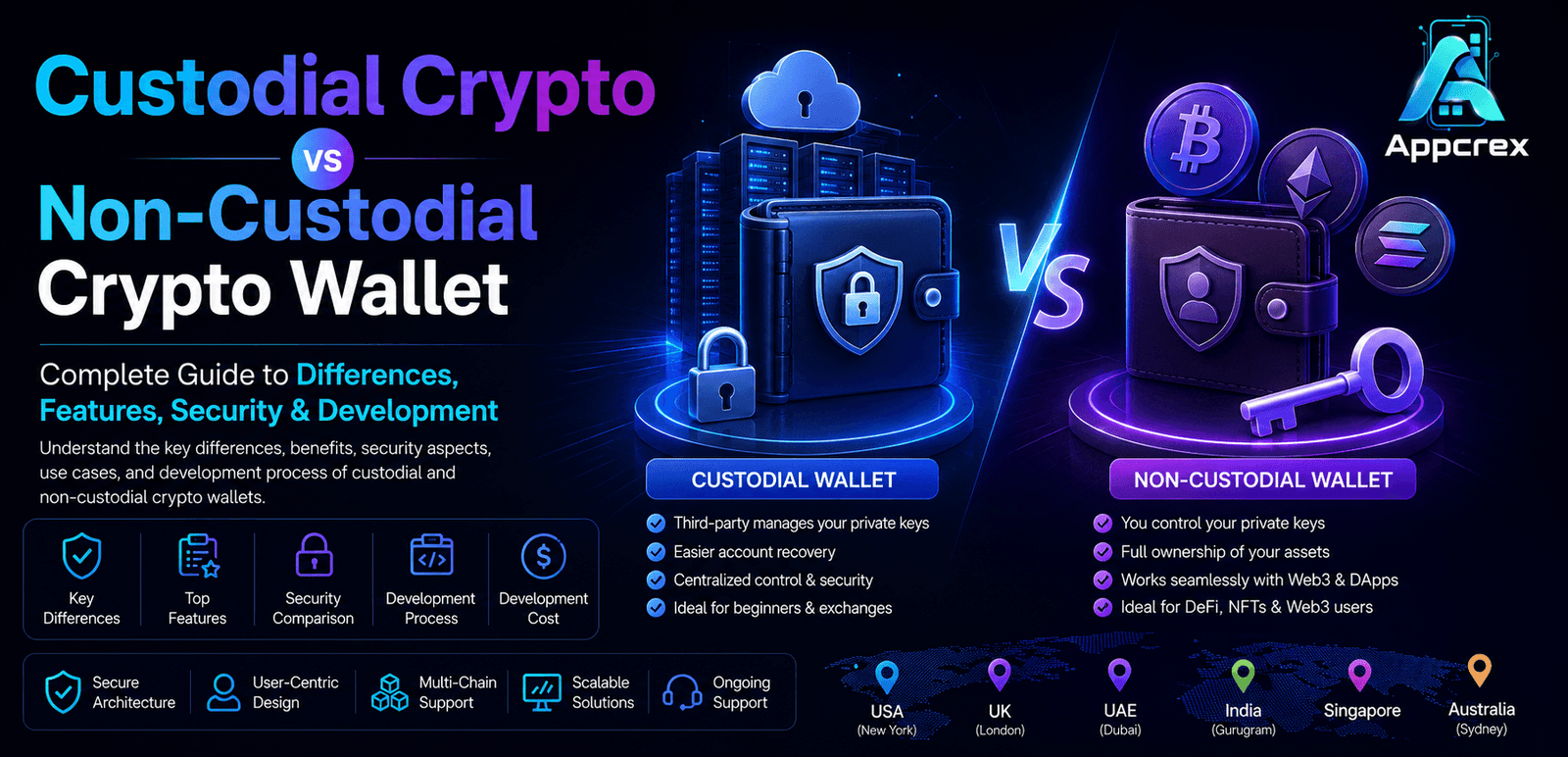
The biggest difference is who controls the private keys. In a custodial wallet, a third-party platform manages the keys and provides users with access to their assets through an account. In a non-custodial wallet, users maintain control of their private keys or recovery credentials.
For businesses planning to build a crypto wallet, choosing between these models affects the product’s architecture, security, user experience, recovery mechanisms, compliance requirements, and development cost.
What Is a Custodial Crypto Wallet?
A custodial crypto wallet is a wallet where a third-party service manages the private keys or controls the wallet infrastructure on behalf of users.
The user generally accesses their cryptocurrency through an account, similar to how users access funds through an online financial platform.
The service provider is responsible for important wallet operations such as:
- Private key management
- Transaction processing
- Wallet infrastructure
- Account recovery
- Security controls
- Asset management
Custodial wallets are commonly associated with cryptocurrency exchanges, payment platforms, fintech services, and centralized digital asset platforms.
Just Read : Blockchain Development Company: Complete Guide to Services, Cost & Development Process
What Is a Non-Custodial Crypto Wallet?
A non-custodial crypto wallet allows users to maintain control over their private keys or recovery credentials.
The wallet provider typically provides the software and infrastructure required to interact with blockchain networks but does not take custody of the user’s assets.
Users are generally responsible for:
- Private keys
- Seed phrases
- Wallet recovery
- Transaction authorization
- Wallet security
This model is widely used in the Web3 ecosystem because it gives users direct control over their blockchain accounts.
Custodial vs Non-Custodial Crypto Wallet: Quick Comparison
| Feature | Custodial Wallet | Non-Custodial Wallet |
|---|---|---|
| Private Key Control | Service provider | User |
| User Responsibility | Lower | Higher |
| Account Recovery | Usually easier | Depends on recovery mechanism |
| User Experience | Generally simpler | Requires more user responsibility |
| Web3 Access | Can be limited depending on platform | Usually strong |
| Asset Control | Managed through provider | Direct user control |
| Security Responsibility | Primarily provider | Primarily user |
| Transaction Approval | Platform-controlled process | User signs transactions |
| Ideal For | Beginners, exchanges, fintech | Web3, DeFi, experienced users |
| Development Complexity | High security and backend requirements | Strong key-management requirements |
The choice should depend on the target users, business model, regulatory environment, and desired level of user control.
How Does a Custodial Crypto Wallet Work?
The basic process can be represented as:
User → Wallet Platform → Custody Infrastructure → Blockchain
The user creates an account and accesses their assets through the platform.
When a transaction is requested, the platform’s infrastructure manages the necessary signing and blockchain interaction according to its custody architecture.
A custodial platform may also provide additional features such as:
- Account recovery
- Internal transfers
- Trading
- Buy/sell functionality
- KYC workflows
- Transaction monitoring
- Customer support
This can make custodial wallets easier for mainstream users.
How Does a Non-Custodial Crypto Wallet Work?
A non-custodial wallet generally follows a different model:
User → Wallet → Private Key/Signing Mechanism → Blockchain
The wallet helps users generate or manage their blockchain credentials.
When a transaction is initiated, the user authorizes it through the wallet’s signing mechanism.
The transaction is then submitted to the relevant blockchain network.
The wallet provider does not normally have the ability to recover the user’s private key if it is lost.
Key Features of Custodial Crypto Wallets
Account-Based Access
Users generally access their wallets through accounts managed by the platform.
Password and Authentication
Platforms can use:
- Passwords
- PINs
- Two-factor authentication
- Biometrics
- Device verification
Account Recovery
One of the biggest advantages of custodial wallets is that platforms can provide account recovery mechanisms.
Transaction Management
The platform manages the underlying transaction infrastructure.
KYC Integration
Depending on the business model and jurisdiction, custodial platforms may integrate identity verification and compliance workflows.
Customer Support
Because the platform manages the service, users can usually contact support when they experience account-related problems.
Just Read : Smart Contract Development Company: Complete Guide to Services, Cost & Development Process
Key Features of Non-Custodial Crypto Wallets
User-Controlled Keys
Users maintain control of the credentials required to authorize blockchain transactions.
Seed Phrase Backup
Many non-custodial wallets use a recovery phrase that users must securely store.
DApp Connectivity
Non-custodial wallets are commonly used to connect with:
- DeFi applications
- NFT marketplaces
- Blockchain games
- DAOs
- Web3 platforms
Transaction Signing
Users can review and approve transactions directly through the wallet.
Multi-Chain Support
Modern non-custodial wallets can support multiple blockchain ecosystems.
Token and NFT Management
Users can manage supported cryptocurrencies, tokens, and NFTs from a single wallet interface.
Advantages of Custodial Crypto Wallets
Easier User Experience
Custodial wallets can hide much of the technical complexity of blockchain transactions.
This makes them suitable for users who are new to cryptocurrency.
Account Recovery
If users lose their password or access credentials, the service may offer recovery mechanisms depending on its architecture.
Customer Support
Centralized support can help users resolve account-related issues.
Integrated Services
A custodial wallet can be integrated with:
- Trading
- Payments
- Fiat on/off ramps
- Transfers
- Compliance systems
This can create an all-in-one digital asset platform.
Disadvantages of Custodial Crypto Wallets
Third-Party Dependency
Users depend on the service provider to maintain access to their assets.
Centralized Security Risk
A security breach affecting the platform can potentially impact many users.
Less Direct Control
Users generally do not control the underlying private keys themselves.
Regulatory Requirements
Depending on the jurisdiction and business model, custodial crypto services may face significant legal and compliance obligations.
Advantages of Non-Custodial Crypto Wallets
Greater User Control
Users maintain control of their wallet credentials and transaction authorization.
Web3 Compatibility
Non-custodial wallets are well suited to decentralized applications and Web3 ecosystems.
No Central Custodian
The wallet provider does not normally hold the user’s assets on their behalf.
Direct Blockchain Interaction
Users can interact directly with blockchain networks and smart contracts.
Greater Privacy Potential
Depending on the implementation and jurisdiction, users may not need a traditional centralized account to interact with certain blockchain services.
Disadvantages of Non-Custodial Crypto Wallets
User Responsibility
Users are responsible for protecting their wallet credentials.
Recovery Challenges
If recovery credentials are permanently lost, the wallet provider may not be able to restore access.
Higher Learning Curve
Blockchain addresses, network fees, transaction signing, and seed phrases can be confusing for new users.
Transaction Mistakes
Blockchain transactions can be difficult or impossible to reverse once confirmed, depending on the network and transaction type.
Also Read : DeFi Development Company: Complete Guide to Services, Cost & Development Process
Custodial vs Non-Custodial Wallet: Which One Should You Choose in 2026?
The right crypto wallet model depends on your business goals, target users, security requirements, and level of control you want to provide.
For Beginners
A custodial wallet can be easier for beginners because account recovery and transaction management may be simpler.
For Web3 & DeFi Businesses
A non-custodial wallet is generally more suitable when users need direct interaction with DeFi protocols, DApps, NFTs, and smart contracts.
For Crypto Exchanges
A custodial wallet may be appropriate when the platform needs to manage user balances, trading, deposits, and withdrawals through centralized infrastructure.
For Fintech & Payment Platforms
The choice depends on the business model. A custodial architecture can provide a more managed user experience, while non-custodial solutions can provide greater user control.
For Enterprise Applications
Enterprises may consider a custodial, non-custodial, or hybrid architecture depending on their operational, security, and regulatory requirements.
Quick Recommendation
Choose Custodial → if simplicity, managed accounts, recovery, and centralized services are priorities.
Choose Non-Custodial → if user ownership, Web3 connectivity, DeFi, and direct transaction control are priorities.
Choose Hybrid → if your business needs different custody models for different products or user groups.
Important: The final architecture should be evaluated with appropriate legal, regulatory, security, and technical professionals, especially when a business will custody customer assets.
Which Is More Secure: Custodial or Non-Custodial?
There is no universal answer.
The security of a wallet depends on its architecture, implementation, infrastructure, key management, authentication, monitoring, and user behavior.
Custodial Security
Security is largely the responsibility of the service provider.
A strong custodial architecture may include:
- Multi-factor authentication
- Encryption
- Access controls
- Key-management systems
- Transaction monitoring
- Cold-storage strategies where appropriate
- Security monitoring
- Regular audits
Non-Custodial Security
Security responsibility is shared more directly with the user.
Important measures include:
- Secure key storage
- Seed phrase protection
- Hardware-backed security where appropriate
- Device security
- Transaction verification
- Phishing protection
- Secure wallet recovery
Therefore, custodial does not automatically mean less secure, and non-custodial does not automatically mean more secure.
Also Read : Cryptocurrency Wallet Development Company: Complete Guide to Services, Features, Cost & Development Process
Custodial vs Non-Custodial: Which Wallet Should a Business Build?
The right choice depends on the business model.
Choose a Custodial Wallet If:
- You want an account-based experience.
- Your platform needs centralized asset management.
- You want integrated trading or payment functionality.
- You plan to provide customer support for account recovery.
- Your business model requires a managed custody infrastructure.
Choose a Non-Custodial Wallet If:
- User ownership is a core product principle.
- You want strong Web3 and DApp connectivity.
- Users should directly control their assets.
- You want users to sign their own transactions.
- Your product targets DeFi and Web3 users.
Hybrid Wallet Architecture
Some businesses may consider a hybrid approach where different services or asset-management functions use different custody models.
This can provide flexibility but also increases architectural and compliance complexity.
How to Build a Custodial Crypto Wallet?
Developing a custodial wallet requires a strong backend and security architecture.
Step 1: Define the Business Model
Determine whether the wallet will be used for:
- Exchange services
- Payments
- Fintech
- Trading
- Remittances
- Enterprise asset management
Step 2: Design Custody Architecture
The development team determines how keys and assets will be managed.
Step 3: Integrate Blockchain Networks
Required blockchain networks and infrastructure are integrated.
Step 4: Build User Accounts
The platform can implement:
- Registration
- Login
- MFA
- Account management
- User verification where required
Step 5: Implement Wallet Infrastructure
Developers implement:
- Wallet generation
- Asset management
- Deposits
- Withdrawals
- Transaction processing
Step 6: Add Security Controls
Security can include:
- Encryption
- Access controls
- Monitoring
- Transaction limits
- Key-management infrastructure
Step 7: Testing and Compliance Review
Extensive testing and appropriate compliance review should be performed before launch.
How to Build a Non-Custodial Crypto Wallet?
Non-custodial development focuses heavily on secure key generation, storage, signing, and recovery.
Step 1: Select Supported Blockchains
Choose the blockchain networks and asset standards.
Step 2: Design Key Management
The architecture should ensure private keys are protected and are not unnecessarily exposed.
Step 3: Build Wallet Creation
The wallet can generate the required blockchain credentials securely.
Step 4: Implement Backup and Recovery
A secure recovery mechanism can be provided, depending on the wallet architecture.
Step 5: Add Transaction Signing
Users should be able to review and authorize transactions before signing.
Step 6: Add Web3 Integration
The wallet can connect with:
- DeFi
- NFT platforms
- DApps
- DAOs
- Web3 applications
Step 7: Test and Audit
The wallet should undergo extensive functional and security testing.
Cost to Develop Custodial vs Non-Custodial Crypto Wallet
The development cost depends on features, architecture, blockchain integrations, security requirements, and platforms.
| Wallet Type | Estimated Cost |
|---|---|
| Basic Non-Custodial Wallet | $20,000 – $40,000 |
| Advanced Non-Custodial Wallet | $35,000 – $80,000+ |
| Basic Custodial Wallet | $30,000 – $60,000 |
| Advanced Custodial Wallet | $50,000 – $120,000+ |
| Enterprise Crypto Wallet | $80,000 – $150,000+ |
These are indicative development ranges, not fixed prices.
Factors Affecting Development Cost
- Number of blockchains
- Number of supported tokens
- Custody architecture
- Security infrastructure
- Mobile platforms
- Web platform
- Wallet integrations
- DApp connectivity
- DeFi features
- NFT support
- Trading functionality
- KYC/AML integrations where applicable
- Admin dashboard
- Transaction monitoring
- Security testing
- Auditing
- Maintenance
Custodial wallets can become more expensive because businesses may need sophisticated custody infrastructure, security controls, monitoring, operational processes, and regulatory compliance.
Custodial and Non-Custodial Wallet Development Services
A professional crypto wallet development company can provide:
- Custodial wallet development
- Non-custodial wallet development
- Multi-chain wallet development
- Mobile wallet development
- Web wallet development
- DeFi wallet development
- Web3 wallet development
- WalletConnect integration
- DApp integration
- NFT wallet development
- Token integration
- Blockchain integration
- Smart contract integration
- Security testing
- Wallet maintenance
The architecture should be selected according to the project’s actual business requirements rather than simply following market trends.
Global Demand for Crypto Wallet Development
Crypto wallet development is relevant to businesses across major technology and digital-asset markets.
USA
Businesses can explore custodial and non-custodial wallets for fintech, Web3, payments, exchanges, and digital asset platforms.
UAE
Dubai and Abu Dhabi have become important markets for businesses exploring blockchain, digital assets, Web3, and fintech solutions.
Saudi Arabia
Businesses in Riyadh and other technology markets can explore blockchain-powered payment, financial, and Web3 solutions.
UK & Europe
Crypto wallet solutions can be developed for fintech, digital asset platforms, Web3 startups, and blockchain applications, with regulatory requirements varying by jurisdiction.
India
Startups and technology companies can explore blockchain wallets, Web3 applications, token platforms, and digital asset infrastructure while considering applicable local requirements.
Singapore
Singapore is another important technology and fintech market for blockchain and digital asset solutions.
Canada & Australia
Businesses can explore crypto wallet development for fintech, blockchain, Web3, payments, and digital asset use cases.
These locations represent target markets for development services, not necessarily physical office locations.
How to Choose a Crypto Wallet Development Company?
Before hiring a development company, evaluate:
Blockchain Expertise
Check experience with the networks you plan to support.
Security Expertise
Ask about:
- Key management
- Encryption
- Secure storage
- Authentication
- Transaction monitoring
- Security testing
Wallet Portfolio
Look for experience developing:
- Custodial wallets
- Non-custodial wallets
- Web3 wallets
- DeFi wallets
- Multi-chain wallets
Compliance Awareness
If building a custodial service, discuss the legal and regulatory requirements relevant to the jurisdictions where the service will operate.
Post-Launch Support
Wallet infrastructure requires ongoing maintenance, security updates, blockchain compatibility updates, and monitoring.
Also Read : How Can You Hire the Best NFT Marketplace Development Company?
Why Choose AppCrex for Crypto Wallet Development?
AppCrex provides customized blockchain and cryptocurrency wallet development solutions for businesses building Web3 and digital asset products.
Our services can include:
- Custodial crypto wallet development
- Non-custodial crypto wallet development
- Multi-chain wallet development
- Mobile crypto wallet development
- Web wallet development
- Web3 wallet development
- DeFi wallet development
- Crypto wallet integration
- Blockchain integration
- Smart contract integration
- DApp integration
- NFT wallet functionality
- Token integration
- Security testing
- Deployment and maintenance
Our team can help businesses select an appropriate wallet architecture and develop a solution around their target users, blockchain ecosystem, security requirements, and business model.
FAQs
Q. What is the main difference between custodial and non-custodial wallets?
The main difference is control of the private keys. In a custodial wallet, a service provider manages custody infrastructure. In a non-custodial wallet, users control their wallet credentials and transaction signing.
Q. Is a non-custodial wallet safer than a custodial wallet?
Not automatically. Both models have different security risks. Custodial security depends heavily on the service provider, while non-custodial security places more responsibility on the user.
Q. Which wallet is better for beginners?
Custodial wallets can provide a simpler experience because the platform handles many technical aspects. Non-custodial wallets can provide greater control but require users to understand wallet security and recovery.
Q. Which wallet is better for Web3?
Non-custodial wallets are generally well suited for Web3 because users can directly connect with DApps and authorize blockchain transactions.
Q. Can a business build both custodial and non-custodial wallets?
Yes, but supporting both models can significantly increase technical, operational, security, and compliance complexity.
Q. How much does it cost to build a crypto wallet?
Depending on the architecture and features, crypto wallet development can range from approximately $20,000 to $150,000+.
Q. How long does it take to develop a crypto wallet?
A basic wallet may take several weeks, while an advanced custodial, multi-chain, or enterprise wallet can require several months.
Q. Can crypto wallets support multiple blockchains?
Yes. Both custodial and non-custodial wallets can be designed to support multiple blockchain networks.
Conclusion
The choice between a custodial crypto wallet and a non-custodial crypto wallet depends on the level of user control, business model, target audience, security architecture, operational requirements, and applicable regulations.
Custodial wallets can provide a convenient, account-based experience with managed custody and recovery options. Non-custodial wallets provide users with greater direct control and are particularly suitable for Web3 and decentralized applications.
For businesses, the most important step is not simply choosing one model—it is designing the right custody architecture, security strategy, user experience, and blockchain infrastructure around the intended product.
Build a Crypto Wallet with AppCrex
AppCrex can help businesses develop custodial and non-custodial cryptocurrency wallets with multi-chain support, Web3 integration, DApp connectivity, token support, security features, and customized functionality.
Have a crypto wallet idea? Contact AppCrex to discuss your wallet development requirements and build a solution tailored to your business.