📌 Key Takeaways
- Blockchain is a distributed ledger designed to create shared, tamper-evident records.
- Smart contracts automate predefined business logic on supported blockchain networks.
- Blockchain has applications beyond cryptocurrency, including finance, supply chain, identity, healthcare, gaming, and asset management.
- Blockchain is not automatically better than a traditional database; the right choice depends on the business problem.
- Successful blockchain development requires careful attention to architecture, security, scalability, integrations, and regulatory requirements.
Quick Answer
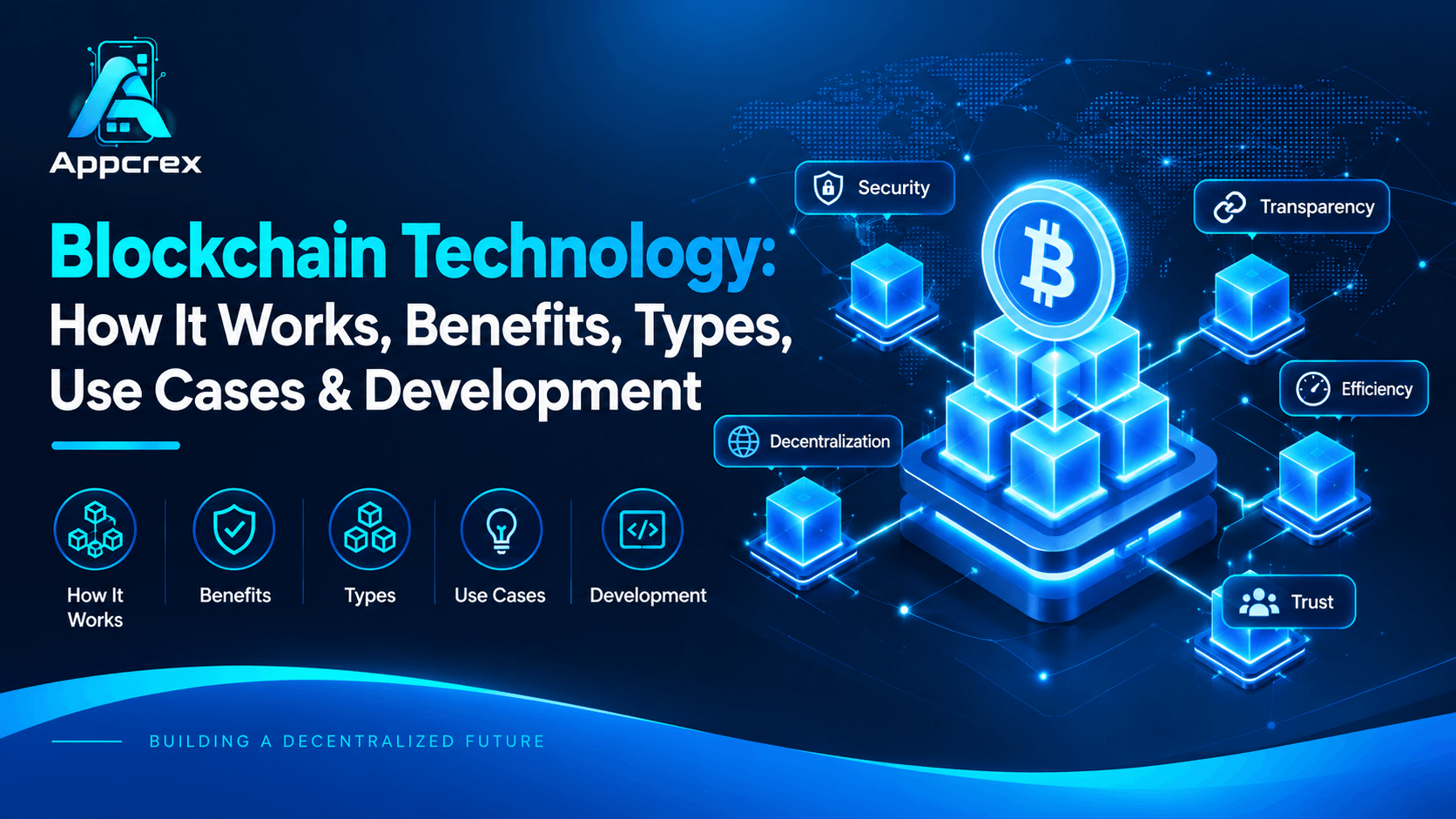
Blockchain technology is a distributed digital ledger that records transactions or data across a network of computers. Transactions are grouped into blocks, cryptographically linked, validated through network rules, and replicated across participating nodes. This makes blockchain useful for applications that require transparency, traceability, shared verification, digital ownership, and automated business rules through smart contracts.
Introduction
Blockchain technology has moved beyond its original association with cryptocurrency. Today, businesses are exploring blockchain for financial services, supply chain management, healthcare, digital identity, asset tokenization, insurance, gaming, real estate, and decentralized applications.
The main idea behind blockchain is relatively simple: instead of keeping important transaction records in a single centralized database, a blockchain can maintain a shared ledger across a network of participating computers.
Each transaction is validated according to the rules of the network and recorded in a block. Blocks are cryptographically connected, creating a chronological chain of records. This structure makes unauthorized changes detectable and can provide a shared source of truth between participating parties.
However, blockchain is not automatically the right solution for every business problem. A traditional database can be faster, simpler, and less expensive for many applications.
The real value of blockchain appears when businesses need shared verification, multi-party trust, traceability, programmable transactions, or decentralized ownership.
Just Read : Blockchain Development Company: Complete Guide to Services, Cost & Development Process
What Is Blockchain Technology?
Blockchain technology is a distributed ledger technology that enables multiple participants to maintain and verify a shared record of transactions or data. Information is grouped into blocks, and each block is cryptographically linked to the previous one.
Unlike a conventional database where one organization generally controls the database, blockchain can distribute copies of the ledger across participating nodes.
A simplified structure looks like this:
Transaction → Validation → Block → Consensus → Blockchain → Replicated Ledger
NIST describes blockchain as a distributed digital ledger containing cryptographically signed transactions that are grouped into blocks and linked after validation and consensus.
Blockchain in simple words
Think of blockchain as a shared digital record book.
Instead of one person keeping the only copy:
- Multiple participants can maintain copies.
- New transactions are validated.
- Records are grouped into blocks.
- Blocks are connected using cryptographic references.
- Changes to historical records become detectable.
This model can be valuable when several organizations need to share transaction information without relying entirely on one central record keeper.
How Does Blockchain Technology Work?
Blockchain generally works through a sequence of validation and recording steps.
1. A transaction is initiated
A user or application creates a transaction.
This could involve:
- Sending a digital asset
- Recording a supply-chain event
- Transferring ownership
- Executing a smart contract
- Creating a token
2. The transaction is broadcast
The transaction is sent to the blockchain network.
Participating nodes receive the transaction and evaluate it according to the network’s rules.
3. The transaction is validated
The network verifies whether the transaction is legitimate.
Validation can involve:
- Digital signatures
- Account balances
- Smart-contract rules
- Network permissions
- Consensus mechanisms
4. Transactions are grouped into blocks
Valid transactions are organized into a block.
The block contains transaction information and cryptographic references that connect it to the existing blockchain.
5. Consensus is achieved
The blockchain network uses its consensus mechanism to determine which transactions or blocks should be accepted.
Different blockchain networks can use different consensus approaches.
6. The block is added to the blockchain
Once accepted, the block becomes part of the blockchain’s chronological record.
7. The ledger is replicated
Relevant participating nodes update their copies of the ledger.
This distributed architecture is one of the fundamental characteristics of blockchain systems.
What Are the Main Components of Blockchain Technology?
A blockchain application usually involves several technical components.
| Component | What It Does |
|---|---|
| Blocks | Store transaction or state information |
| Nodes | Participate in maintaining or validating the network |
| Cryptography | Helps protect transaction integrity |
| Consensus | Helps participants agree on network state |
| Digital Signatures | Authenticate transactions |
| Smart Contracts | Execute programmed business logic |
| Wallets | Manage blockchain accounts and assets |
| Oracles | Bring external data into smart-contract environments |
| APIs/RPC | Connect applications with blockchain networks |
| Blockchain Network | Provides the underlying distributed infrastructure |
These components can vary depending on whether the project uses a public, private, consortium, or hybrid blockchain architecture.
What Are the Different Types of Blockchain?
Blockchain networks can be designed differently depending on participation, governance, access, and business requirements.
Public Blockchain
A public blockchain is generally open for broad participation.
Examples include:
- Bitcoin
- Ethereum
Public blockchains are commonly used for:
- Cryptocurrency
- Decentralized applications
- Digital assets
- Smart contracts
- Tokenization
Private Blockchain
A private blockchain restricts participation to approved users or organizations.
It can be useful for enterprise applications where businesses need greater control over:
- Access
- Participants
- Data visibility
- Governance
- Network operations
Consortium Blockchain
A consortium blockchain is governed by multiple organizations.
For example, several companies in a supply chain could participate in a shared blockchain network.
This model can be useful when no single organization should have complete control over the shared ledger.
Hybrid Blockchain
A hybrid blockchain combines selected characteristics of public and private blockchain environments.
It can be considered when an organization needs controlled access to certain information while still requiring broader verification for other activities.
What Is a Smart Contract?
A smart contract is a program deployed on a blockchain that executes predefined logic when its functions are called and the required conditions are met. NIST describes smart contracts as code and data deployed through cryptographically signed blockchain transactions and executed by network nodes.
For example:
Payment received → Verify conditions → Transfer digital asset → Record transaction
Smart contracts can automate processes that would otherwise require manual intervention.
Smart contract use cases include:
- Digital marketplaces
- Tokenization
- Decentralized finance
- Insurance automation
- Escrow
- Digital assets
- Gaming
- Loyalty programs
- Supply-chain workflows
Ethereum, for example, uses smart contracts as programmable applications running on its blockchain. Solidity and Vyper are among the languages used for Ethereum smart contract development.
What Are the Benefits of Blockchain Technology?
1. Transparency
Blockchain can provide participating parties with a shared transaction history, depending on the network’s access and visibility model.
This can improve visibility across multi-party processes.
2. Traceability
Blockchain can create a chronological record of transactions or events.
This makes it useful for:
- Supply chains
- Product provenance
- Asset tracking
- Logistics
- Manufacturing
3. Tamper Evidence
Cryptographic links between blocks make unauthorized changes to historical records detectable.
However, blockchain should not be described as magically “100% immutable” or “completely secure.” Application architecture, private keys, smart contracts, access controls, and the underlying network all affect security.
4. Automation
Smart contracts can automate predefined processes without requiring manual execution for every step.
Organizations can use blockchain to maintain a common record across participating parties.
6. Digital Ownership
Blockchain can represent ownership or control of digital assets through tokens and smart contracts.
7. Reduced Reconciliation
Where multiple organizations maintain separate records, a shared ledger can potentially reduce the need to repeatedly reconcile databases.
What Are the Use Cases of Blockchain Technology?
Blockchain has applications across multiple industries.
Blockchain in Financial Services
Financial organizations can explore blockchain for:
- Digital assets
- Tokenization
- Transaction settlement
- Cross-border payment infrastructure
- Smart-contract-based workflows
- Asset management
Blockchain in Supply Chain Management
Supply chains involve multiple organizations that often maintain separate systems.
Blockchain can provide a shared record for events such as:
Manufacturer → Supplier → Distributor → Warehouse → Retailer
Potential applications include:
- Product provenance
- Shipment tracking
- Inventory events
- Supplier verification
- Anti-counterfeit systems
NIST identifies manufacturing supply chains and related records as potential blockchain application areas.
Blockchain in Healthcare
Potential healthcare applications include:
- Provider credential verification
- Medical data sharing
- Pharmaceutical traceability
- Consent management
- Clinical research
- Identity verification
However, sensitive medical information requires careful privacy, access-control, security, and regulatory design. Blockchain should not automatically be treated as a replacement for conventional healthcare databases.
Blockchain in Real Estate
Blockchain can support:
- Digital ownership
- Asset tokenization
- Property records
- Automated agreements
- Transaction workflows
Blockchain in Insurance
Potential use cases include:
- Automated claims
- Fraud prevention workflows
- Policy management
- Smart-contract-based payouts
- Document verification
Blockchain in Gaming
Blockchain gaming applications can use blockchain networks for:
- Digital assets
- Tokenized items
- Marketplace transactions
- Player-owned assets
- Digital collectibles
Blockchain for Digital Identity
Blockchain-based identity systems can support:
- Verifiable credentials
- Identity verification
- Credential management
- Decentralized identity models
NIST has also researched blockchain-based identity management approaches.
Blockchain vs Traditional Database
A common misconception is that blockchain is always better than a traditional database.
It isn’t.
The right technology depends on the business problem.
| Factor | Blockchain | Traditional Database |
|---|---|---|
| Data ownership | Can be distributed | Usually centralized |
| Governance | Network-defined | Database owner-defined |
| Consensus | Often required | Generally unnecessary |
| Historical modification | Designed for tamper evidence | Usually easier |
| Performance | Depends on blockchain design | Often very high |
| Multi-party trust | Strong use case | Requires trusted central party |
| Smart contracts | Supported by suitable platforms | Requires application logic |
| Best for | Shared verification and decentralized workflows | Centralized applications |
When should a business use blockchain?
Blockchain may be appropriate when:
- Multiple parties need a shared ledger.
- Participants do not fully trust one central authority.
- Transaction history needs strong traceability.
- Digital assets or ownership are important.
- Smart contracts can automate business rules.
- Multiple organizations need shared verification.
If none of these requirements exist, a conventional database may be a better solution.
What Technologies Are Used for Blockchain Development?
A blockchain development project can include several technology layers.
Blockchain Platforms
Common platforms and ecosystems include:
- Ethereum
- Polygon
- Solana
- Avalanche
- BNB Chain
- Hyperledger technologies
The right choice depends on the project’s requirements rather than popularity alone.
Smart Contract Technologies
Depending on the blockchain:
- Solidity
- Vyper
- Chaincode
- EVM-compatible development tools
Backend Technologies
A blockchain application can use:
- Node.js
- Python
- Java
- Go
- REST APIs
- RPC services
Frontend Technologies
For web and mobile interfaces:
- React
- Next.js
- JavaScript/TypeScript
- React Native
- Flutter
Infrastructure
Enterprise blockchain applications may also require:
- Cloud infrastructure
- Databases
- API gateways
- Monitoring
- Security systems
- Blockchain nodes
- Indexing infrastructure
- Wallet services
How Do You Develop a Blockchain Application?
A typical blockchain development process includes:
Step 1: Define the Business Use Case
First determine whether blockchain actually solves the business problem.
Step 2: Choose the Blockchain Architecture
Decide between:
- Public
- Private
- Consortium
- Hybrid
Step 3: Select the Blockchain Platform
Evaluate:
- Scalability
- Transaction model
- Ecosystem
- Security
- Governance
- Development tools
- Cost
Step 4: Design Smart Contracts
Define:
- Business rules
- Functions
- Permissions
- Data structures
- Transaction logic
Step 5: Develop Backend and APIs
Connect blockchain infrastructure with your business systems.
Step 6: Build Web or Mobile Applications
Create the user-facing application.
Step 7: Integrate Wallets and External Systems
Depending on the application, this could include:
- Digital wallets
- Payment systems
- ERP
- CRM
- Identity systems
- Third-party APIs
Step 8: Test the Application
Testing should cover:
- Smart contracts
- APIs
- Transactions
- Authentication
- Wallet interactions
- Performance
- Security
Step 9: Conduct Security Review
Smart contracts and blockchain applications should undergo appropriate security testing before production.
Step 10: Deploy and Monitor
After deployment, monitor:
- Transactions
- Infrastructure
- Smart contracts
- APIs
- Security events
- Application performance
How Much Does Blockchain Development Cost?
The cost of blockchain development depends on the project’s architecture, features, blockchain platform, smart contracts, integrations, security requirements, and development team.
For planning purposes:
| Project Type | Estimated Development Cost |
|---|---|
| Basic Blockchain MVP | $25,000–$50,000 |
| Blockchain DApp | $40,000–$100,000 |
| Smart Contract Platform | $30,000–$100,000+ |
| Tokenization Platform | $50,000–$150,000+ |
| Blockchain Marketplace | $60,000–$150,000+ |
| Enterprise Blockchain | $100,000–$300,000+ |
| Complex Blockchain Ecosystem | $200,000–$500,000+ |
These are indicative planning ranges, not fixed industry prices.
What affects blockchain development cost?
The biggest cost factors include:
- Blockchain architecture
- Platform selection
- Smart-contract complexity
- Number of integrations
- Wallet functionality
- UI/UX requirements
- Security audits
- Backend infrastructure
- Compliance requirements
- Development team location
- Testing requirements
- Post-launch maintenance
Also Read : E-Wallet App Development Like Paytm & PhonePe: Features, Cost & Tech Stack (2026)
What Are the Challenges of Blockchain Technology?
Blockchain provides valuable capabilities, but businesses should also understand its limitations.
Scalability
Different blockchain networks have different performance characteristics. High transaction volumes can require specialized architecture or scaling solutions.
Development Complexity
Blockchain applications require expertise across:
- Distributed systems
- Cryptography
- Smart contracts
- Security
- Backend development
- Web/mobile development
Security Risks
Blockchain itself may provide strong security mechanisms, but vulnerabilities can still exist in:
- Smart contracts
- Wallets
- Private-key management
- APIs
- Frontend applications
- Access controls
Regulatory Requirements
Applications involving financial services, digital assets, healthcare, identity, or sensitive data may have specific legal and regulatory requirements.
User Experience
Wallet addresses, transaction confirmations, network fees, and blockchain terminology can make applications difficult for mainstream users.
A successful blockchain product should therefore make the underlying technology as invisible as possible to the end user.
How Do You Choose the Right Blockchain Development Company?
Before hiring a blockchain development company, consider these factors.
Technical Expertise
Check experience with:
- Blockchain architecture
- Smart contracts
- DApps
- Wallets
- APIs
- Security
- Cloud infrastructure
Industry Experience
A company that understands your industry can better identify relevant blockchain use cases and integration requirements.
Security Practices
Ask about:
- Smart-contract testing
- Code reviews
- Security audits
- Penetration testing
- Key management
- Access controls
Technology Selection
The Mobile development company should recommend the technology based on your business requirements rather than forcing the same blockchain onto every project.
Scalability Planning
The architecture should support future growth in:
- Users
- Transactions
- Assets
- Integrations
- Geographic markets
Post-Launch Support
Blockchain applications require ongoing:
- Monitoring
- Security updates
- Infrastructure management
- Smart-contract maintenance
- Performance optimization
Why Choose AppCrex for Blockchain Development?
AppCrex can help businesses plan and develop custom blockchain applications based on their technical and business requirements.
Potential blockchain development services include:
- Blockchain consulting
- Blockchain application development
- Smart contract development
- DApp development
- Blockchain mobile app development
- Tokenization solutions
- Wallet integration
- Blockchain API integration
- Enterprise blockchain solutions
- Web3 development
- Blockchain maintenance and support
The goal should be to determine where blockchain provides a genuine business advantage and then build the application around that use case.
FAQs
Q. What is blockchain technology?
Blockchain technology is a distributed ledger system that records transactions or data across a network. Records are grouped into blocks and cryptographically linked, creating a tamper-evident history that participating nodes can maintain and validate.
Q. How does blockchain work?
Blockchain works by validating transactions, grouping them into blocks, reaching consensus according to network rules, adding accepted blocks to the chain, and distributing the updated ledger across participating nodes.
Q. Is blockchain only used for cryptocurrency?
No. Blockchain can also be used for supply chain management, digital identity, asset tokenization, healthcare-related workflows, financial applications, gaming, insurance, and other multi-party systems.
Q. What is a smart contract?
A smart contract is blockchain-based code and data that executes predefined logic when called. Its results are recorded on the blockchain.
Q. What is the difference between blockchain and a database?
A traditional database is generally controlled by a central organization, while blockchain can distribute ledger maintenance across participating nodes and use consensus to establish a shared record.
Q. How much does blockchain development cost?
Blockchain development can range from approximately $25,000 for a basic MVP to $300,000+ for complex enterprise solutions, while highly sophisticated blockchain ecosystems can cost considerably more.
Q. Which blockchain is best for business applications?
There is no universal best blockchain. The right platform depends on factors such as application requirements, transaction model, security, scalability, governance, integrations, smart-contract requirements, and regulatory considerations.
Q. Is blockchain completely secure?
No technology is completely secure. Blockchain can provide cryptographic protection and tamper-evident records, but smart contracts, wallets, private keys, APIs, and application code can still introduce vulnerabilities.
Conclusion
Blockchain technology provides a new way for organizations and applications to create shared, verifiable, and tamper-evident digital records. Its strongest applications are generally those involving multiple parties, digital assets, traceability, shared verification, or programmable transactions.
From financial services and supply chains to healthcare, digital identity, real estate, gaming, and enterprise applications, blockchain can support a wide range of business models.
However, blockchain should not be selected simply because it is a popular technology. Businesses should first evaluate whether decentralization, shared verification, smart contracts, or digital ownership solve a genuine problem.
For organizations moving forward with blockchain development, the right approach is to begin with the business use case, select the appropriate architecture and blockchain platform, design a secure application, and plan for scalability, compliance, and long-term maintenance.