📌 Key Takeaways
- NDIS software can centralise participants, plans, services, workers, billing and reporting.
- Custom NDIS software costs roughly AUD $30,000–$300,000+ depending on complexity.
- Security, permissions and data protection should be considered from the beginning.
- AI can add automation, analytics, document processing and scheduling assistance.
- NDIS pricing and operational requirements change, so software should be designed for ongoing updates.
Quick Answer
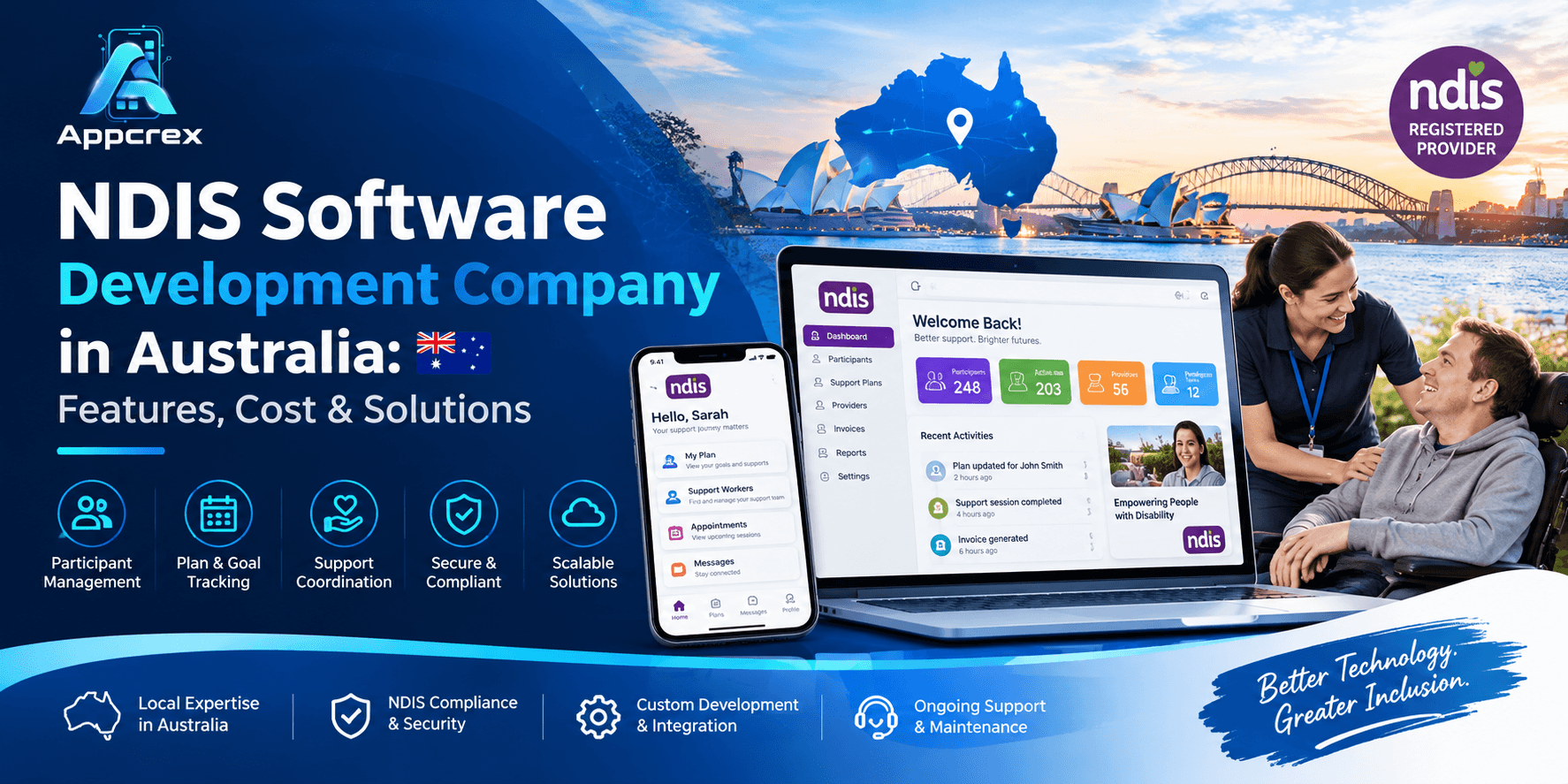
NDIS software development in Australia involves creating customised digital platforms that help NDIS providers, plan managers and disability support organisations manage participants, plans, budgets, services, staff, invoices, claims, documentation and reporting. A custom NDIS software solution can include web dashboards, mobile apps, automation, analytics and integrations to streamline operations and improve visibility.
The NDIS currently publishes pricing schedules and maximum prices for relevant supports, including a schedule effective from July 2026, so NDIS software should be designed with the organisation’s actual workflows and current requirements in mind.
Introduction
The NDIS has created a growing need for reliable digital solutions across Australia. Managing participants, support workers, schedules, budgets, invoices and claims through multiple systems can become challenging as an organisation grows.
An NDIS software development company in Australia can build a centralised platform to simplify these workflows, automate repetitive tasks and improve operational visibility. With NDIS pricing arrangements and requirements continuing to evolve, flexible software architecture is also important for long-term scalability.
In this guide, we’ll cover NDIS software features, development costs, technology, security considerations and the process of building a custom NDIS solution in Australia.
What Is NDIS Software Development?
NDIS software development means building a custom software platform specifically for businesses operating within the National Disability Insurance Scheme (NDIS) ecosystem.
Depending on the organisation, the platform may help manage:
- NDIS participants
- Support workers
- Service providers
- Participant plans
- Funding and budgets
- Invoices and payments
- Claims
- Rostering and scheduling
- Service agreements
- Documents
- Reporting
- Communication
- Staff management
- Business analytics
For example, NDIS plan managers are responsible for financial administration, tracking participant spending, processing invoices, paying providers and maintaining records.
A well-designed NDIS management system brings these activities into one centralised platform rather than relying on spreadsheets, emails and disconnected tools.
Why Do NDIS Providers Need Custom Software?
Managing NDIS operations manually can become difficult as the number of participants, workers and service bookings increases.
Custom NDIS software can help organisations:
- Reduce repetitive administrative work
- Centralise participant information
- Monitor budgets and spending
- Manage employee schedules
- Automate invoices
- Track claims
- Store important documents
- Improve communication
- Generate reports
- Monitor business performance
- Reduce data duplication
- Improve operational visibility
For plan managers in particular, software can support workflows around budgets, invoices, provider payments, claims and financial records.
What Features Should NDIS Software Include?
The right features depend on whether the platform is designed for an NDIS provider, plan manager, support coordinator, participant or a larger disability services organisation.
1. Participant Management
Create a central participant profile containing:
- Personal information
- NDIS plan details
- Funding information
- Support requirements
- Service agreements
- Documents
- Contact information
- Assigned workers
- Service history
2. NDIS Plan and Budget Management
The system can help organisations monitor:
- Total allocated funding
- Budget categories
- Amount spent
- Remaining budget
- Service utilisation
- Upcoming expenses
- Budget alerts
This can make it easier to identify potential overspending or under-utilisation.
3. Support Worker Management
An NDIS platform can provide:
- Worker profiles
- Availability management
- Qualifications
- Certifications
- Participant assignments
- Timesheets
- Shift management
- Performance information
4. Rostering and Scheduling
Scheduling functionality can help businesses assign support workers according to:
- Participant requirements
- Worker availability
- Service type
- Location
- Date and time
- Recurring schedules
A calendar-based interface can make rostering easier for administrators.
5. Invoicing and Payments
An NDIS software platform can automate parts of the invoicing workflow, including:
- Invoice creation
- Invoice tracking
- Payment status
- Provider payments
- Receipts
- Outstanding invoices
- Financial reports
6. Claims Management
Claims functionality can help organisations prepare, review and track claims while applying their own business rules and required checks.
Because NDIS claims need to align with applicable plans, budgets and support requirements, the software should provide appropriate validation and review workflows rather than assuming every claim is automatically compliant.
7. Document Management
The platform can securely organise:
- Service agreements
- Participant documents
- Worker documents
- Reports
- Invoices
- Assessment documents
- Consent records
- Compliance-related documents
8. Notifications and Alerts
Automated notifications can remind users about:
- Upcoming appointments
- Expiring documents
- Worker certifications
- Scheduled services
- Invoice deadlines
- Budget thresholds
- Important participant activities
9. Reporting and Analytics
Administrators can access dashboards for:
- Revenue
- Expenses
- Participant activity
- Worker utilisation
- Service delivery
- Claims
- Budget utilisation
- Outstanding invoices
What Advanced Features Can Be Added to NDIS Software?
Modern NDIS platforms can go beyond basic administration.
AI-Powered Features
AI can potentially support:
- Intelligent document classification
- Automated data extraction
- Invoice categorisation
- Demand forecasting
- Workforce scheduling assistance
- Anomaly detection
- Predictive business analytics
- AI-powered support chatbots
- Automated report generation
AI should support staff rather than make unsupported decisions about participant eligibility, funding or care.
Mobile Applications
A companion mobile app can be developed for:
Support workers
- View schedules
- Check participant details
- Record service information
- Submit timesheets
- Receive notifications
Participants
- View appointments
- Access documents
- Communicate with providers
- Track relevant information
Administrators
- Monitor operations
- Approve workflows
- Review alerts
- Access dashboards
How Much Does It Cost to Develop NDIS Software in Australia?
The cost of developing custom NDIS software generally depends on the number of modules, user roles, integrations, automation requirements, security architecture and whether mobile applications are included.
| NDIS Software Type | Estimated Cost |
|---|---|
| Basic NDIS Management MVP | AUD $30,000–$50,000 |
| Mid-Level NDIS Platform | AUD $50,000–$100,000 |
| Advanced NDIS Software | AUD $100,000–$180,000+ |
| Enterprise NDIS Platform | AUD $180,000–$300,000+ |
These are indicative software development estimates, not official NDIS prices.
For a simple internal management platform, the cost can be considerably lower than a large multi-tenant platform with mobile apps, advanced analytics and multiple integrations.
What Factors Affect NDIS Software Development Cost?
Several factors can significantly change the final development budget.
1. Number of Features
A basic participant management system costs less than a complete platform combining:
- CRM
- Rostering
- Billing
- Claims
- Accounting
- Reporting
- Mobile apps
- AI
2. Number of User Roles
A platform supporting participants, support workers, administrators, plan managers and providers requires more complex permissions and workflows.
3. Integrations
Integrating third-party systems, payment services, accounting platforms, communication tools or relevant NDIS-related workflows can increase development complexity.
4. Mobile Applications
Developing separate native iOS and Android applications can increase cost. Cross-platform technologies such as React Native can be considered when appropriate.
5. Security Requirements
NDIS software may handle highly sensitive personal and operational information, so security should be considered from the architecture stage.
Important areas include:
- Encryption
- Authentication
- Role-based access
- Secure APIs
- Audit logs
- Backup
- Access monitoring
- Data retention policies
6. AI and Automation
AI-powered workflows require additional development, testing, data processing and monitoring.
How Does NDIS Software Work?
A typical NDIS management platform can follow this workflow:
Participant Registration → Plan & Budget Setup → Service Management → Worker Scheduling → Service Delivery → Invoice Creation → Claim Review → Payment → Reporting
For plan management workflows, the NDIS states that plan managers use provider portals to access participant plan and budget information and submit claims through the applicable portal processes.
The custom platform can therefore act as the organisation’s operational layer while integrations and portal workflows are designed around the systems the business is actually authorised and required to use.
NDIS Software Development Process
A professional NDIS software development process usually includes:
Step 1: Business Requirement Analysis
The development team identifies:
- Business model
- User roles
- Existing systems
- Operational problems
- Required integrations
- Security requirements
Step 2: UX/UI Design
Design intuitive dashboards for:
- Administrators
- Participants
- Workers
- Managers
- Providers
Step 3: MVP Development
Start with essential functionality such as participant management, scheduling, invoicing and reporting.
Step 4: Backend Development
Develop APIs, databases, authentication and business logic.
Step 5: Frontend and Mobile Development
Build responsive web dashboards and mobile applications where required.
Step 6: Integration
Connect required third-party systems and business tools.
Step 7: Security Testing
Test authentication, permissions, APIs, data protection and potential vulnerabilities.
Step 8: User Acceptance Testing
Allow real business users to test important workflows before launch.
Step 9: Deployment
Deploy the platform to the selected cloud environment with appropriate monitoring and backup systems.
Step 10: Maintenance
Continue with:
- Security updates
- Bug fixes
- Performance optimisation
- New features
- Integration updates
- Regulatory/workflow updates
What Technology Stack Can Be Used?
An NDIS software development company may use technologies such as:
| Layer | Technologies |
|---|---|
| Frontend | React.js, Next.js, Angular |
| Mobile | React Native, Flutter, Swift, Kotlin |
| Backend | Node.js, Python, Java, .NET |
| Database | PostgreSQL, MySQL, MongoDB |
| Cloud | AWS, Microsoft Azure, Google Cloud |
| APIs | REST APIs, GraphQL |
| AI | Python, ML frameworks, LLM APIs |
| Security | OAuth, JWT, RBAC, encryption |
| Analytics | Power BI, custom dashboards |
The exact stack should be selected based on the platform’s requirements rather than simply choosing the most popular technology.
NDIS Software Security and Compliance Considerations
Security should be one of the most important parts of an NDIS software project.
The platform may handle sensitive participant and financial information, so businesses should consider:
- Role-based access control
- Multi-factor authentication
- Encryption in transit and at rest
- Secure API architecture
- Audit trails
- Data backup
- Access logging
- Secure cloud infrastructure
- Vulnerability testing
- Data retention policies
- Disaster recovery
It is also important to distinguish software security from regulatory compliance. Building an application does not automatically make it “NDIS compliant.” The final architecture and operational processes should be reviewed against the organisation’s applicable obligations and current NDIS requirements.
The NDIS pricing environment can also change; the current 2026–27 pricing schedules establish maximum prices for applicable supports, so software involving pricing or billing should be designed to accommodate updates rather than hard-code assumptions.
Custom NDIS Software vs Off-the-Shelf Software
| Factor | Custom NDIS Software | Off-the-Shelf Software |
|---|---|---|
| Customisation | High | Limited |
| Business workflows | Tailored | Predefined |
| Scalability | High | Depends on vendor |
| Integrations | Customisable | Available options |
| Initial Cost | Higher | Usually lower |
| Long-Term Flexibility | High | Moderate |
| Branding | Full control | Limited |
| AI Features | Customisable | Depends on product |
Custom development makes more sense when an organisation has complex workflows or wants to build a differentiated NDIS platform rather than adapt its processes to an existing product.
How to Choose an NDIS Software Development Company in Australia?
Before hiring a development partner, evaluate:
NDIS Domain Understanding
The team should understand the difference between participants, providers, plan managers, support workers and other stakeholders.
Technical Expertise
Check experience with:
- Web applications
- Mobile applications
- Cloud
- APIs
- Security
- AI
- Database architecture
Data Security
Ask how the development company handles:
- Authentication
- Encryption
- Permissions
- Backups
- Audit logs
- Security testing
Scalability
Your software should be able to support additional participants, workers, locations and organisations as the business grows.
Post-Launch Support
Ask whether the development partner provides:
- Maintenance
- Security updates
- Bug fixing
- Cloud support
- Performance monitoring
- Feature upgrades
Also Read : Custom Software Development Company: Complete Guide to Services, Process, Cost & Benefits (2026)
Why Choose AppCrex for NDIS Software Development?
AppCrex can help businesses build custom NDIS software solutions based on their operational requirements.
Possible solutions include:
- NDIS provider management software
- Participant management systems
- NDIS plan management platforms
- Disability support management software
- NDIS billing solutions
- Workforce management platforms
- NDIS mobile applications
- AI-powered disability support platforms
- Custom dashboards and reporting systems
The development approach can be tailored around the organisation’s users, workflows, integrations, security requirements and future scalability.
FAQs
Q. How much does NDIS software development cost in Australia?
Custom NDIS software can start from around AUD $30,000 for a basic MVP and exceed AUD $300,000 for a complex enterprise platform. Features, integrations, mobile apps, security, AI, user roles and development complexity are major cost factors.
Q. How long does it take to develop NDIS software?
A basic NDIS MVP may take approximately 3–5 months, while a medium or advanced platform can take 6–12+ months. Enterprise solutions may require longer depending on integrations and testing.
Q. Can NDIS software include a mobile app?
Yes. An NDIS platform can include mobile applications for participants, support workers, administrators or other authorised users.
Q. Can AI be integrated into NDIS software?
Yes. AI can be used for document processing, reporting, scheduling assistance, analytics, workflow automation and other carefully defined use cases.
Q. Can NDIS software integrate with accounting systems?
Yes. Custom software can be designed to integrate with accounting, payment, CRM, communication and other business systems through APIs where supported.
Q. Is custom NDIS software automatically NDIS compliant?
No. Software compliance depends on the applicable requirements, architecture, data handling, workflows and how the organisation operates the platform. Requirements should be reviewed as NDIS policies and pricing arrangements change.
Conclusion
An NDIS software development company in Australia can help disability service providers and related organisations replace fragmented administrative processes with a centralised digital platform.
From participant management and worker scheduling to invoicing, claims, reporting, mobile apps and AI-powered automation, custom software can be designed around the organisation’s specific operational requirements.
For organisations planning an NDIS platform in Australia, the best approach is to start with the core workflows, build an MVP, establish strong security and then expand the platform through integrations, automation, analytics and mobile functionality.