
📌 Key Takeaways
- Aerospace MES software can cost $50,000 to $500,000+, depending on complexity and integrations.
- Core features include production management, traceability, quality control, digital work instructions, and analytics.
- ERP, PLM, QMS, IoT, and testing integrations can significantly increase development costs.
- AI can add predictive maintenance, demand forecasting, anomaly detection, and advanced production analytics.
- A custom aerospace MES platform can improve production visibility, traceability, automation, and operational decision-making.
Introduction
Aerospace manufacturing requires highly controlled production processes, complete traceability, strict quality management, engineering change control, and real-time visibility across manufacturing operations. As aerospace companies modernise their factories, aerospace manufacturing execution software (MES) is becoming an important part of digital manufacturing strategies.
But how much does it cost to develop aerospace manufacturing execution software?
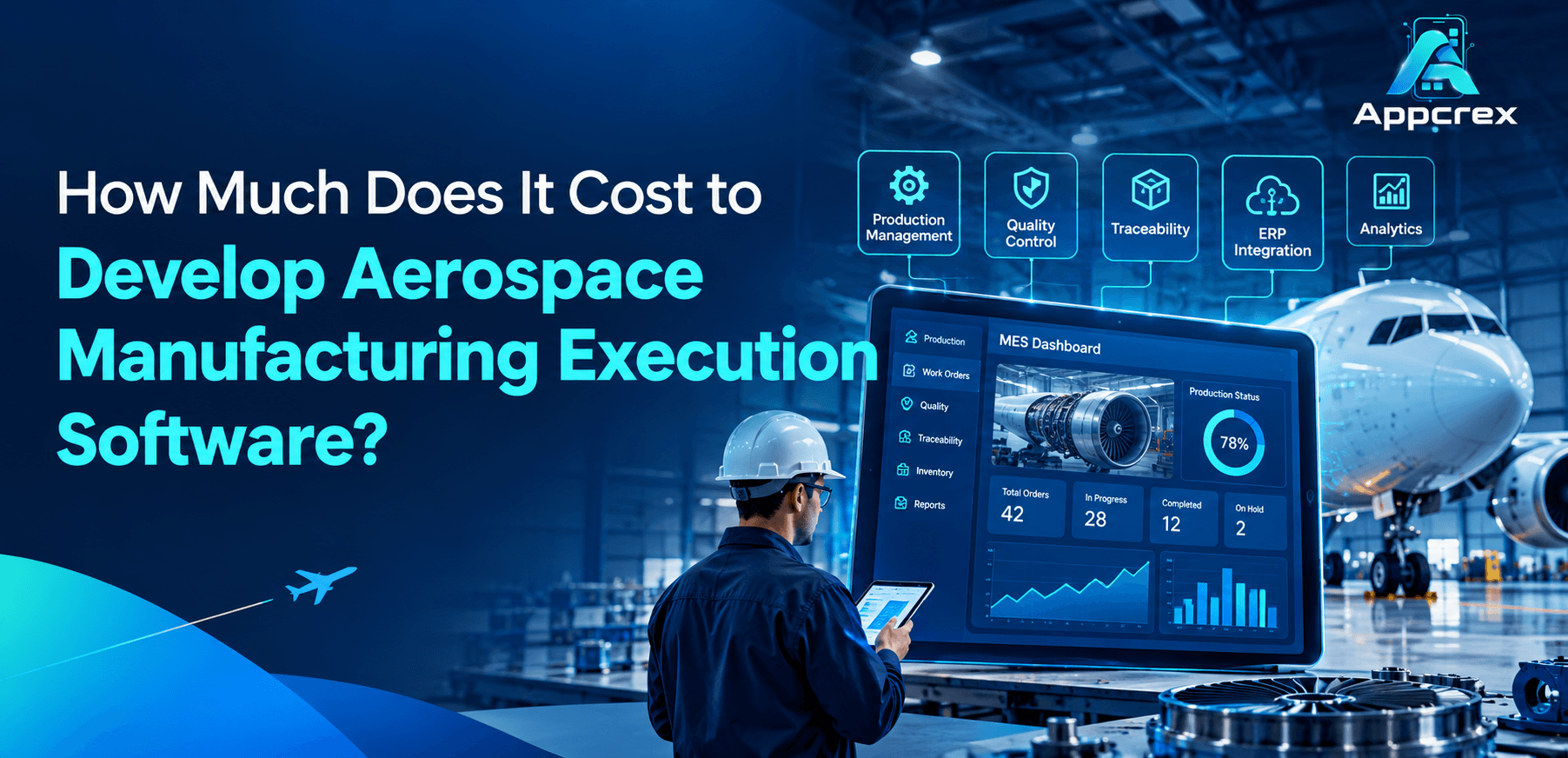
Custom aerospace manufacturing execution software typically costs between $50,000 and $500,000+, depending on the complexity of the platform, number of users and facilities, integrations, compliance requirements, production workflows, testing capabilities, analytics, security, and AI features. Enterprise-grade platforms connecting MES with ERP, PLM, QMS, IoT, testing equipment, and supplier systems can require a significantly larger investment.
This guide explains the aerospace MES development cost, key features, development process, technology stack, integrations, security requirements, and factors that influence the final budget.
Quick Answer: How Much Does Aerospace Manufacturing Execution Software Cost?
The cost to develop aerospace manufacturing execution software generally ranges from $50,000 to $500,000+.
| Software Type | Estimated Cost | Development Timeline |
|---|---|---|
| Basic Aerospace MES MVP | $50,000–$100,000 | 4–6 months |
| Mid-Level MES Platform | $100,000–$200,000 | 6–10 months |
| Advanced Aerospace MES | $200,000–$350,000 | 9–14 months |
| Enterprise Aerospace Platform | $350,000–$500,000+ | 12–18+ months |
These are planning estimates rather than fixed market prices. Aerospace software can vary significantly depending on whether the platform manages basic production workflows or becomes a connected digital execution layer across manufacturing, quality, engineering, suppliers, and testing.
Just Read : How Much Does It Cost to Develop Aviation Software?
What Is Aerospace Manufacturing Execution Software?
Aerospace manufacturing execution software is a digital system that monitors, controls, documents, and tracks manufacturing activities from production planning through assembly, inspection, testing, and final delivery.
A manufacturing execution system generally sits between enterprise-level systems such as ERP and shop-floor operations, helping organisations collect and use production data in real time.
For aerospace manufacturers, the software may manage:
- Production planning
- Work orders
- Digital work instructions
- Assembly operations
- Quality inspections
- Material traceability
- Part and serial-number genealogy
- Engineering revisions
- Non-conformance management
- Testing
- Supplier information
- Production analytics
- Audit records
- Compliance documentation
This makes aerospace MES software different from a basic manufacturing management application.
Why Do Aerospace Manufacturers Need MES Software?
Aerospace manufacturing involves complex products, long production cycles, strict quality requirements, and extensive documentation.
Manufacturers may need to track a component from its raw material source through machining, assembly, inspection, testing, and final shipment.
Modern aerospace MES platforms commonly provide real-time production visibility, traceability, quality controls, scheduling, and digital records.
Without a connected system, teams may depend on:
- Spreadsheets
- Paper work instructions
- Separate testing systems
- Manual reporting
- Disconnected ERP data
- Email-based approvals
- Standalone quality systems
This can make it harder to identify production issues and reconstruct the history of a part or process.
A centralised aerospace execution platform can bring these workflows together.
What Features Should Aerospace Manufacturing Execution Software Include?
1. Production Planning and Scheduling
Production scheduling helps manufacturers plan jobs according to:
- Available machines
- Labour
- Materials
- Production capacity
- Delivery deadlines
- Process dependencies
- Manufacturing priorities
Advanced scheduling can provide real-time visibility into work-in-progress and potential bottlenecks.
2. Digital Work Instructions
Digital work instructions replace or reduce dependence on paper-based manufacturing instructions.
Operators can access:
- Step-by-step procedures
- Assembly instructions
- Images
- Videos
- Safety information
- Quality checkpoints
- Required tools
- Acceptance criteria
The system can also record whether each step has been completed.
Digital work instructions are increasingly used in aerospace manufacturing execution environments to standardise complex production and testing procedures.
3. Part and Serial Number Traceability
Traceability is one of the most important requirements for aerospace manufacturing software.
The system can track:
- Part numbers
- Serial numbers
- Material lots
- Suppliers
- Operators
- Equipment
- Production steps
- Inspection results
- Test results
- Engineering revisions
This creates a digital history for each component or finished product.
4. Quality Management
Aerospace manufacturing software can include quality workflows for:
- Inspections
- Quality checks
- Defect management
- Non-conformance reports
- Corrective actions
- Preventive actions
- First article inspection
- Quality holds
- Approval workflows
Integrated quality management helps organisations maintain production records and support audit readiness.
5. Engineering Change Management
Aerospace products can go through multiple engineering revisions.
The software can track:
- Engineering change orders
- Drawing revisions
- BOM changes
- Process revisions
- Configuration changes
- Approval history
- Effective dates
This helps ensure operators are using the correct version of manufacturing instructions.
6. Testing & Equipment Integration
Advanced aerospace execution platforms can connect manufacturing software with testing equipment and shop-floor devices.
Possible integrations include:
- Test benches
- Sensors
- Measurement devices
- Industrial equipment
- IoT devices
- Automated testing systems
- Calibration systems
Modern aerospace MES platforms increasingly connect execution and test data so manufacturers can create a more complete production history.
7. Supplier Management
Aerospace manufacturers often depend on extensive supplier networks.
A supplier management module can track:
- Supplier details
- Material certifications
- Purchase orders
- Supplier performance
- Incoming inspection
- Supplier quality
- Delivery performance
- Supplier documentation
This provides greater visibility across the supply chain.
8. Inventory and Material Management
The software can monitor:
- Raw materials
- Components
- Work-in-progress
- Finished goods
- Material lots
- Expiry dates
- Storage locations
- Material movements
Material records can also be linked to production orders and final products.
9. Real-Time Production Dashboard
A central dashboard can display:
- Production status
- Active work orders
- Delayed jobs
- Machine utilisation
- Quality issues
- WIP
- Production throughput
- First-pass yield
- Scrap
- Rework
This gives production managers a real-time view of factory operations.
Also Read : Inventory Management Software Development Company: Complete Guide
What Advanced Features Can Be Added?
For larger aerospace manufacturers, an advanced platform can include additional capabilities.
AI-Powered Production Analytics
AI can analyse production data to identify trends, anomalies, and potential process problems.
Predictive Maintenance
Machine data can be analysed to identify potential equipment issues before unexpected downtime occurs.
Demand Forecasting
Historical production and order data can help estimate future manufacturing requirements.
Automated Compliance Reporting
The system can automatically compile relevant production, inspection, and testing records into structured reports.
Digital Twin Integration
A digital twin can provide a digital representation of equipment, processes, or products and connect operational data with engineering information.
AI-Assisted Non-Conformance Management
AI can help categorise non-conformances, search historical cases, identify similar incidents, and assist teams with investigation workflows.
Recent aerospace research is also exploring agentic AI and digital-thread approaches for non-conformance management by connecting PLM, MES, ERP, QMS, and supplier data.
How Much Does It Cost to Develop Aerospace MES Software?
The development cost depends heavily on the scope.
Basic Aerospace MES: $50,000–$100,000
A basic platform may include:
- Production management
- Work orders
- Digital work instructions
- Basic quality management
- User management
- Traceability
- Reporting
- Admin dashboard
This can be suitable for an MVP or smaller manufacturing operation.
Mid-Level Platform: $100,000–$200,000
A medium-complexity solution may add:
- Advanced scheduling
- Inventory
- Supplier management
- Quality workflows
- ERP integration
- Analytics
- Mobile access
- Advanced traceability
- Engineering revision management
Advanced Aerospace MES: $200,000–$350,000
An advanced system may include:
- IoT integration
- Equipment integration
- Automated testing
- Advanced analytics
- PLM integration
- ERP integration
- AI features
- Multi-site operations
- Advanced compliance workflows
Enterprise Platform: $350,000–$500,000+
Large aerospace organisations may require:
- Multiple manufacturing facilities
- Complex supply chains
- High-volume production data
- Multiple ERP/PLM systems
- Advanced security
- Custom integrations
- Extensive reporting
- AI and predictive analytics
- High availability
- Enterprise support
In this category, the final investment can exceed $500,000 depending on the scope.
What Factors Affect Aerospace MES Development Cost?
1. Software Complexity
A simple production dashboard costs considerably less than a complete MES connected to ERP, PLM, QMS, IoT, and testing systems.
2. Number of Users
The architecture required for 50 users is different from a system serving thousands of operators, engineers, managers, suppliers, and administrators.
3. Number of Manufacturing Sites
Multi-site deployments require additional configuration, permissions, reporting, data management, and infrastructure.
4. Third-Party Integrations
Integrating with existing systems can become a significant portion of the development budget.
Common integrations include:
- ERP
- PLM
- QMS
- CRM
- Accounting
- IoT
- Testing equipment
- Supplier systems
- Cloud platforms
5. Security Requirements
Aerospace software may require strong access controls, encryption, audit trails, secure APIs, data segregation, and other security controls depending on the organisation and contract.
6. Compliance Requirements
The specific compliance and contractual requirements of the manufacturer can affect architecture, workflows, documentation, validation, hosting, and security.
7. AI Features
AI forecasting, predictive maintenance, anomaly detection, intelligent search, and AI assistants can increase development and infrastructure costs.
Aerospace MES vs ERP: What’s the Difference?
A common question is whether an aerospace manufacturer needs MES if it already has an ERP.
The two systems generally serve different purposes.
| ERP | MES |
|---|---|
| Business-level management | Manufacturing execution |
| Finance | Shop-floor operations |
| Procurement | Production tracking |
| Sales | Work instructions |
| Enterprise inventory | WIP monitoring |
| Business planning | Quality execution |
| Supplier management | Production traceability |
ERP manages broader business processes, while MES focuses more closely on manufacturing execution and shop-floor operations.
The two systems can work together through APIs and data integrations.
How Does Aerospace Manufacturing Execution Software Work?
A typical workflow may look like:
ERP / PLM → Production Planning → Work Order → Digital Work Instructions → Manufacturing → Inspection → Testing → Quality Approval → Final Documentation
For example:
- An order enters the ERP system.
- Production planning creates a manufacturing schedule.
- The MES creates or receives the work order.
- Operators receive the correct digital work instructions.
- Production data is captured during execution.
- Quality inspections are performed.
- Testing equipment sends results to the system.
- Material and serial-number genealogy is updated.
- Non-conformances are recorded when required.
- Final production documentation is generated.
This creates a connected digital record of the manufacturing process.
Aerospace MES Development Process
Step 1: Requirement Analysis
The development team studies:
- Manufacturing workflows
- Existing ERP/PLM/QMS systems
- Production processes
- Quality requirements
- Testing requirements
- User roles
- Security requirements
- Reporting requirements
Step 2: Solution Architecture
The team defines:
- System architecture
- Database structure
- APIs
- Integration strategy
- Cloud infrastructure
- Security model
- Scalability requirements
Step 3: UI/UX Design
Interfaces are designed for:
- Operators
- Production managers
- Quality teams
- Engineers
- Administrators
- Suppliers
- Executives
Step 4: MVP Development
The core production execution capabilities are developed first.
Step 5: System Integrations
The MES is connected with existing enterprise and manufacturing systems.
Step 6: Testing
Testing should cover:
- Functional testing
- Integration testing
- Performance testing
- Security testing
- User acceptance testing
- Data validation
Step 7: Deployment
The platform is deployed to the selected infrastructure and configured for the manufacturing environment.
Step 8: Training and Support
Operators and management teams receive training, followed by ongoing maintenance and improvements.
Technology Stack for Aerospace Manufacturing Software
A typical technology stack can include:
Frontend
- React
- Angular
- Vue.js
- TypeScript
Backend
- Node.js
- Python
- Java
- .NET
Mobile
- React Native
- Flutter
- Kotlin
- Swift
Database
- PostgreSQL
- MySQL
- MongoDB
Cloud
- AWS
- Microsoft Azure
- Google Cloud
APIs
- REST APIs
- GraphQL
- WebSockets
- Industrial equipment APIs
AI & Analytics
- Python
- Machine learning frameworks
- AI APIs
- Data analytics platforms
The right technology stack depends on the existing aerospace IT environment, required integrations, security architecture, scalability, and deployment model.
What Is the ROI of Aerospace MES Software?
The ROI depends on the manufacturing environment and how the software is used.
Potential business improvements include:
- Reduced manual data entry
- Lower paperwork
- Better production visibility
- Reduced rework
- Faster quality investigations
- Improved traceability
- Better machine utilisation
- Faster reporting
- Reduced production delays
- Improved decision-making
For example, GE Vernova describes aerospace MES deployments focused on production visibility, quality, engineering changes, supply-chain complexity, and productivity improvements.
However, ROI should be calculated using the manufacturer’s own baseline data rather than assuming a fixed percentage improvement.
How to Choose an Aerospace Software Development Company?
Before hiring an aerospace software development company, evaluate:
Industry Understanding
The team should understand manufacturing execution, production workflows, quality management, traceability, and aerospace-specific requirements.
Integration Experience
Ask how the development company handles ERP, PLM, QMS, IoT, equipment, and testing integrations.
Security Capabilities
Review authentication, encryption, access control, audit logging, API security, backups, and infrastructure practices.
Scalability
The architecture should support future users, facilities, machines, production lines, and data volumes.
Customisation
Aerospace manufacturing workflows can be highly specialised, so the platform should support configurable workflows rather than forcing every operation into a generic process.
Long-Term Support
Choose a development partner that can support maintenance, integrations, security updates, performance optimisation, and future feature development.
Why Choose AppCrex for Aerospace Software Development?
AppCrex can help businesses plan and develop custom aerospace manufacturing software and execution platforms based on their operational requirements.
Potential development services include:
- Custom aerospace software development
- Manufacturing execution software
- Production management systems
- Digital work instruction platforms
- Quality management modules
- Inventory and material tracking
- Supplier management
- ERP integrations
- PLM integrations
- IoT integrations
- Analytics dashboards
- AI-powered manufacturing solutions
- Web and mobile applications
- Cloud-based software development
The development approach can begin with an MVP and progressively add advanced integrations, analytics, automation, and AI capabilities as the manufacturing operation grows.
FAQS
Q. How much does it cost to develop aerospace manufacturing execution software?
Custom aerospace MES development can cost approximately $50,000 to $500,000+. The final cost depends on software complexity, integrations, users, facilities, security, compliance requirements, testing, analytics, and AI capabilities.
Q. How long does it take to build aerospace MES software?
A basic MVP can take around 4–6 months, while advanced and enterprise platforms can require 9–18+ months, depending on integrations and validation requirements.
Q. What is aerospace MES software?
Aerospace MES software is a manufacturing execution system designed to manage production activities, work instructions, quality checks, traceability, testing, and real-time manufacturing data.
Q. Can aerospace MES integrate with ERP?
Yes. MES platforms can integrate with ERP systems to exchange information such as production orders, inventory, materials, schedules, and production status.
Q. Can aerospace MES integrate with PLM?
Yes. PLM integration can help connect engineering information, product configurations, revisions, and manufacturing processes.
Q. Does aerospace MES support traceability?
Yes. Traceability can include parts, serial numbers, material lots, operators, equipment, production steps, inspection results, and testing records.
Q. Can AI be added to aerospace manufacturing software?
Yes. AI can support predictive maintenance, production forecasting, anomaly detection, quality analytics, intelligent search, and decision-support workflows.
Q. Is aerospace MES different from normal manufacturing software?
Yes. Aerospace MES typically requires stronger traceability, quality controls, configuration management, documentation, testing workflows, and compliance support because aerospace manufacturing involves highly controlled production environments.
Q. Can the software support multiple manufacturing sites?
Yes. A scalable architecture can support multiple facilities, production lines, user groups, suppliers, and geographic locations.
Final Thoughts
Aerospace manufacturing execution software is more than a production tracking tool. It can become the digital execution layer connecting people, machines, production processes, quality systems, engineering data, and enterprise applications.
For a basic implementation, development may start around $50,000, while sophisticated enterprise aerospace MES platforms can exceed $500,000 when they include extensive integrations, advanced analytics, testing automation, AI, security, and multi-site operations.
The most effective approach is to define the required workflows first, identify the systems that need to be integrated, build a focused MVP, and then expand the platform as operational requirements grow.
If you’re planning a custom aerospace manufacturing execution platform, AppCrex can help with software architecture, UI/UX, development, integrations, AI capabilities, cloud deployment, and ongoing support.