📌 Key Takeaways
- Understand HIPAA Requirements – Determine whether HIPAA applies to your mobile app and business model.
- Protect Sensitive Health Data – Use appropriate encryption, authentication, access controls, and secure APIs.
- Build Security Into the App – Conduct risk assessments and security testing throughout development.
- Choose Vendors Carefully – Review cloud providers, APIs, integrations, and Business Associate Agreement requirements.
- Maintain Compliance After Launch – Regular monitoring, updates, testing, and risk assessments are essential.
Introduction
The healthcare industry is rapidly adopting mobile technology to improve patient engagement, simplify communication, and make healthcare services more accessible. From telemedicine and digital patient portals to remote monitoring and wellness platforms, mobile applications have become an important part of modern healthcare.
However, healthcare applications often deal with sensitive personal and medical information. This makes privacy and security a critical part of healthcare app development.
If your application handles protected health information (PHI) in a situation covered by the Health Insurance Portability and Accountability Act (HIPAA), you need to consider HIPAA requirements when planning, developing, deploying, and maintaining the application.
So, how do you build a HIPAA-compliant mobile app?
The process involves more than adding encryption or creating a secure login. You need to understand whether HIPAA applies to your application, identify the information being handled, assess security risks, implement appropriate safeguards, control access to sensitive data, secure third-party integrations, and maintain appropriate policies and processes.
In this guide, we explain how to build a HIPAA-compliant mobile app, including key features, development steps, security requirements, technology considerations, estimated costs, and common mistakes to avoid.
Quick Answer: To build a HIPAA-compliant mobile app, first determine whether HIPAA applies to your application and identify the PHI it handles. Then perform a security risk analysis, design appropriate access controls and security safeguards, secure data in transit and at rest, choose appropriate technology and infrastructure, establish required Business Associate Agreements (BAAs), test the application, and continuously monitor and improve its security.
What Is a HIPAA-Compliant Mobile App?
A HIPAA-compliant mobile app is an application designed and operated with appropriate safeguards for protecting protected health information when HIPAA applies to the organisation and application involved.
Such applications may handle information such as:
- Patient names and contact details
- Medical records
- Diagnoses
- Treatment information
- Prescription details
- Lab results
- Insurance information
- Appointment details
- Telehealth communications
- Patient-generated health information
However, HIPAA compliance is not a single feature or certification that developers simply add to an app.
It involves a combination of:
- Administrative safeguards
- Physical safeguards
- Technical safeguards
- Access controls
- Risk management
- Data protection
- Security policies
- Vendor management
- Ongoing monitoring
The exact obligations depend on the application’s use case, organisation, relationships, and the type of information being handled.
Does Every Healthcare App Need to Be HIPAA Compliant?
No.
This is an important distinction when planning a healthcare or wellness application.
HIPAA generally applies to covered entities such as certain healthcare providers, health plans, and healthcare clearinghouses, as well as business associates performing certain functions involving PHI on behalf of covered entities.
Therefore, whether an application needs to comply with HIPAA depends on the circumstances.
For example, a healthcare application developed for a hospital that stores and transmits patient information may have significant HIPAA obligations. A consumer wellness application independently used by individuals may have a different regulatory situation.
This is why businesses should determine their compliance requirements before development begins rather than assuming every healthcare application has identical HIPAA obligations.
Why Is HIPAA Compliance Important for Mobile Apps?
Healthcare applications deal with some of the most sensitive information a person can share.
A security incident can expose:
- Medical information
- Personal information
- Treatment records
- Prescription information
- Insurance details
- Communication records
Poor security can result in loss of patient trust, data exposure, business disruption, and regulatory consequences.
HIPAA’s Security Rule addresses the protection of electronic protected health information (ePHI), including its confidentiality, integrity, and availability.
For this reason, security should be considered from the beginning of the development process.
Types of Healthcare and Wellness Apps
The healthcare technology market includes many different types of mobile applications.
1. Telemedicine Apps
Telemedicine applications allow patients to connect with healthcare professionals remotely through:
- Video consultations
- Audio calls
- Secure messaging
- Appointment scheduling
- Digital prescriptions
- Medical document sharing
2. Patient Portal Apps
Patient portal applications can allow users to:
- View medical records
- Check appointments
- Access test results
- Communicate with providers
- Manage prescriptions
- Update personal information
3. Remote Patient Monitoring Apps
These applications can collect health-related information from connected devices and provide it to healthcare professionals.
Examples include:
- Blood pressure monitoring
- Glucose monitoring
- Heart-rate tracking
- Activity monitoring
- Other remote health measurements
4. Healthcare Management Apps
Healthcare organisations can use mobile applications to manage:
- Patients
- Appointments
- Staff
- Medical workflows
- Communications
- Reports
5. Fitness Apps
The growing demand for digital wellness has also increased investment in fitness app development.
Fitness apps can include:
- Workout plans
- Activity tracking
- Calorie tracking
- Progress monitoring
- Personalised recommendations
- Trainer communication
- Wearable integrations
Not every fitness application is subject to HIPAA. However, if a fitness app is developed for a HIPAA-covered organisation or business associate and handles PHI, its compliance requirements need to be evaluated.
6. Yoga Apps
Yoga app development has also become a growing area within the digital wellness market.
A yoga application can provide:
- Guided yoga sessions
- Personalised routines
- Meditation
- Wellness programs
- Progress tracking
- Instructor communication
- Subscription plans
- Video classes
Again, HIPAA applicability depends on the specific business relationship and the type of information the application handles.
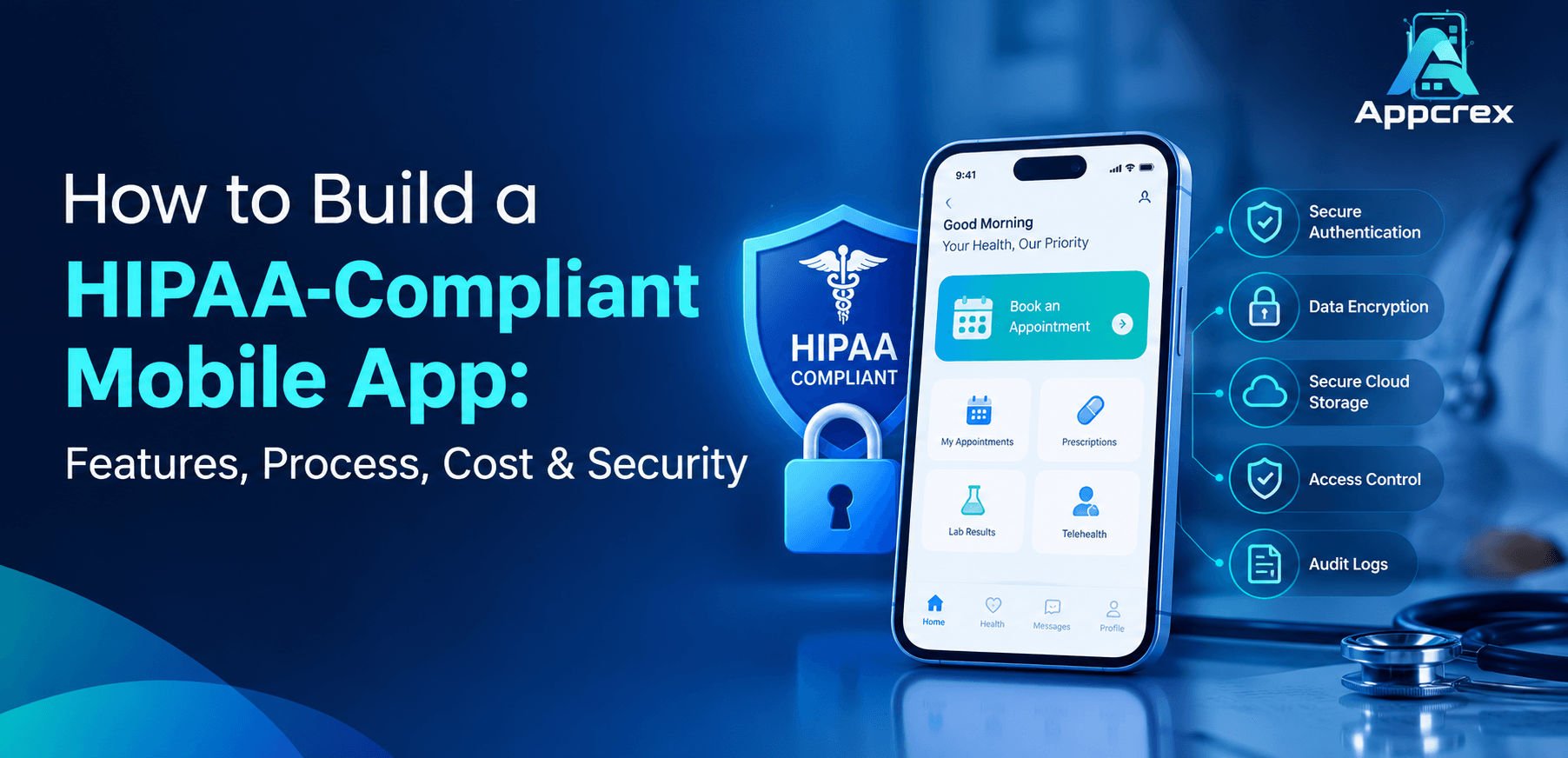
Key Features of a HIPAA-Compliant Mobile App
The exact features depend on your application’s purpose, but security and privacy should be built into the architecture.
1. Secure Authentication
Users should have appropriate methods for verifying their identity.
Depending on the application, authentication may include:
- Strong passwords
- Multi-factor authentication
- Biometrics
- One-time passwords
- Secure session management
- Automatic logout
Authentication helps prevent unauthorised users from accessing sensitive information.
2. Role-Based Access Control
Different users require different levels of access.
For example:
Patient: Access to their own health information.
Doctor: Access to information for authorised patients.
Administrator: Access to appropriate operational information.
Support staff: Limited access based on job responsibilities.
Role-based access helps ensure users only access information required for their role.
3. Data Encryption
Sensitive data should be appropriately protected during transmission and storage.
Encryption may be required for:
- Data in transit
- Data at rest
- Database information
- Backups
- API communication
- Sensitive local device data
The specific implementation should be based on the application’s architecture and security risk assessment.
4. Audit Logs
Audit logging can help organisations understand how sensitive information is being accessed and used.
Logs can record activities such as:
- User login
- Data access
- Data modification
- File access
- Administrative actions
- Security events
This provides greater visibility into application activity.
5. Secure Messaging
Healthcare applications may require secure communication between:
- Patients
- Doctors
- Nurses
- Healthcare staff
Secure messaging can support:
- Text communication
- Document sharing
- Medical attachments
- Notifications
- Message history
If the messaging system handles PHI, it needs to be designed accordingly.
6. Secure Push Notifications
Push notifications can create privacy risks if sensitive information is displayed on a locked device screen.
For example, instead of displaying detailed medical information, a notification can simply tell the user that they have a new message and require authentication to view the details.
7. Automatic Session Timeout
Applications can use session timeout mechanisms to reduce the risk of unauthorised access when a user leaves their device unattended.
8. Secure API Integration
Healthcare applications often integrate with:
- EHR systems
- EMR systems
- Pharmacies
- Laboratories
- Payment systems
- Wearable devices
- Hospital systems
APIs should use appropriate authentication, authorisation, validation, encryption, and monitoring.
How to Build a HIPAA-Compliant Mobile App?
Now let’s look at the complete development process.
Step 1: Define Your App’s Purpose
Start by defining exactly what your application will do.
For example:
- Telemedicine
- Patient monitoring
- Healthcare booking
- Medical records
- Medication management
- Fitness tracking
- Yoga and wellness
- Doctor consultation
- Hospital management
The application type determines what information you need to collect and how that information will be processed.
Step 2: Identify PHI and ePHI
Create a clear map of the information your application collects, processes, stores, and transmits.
Ask:
- What data is collected?
- Where is it stored?
- Who can access it?
- Which APIs receive it?
- Which vendors process it?
- How long is it retained?
- How is it deleted?
Data mapping helps developers create an appropriate security architecture.
Step 3: Determine Whether HIPAA Applies
Before development, determine whether your organisation or application is subject to HIPAA.
This may involve analysing:
- Your business model
- Your relationship with healthcare organisations
- The type of data handled
- Your vendors
- Your cloud infrastructure
- Your role as a service provider
For complex situations, businesses should obtain advice from qualified HIPAA/privacy professionals.
Step 4: Perform a Security Risk Analysis
Identify potential threats and vulnerabilities before building the application.
Common risks include:
- Weak passwords
- Unauthorised access
- Stolen devices
- Insecure APIs
- Data leakage
- Cloud misconfiguration
- Insecure local storage
- Third-party vulnerabilities
- Insider threats
The risk analysis should inform the application’s security architecture.
Step 5: Design the Security Architecture
Next, determine how sensitive information will be protected.
Your architecture may include:
- Authentication
- Authorisation
- Encryption
- API security
- Database security
- Access management
- Audit logging
- Backup protection
- Disaster recovery
- Monitoring
Security should be designed into the application rather than added just before launch.
Step 6: Choose the Right Technology Stack
HIPAA compliance does not require one particular programming language or framework.
Depending on project requirements, you may use:
Mobile Development
- Swift
- Kotlin
- React Native
- Flutter
Backend Development
- Node.js
- Python
- Java
- .NET
Databases
- PostgreSQL
- MySQL
- MongoDB
Cloud Infrastructure
Cloud platforms can be used for healthcare applications when the relevant HIPAA requirements and contractual arrangements are properly addressed.
Important: A programming framework or cloud provider does not automatically make an application HIPAA compliant.
Compliance depends on the complete architecture, configuration, processes, relationships, and safeguards.
Step 7: Implement Security Controls
During development, implement the security controls defined during the planning stage.
These may include:
Authentication
Use appropriate identity verification and session management.
Authorisation
Control access based on user roles and permissions.
Encryption
Protect sensitive information during transmission and storage where appropriate.
Audit Logging
Maintain appropriate records of relevant activity.
Data Minimisation
Avoid collecting unnecessary sensitive information.
Secure APIs
Protect APIs with appropriate authentication, authorisation, input validation, and monitoring.
Step 8: Secure Cloud Infrastructure
Many modern healthcare applications use cloud infrastructure for scalability and reliability.
However, choosing a well-known cloud provider does not automatically make your application HIPAA compliant.
You need to consider:
- Which services process ePHI
- Security configuration
- Encryption
- Access management
- Backups
- Monitoring
- Data retention
- Disaster recovery
- Business Associate Agreements
Cloud infrastructure should be evaluated as part of the overall risk and compliance strategy.
Step 9: Review Third-Party Vendors
Modern healthcare applications often depend on third-party services.
Before using a vendor to process sensitive information, review:
- What information the service receives
- How it stores data
- Where data is processed
- Security controls
- Contractual requirements
- Whether a BAA is required
- Data retention and deletion practices
This is particularly important for analytics, communication, cloud, storage, AI, and integration services.
Step 10: Conduct Security Testing
Before launch, test the application thoroughly.
Functional Testing
Verify that healthcare workflows work correctly.
Security Testing
Test authentication, permissions, APIs, storage, and sessions.
Vulnerability Testing
Identify security weaknesses before attackers can exploit them.
Penetration Testing
Conduct appropriate penetration testing to identify exploitable vulnerabilities.
Performance Testing
Make sure the application performs reliably under expected traffic.
Device Testing
Test supported Android and iOS devices and operating systems.
Step 11: Launch and Monitor the App
HIPAA compliance is not a one-time development task.
After launch, organisations should continue to:
- Monitor security events
- Review access
- Patch vulnerabilities
- Update dependencies
- Review vendors
- Test backups
- Assess new risks
- Update policies
- Respond to incidents
Every new feature or integration can introduce new risks, so security needs to be maintained throughout the application’s lifecycle.
HIPAA Compliance Checklist
Before launching your application, review the following checklist.
Data & Privacy
- Identify PHI/ePHI
- Map data flows
- Minimise unnecessary data collection
- Define data retention
- Define deletion procedures
- Review data-sharing practices
Authentication & Access
- Secure authentication
- Appropriate authorisation
- Role-based access
- Session management
- Appropriate timeout controls
- Privileged-access management
Security
- Encryption
- Secure APIs
- Audit logging
- Secure backups
- Vulnerability management
- Security testing
- Incident response
Infrastructure
- Secure cloud configuration
- Appropriate vendor agreements
- Protected databases
- Backup security
- Monitoring
Ongoing Compliance
- Regular risk analysis
- Security updates
- Vendor reviews
- Access reviews
- Incident management
- Periodic security testing
How Much Does It Cost to Build a HIPAA-Compliant Mobile App?
The cost depends on the application’s complexity, features, integrations, platforms, security requirements, and development team.
As a general estimate:
| App Type | Estimated Development Cost |
|---|---|
| Basic healthcare app | $40,000 – $70,000 |
| Medium-complexity healthcare app | $70,000 – $130,000 |
| Advanced telemedicine app | $130,000 – $250,000+ |
| Enterprise healthcare platform | $250,000+ |
These figures are development estimates, not a fixed price for achieving HIPAA compliance.
Factors That Affect Development Cost
The final cost can depend on:
- Number of platforms
- UI/UX complexity
- Patient and doctor portals
- Telemedicine
- Video calling
- EHR/EMR integration
- Wearable integration
- AI features
- Cloud architecture
- Security testing
- Admin dashboard
- Third-party integrations
- Maintenance requirements
Common Mistakes When Building a HIPAA-Compliant App
1. Thinking Encryption Alone Is Enough
Encryption is important, but it is only one component of a broader security approach.
2. Collecting Unnecessary Data
Only collect information required for the application’s intended purpose.
3. Ignoring Third-Party Vendors
Third-party services can introduce privacy and security risks if they are not properly evaluated.
4. Storing Sensitive Information Locally
Sensitive data stored on a mobile device can create additional security risks. Local storage should be carefully evaluated.
5. Ignoring API Security
Healthcare applications often rely heavily on APIs. Poorly secured APIs can expose sensitive information.
6. Treating Compliance as a One-Time Task
A secure application today can become vulnerable tomorrow as dependencies, integrations, threats, and features change.
Healthcare, Fitness & Yoga App Development With AppCrex
Building a digital health product requires a combination of strong technology, user experience, security, and business understanding.
At AppCrex, we provide end-to-end healthcare app development services for businesses looking to build modern and scalable digital healthcare products.
Our expertise can also support fitness app development and yoga app development, helping businesses create digital wellness platforms with features such as:
- User profiles
- Workout programs
- Yoga sessions
- Activity tracking
- Progress tracking
- Personalised plans
- Video sessions
- Trainer/instructor communication
- Subscription management
- Wearable integrations
- Secure messaging
For healthcare projects, we can also support:
- Telemedicine apps
- Patient portals
- Doctor applications
- Remote patient monitoring
- Medical record applications
- Healthcare SaaS platforms
- Healthcare communication platforms
- AI-powered healthcare solutions
From product discovery and UI/UX design to mobile app development, backend development, API integration, testing, deployment, and ongoing support, our team can help you build a digital healthcare or wellness product around your specific requirements.
FAQs
Q. How do I build a HIPAA-compliant mobile app?
To build a HIPAA-compliant mobile app, first determine whether HIPAA applies to your application. Then identify PHI/ePHI, perform a security risk analysis, design appropriate access controls and security safeguards, secure data and APIs, evaluate third-party vendors, establish required agreements, test the application, and maintain security after launch.
Q. What makes a mobile app HIPAA compliant?
HIPAA compliance depends on the specific application and circumstances. Important areas can include appropriate access controls, authentication, audit controls, security safeguards, risk management, secure infrastructure, vendor management, and ongoing security practices.
Q. Does every healthcare app need to be HIPAA compliant?
No. HIPAA does not automatically apply to every healthcare or wellness application. Applicability depends on factors such as the organisation involved, the application’s relationships, and how PHI is handled.
Q. Can React Native be used for a HIPAA-compliant mobile app?
Yes. React Native can be used to develop healthcare applications. However, React Native itself does not make an application HIPAA compliant. Compliance depends on the complete application architecture, security controls, infrastructure, data handling, processes, and applicable contractual requirements.
Q. Can fitness apps be HIPAA compliant?
A fitness app may need to address HIPAA requirements when it is developed or operated in a HIPAA-covered context and handles PHI. Many consumer fitness applications, however, are not automatically covered by HIPAA.
Q. Can a yoga app be HIPAA compliant?
Yoga apps can be built with strong privacy and security controls. Whether HIPAA applies depends on the business relationship, the organisation involved, and the type of health information being handled.
Q. How much does a HIPAA-compliant mobile app cost?
A healthcare mobile application can cost approximately $40,000 to $250,000+, depending on features, platforms, integrations, security requirements, and overall complexity.
Q. How long does it take to build a HIPAA-compliant mobile app?
A basic healthcare application may take around 4–6 months, while a complex telemedicine or enterprise healthcare platform can take 8–12 months or longer. The timeline depends on features, integrations, design, testing, security requirements, and project scope.
Conclusion
Building a HIPAA-compliant mobile app requires much more than creating a healthcare interface and adding a secure login. Businesses need to consider data protection, access control, risk management, secure infrastructure, third-party vendors, APIs, testing, and ongoing security throughout the application lifecycle.
Whether you are planning a telemedicine platform, patient portal, remote monitoring solution, healthcare app development project, fitness app development platform, or yoga app development product, the right architecture should be planned from the beginning.
The most important thing to remember is that HIPAA compliance is an ongoing process rather than a single technology feature.
If you are planning to build a healthcare or wellness application, AppCrex can help you transform your idea into a scalable digital product with security and compliance requirements considered throughout the development process.
Ready to build your healthcare or wellness app? Talk to AppCrex today.
Important Note
This article is for general informational purposes and should not be treated as legal advice. HIPAA applicability and compliance obligations depend on the specific facts, organisations, relationships, services, and data involved. Businesses should consult qualified legal or compliance professionals for situation-specific guidance.