📌 Key Takeaways
- Online water delivery apps are more than ordering platforms—they connect customers, inventory, drivers, payments, subscriptions, and administration.
- Subscriptions and recurring deliveries can create predictable revenue and improve customer retention.
- Real-time tracking, route optimization, inventory, and driver management are among the most important operational features.
- Cross-platform app development can be a practical option when a business wants Android and iOS coverage with a shared codebase.
- The right mobile app development company should understand both mobile technology and the operational complexity of on-demand delivery.
Introduction
The way people order drinking water is changing. Instead of calling a local supplier, sending a WhatsApp message, or placing a repeat order manually, customers can now use a mobile app to choose water products, select quantities, schedule deliveries, pay online, and track their orders.
This has created a growing opportunity for businesses to invest in online water delivery app development. The model can work for bottled-water companies, water-can suppliers, distributors, subscription businesses, offices, restaurants, hotels, and multi-vendor marketplaces.
A modern water delivery platform is more than a shopping application. It needs to coordinate customers, inventory, delivery drivers, recurring orders, payments, routes, notifications, and administration from one system. Current industry guides similarly identify subscriptions, route optimization, inventory, tracking, payments, and admin management as core components of a water delivery platform.
If you are planning to build such a platform, this guide explains features, app types, development cost, business models, technology, development process, monetization, and important considerations when choosing a development company.
Just Read : Build an On-Demand Grocery App Development Company | Features, Cost & Guide (2026)
What Is an Online Water Delivery App?
An online water delivery app is a digital platform that allows customers to order drinking water through a smartphone or web application.
Depending on the business model, customers can order:
- Bottled drinking water
- Water cans
- Large water containers
- Mineral water
- Sparkling water
- Office drinking-water supplies
- Water dispensers
- Water coolers
- Bulk commercial water
- Subscription-based water deliveries
The application can connect customers with a single water supplier or multiple suppliers.
A basic platform may simply allow customers to place an order. A more advanced on demand app development solution can provide real-time delivery tracking, automated subscriptions, smart route planning, inventory synchronization, recurring payments, customer support, and analytics.
For a growing water business, the real value is not only online ordering. The platform can automate much of the operational workflow that would otherwise be managed through calls, spreadsheets, messages, and manual coordination.
Why Build a Water Delivery App?
The water delivery business has several characteristics that make it suitable for a mobile-first model.
Customers often need water repeatedly, which means businesses can create subscription and scheduled-delivery models rather than depending only on one-time orders.
An app can also give businesses better visibility into their operations.
For example, instead of receiving an order by phone and manually assigning it to a driver, the system can:
Customer places order → payment confirmed → inventory updated → driver assigned → route optimized → customer notified → delivery completed.
This creates a much more structured workflow.
Benefits for Customers
A well-designed water delivery application can offer:
- Faster ordering
- Product comparison
- Scheduled deliveries
- Recurring subscriptions
- Multiple payment options
- Real-time tracking
- Delivery notifications
- Order history
- Easy reordering
- Customer support
Benefits for Water Businesses
For suppliers and distributors, the platform can help with:
- Order automation
- Inventory visibility
- Delivery management
- Customer management
- Driver management
- Subscription revenue
- Route optimization
- Digital payments
- Sales analytics
- Customer retention
This is why water delivery is increasingly being approached as an on-demand delivery platform rather than simply an e-commerce application.
Just Read : What Makes an On-Demand Service App Successful Today?
Types of Water Delivery Apps You Can Build
There isn’t one universal water delivery app model. The right architecture depends on your target customers and business operations.
1. Single-Vendor Water Delivery App
This model is suitable for an individual water supplier or brand.
The business manages its own:
- Products
- Prices
- Inventory
- Customers
- Drivers
- Deliveries
- Payments
It is generally easier to develop because there is no marketplace or vendor-management layer.
2. Multi-Vendor Water Delivery Marketplace
A marketplace connects multiple water suppliers with customers.
Customers can compare:
- Brands
- Bottle sizes
- Prices
- Delivery times
- Ratings
- Availability
The platform owner can earn commissions from suppliers.
However, multi-vendor architecture increases complexity because the system needs vendor dashboards, commission management, order distribution, vendor settlements, and potentially separate inventory systems.
3. Subscription-Based Water Delivery App
This is particularly relevant because water is a recurring-use product.
Customers could select:
- Daily delivery
- Weekly delivery
- Biweekly delivery
- Monthly delivery
- Custom schedules
The system can automatically generate recurring orders and charge customers according to their selected plan.
4. B2B Water Delivery Platform
Instead of targeting households, the application can focus on:
- Offices
- Hotels
- Restaurants
- Schools
- Hospitals
- Gyms
- Retail stores
- Corporate facilities
B2B customers may require bulk ordering, invoices, account management, negotiated pricing, and recurring contracts.
5. On-Demand Water Delivery App
In this model, customers request water when they need it and expect fast fulfillment.
The platform may use location services to identify nearby suppliers or delivery teams and assign orders based on availability and distance.
Current water-delivery development estimates specifically identify on-demand and multi-vendor platforms as more complex because of vendor management, payments, delivery coordination, and backend requirements.
Essential Features of an Online Water Delivery App
A successful water delivery platform normally requires multiple applications or interfaces rather than just one customer app.
The main components are usually:
- Customer app
- Delivery driver app
- Supplier/vendor panel
- Admin dashboard
Let’s look at the important functionality.
Customer App
The customer should be able to register using email, phone number, or social authentication.
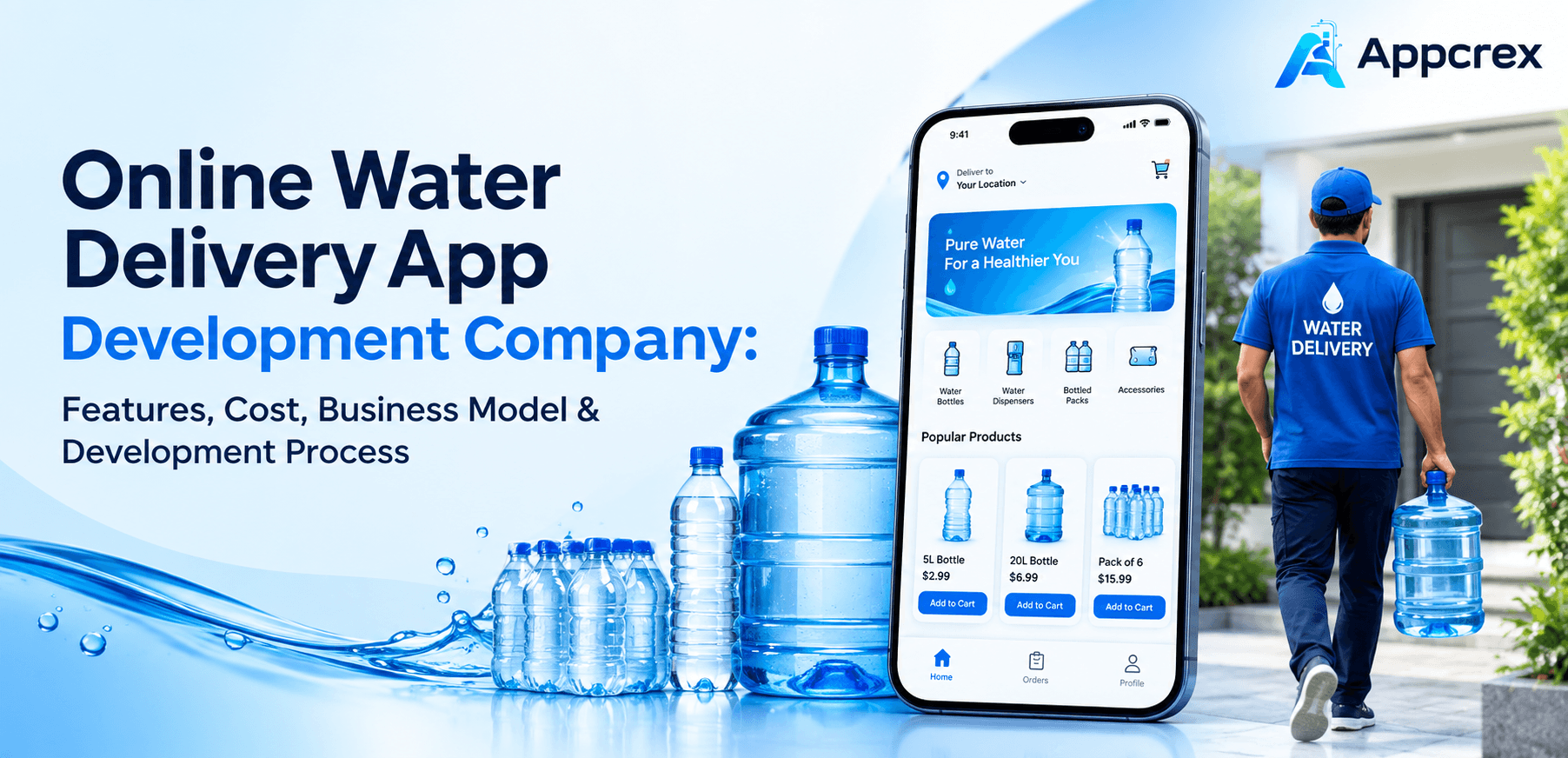
The home screen can display:
- Available water products
- Popular products
- Subscription offers
- Discounts
- Nearby delivery options
- Previous orders
- Recommended products
Product Catalog
Customers should be able to view:
- Brand
- Bottle size
- Quantity
- Price
- Product description
- Availability
- Delivery estimate
Search and filtering can make it easier to find specific products.
Smart Ordering
Customers should be able to select products, quantities, delivery addresses, and preferred delivery times before confirming the order.
Scheduled Delivery
This feature is particularly important for water businesses.
Customers can select a future delivery date and time instead of requesting immediate delivery.
Subscription Management
Users can create recurring delivery plans and manage:
- Frequency
- Quantity
- Delivery address
- Payment method
- Next delivery date
- Pause/resume
- Cancellation
Subscription management can become one of the strongest retention features in a water delivery application.
Real-Time Tracking
Customers can track their delivery after the order has been dispatched.
The system can show:
- Order confirmed
- Preparing
- Assigned to driver
- Out for delivery
- Delivered
GPS-based tracking can provide more precise visibility.
Payments
The app can support relevant payment methods such as:
- Credit/debit cards
- Digital wallets
- Apple Pay
- Google Pay
- UPI
- Local payment gateways
- Cash on delivery, where applicable
The exact payment options should depend on the target market.
Push Notifications
Notifications can inform customers about:
- Order confirmation
- Payment status
- Delivery assignment
- Driver arrival
- Subscription renewal
- Promotional offers
- Failed deliveries
Delivery Driver App
The driver application connects the delivery operation with the customer.
Drivers can receive assigned orders and see their delivery schedules.
Important features include:
- Driver registration
- Profile management
- Order list
- Order acceptance
- Customer details
- Navigation
- GPS tracking
- Route optimization
- Delivery status
- Proof of delivery
- Earnings information
- Delivery history
For businesses handling many deliveries each day, route optimization can be particularly valuable because inefficient routes increase delivery time and operating costs.
The driver app can also use location data to provide customers with more accurate delivery estimates.
Admin and Supplier Dashboard
The admin panel controls the complete platform.
Administrators may manage:
- Customers
- Vendors
- Products
- Inventory
- Orders
- Drivers
- Delivery zones
- Subscriptions
- Payments
- Discounts
- Reviews
- Reports
- Notifications
Inventory Management
Inventory management is especially important for water suppliers.
The system can track:
- Product quantity
- Bottle sizes
- Available stock
- Low-stock products
- Returned containers
- Supplier inventory
- Warehouse inventory
For businesses using reusable bottles or water cans, container-return management can also be integrated into the system.
Analytics Dashboard
The admin should be able to monitor:
- Total orders
- Revenue
- Active customers
- Subscription customers
- Repeat orders
- Delivery performance
- Best-selling products
- Driver performance
- Cancellation rate
- Customer acquisition
- Geographic demand
This information can help businesses identify high-demand areas and optimize their delivery operations.
Advanced Features for a Modern Water Delivery Platform
Once the core product is working, businesses can add more advanced capabilities.
AI-Based Demand Forecasting
AI can analyze historical orders and identify patterns.
For example, the system could estimate how much water may be required in a particular area during a specific period.
This can help with:
- Inventory planning
- Delivery capacity
- Supplier management
- Demand forecasting
Smart Route Optimization
Instead of assigning drivers manually, the system can consider:
- Driver location
- Delivery addresses
- Traffic
- Delivery windows
- Vehicle capacity
- Number of orders
and generate optimized routes.
Personalized Recommendations
AI can recommend products or subscription plans based on customer ordering history.
For example:
“You usually order two 20-liter bottles every Monday. Would you like to schedule your next delivery?”
AI Customer Support
An AI chatbot can answer common questions about:
- Delivery times
- Pricing
- Subscriptions
- Orders
- Refunds
- Product availability
Complex issues can be transferred to human support.
IoT Integration
For businesses using smart water dispensers or connected equipment, IoT integration can provide information such as:
- Water consumption
- Dispenser status
- Refill requirements
- Equipment alerts
This can create an advanced connected-water delivery ecosystem.
How Much Does It Cost to Develop an Online Water Delivery App?
The cost depends on the app’s complexity, number of platforms, features, integrations, and development team.
A practical planning range is:
| App Type | Estimated Cost | Timeline |
|---|---|---|
| Basic MVP | $10,000–$20,000 | 2–3 months |
| Standard App | $20,000–$40,000 | 3–5 months |
| Advanced Platform | $40,000–$70,000+ | 5–8 months |
| Multi-Vendor Platform | $50,000–$100,000+ | 6–10 months |
| Enterprise/AI Platform | $80,000–$150,000+ | 8–12+ months |
These figures are planning estimates rather than fixed quotations. Published 2026 estimates vary considerably: some place basic water delivery apps around $5,000–$15,000 and advanced platforms above $30,000, while more detailed end-to-end estimates can reach $25,000–$90,000 depending on scope.
For example, a simple supplier app with ordering and payments will have a very different budget from a platform containing customer, driver, vendor, and admin applications plus subscriptions, route optimization, analytics, and AI.
What Factors Affect Water Delivery App Development Cost?
Several factors can change the final development budget.
App Complexity
More workflows and business rules require more development.
Number of Platforms
You may build:
- Android
- iOS
- Web
- Driver application
- Vendor dashboard
- Admin dashboard
Supporting more platforms increases the scope.
UI/UX Design
A basic interface is cheaper than a highly customized experience with animations, personalization, advanced dashboards, and complex user flows.
Third-Party APIs
You may need:
- Google Maps or other mapping services
- Payment gateways
- SMS
- Push notification services
- Address verification
- Analytics
- CRM
- ERP
- Accounting systems
Every integration adds development and testing requirements.
Subscription Logic
Recurring billing, pauses, skips, renewals, refunds, and subscription changes make the backend more complicated.
Multi-Vendor Functionality
If multiple suppliers operate through the platform, you need vendor management, commissions, settlements, inventory, order allocation, and vendor analytics.
AI and Automation
AI demand forecasting, recommendations, chatbots, dynamic pricing, and route optimization can increase both development and ongoing infrastructure costs.
Cross-Platform App Development for Water Delivery
For many water delivery businesses, cross platform app development can be a practical approach.
Instead of maintaining completely separate native codebases for Android and iOS, a cross-platform framework can allow businesses to build a large portion of the application from a shared codebase.
Common technologies include:
- Flutter
- React Native
This can reduce development duplication and make it easier to maintain consistent features across Android and iOS.
However, cross-platform development isn’t automatically the best choice for every project. If the application requires highly specialized native functionality, extensive hardware integration, or platform-specific optimization, native development may be more appropriate.
The technology decision should be based on the actual requirements rather than simply choosing the cheapest option.
Technology Stack for Water Delivery App Development
A typical modern platform may use:
Mobile
Flutter / React Native / Swift / Kotlin
Frontend
React / Next.js / Angular
Backend
Node.js / Python / Java / .NET
Database
PostgreSQL / MySQL / MongoDB
Cloud
AWS / Azure / Google Cloud
Maps & Location
Google Maps APIs or equivalent mapping services
Payments
The payment provider should be selected according to the target market.
AI
For advanced systems:
- Machine learning
- LLMs
- AI agents
- Recommendation systems
- Predictive analytics
Notifications
- Firebase Cloud Messaging
- SMS
- In-app notifications
A scalable architecture should also include monitoring, logging, authentication, API security, backups, and automated deployment.
How to Build an Online Water Delivery App?
A successful water delivery project should be developed in stages.
1. Market and Business Analysis
Start by defining:
- Target customers
- Delivery area
- Product types
- Competitors
- Pricing
- Delivery model
- Subscription strategy
- Business model
For example, a platform designed for UAE households may have different payment, language, address, and delivery requirements than one targeting US office customers.
2. Define the MVP
Don’t start with 50 features.
Identify the features needed to launch.
A basic MVP could include:
- Registration
- Product catalog
- Cart
- Ordering
- Payments
- Scheduling
- Driver management
- Tracking
- Notifications
- Admin dashboard
3. UI/UX Design
Create customer, driver, and admin workflows before development.
The objective should be to make ordering and delivery management simple.
4. Backend Development
Develop the APIs, database, authentication, order management, subscription logic, inventory, and delivery system.
5. Mobile App Development
The customer and driver applications are developed using the selected technology stack.
6. Integrations
Connect maps, payments, notifications, analytics, CRM, ERP, and other required services.
7. Testing
Test:
- Ordering
- Payments
- Subscription renewals
- GPS tracking
- Driver assignment
- Notifications
- Inventory
- Security
- Performance
8. Launch
After QA and user acceptance testing, deploy the application and backend infrastructure.
9. Post-Launch Optimization
Monitor real users and improve the platform based on:
- Failed orders
- Customer feedback
- Delivery delays
- App crashes
- Subscription cancellations
- Popular products
How Does a Water Delivery App Make Money?
There are several possible monetization models.
Product Margin
The business earns from the difference between product cost and selling price.
Delivery Fees
Customers may pay a delivery fee depending on location, order size, or delivery speed.
Subscription Plans
Monthly or annual plans can provide recurring revenue.
For example:
- Basic
- Family
- Office
- Premium
Vendor Commission
A marketplace can charge suppliers a commission for each order.
Featured Listings
Suppliers can pay to appear prominently in search results.
B2B Contracts
Businesses can generate recurring revenue through contracts with:
- Offices
- Hotels
- Restaurants
- Schools
- Hospitals
A combination of subscriptions, delivery fees, product margins, and B2B contracts can create a stronger revenue model than depending on a single source.
Water Delivery App Development for UAE and USA Markets
The market you target should influence the application architecture from the beginning.
Water Delivery App in UAE
For UAE businesses, the platform may need to support:
- Arabic and English
- AED payments
- Local payment options
- Location-based delivery
- Subscription services
- VAT-related invoicing
- Multiple delivery zones
- Driver tracking
- Multi-branch operations
Businesses looking for an app development company in UAE should also consider whether the development partner understands local customer behavior, payment preferences, Arabic/RTL requirements, and delivery operations.
Water delivery is particularly suitable for subscription-based models in markets where homes, offices, hotels, and businesses require regular deliveries.
Water Delivery App in the USA
For the US market, businesses may need:
- Credit/debit card payments
- Apple Pay and Google Pay
- Subscription billing
- ZIP-code based delivery zones
- Address validation
- Route optimization
- Customer notifications
- Business accounts
- Tax and invoice support
- CRM integration
A US-focused platform can also target residential water delivery, office water services, bottled-water businesses, dispenser services, and bulk commercial customers.
If the project requires local market expertise, businesses can work with experienced app developers USA who understand US payment systems, subscription models, compliance expectations, and customer workflows.
How to Choose an Online Water Delivery App Development Company?
Choosing the development partner is as important as choosing the technology.
Look for a mobile app development company that understands both application development and delivery logistics.
Ask potential development partners about their experience with:
- On-demand platforms
- Delivery management
- GPS tracking
- Subscription systems
- Payment integration
- Inventory management
- Route optimization
- Multi-vendor architecture
- Cloud infrastructure
- AI integration
- Cross-platform development
Don’t evaluate companies only by their initial quote.
A lower development price may exclude:
- UI/UX
- Backend
- Driver app
- Admin dashboard
- API integrations
- Testing
- Deployment
- Maintenance
Always compare proposals based on complete scope, architecture, timeline, support, and scalability.
How AppCrex Can Help Build a Water Delivery App?
AppCrex can help businesses plan and develop custom water delivery platforms around their specific operational model.
The solution can include:
- Customer mobile application
- Driver application
- Vendor dashboard
- Admin panel
- Product and inventory management
- Subscription management
- Online payments
- GPS tracking
- Route optimization
- Push notifications
- Analytics
- CRM/ERP integrations
- AI chatbot
- AI-powered recommendations
- Predictive demand analytics
Whether you need a focused MVP or a scalable multi-vendor platform, the architecture can be designed around your current requirements while keeping future expansion in mind.
AppCrex can also use cross platform app development when it makes sense for the project, helping businesses launch Android and iOS applications through an efficient shared development approach.
FAQs
Q. How much does it cost to develop an online water delivery app?
A basic MVP can cost around $10,000–$20,000, while a standard application may cost $20,000–$40,000. Advanced, multi-vendor, or AI-powered platforms can reach $50,000–$150,000+, depending on features and integrations. Current published estimates vary significantly according to project scope and development model.
Q. How long does it take to build a water delivery app?
A basic MVP may take approximately 2–3 months, while a feature-rich platform can take 5–8 months or longer. One current UAE water-delivery development estimate places many MVPs around 10–16 weeks.
Q. Can I add water delivery subscriptions to the app?
Yes. You can allow customers to schedule recurring deliveries and manage frequency, quantities, payment methods, pauses, skips, and cancellations.
Q. Can a water delivery app support multiple suppliers?
Yes. A multi-vendor platform can allow multiple water suppliers to list products and manage their own orders, inventory, pricing, and delivery operations.
Q. Can I build a water delivery app for UAE customers?
Yes. The platform can be customized for UAE operations with Arabic/English interfaces, AED payments, local delivery zones, subscription plans, location services, and other market-specific requirements.
Q. Can I build a water delivery app for the USA?
Yes. A USA-focused application can support subscription billing, US payment methods, ZIP-code based delivery areas, address validation, driver tracking, business accounts, and other market-specific functionality.
Q. Should I choose native or cross-platform development?
For many water delivery businesses, cross platform app development with Flutter or React Native can be a practical choice because both Android and iOS can be supported from a shared codebase. Native development may be preferable when the project requires extensive platform-specific functionality.
Q. Can AI be added to a water delivery app?
Yes. AI can be used for demand forecasting, personalized recommendations, customer support, route optimization, churn prediction, and inventory planning.
Conclusion
An online water delivery app can transform a traditional water supply business into a more automated, scalable, and customer-friendly operation.
The most successful platforms don’t focus only on the customer ordering screen. They connect the entire delivery ecosystem—from product and inventory management to subscriptions, payments, drivers, GPS tracking, route planning, analytics, and customer support.
For startups, beginning with an MVP is usually the practical approach. As order volume grows, you can add multi-vendor functionality, advanced analytics, AI, IoT, automated subscriptions, and enterprise integrations.
Whether you are targeting UAE, USA, India, or another market, the development strategy should be based on your delivery model, customer type, product catalog, service area, and long-term growth plans.
Build Your Online Water Delivery App with AppCrex
AppCrex helps businesses build custom on-demand delivery applications with customer apps, driver apps, admin dashboards, subscriptions, payments, GPS tracking, analytics, AI, and third-party integrations.
If you are planning an online water delivery platform for residential customers, offices, hotels, distributors, or a multi-vendor marketplace, AppCrex can help you move from business idea and MVP planning to development, deployment, and long-term scaling.