📌 Key Takeaways
- Arabic NLP solutions help UAE businesses build AI systems that understand Arabic, English, and bilingual customer interactions.
- Major use cases include AI chatbots, document processing, sentiment analysis, semantic search, text classification, and enterprise automation.
- Arabic-specific development is important because generic AI models may struggle with dialects, context, writing variations, and Arabic-English code-switching.
- Arabic NLP development costs can range from approximately $20,000 for a basic solution to $500,000+ for a large enterprise platform.
- Data quality, security, Arabic language accuracy, system integration, and continuous AI monitoring are critical to a successful project.
Introduction
The UAE is rapidly becoming one of the most important AI and digital transformation markets in the Middle East. Businesses and government organizations are increasingly exploring AI systems that can understand customer queries, analyze documents, automate communication, process Arabic text, and deliver more personalized digital experiences.
However, building AI systems for the UAE market involves an important challenge: Arabic is not a simple language for traditional NLP systems to process.
Arabic has different dialects, writing styles, grammatical structures, regional variations, and frequent Arabic-English code-switching. A generic English-first AI model may translate Arabic text, but that does not always provide the accuracy, context awareness, or cultural understanding required for enterprise use.
This is where Arabic NLP solutions become valuable.
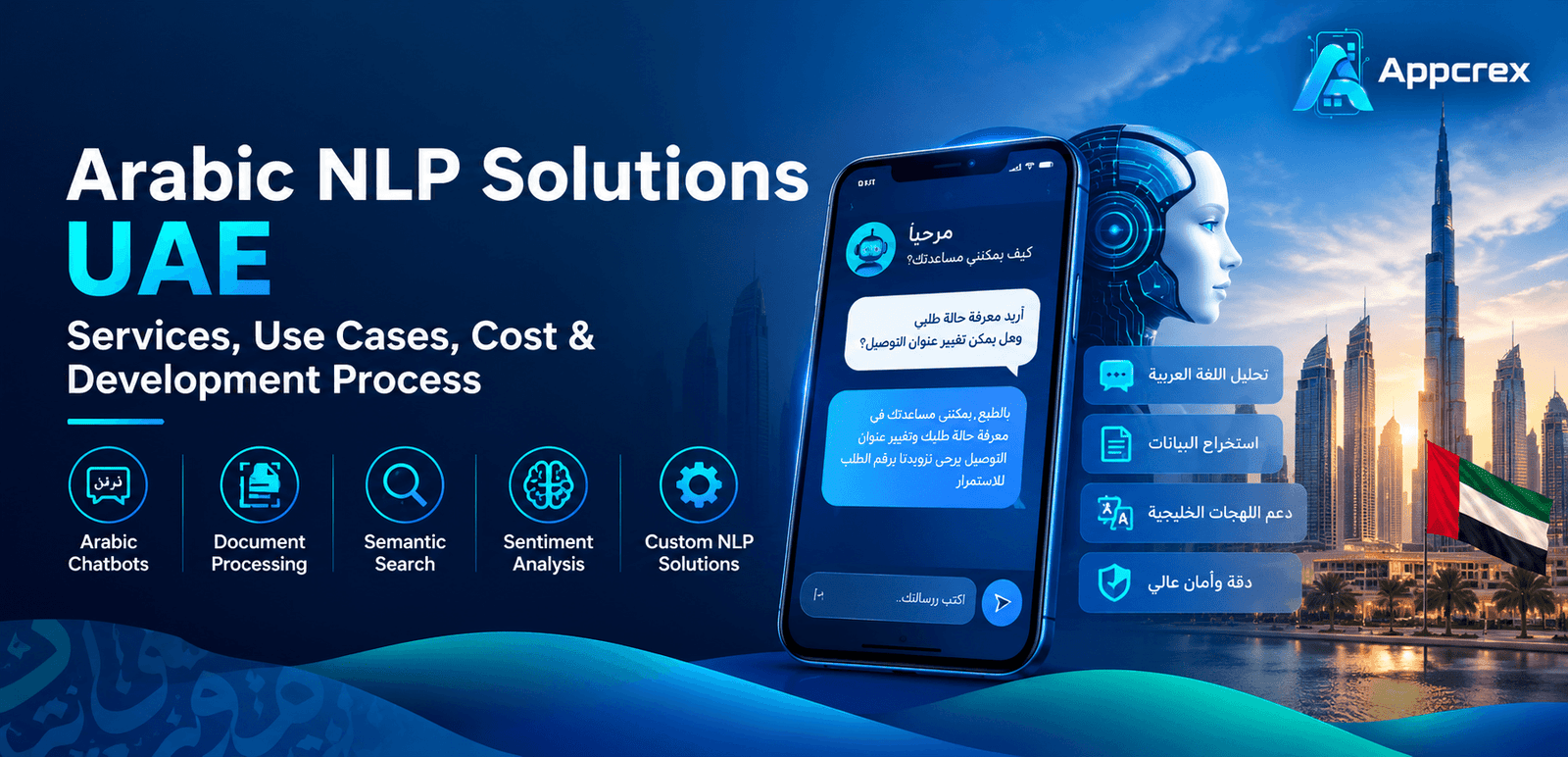
Arabic Natural Language Processing (NLP) solutions help businesses build AI systems capable of understanding, analyzing, processing, and generating Arabic language content. These solutions can power Arabic AI chatbots, document intelligence platforms, voice assistants, sentiment analysis systems, semantic search, customer support automation, and enterprise AI platforms.
The UAE’s wider AI strategy is also creating a favorable environment for AI adoption across government and business sectors. The UAE government continues to position AI as a strategic technology, with national initiatives focused on digital transformation, responsible AI, government services, and broader AI adoption.
This guide explains how Arabic NLP solutions in the UAE work, the services businesses can build, major use cases, development costs, challenges, and the process of building an Arabic NLP platform.
What Are Arabic NLP Solutions?
Arabic NLP solutions use artificial intelligence, machine learning, large language models, and linguistic technologies to help computers understand and process the Arabic language.
A business may use Arabic NLP to answer customer questions, extract information from documents, classify messages, understand customer sentiment, translate or summarize content, or create intelligent search systems.
For example, imagine a UAE customer sends the following message to a company:
“أريد معرفة حالة طلبي وهل يمكن تغيير عنوان التوصيل؟”
An Arabic NLP system should understand that the customer is asking about both order status and changing the delivery address.
A more advanced system should also understand variations in language, spelling mistakes, mixed Arabic-English communication, and different ways customers may express the same intent.
This is why Arabic NLP development is more than simply translating an English chatbot into Arabic. The AI system needs to understand:
- Modern Standard Arabic (MSA)
- Regional Arabic variations
- UAE/Gulf communication patterns
- Arabic-English mixed conversations
- Different writing styles
- Context and intent
- Industry-specific terminology
For UAE businesses, bilingual capabilities can be particularly valuable because many organizations serve both Arabic-speaking and English-speaking customers.
Why UAE Businesses Need Arabic-Specific NLP?
The UAE has a highly diverse and digitally connected population. Many organizations need to communicate with customers, employees, citizens, and partners in both Arabic and English.
A generic NLP system may perform adequately with simple questions. However, enterprise use cases often require much higher accuracy.
For example, a banking chatbot must understand financial terminology. A healthcare platform may need to process medical documents. A government platform may need to understand formal Arabic requests. A real estate company may receive thousands of inquiries involving Arabic, English, and mixed-language communication.
Arabic-specific NLP can improve the ability of AI systems to understand these interactions.
The UAE is also continuing to invest in AI infrastructure and adoption. Its AI strategy focuses on strengthening government performance, developing AI capabilities, and expanding AI use across important sectors. More recently, UAE government initiatives have also continued to emphasize advanced AI deployment and responsible AI governance.
The development of Arabic-focused AI models within the UAE ecosystem is another important signal. In January 2026, Abu Dhabi’s Technology Innovation Institute announced Falcon-H1 Arabic, a model designed specifically for advanced Arabic language performance.
For businesses, this means Arabic AI is increasingly becoming a practical technology category rather than simply an experimental project.
Just Read : AI Chatbot Development Company: Complete Guide to Features, Benefits, Cost & Trends (2026)
Arabic NLP Services for Businesses in UAE
Arabic NLP development can cover multiple services depending on the organization’s requirements.
Arabic AI Chatbot Development
Arabic chatbots are one of the most common NLP use cases.
Instead of relying only on predefined questions and answers, an AI-powered chatbot can understand user intent and generate contextually relevant responses.
For example, customers may ask:
- أين طلبي؟
- متى سيتم التوصيل؟
- أريد إلغاء الطلب
- How can I change my order?
- Can I speak to customer support?
A properly designed bilingual NLP system can identify the customer’s intent regardless of whether the query is written in Arabic, English, or a combination of both languages.
These systems can be integrated with:
- Websites
- Mobile apps
- Customer support platforms
- CRM systems
- Internal enterprise portals
Arabic Document Processing
Many UAE organizations manage large volumes of Arabic documents.
These may include:
- Contracts
- Invoices
- Government forms
- Reports
- Legal documents
- Customer applications
- Insurance documents
- Financial records
Arabic NLP combined with OCR and document AI can automatically extract relevant information from documents.
For example, the system can identify:
- Names
- Dates
- Addresses
- Contract numbers
- Invoice values
- Company names
- Document categories
The extracted data can then be sent to an ERP, CRM, database, or workflow automation platform.
This can reduce manual data-entry work and help organizations process documents faster.
Arabic Sentiment Analysis
Sentiment analysis helps businesses understand how customers feel about a product, service, or brand.
An Arabic NLP system can analyze:
- Customer reviews
- Social media comments
- Support tickets
- Surveys
- Emails
- Chat conversations
The AI can classify feedback into categories such as positive, negative, neutral, or urgent.
A more advanced platform can also identify common issues.
For example, an eCommerce business might discover that a large percentage of negative Arabic-language feedback is related to delivery delays rather than product quality.
Arabic Text Classification
Businesses receive large amounts of unstructured text every day.
Arabic text classification can automatically categorize:
- Support requests
- Emails
- Documents
- Customer complaints
- News articles
- Social media content
- Internal messages
For example, incoming customer support messages could automatically be classified as:
Billing → Delivery → Technical Issue → Cancellation → General Inquiry
This classification can then route the request to the correct department or AI workflow.
Arabic Semantic Search
Traditional search systems primarily look for keywords.
Semantic search attempts to understand the meaning behind a user’s query.
For example, a customer searching:
“كيف أفتح حساب جديد؟”
and another searching:
“ما هي طريقة التسجيل؟”
may be looking for similar information even though they use different words.
Arabic semantic search can help businesses improve search across:
- Websites
- Knowledge bases
- Enterprise documents
- Government portals
- eCommerce platforms
- Internal company systems
Also Read : Arabic AI Development Company: Services, Cost, Use Cases & Development Process
Major Use Cases of Arabic NLP Solutions in UAE
Arabic NLP can be applied across multiple industries.
Banking and Financial Services
Banks and financial institutions can use Arabic NLP for customer service automation, document processing, fraud-related communication analysis, intelligent search, and internal knowledge assistants.
An AI assistant could help customers understand account services, transaction processes, loan information, or frequently asked questions while transferring complex issues to human agents.
Security, privacy, data governance, and regulatory requirements should be considered carefully when developing NLP solutions for financial organizations.
Government and Public Services
Government services often involve large volumes of Arabic communication and documentation.
Arabic NLP can support:
- Citizen service chatbots
- Automated request classification
- Document analysis
- Arabic search
- Knowledge assistants
- Service automation
- AI-powered information retrieval
The UAE continues to prioritize AI adoption in government services as part of its broader digital transformation strategy.
Healthcare
Healthcare organizations can use NLP for Arabic document processing, patient communication, appointment assistants, medical information search, and administrative automation.
However, healthcare AI requires additional attention to privacy, security, accuracy, and human oversight.
Real Estate
Real estate companies in Dubai and other UAE markets receive inquiries from customers in multiple languages.
Arabic NLP can help automate lead qualification, property search, customer support, document processing, and personalized communication.
An AI assistant could understand requests such as:
“أبحث عن شقة بغرفتين في دبي”
and guide the customer toward relevant properties.
Retail and eCommerce
Arabic NLP can improve customer support, product search, review analysis, recommendation systems, and automated order assistance.
A bilingual AI assistant can provide support across Arabic and English without forcing customers to select a language manually for every interaction.
Legal and Enterprise Services
Organizations dealing with large document collections can use Arabic NLP to classify, summarize, search, and extract information from Arabic content.
For legal use cases, AI should generally assist professionals rather than operate as an unsupervised replacement for legal judgment.
Key Features of an Arabic NLP Platform
A custom Arabic NLP solution can be developed with different capabilities depending on the use case.
The most important features may include:
| Feature | Business Purpose |
|---|---|
| Arabic Language Understanding | Understand Arabic text and user intent |
| Bilingual NLP | Process Arabic and English interactions |
| Intent Recognition | Identify what the user wants |
| Entity Extraction | Extract names, dates, locations and other data |
| Sentiment Analysis | Understand customer feedback |
| Text Classification | Automatically categorize text |
| Semantic Search | Search based on meaning and context |
| Document Intelligence | Extract and analyze document data |
| AI Chatbot | Automate conversations |
| Speech-to-Text | Convert Arabic voice into text |
| Text Summarization | Create summaries of long content |
| Analytics Dashboard | Monitor AI performance and user interactions |
| Human Handover | Transfer complex conversations to staff |
| API Integration | Connect the AI platform with business systems |
The exact feature set should depend on the business problem.
A customer support chatbot, for example, may need conversational AI, intent recognition, CRM integration, and analytics.
A document intelligence platform may instead require OCR, Arabic text extraction, classification, entity recognition, and workflow automation.
Arabic NLP vs Generic NLP: What Is the Difference?
Generic NLP systems are often trained on multiple languages and may provide basic Arabic support.
However, an Arabic-focused NLP solution can be designed around specific linguistic requirements.
Arabic presents several technical challenges.
One word can have different meanings depending on context. Words may be written with different variations. Users may omit certain characters or write informally. Regional dialects can also differ significantly from formal Modern Standard Arabic.
Another challenge is Arabic-English code-switching.
For example, a UAE customer might write:
“مرحبا، I want to upgrade my subscription.”
A bilingual NLP system should understand the complete sentence instead of treating the Arabic and English parts as separate, unrelated inputs.
This is particularly relevant in the UAE, where businesses often serve multilingual audiences.
How Much Does Arabic NLP Development Cost in UAE?
The cost of developing an Arabic NLP solution depends on the complexity of the system.
A basic chatbot using existing AI models and APIs will cost significantly less than a custom enterprise NLP platform trained on proprietary Arabic datasets.
Estimated Development Cost
| Solution Type | Estimated Cost |
|---|---|
| Basic Arabic AI Chatbot | $20,000 – $50,000 |
| Arabic NLP MVP | $40,000 – $80,000 |
| Custom NLP Platform | $80,000 – $200,000 |
| Enterprise Arabic AI Solution | $200,000 – $500,000+ |
These are general development estimates, not fixed prices. The actual cost depends on the project scope.
Major factors include:
Data availability: Custom training can become expensive if data needs to be collected, cleaned, labeled, and validated.
Model selection: Businesses may use existing APIs, open models, fine-tuned models, or fully customized architectures.
Arabic dialect requirements: Supporting multiple dialects can require additional development and testing.
Integrations: Connecting the NLP system with CRM, ERP, WhatsApp, cloud platforms, databases, or internal enterprise software increases complexity.
Security requirements: Enterprises may require private cloud, on-premise deployment, encryption, access controls, and audit logging.
AI infrastructure: Ongoing costs may include cloud computing, API usage, model hosting, storage, monitoring, and maintenance.
The UAE NLP market itself is expected to grow substantially according to current market estimates, although such third-party forecasts should be treated as directional rather than guaranteed outcomes.
Arabic NLP Development Process
A successful Arabic NLP project should start with a clear business problem rather than simply deciding to “add AI.”
The first stage is discovery and use-case definition.
The development team identifies what the AI system should accomplish. For example:
- Reduce customer support workload
- Automate Arabic document processing
- Improve enterprise search
- Analyze customer feedback
- Build an Arabic AI assistant
The next stage involves data analysis.
The quality of the NLP system depends heavily on the quality of available data. Developers may need to analyze historical chats, documents, FAQs, support tickets, knowledge bases, or other approved business data.
After this, the team selects the appropriate AI architecture.
Depending on the project, this may involve:
- Large language models
- Arabic-specific models
- Retrieval-Augmented Generation (RAG)
- Machine learning classifiers
- OCR
- Speech recognition
- Vector databases
- Fine-tuning
The system is then integrated with the required business infrastructure.
For example:
User → Arabic AI Assistant → NLP/LLM → Knowledge Base → CRM/ERP → Response
Testing is particularly important for Arabic NLP.
The system should be tested with:
- Formal Arabic
- Informal Arabic
- Arabic-English mixed queries
- Misspellings
- Industry-specific terminology
- Complex questions
- Ambiguous queries
Finally, the platform is deployed and continuously monitored.
AI systems should not be considered “finished” after launch. User interactions can reveal new language patterns, missing intents, inaccurate responses, and opportunities for improvement.
Challenges in Arabic NLP Development
Arabic NLP is improving rapidly, but businesses should understand the challenges before starting development.
Dialect Differences
Arabic is not used identically across every country.
An AI system trained mainly on Modern Standard Arabic may not always perform well with informal UAE or Gulf Arabic.
Limited High-Quality Domain Data
A model may understand general Arabic but struggle with banking, healthcare, legal, or industry-specific terminology.
Custom datasets and RAG systems can help address this problem.
Accuracy and Hallucinations
Generative AI can sometimes produce incorrect information.
For enterprise systems, businesses should implement safeguards such as:
- Approved knowledge sources
- Retrieval systems
- Confidence thresholds
- Human review
- Access controls
- Logging and monitoring
Data Privacy and Governance
Organizations handling sensitive customer or enterprise information need to carefully consider where data is processed and stored.
The UAE Charter for the Development and Use of Artificial Intelligence emphasizes responsible AI principles, including privacy and data security considerations.
How to Choose an Arabic NLP Development Company in UAE?
When choosing an Arabic NLP development partner, businesses should look beyond general AI experience.
The development company should understand:
- Arabic language processing
- Modern Arabic AI models
- Bilingual NLP
- LLM integration
- RAG architecture
- Vector databases
- Enterprise AI security
- Cloud deployment
- API development
- System integration
- AI monitoring and evaluation
Before selecting a partner, ask:
- Can the system understand both Arabic and English?
- How will you evaluate Arabic language accuracy?
- Can the solution support UAE/Gulf communication patterns?
- Will our business data be used securely?
- Can the AI integrate with our CRM or ERP?
- Will the solution use RAG or custom model training?
- Where will the AI infrastructure be deployed?
- How will inaccurate responses be monitored?
- Can the platform scale as usage increases?
- What post-launch support is included?
The right development partner should help define the use case and architecture rather than simply offering a generic chatbot.
FAQs
Q. What are Arabic NLP solutions?
Arabic NLP solutions use AI and machine learning to understand, analyze, classify, search, summarize, and generate Arabic language content.
Q. Can an Arabic NLP solution support English?
Yes. A bilingual NLP platform can process both Arabic and English and may also support mixed-language conversations.
Q. How much does Arabic NLP development cost?
A basic Arabic AI chatbot may start around $20,000, while enterprise Arabic NLP platforms can cost $200,000 or more depending on customization, integrations, AI models, security, and infrastructure.
Q. Can Arabic NLP understand UAE or Gulf dialects?
Yes, but dialect support should be included in the training, testing, and evaluation requirements. A system optimized only for Modern Standard Arabic may not perform equally well with informal regional language.
Q. Which industries can use Arabic NLP?
Banking, government, healthcare, real estate, eCommerce, telecom, legal services, education, and enterprise organizations can all use Arabic NLP.
Q. What is the difference between an Arabic chatbot and Arabic NLP?
An Arabic chatbot is one possible product. NLP is the underlying technology that enables systems to understand language, identify intent, extract information, and process text.
Conclusion
Arabic NLP is becoming an increasingly important part of the UAE’s broader AI and digital transformation ecosystem. As businesses adopt AI for customer service, enterprise automation, document intelligence, and knowledge management, the ability to understand Arabic accurately becomes a competitive requirement rather than simply an additional feature.
The strongest Arabic NLP solutions are not generic chatbots translated into Arabic. They are designed around the actual needs of the organization, including language requirements, industry terminology, bilingual communication, enterprise data, security, and integration with existing business systems.
For startups, an Arabic AI chatbot or semantic search MVP may be the right starting point. Larger enterprises may require a more advanced platform combining Arabic NLP, RAG, document intelligence, AI agents, analytics, and private infrastructure.
The UAE’s continued focus on AI adoption, responsible AI, and digital transformation makes this an important technology area for businesses planning future-ready AI solutions.
Build a Custom Arabic NLP Solution with AppCrex
AppCrex can help businesses develop custom Arabic NLP solutions, AI chatbots, enterprise AI platforms, document intelligence systems, semantic search solutions, and AI-powered automation tools.
Whether you want to build an Arabic customer support assistant, bilingual AI platform, intelligent document processing system, or custom enterprise NLP solution, the right architecture should be designed around your business requirements and target users.
Turn your Arabic AI idea into a scalable, secure, and business-ready solution with AppCrex.