
📌 Key Takeaways
- Field service management software connects scheduling, dispatch, technicians, customers, work orders, assets, inventory, and billing.
- AI-powered scheduling, mobile applications, predictive maintenance, and IoT are shaping the next generation of FSM platforms.
- A technician mobile app is essential for real-time field execution, communication, documentation, and job updates.
- FSM development in the USA can range from roughly $30,000 for a focused MVP to $250,000+ for complex enterprise platforms.
- Starting with an MVP and gradually adding AI, IoT, analytics, and enterprise integrations can reduce risk and control development costs.
Introduction
The UAE has become a highly competitive market for mobile-first businesses. From eCommerce and fintech to real estate, healthcare, logistics, food delivery, travel, and on-demand services, companies increasingly depend on mobile apps to engage customers and automate business operations.
For many businesses, developing separate native apps for iOS and Android can increase development time, cost, and long-term maintenance. This is where hybrid and cross-platform app development becomes an attractive option.
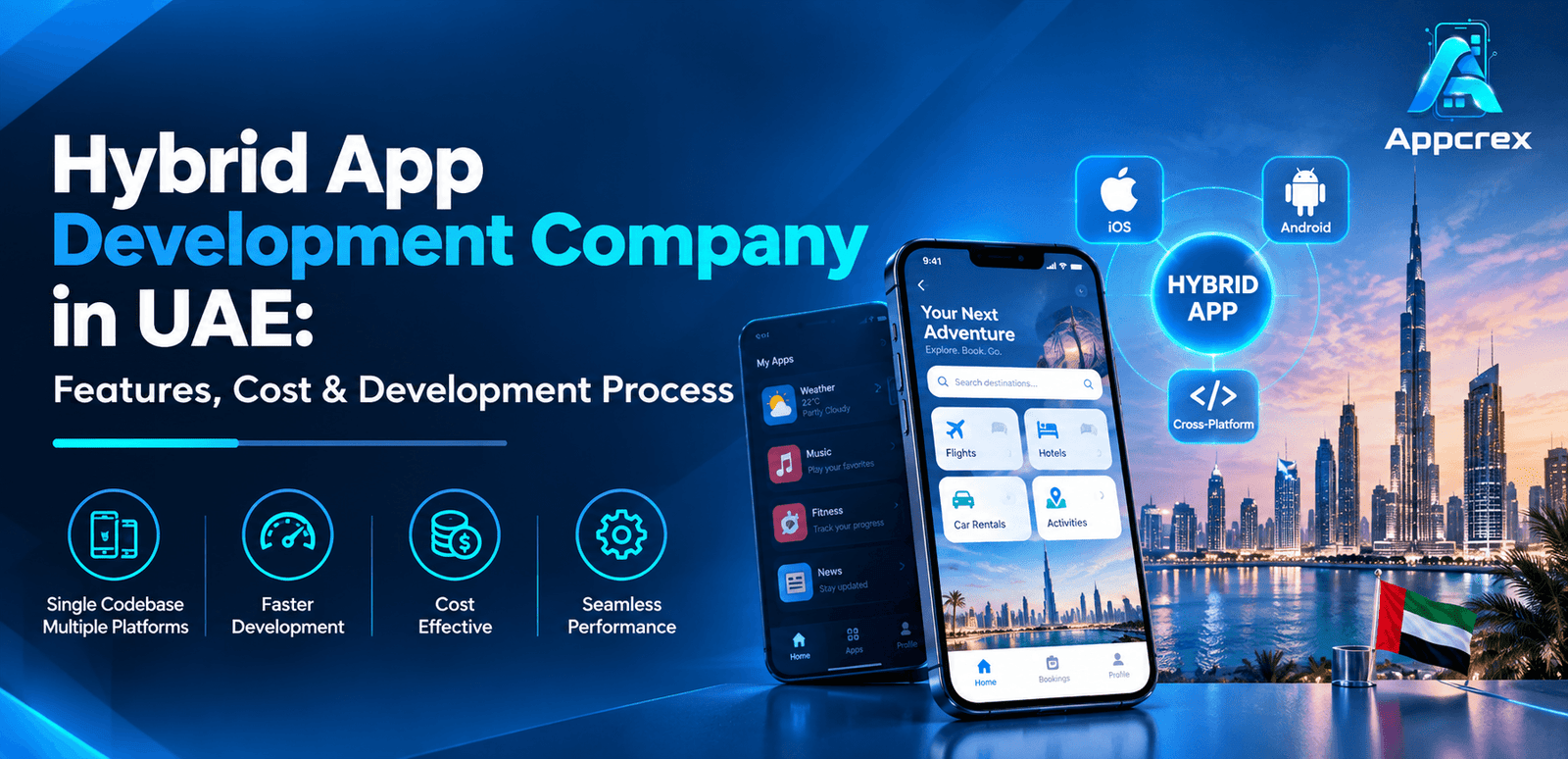
A hybrid app development approach allows businesses to build an app that can serve multiple platforms from a shared codebase. Modern technologies such as Flutter and React Native have made cross-platform development suitable for many commercial applications, while traditional web-wrapper approaches such as Cordova or Ionic are better suited to simpler use cases. Current UAE market research tracks hybrid apps and cross-platform development as distinct segments within the country’s mobile app market.
For UAE businesses, the decision is not simply about reducing development costs. A successful hybrid app should also provide strong performance, Arabic RTL support, secure payments, scalable backend infrastructure, UAE-specific integrations, and a consistent user experience across devices.
This guide explains hybrid app development in the UAE, including services, features, benefits, technology stack, development process, estimated cost, and how to choose the right development company.
What Is Hybrid App Development?
Hybrid app development traditionally means building a mobile app using web technologies such as HTML, CSS, and JavaScript and running it inside a native mobile container.
However, the term hybrid app development is now often used commercially to describe modern cross-platform development using technologies such as Flutter and React Native.
These frameworks allow developers to maintain a shared codebase while delivering applications for both Android and iOS.
For example, instead of creating:
Android → Kotlin/Java development
and
iOS → Swift development
a business can use:
Flutter → Shared codebase → Android + iOS
or:
React Native → Shared codebase → Android + iOS
This can reduce duplicated development work and make it easier to maintain feature consistency across platforms.
Current UAE development discussions show strong interest in Flutter and React Native for cross-platform applications, particularly where businesses want faster delivery and lower development overhead.
It is worth making one distinction clear: modern cross-platform development is not exactly the same as older web-wrapper hybrid development. Flutter and React Native can provide near-native experiences for many business applications, while traditional wrapper technologies may be better suited to simpler applications.
Why UAE Businesses Are Choosing Hybrid App Development?
The UAE market includes startups, SMEs, large enterprises, and government-focused digital services. Businesses in these categories often need to launch quickly while maintaining control over development budgets.
A shared-codebase approach can be particularly useful when a company needs both Android and iOS applications without maintaining two completely separate development projects.
Lower Development Cost
One of the biggest advantages is that developers can reuse a substantial portion of the application code.
Instead of developing the same business logic twice, the team can implement it once and adapt platform-specific components where necessary.
This does not mean that hybrid development automatically costs half as much as native development. The actual saving depends on the application’s complexity, integrations, design, backend, testing, and device-specific requirements.
However, cross-platform development can reduce duplicated engineering work and make it more economical for many business applications.
Faster Time to Market
A UAE startup launching a new marketplace, booking platform, delivery service, or fintech product may not want to spend many additional months developing separate applications.
A well-planned cross-platform project can allow Android and iOS versions to progress together.
This is particularly useful for MVPs because businesses can launch, collect user feedback, validate demand, and then invest in more advanced features.
Easier Maintenance
With a shared codebase, many feature updates and bug fixes can be implemented centrally.
For example, if a company introduces a new loyalty feature, developers can implement the core functionality in the shared codebase rather than maintaining completely separate implementations.
This can simplify long-term maintenance and reduce inconsistencies between Android and iOS.
Consistent User Experience
A business often wants customers to receive the same core experience regardless of their device.
A carefully designed Flutter or React Native application can maintain consistent:
- Navigation
- Branding
- Business logic
- Features
- API integrations
- Notifications
- User accounts
- Payment flows
This is particularly valuable for UAE businesses serving customers across multiple device ecosystems.
Hybrid App Development Services in UAE
A professional hybrid app development company in UAE should provide more than just mobile coding.
The development process normally includes product strategy, UI/UX, mobile development, backend development, API integration, testing, deployment, and post-launch support.
Flutter App Development
Flutter is a popular choice for businesses that want a single codebase for Android and iOS and potentially additional platforms.
It can be suitable for:
- eCommerce apps
- Booking apps
- Fintech apps
- Healthcare apps
- Logistics apps
- Food delivery apps
- Education apps
- Enterprise apps
- Marketplace apps
Flutter’s widget-based approach also gives developers significant control over UI consistency.
React Native App Development
React Native is another major cross-platform framework.
It can be particularly attractive for businesses whose existing teams already have JavaScript or TypeScript expertise.
React Native can be used for:
- Social apps
- Marketplace platforms
- Delivery applications
- Travel apps
- SaaS products
- Enterprise applications
- On-demand services
Custom Hybrid App Development
A custom solution can be designed around the company’s business model rather than forcing the business into a predefined template.
This may include:
- Custom UI/UX
- Backend APIs
- Admin dashboard
- Payment integration
- Real-time tracking
- Push notifications
- Third-party APIs
- AI features
- Analytics
- Cloud infrastructure
Hybrid eCommerce App Development
UAE retailers can build cross-platform shopping apps with:
- Product catalogues
- Search
- Filters
- Cart
- Wishlist
- Checkout
- Coupons
- Loyalty programs
- Payment gateways
- Order tracking
- Push notifications
- Arabic and English interfaces
Hybrid Enterprise App Development
Enterprise applications can be developed for internal teams, field workers, sales representatives, logistics operations, and business workflows.
These apps can connect to existing:
- ERP systems
- CRM platforms
- HR systems
- Databases
- Cloud services
- Business APIs
Also Read : How Much Does It Cost to Build an AI-Powered App in Dubai? Complete Pricing Guide (2026)
Features of a Successful Hybrid App
The features depend on the business model, but a modern UAE-focused application may include several core capabilities.
User Registration and Authentication
Users can register using email, phone number, social login, or other authentication mechanisms.
For enterprise or government-oriented solutions, stronger identity and access controls may be required.
Arabic and English Support
This is especially important for UAE applications.
A bilingual app can allow users to switch between Arabic and English while maintaining proper right-to-left (RTL) layouts for Arabic.
RTL support should be considered during UI/UX design rather than added at the end.
Push Notifications
Notifications can be used for:
- Orders
- Offers
- Appointments
- Payments
- Deliveries
- Promotions
- Account updates
Payment Integration
Depending on the business model, the application can integrate with appropriate UAE and international payment services.
Payment security should be designed into the architecture from the beginning.
GPS and Location
Location-based functionality is important for:
- Taxi apps
- Delivery apps
- Logistics
- Real estate
- Travel
- Food delivery
- On-demand services
Real-Time Tracking
Businesses can provide real-time order, driver, delivery, or service tracking.
Chat and Communication
Applications can include:
- Customer support chat
- Agent chat
- Voice communication
- Video calling
- AI chatbot integration
Admin Dashboard
The backend dashboard allows administrators to manage:
- Users
- Orders
- Products
- Payments
- Content
- Notifications
- Reports
- Analytics
- Customer support
Analytics
Analytics can provide information about:
- Active users
- Retention
- Sessions
- Conversion
- Revenue
- Feature usage
- Customer behavior
This information helps businesses continuously improve the application.
Technology Stack for Hybrid App Development
The technology stack depends on the application’s complexity and future requirements.
| Layer | Common Technologies |
|---|---|
| Mobile | Flutter, React Native |
| Native Modules | Swift, Kotlin |
| Frontend/Web | React.js, Next.js |
| Backend | Node.js, Python, Java, .NET |
| Database | PostgreSQL, MySQL, MongoDB |
| Cloud | AWS, Azure, Google Cloud |
| APIs | REST, GraphQL |
| Authentication | OAuth, JWT |
| Payments | Regional & international payment APIs |
| Maps | Google Maps, Mapbox |
| Notifications | Firebase Cloud Messaging, APNs |
| Analytics | Firebase, custom analytics |
| AI | OpenAI APIs, LLMs, ML models |
| DevOps | Docker, CI/CD, cloud infrastructure |
The key is not to choose technologies simply because they are popular. The stack should match the app’s performance requirements, expected traffic, integrations, security requirements, and long-term roadmap.
Hybrid App Development Process in UAE
Building a successful hybrid app begins with understanding the business rather than immediately writing code.
1. Requirement Analysis
The first stage is to define:
- Target audience
- Business model
- Core features
- Platforms
- Geographic market
- Revenue model
- Third-party integrations
- Security requirements
For a UAE application, Arabic/English support and local payment or identity integrations may need to be considered during this stage.
2. UI/UX Design
The design team creates wireframes and interactive prototypes.
For UAE audiences, the design should account for:
- Arabic RTL
- English LTR
- Different screen sizes
- Accessibility
- Localization
- Simple navigation
- Brand consistency
3. Framework Selection
The development team evaluates whether Flutter, React Native, native development, or another approach is appropriate.
For many standard business applications, Flutter or React Native may be an efficient choice.
However, applications involving highly specialized hardware, advanced AR/VR, extremely graphics-intensive experiences, or certain device-specific functionality may benefit from native development.
4. Backend and API Development
The backend manages business logic, users, databases, payments, notifications, and integrations.
A scalable API architecture should be created so the mobile application can communicate efficiently with backend services.
5. Mobile Development
Developers build the application using the selected cross-platform framework.
Platform-specific native modules can be added wherever necessary.
6. Testing
Testing should cover:
- Android devices
- iPhones
- Different screen sizes
- Network conditions
- Arabic RTL
- English LTR
- Payments
- APIs
- Security
- Performance
- Push notifications
7. Deployment
The team prepares the application for:
- Apple App Store
- Google Play Store
This includes app configuration, store assets, privacy information, testing, and release management.
8. Maintenance and Scaling
After launch, the development team monitors performance and user feedback.
Future updates may include:
- New features
- AI integration
- Performance optimization
- Security updates
- OS compatibility
- Analytics improvements
- Backend scaling
How Much Does Hybrid App Development Cost in UAE?
The cost depends heavily on the app’s functionality.
A useful planning range for 2026 is:
| App Type | Estimated Cost |
|---|---|
| Basic Hybrid MVP | AED 20,000 – 50,000 |
| Medium Complexity App | AED 50,000 – 120,000 |
| Advanced Business App | AED 120,000 – 250,000 |
| Enterprise Hybrid App | AED 250,000 – 500,000+ |
Current UAE-focused development estimates also place basic hybrid projects around AED 20,000 and more complex enterprise solutions at AED 150,000+, although actual pricing varies considerably by scope.
Dubai-focused 2026 estimates similarly show a broad range, from tens of thousands of dirhams for simpler applications to hundreds of thousands or more for complex enterprise products.
What Determines the Cost?
Number of features: A simple booking app costs less than a multi-vendor marketplace.
Backend complexity: Real-time systems, complex APIs, analytics, and custom databases increase development effort.
Third-party integrations: Payments, maps, CRM, ERP, social login, AI APIs, and other integrations affect the budget.
UI/UX: Highly customized interfaces require more design and development time.
Security: Fintech, healthcare, enterprise, and government-oriented applications typically require stronger security architecture.
AI integration: AI assistants, recommendation engines, document processing, and predictive analytics can increase the development budget.
Post-launch requirements: Maintenance, cloud infrastructure, monitoring, and ongoing development should also be included in the overall budget.
Hybrid vs Native App Development: Which Is Better?
There is no universal winner.
| Factor | Hybrid/Cross-Platform | Native |
|---|---|---|
| Development Cost | Usually lower | Usually higher |
| Time to Market | Faster | Longer |
| Codebase | Shared | Separate |
| Maintenance | Simpler | More complex |
| Performance | Near-native for many apps | Maximum |
| Device Integration | Strong | Best |
| Best For | Most business apps | Highly specialized apps |
For a UAE startup, marketplace, delivery service, booking platform, eCommerce business, or SaaS product, cross-platform development can often provide a strong balance between cost, speed, and functionality.
For highly graphics-intensive products or applications that depend heavily on advanced hardware capabilities, native development may be more appropriate.
So the right question is not:
“Is hybrid better than native?”
It is:
“Which architecture best matches the application’s business and technical requirements?”
Why Choose a Hybrid App Development Company in UAE?
The UAE market has specific requirements that should be considered during development.
A development partner should understand:
- Arabic RTL design
- UAE user expectations
- Local payment integrations
- Data security
- Cloud infrastructure
- iOS and Android deployment
- AI integration
- Enterprise APIs
- Scalable architecture
The UAE’s digital transformation strategy emphasizes digital services, platforms, apps, and more personalized digital experiences, creating a strong environment for businesses investing in mobile-first services.
Before hiring a development company, ask:
- Do you have experience with Flutter or React Native?
- Can you support Arabic RTL?
- Can you integrate UAE payment systems?
- Can you build both mobile and backend systems?
- How do you handle platform-specific functionality?
- What testing process do you follow?
- How will the application scale?
- What is included in post-launch maintenance?
- Can you integrate AI and third-party APIs?
- Who owns the source code and intellectual property?
Also Read : AI Automation Company UAE: Services, Use Cases, Cost & Development Process
FAQs
Q. How much does hybrid app development cost in UAE?
A basic hybrid MVP may cost around AED 20,000–50,000, while medium and advanced applications can range from AED 50,000 to AED 250,000+. Enterprise applications can exceed AED 500,000 depending on complexity.
Q. Which is better for UAE businesses: Flutter or React Native?
Both are strong options. Flutter can be attractive for highly customized interfaces, while React Native can be a good choice when JavaScript/TypeScript expertise and native-component integration are priorities.
Q. Can hybrid apps support Arabic?
Yes. Hybrid applications can support Arabic interfaces, RTL layouts, localization, and bilingual Arabic-English experiences.
Q. Can a hybrid app use GPS, camera, and notifications?
Yes. Modern cross-platform frameworks can access many device capabilities through plugins and native modules.
Q. How long does it take to develop a hybrid app?
A simple MVP may take around 2–4 months, while an advanced business or enterprise application may require 4–9+ months, depending on features, integrations, testing, and backend requirements.
Q. Are hybrid apps suitable for startups?
Yes. A shared-codebase approach can help startups launch on Android and iOS while controlling initial development costs.
Q. Can a hybrid app be converted into a native app later?
Yes, but migration should be planned carefully. A well-designed architecture can make future platform-specific development easier if the product eventually requires it.
Conclusion
For many businesses in the UAE, hybrid app development offers a practical balance between development cost, speed, platform coverage, and long-term maintenance. Modern cross-platform technologies have made it possible to create polished mobile experiences without necessarily maintaining completely separate iOS and Android codebases.
The best approach is to begin with a clear product strategy, identify the features that genuinely matter to users, select the appropriate framework, and build the backend architecture with future scalability in mind.
For UAE businesses, additional considerations such as Arabic RTL support, bilingual experiences, local payment integrations, security, cloud infrastructure, and regional user expectations can make a significant difference to the final product.
Whether you are planning an eCommerce app, fintech platform, healthcare solution, logistics application, marketplace, booking platform, or enterprise mobile solution, the right hybrid development strategy can help you move from idea to market more efficiently.
Build Your Hybrid App with AppCrex
AppCrex provides custom mobile app development services for businesses looking to build scalable Android and iOS applications using modern cross-platform technologies.
From React Native and flutter app development to UI/UX design, backend APIs, payment integration, AI integration, cloud deployment, testing, and post-launch maintenance, the development approach can be tailored to your business requirements.
Have a mobile app idea for the UAE market? Build it faster, support both major platforms, and create a scalable product with AppCrex.
