📌 Key Takeaways
- A Delhi Metro Sarthi-like MVP can start from around $50,000.
- QR ticketing, route planning, payments and real-time information are core features.
- Last-mile and multimodal transport integration can turn a metro app into a complete mobility platform.
- AI can add intelligent route assistance, multilingual support and customer service.
- A phased MVP approach can significantly reduce the initial development investment.
Introduction
Urban transportation is becoming increasingly digital. Commuters now expect more than just a route map—they want to check routes, calculate fares, purchase tickets, make digital payments, access travel information, and connect with other transportation services from a single platform.
The Delhi Metro Sarthi App is a good example of how a metro-focused digital platform can evolve into a broader commuter-services ecosystem. According to DMRC’s 2024–25 annual report, Sarthi has expanded beyond basic ticketing to include virtual smart cards, metro-card top-ups, integrated QR ticketing, digital lockers, courier services, e-shopping, utility payments, last-mile connectivity, timetable and service-status information, and door-to-door journeys involving metro, bike, auto, cab, and Rapid Rail/NCRTC services.
This makes “How Much Does It Cost to Build an App Like Delhi Metro Sarthi?” a strong app-development topic for businesses looking to enter the smart transportation, metro ticketing, public transit, mobility, or travel technology market.
The estimated cost can range from around $50,000 for a basic metro app MVP to $200,000+ for an advanced integrated transportation platform. A large-scale ecosystem with multiple transport integrations, sophisticated ticketing, real-time data, payments, AI, and enterprise infrastructure can cost considerably more.
This guide explains the Delhi Metro Sarthi app features, development cost, technology stack, business model, development process, timeline, security requirements, and ways to reduce development expenses.
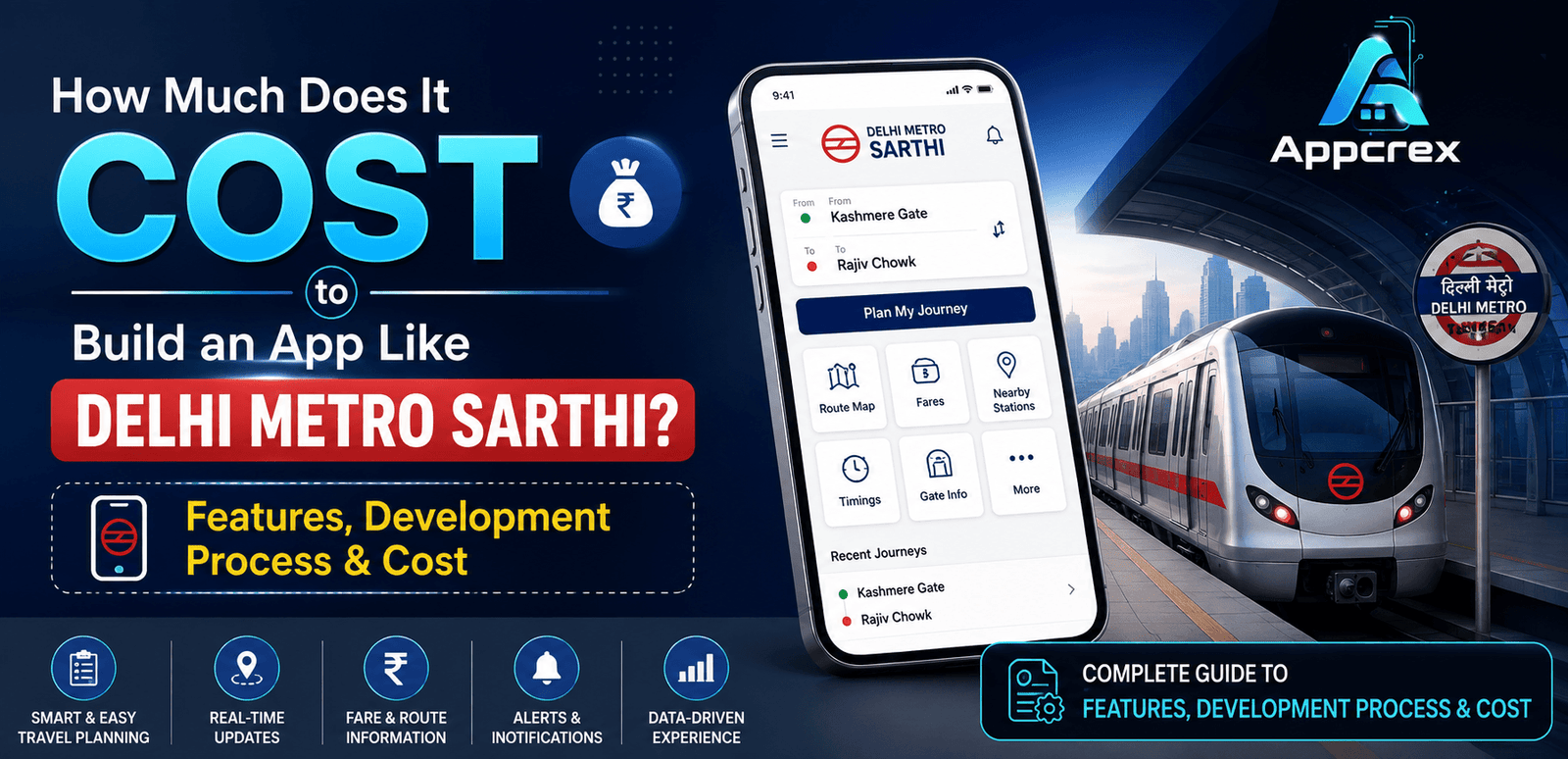
How Much Does It Cost to Build an App Like Delhi Metro Sarthi?
The development cost depends mainly on the number of features, payment integrations, transport APIs, backend complexity, platforms, and real-time data requirements.
| App Type | Estimated Cost |
|---|---|
| Basic Metro App MVP | $50,000–$75,000 |
| Standard Metro Ticketing App | $75,000–$120,000 |
| Advanced Metro Mobility App | $120,000–$200,000+ |
| Enterprise Multi-Transport Platform | $200,000–$350,000+ |
These are estimated software development costs. Expenses such as payment-provider charges, cloud infrastructure, third-party APIs, licensing, compliance, hardware integration, security audits, and ongoing maintenance can be additional.
For a startup, building every feature at once is usually unnecessary. A better approach is to start with route planning, station information, digital ticketing, payments, notifications, and an admin panel, then expand the platform.
Just Read : How to Build an Indian Messaging App Like Vaarta: Features, Cost & Development Guide
What Is the Delhi Metro Sarthi App?
Delhi Metro Sarthi is a digital platform developed around the commuter experience of the Delhi Metro ecosystem.
The platform has evolved beyond simple metro ticket booking. DMRC’s latest annual report describes Sarthi as a broader commuter platform offering integrated QR ticketing across metro lines, virtual smart cards, metro-card top-up, Smart Box digital lockers, courier services, e-shopping, utility payments, last-mile connectivity, timetable and service-status information, and integrated door-to-door journeys.
This evolution is important for entrepreneurs because it demonstrates how a metro app can become a complete mobility platform rather than remaining only a ticket-booking application.
Why Build an App Like Delhi Metro Sarthi?
A modern transportation app can solve several commuter problems from one interface.
Instead of requiring users to switch between multiple services, a mobility application can combine:
- Metro routes
- Station information
- Fare calculation
- Ticket booking
- QR tickets
- Smart-card services
- Digital payments
- Last-mile transportation
- Travel notifications
- Service updates
- Customer support
DMRC has also integrated digital ticketing across multiple channels and platforms, including WhatsApp, Paytm, One Delhi, PhonePe, Amazon Pay and other platforms through ONDC-linked channels.
For a new transportation startup, this creates an opportunity to build a city-specific or multi-city mobility platform.
Just Read : Mobile App Development Company India: Custom Android, iOS & AI App Development Services
Key Features of an App Like Delhi Metro Sarthi
1. User Registration & Login
Users should be able to create an account using:
- Mobile number
- OTP
- Social login, where appropriate
OTP authentication is particularly useful for transportation apps because commuters generally want fast access without complicated registration.
2. Metro Route Planner
Route planning should be one of the core features.
Users can enter:
Starting Station → Destination Station
The app can then display:
- Recommended route
- Interchange stations
- Number of stops
- Estimated travel time
- Fare
- Walking distance
- First/last-mile options
An advanced version can compare multiple routes and suggest the fastest or most convenient option.
3. Station Information
Users can search for a station and view:
- Station name
- Line
- Platform information
- Nearby stations
- Entry/exit gates
- Parking
- Accessibility information
- Nearby transport
- Facilities
This can make the app useful even when the commuter is not purchasing a ticket.
4. Fare Calculator
A fare calculator can automatically estimate the journey cost.
Users select:
Source Station + Destination Station
The system returns the estimated fare.
The fare engine should be configurable through the admin panel because transportation authorities may change pricing structures.
5. QR Ticket Booking
Digital QR ticketing can be one of the most important monetizable features.
The user selects:
- Source
- Destination
- Number of passengers
- Payment method
After successful payment, the application generates a digital QR ticket.
DMRC’s annual report identifies digital QR ticketing as an important part of Sarthi’s digital ticketing ecosystem.
6. Digital Payment Integration
A metro app can support:
- UPI
- Credit cards
- Debit cards
- Net banking
- Wallets
- Other supported payment methods
DMRC reports that UPI, credit/debit cards, net banking and wallets are accepted across its system.
For a private transportation platform, the exact payment options would depend on the target market and payment partners.
7. Metro Card Top-Up
Users can recharge their metro or compatible transit cards through the application.
Features can include:
- Enter card number
- Select amount
- Make payment
- Confirm recharge
- View transaction history
This can significantly improve convenience for regular commuters.
8. Virtual Smart Card
A more advanced platform can provide a virtual transit card or digital representation of an eligible card.
The underlying implementation depends on the transit authority, payment network, and applicable infrastructure.
DMRC specifically lists a Virtual Smart Card among Sarthi’s services.
9. Journey History
Users should be able to view:
- Previous journeys
- Ticket history
- Payment history
- Recharge history
- Refunds
This is particularly useful for frequent commuters.
10. Real-Time Service Updates
Transportation applications can display:
- Service status
- Delays
- Line disruptions
- Station closures
- Maintenance information
- Important announcements
DMRC identifies timetable and service-status information as part of the Sarthi platform.
11. Last-Mile Connectivity
A modern metro app should not necessarily stop at the station.
It can connect commuters with:
- Auto-rickshaws
- Cabs
- Bike taxis
- Feeder buses
- E-rickshaws
- Walking routes
This creates a complete journey rather than a metro-only experience.
DMRC’s Sarthi platform supports last-mile connectivity and integrated door-to-door journeys involving metro, bike, auto, cab and Rapid Rail/NCRTC services.
12. Door-to-Door Journey Planning
This is one of the strongest opportunities for a next-generation mobility platform.
Instead of:
Home → Metro Station → Metro → Destination Station
the app can plan:
Home → Bike/Auto → Metro → Rapid Rail → Cab → Destination
The application can potentially provide:
- Total journey time
- Estimated cost
- Transfer points
- Walking distance
- Transport options
This transforms a metro app into a multimodal transportation application.
13. Digital Locker / Smart Box Integration
A mobility platform can also introduce additional station-based services.
Digital locker functionality can allow users to:
- Reserve lockers
- Select duration
- Make payments
- Receive access credentials
- Track booking
DMRC’s annual report lists Digital Locker services through Sarthi.
14. Utility Payments
A broader commuter platform can include additional services such as:
- Electricity bills
- Mobile recharge
- Broadband
- DTH
- Other supported utilities
However, these features should be added only when they make sense for the platform’s business model.
15. E-Commerce Integration
An advanced mobility ecosystem can offer shopping and station-related services.
DMRC lists e-shopping among Sarthi’s expanded services.
A private platform could explore:
- Station pickup
- Local merchant offers
- Travel products
- Food ordering
- Convenience services
16. Notifications
Push notifications can inform commuters about:
- Ticket confirmation
- Payment status
- Train/service updates
- Route changes
- Promotional offers
- Recharge confirmation
- Refunds
Notifications can be personalized according to user preferences.
17. Saved Routes & Favorite Stations
Frequent commuters can save:
- Home
- Office
- Favorite stations
- Regular routes
This reduces the number of steps required for repeat journeys.
18. Accessibility Features
A modern public transportation application should consider users with different accessibility needs.
Possible features include:
- Accessible route suggestions
- Lift information
- Escalator status
- Audio guidance
- Larger text
- High-contrast UI
- Screen-reader compatibility
This can improve the usefulness of the application for a wider audience.
19. Customer Support
The application should provide:
- FAQs
- Help center
- Complaint submission
- Ticket-related support
- Payment issue reporting
- Refund requests
DMRC has also emphasized digital feedback and complaint channels as part of its digital customer-service initiatives.
20. Admin Dashboard
The admin panel is critical for managing the entire platform.
Administrators can manage:
- Stations
- Metro lines
- Routes
- Fares
- Tickets
- Payments
- Refunds
- Users
- Notifications
- Service alerts
- Transport integrations
- Complaints
- Analytics
A role-based permission system should control access to sensitive operations.
21. Analytics Dashboard
The platform can provide insights into:
- Daily users
- Ticket sales
- Popular stations
- Peak travel times
- Payment methods
- Failed transactions
- Popular routes
- Last-mile bookings
These analytics can help transportation operators improve services and plan capacity.
Also Read : How Much Does It Cost to Build an App in Delhi NCR? Complete Pricing Guide
AI Features for a Metro App
AI can make a modern metro application considerably more useful.
AI Travel Assistant
Users could ask:
“How can I reach Connaught Place from Noida Sector 62?”
The AI assistant could provide:
- Recommended route
- Interchange stations
- Estimated travel time
- Fare
- Last-mile options
Predictive Journey Planning
AI can analyze historical and real-time data to suggest less crowded or faster travel options where appropriate data is available.
Multilingual AI Assistant
India has a multilingual commuter base.
An AI assistant could support:
- English
- Hindi
- Bengali
- Tamil
- Telugu
- Marathi
- Gujarati
- Other regional languages
This can make the platform more accessible.
AI Customer Support
An AI chatbot can answer common questions about:
- Routes
- Tickets
- Fares
- Stations
- Refunds
- Service information
Complex cases can be transferred to human support.
Also Read : AI App Development Guide: Features, Cost & Process (2026)
Technology Stack for a Delhi Metro Sarthi-Like App
Mobile App
Possible technologies include:
- Flutter
- React Native
- Kotlin
- Swift
For a startup launching on both Android and iOS, Flutter or React Native can reduce duplicated development work.
Frontend
Possible technologies:
- React
- Next.js
- TypeScript
These can be used for web-based commuter portals and admin dashboards.
Backend
Potential technologies include:
- Node.js
- Java
- Python
- Go
The backend needs to support high transaction volumes and real-time transportation data.
Database
Potential choices include:
- PostgreSQL
- MySQL
- MongoDB
- Redis
A combination of databases and caching systems may be used depending on the workload.
Maps & Location Technology
A metro application may require:
- GPS
- Maps
- Geolocation
- Route APIs
- Geofencing
- Distance calculation
These services help with:
- Station discovery
- Walking directions
- Last-mile planning
- Nearby transport
- Journey estimation
Payment Technology
Payment integrations may include:
- UPI
- Payment gateways
- Cards
- Net banking
- Wallets
The exact integrations depend on the target market and commercial agreements.
Also Read : GPS Navigation App Development Guide: Features, Cost & Development Process
Real-Time Transportation APIs
A sophisticated platform may connect with:
- Metro APIs
- Bus APIs
- Cab APIs
- Bike taxi APIs
- Railway APIs
- Traffic data
- Maps
- Weather data
The quality of these integrations can significantly affect the accuracy of journey planning.
How Does a Metro Mobility App Work?
A simplified architecture could look like:
User App → API Gateway → Backend → Transport Data + Payment + Maps + Ticketing Systems
For ticket booking:
User → Select Route → Fare Engine → Payment Gateway → Ticket Service → QR Ticket
For multimodal travel:
User → Destination → Route Engine → Metro + Bus/Auto/Cab APIs → Combined Journey
For real-time updates:
Transport System → Data API → Backend → Mobile App → User Notification
This architecture needs to be designed for reliability because transportation services are used throughout the day.
Development Process
Step 1: Market & Business Research
Determine:
- Target city
- Target users
- Transport services
- Revenue model
- Required integrations
- Competitors
If the platform is intended for use by a metro authority, the technical and commercial requirements will be very different from a consumer travel startup.
Step 2: Define the MVP
A basic MVP could include:
- Registration
- Station directory
- Route planning
- Fare calculator
- QR ticketing
- Payment integration
- Ticket history
- Notifications
- Admin dashboard
Also Read : What Is an MVP in App Development? A Complete Guide
Step 3: UI/UX Design
Design the primary screens:
- Home
- Search station
- Route planner
- Fare calculator
- Ticket booking
- QR ticket
- Payments
- Journey history
- Profile
- Support
The interface should prioritize speed because commuters often use the application while traveling.
Step 4: Backend Development
Build:
- User management
- Route engine
- Fare engine
- Ticket system
- Payment processing
- Notification system
- API integrations
- Analytics
Step 5: Integrate Maps & Transport APIs
Connect the application to required location and transportation services.
Step 6: Payment & Ticketing
Implement:
- Payment gateway
- QR ticket generation
- Ticket validation
- Refunds
- Transaction history
For a real transit deployment, ticket validation and gate-side infrastructure may require additional hardware and authority-level integration.
Step 7: Security
Implement:
- Encryption
- Secure authentication
- API security
- Access control
- Fraud detection
- Secure payment handling
- Audit logs
Step 8: Testing
Test:
- Route accuracy
- Ticket generation
- Payment failures
- QR validation
- API failures
- Notifications
- Location accuracy
- Peak traffic
- Security vulnerabilities
Step 9: Launch
After testing, deploy the application to:
- Google Play Store
- Apple App Store
- Web platform, if required
Then continuously monitor performance and user feedback.
Also Read : How to Upload an App on Google Play Store: Complete Step-by-Step Guide (2026)
How Long Does It Take to Build an App Like Delhi Metro Sarthi?
| Development Scope | Timeline |
|---|---|
| Basic Metro App | 4–6 months |
| Metro Ticketing MVP | 5–8 months |
| Advanced Mobility App | 8–12 months |
| Multi-Transport Ecosystem | 12–18+ months |
Payment integration, ticketing infrastructure, real-time transport APIs, third-party integrations, and government/transport authority approvals can affect the timeline considerably.
Cost Breakdown
A rough development budget could be:
| Component | Estimated Cost |
|---|---|
| UI/UX Design | $5,000–$12,000 |
| Mobile App | $20,000–$40,000 |
| Backend & APIs | $20,000–$45,000 |
| Route & Fare Engine | $10,000–$25,000 |
| QR Ticketing | $10,000–$25,000 |
| Payment Integration | $5,000–$15,000 |
| Maps & Location | $5,000–$15,000 |
| Admin Dashboard | $8,000–$18,000 |
| Testing & Security | $10,000–$25,000 |
| DevOps & Deployment | $5,000–$15,000 |
The actual price will depend on the scope and integrations.
What Factors Affect the Cost?
Number of Transport Integrations
Connecting metro, buses, cabs, auto-rickshaws, bike taxis, railways, and other services increases development complexity.
Ticketing Infrastructure
A simple ticketing interface is much less complex than an end-to-end ticketing system integrated with gates and transit infrastructure.
Real-Time Data
Live service information requires reliable data feeds and backend infrastructure.
Payment Methods
Every additional payment method can introduce additional integration and testing requirements.
Multi-City Support
Supporting multiple metro systems requires configurable routes, stations, fares, rules, and APIs.
AI Features
AI travel assistants, prediction systems, translation, and intelligent customer support increase development and infrastructure costs.
Business Model for a Metro Mobility App
A metro app can generate revenue through multiple channels.
Ticketing Service Fees
Depending on the business arrangement, a platform can potentially earn service or convenience fees.
Commission From Mobility Partners
The platform can earn commissions from:
- Cabs
- Auto services
- Bike taxis
- Bus operators
- Other mobility providers
Advertising
Relevant advertising can be displayed to commuters.
Premium Services
Premium users could receive:
- Advanced route planning
- Travel alerts
- Premium support
- Personalized recommendations
Merchant Services
Station-area businesses can pay for:
- Promotions
- Listings
- Offers
- Sponsored placements
How to Reduce the Cost of Development?
You don’t need to build a complete Sarthi-style ecosystem in version one.
Start with:
Phase 1
- Metro routes
- Station information
- Fare calculator
- QR ticketing
- Payments
- Notifications
Phase 2
- Smart-card services
- Last-mile transportation
- Advanced journey planning
- Real-time updates
Phase 3
- AI travel assistant
- Multimodal transportation
- Business partnerships
- Additional city support
This phased approach can reduce initial investment and help validate the product before expanding.
Why Choose AppCrex for Metro App Development?
AppCrex can help businesses build custom metro, transportation, mobility, and public transit applications based on their target market and business model.
Our services can include:
- Metro App Development
- Transportation App Development
- Public Transit App Development
- Ticket Booking App Development
- QR Ticketing Solutions
- Travel App Development
- GPS & Location Integration
- Route Planning
- Payment Gateway Integration
- Real-Time Tracking
- Last-Mile Connectivity
- Multi-Transport Integration
- AI Travel Assistant Development
- Admin Dashboard Development
- Cloud Backend Development
- API Integration
- iOS & Android App Development
- Maintenance & Support
Also Read : Last Mile Delivery Software Development Company: Complete Guide to Features, Cost & Development Process
Whether you want to build a metro ticket booking app, smart transportation platform, public transit application, or multimodal mobility solution, AppCrex can help transform the concept into a scalable digital product.
Build a Metro Mobility App Like Delhi Metro Sarthi
The cost to build an app like Delhi Metro Sarthi can start at around $50,000 for a focused MVP and reach $200,000–$350,000+ for an advanced multi-transport platform.
However, the development cost is only one part of the investment. Payment infrastructure, maps, real-time transportation data, ticketing systems, cloud services, security, third-party APIs, and operational integrations can significantly affect the total cost.
The biggest lesson from Sarthi’s evolution is that a successful metro application does not have to remain limited to ticket booking. It can become a broader digital mobility platform connecting ticketing, payments, route planning, last-mile transportation, smart-card services, and other commuter services. DMRC’s own reporting shows this expansion clearly.
For a startup, the best strategy is to begin with a focused MVP, establish a reliable ticketing and journey-planning experience, and then expand into multimodal transportation, AI, smart-card services, last-mile connectivity, and additional cities.
Want to build a metro or public transportation app? Contact AppCrex to discuss your idea, required features, technology stack, development timeline, and estimated budget.
FAQs
Q. How much does it cost to build an app like Delhi Metro Sarthi?
A basic metro app can cost approximately $50,000–$75,000, while an advanced metro mobility platform can cost $120,000–$200,000+.
Q. How long does it take to build a metro ticket booking app?
A basic MVP can take around 4–6 months, while a feature-rich transportation platform may require 8–18 months or more.
Q. What are the main features of a Delhi Metro Sarthi-like app?
Important features include route planning, station information, fare calculation, QR ticketing, payments, smart-card services, journey history, service updates, notifications, and last-mile connectivity.
Q. Can a metro app support QR ticketing?
Yes. QR ticketing can be integrated into a metro application, provided the necessary ticketing infrastructure, validation systems, payment integrations, and transit-operator requirements are supported.
Q. Can a metro app integrate cabs and auto-rickshaws?
Yes. APIs and commercial integrations can connect the app with eligible mobility providers and allow users to plan multimodal or door-to-door journeys.
Q. Can AI be integrated into a metro application?
Yes. AI can support travel assistance, multilingual communication, route recommendations, customer support, service queries, and predictive analytics.
Q. Can one app support multiple metro cities?
Yes. The platform can be designed with configurable city, station, route, fare, and transport data so additional cities can be added without rebuilding the entire application.
Q. Can AppCrex develop a metro ticket booking app?
Yes. AppCrex can develop custom metro, public transportation, ticket booking, route planning, mobility, and multimodal transportation platforms.