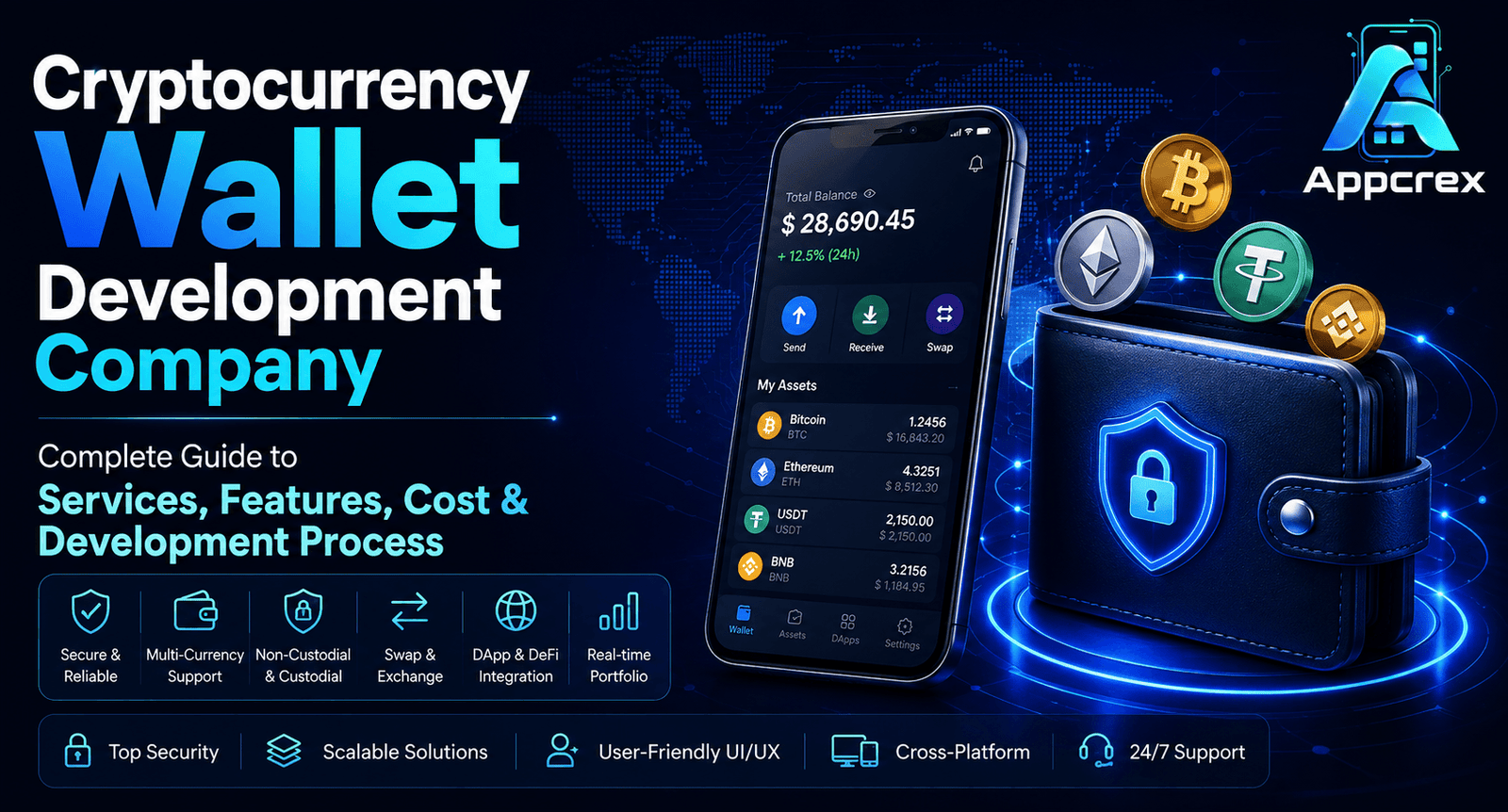
Cryptocurrency wallets have become an essential part of the blockchain and Web3 ecosystem. They allow users to store, manage, send, receive, and interact with digital assets while also providing access to decentralized applications, DeFi platforms, NFT marketplaces, and other blockchain-based services.
As cryptocurrency adoption continues to expand, businesses are investing in cryptocurrency wallet development to create secure, user-friendly, and feature-rich digital asset solutions. However, developing a crypto wallet involves much more than creating a simple interface. It requires blockchain integration, wallet architecture, transaction management, security mechanisms, key management, Web3 connectivity, and extensive testing.
A professional cryptocurrency wallet development company can help businesses build customized wallet solutions for mobile, web, desktop, and Web3 environments.
This guide covers crypto wallet development services, types, features, wallet integration, development process, technology stack, security considerations, cost, and how to choose the right development company.
What Is a Cryptocurrency Wallet?
A cryptocurrency wallet is a software or hardware-based solution that allows users to interact with blockchain networks and manage their digital assets.
Unlike a traditional wallet that physically stores cash, a cryptocurrency wallet generally manages the cryptographic keys that allow users to access and authorize transactions involving blockchain assets.
A crypto wallet can enable users to:
- Send cryptocurrency
- Receive cryptocurrency
- View asset balances
- Manage multiple tokens
- Connect with DApps
- Swap supported assets
- Sign blockchain transactions
- Access DeFi services
- Manage NFTs
- Monitor transaction history
Depending on the wallet architecture, users may have different levels of control over their private keys and assets.
Just Read : How Can You Hire the Best NFT Marketplace Development Company?
What Is Cryptocurrency Wallet Development?
Cryptocurrency wallet development is the process of designing and building a digital wallet that allows users to securely interact with blockchain networks and manage supported digital assets.
A professional wallet development project may include:
- Wallet architecture
- Blockchain integration
- Private key management
- Multi-chain support
- Transaction management
- Wallet security
- Web3 integration
- DApp connectivity
- Token support
- Mobile or web development
- Admin dashboard
- Testing and deployment
The wallet’s features and architecture depend on the target users, supported blockchains, custody model, and business requirements.
Types of Cryptocurrency Wallets
Before developing a crypto wallet, businesses need to decide what type of wallet they want to build.
1. Custodial Crypto Wallet
In a custodial wallet, a centralized service manages or controls the private keys on behalf of users.
These wallets can provide:
- Account recovery options
- User-friendly onboarding
- Transaction management
- KYC integration where required
- Administrative controls
Custodial wallets are commonly used by cryptocurrency exchanges and financial platforms.
Because the service manages sensitive wallet infrastructure, strong security and operational controls are essential.
2. Non-Custodial Crypto Wallet
A non-custodial wallet gives users control over their private keys or recovery credentials.
The service provider generally does not control users’ assets directly.
Popular features include:
- User-controlled keys
- Seed phrase backup
- Transaction signing
- DApp connectivity
- Web3 access
- Multi-chain support
Non-custodial wallets are particularly important in the Web3 ecosystem.
3. Mobile Cryptocurrency Wallet
Mobile wallets allow users to manage digital assets through smartphones and tablets.
A mobile wallet can include:
- Send and receive
- QR code scanning
- Token management
- Transaction history
- Biometric authentication
- WalletConnect-style DApp connectivity
- Push notifications
- Network selection
Mobile wallet development can target Android, iOS, or both platforms.
4. Web Cryptocurrency Wallet
A web wallet allows users to access wallet functionality through a browser-based interface.
Web wallets can be integrated with:
- DeFi platforms
- DApps
- NFT marketplaces
- Exchanges
- Blockchain applications
The user experience should prioritize secure authentication and transaction signing.
5. Desktop Crypto Wallet
Desktop wallets provide users with a dedicated application for managing digital assets.
They can provide advanced functionality such as:
- Multi-chain support
- Asset management
- Transaction signing
- Network configuration
- Advanced security controls
6. Multicurrency Wallet
A multicurrency wallet allows users to manage multiple cryptocurrencies and tokens from one interface.
Instead of maintaining separate wallet applications for different assets, users can access supported networks through a unified platform.
This can improve convenience and simplify portfolio management.
Also Read : Blockchain Development Company: Complete Guide to Services, Cost & Development Process
Cryptocurrency Wallet Development Services
A professional cryptocurrency wallet development company can provide end-to-end wallet development services.
Custom Crypto Wallet Development
Custom wallets are developed according to a company’s specific business requirements.
The development process can include:
- Wallet architecture
- UI/UX design
- Blockchain integration
- Transaction functionality
- Security implementation
- Token support
- Web3 integration
- Testing
- Deployment
Custom development gives businesses more control over the wallet’s functionality and branding.
Multi-Currency Wallet Development
A multi-currency wallet can support multiple cryptocurrencies and blockchain networks.
Depending on the architecture, users may be able to manage:
- Native blockchain assets
- Stablecoins
- Utility tokens
- NFT assets
- Other supported digital assets
DeFi Wallet Development
DeFi wallets are designed to interact with decentralized finance applications.
They can support:
- Token swaps
- Staking
- Liquidity pools
- Lending
- Borrowing
- Yield-related applications
- DApp connectivity
DeFi wallet development requires reliable blockchain connectivity and secure transaction signing.
Web3 Wallet Development
Web3 wallets allow users to interact with decentralized applications.
A Web3 wallet can provide:
- DApp connection
- Transaction signing
- Token management
- NFT support
- Smart contract interaction
- Network switching
These wallets can act as the user’s identity and transaction gateway within Web3 ecosystems.
NFT Wallet Development
NFT-enabled wallets allow users to manage non-fungible assets.
Features may include:
- NFT storage and display
- Collection management
- NFT transfers
- Marketplace connectivity
- Metadata display
- Transaction history
Also Read : Smart Contract Development Company: Complete Guide to Services, Cost & Development Process
Key Features of a Cryptocurrency Wallet
A modern cryptocurrency wallet can include many features depending on the target market.
User Registration and Authentication
Users can securely create accounts or configure wallet access according to the wallet model.
Authentication may include:
- Password protection
- PIN
- Two-factor authentication
- Biometrics
- Device authentication
Send and Receive Cryptocurrency
The basic functionality of a wallet is sending and receiving supported assets.
Users should be able to:
- Enter or scan wallet addresses
- Select blockchain networks
- Enter transaction amounts
- Review network fees
- Confirm transactions
- Track transaction status
QR Code Support
QR codes simplify cryptocurrency transactions.
Users can scan wallet addresses instead of manually entering long blockchain addresses.
Multi-Chain Support
Multi-chain functionality allows users to manage assets across multiple supported blockchain networks.
This feature can make the wallet more useful for Web3 and DeFi users.
Token Management
Users can view and manage supported tokens from a single dashboard.
The wallet can display:
- Token balances
- Token prices
- Asset allocation
- Transaction history
Transaction History
A transaction history feature allows users to monitor:
- Incoming transactions
- Outgoing transactions
- Transaction status
- Network fees
- Blockchain transaction IDs
DApp Integration
DApp integration allows users to connect the wallet with decentralized applications.
This is particularly important for:
- DeFi
- NFT marketplaces
- Blockchain gaming
- DAO platforms
- Web3 applications
Token Swap
A wallet can integrate swap functionality through supported decentralized exchanges or liquidity infrastructure.
Users can exchange supported assets without leaving the wallet interface, depending on the implementation.
Portfolio Management
A portfolio dashboard can provide an overview of:
- Total asset holdings
- Individual token balances
- Portfolio allocation
- Transaction history
- Supported asset values
Push Notifications
Notifications can inform users about:
- Transaction confirmations
- Incoming transfers
- Failed transactions
- Security events
- Wallet activity
Crypto Wallet Integration Services
Crypto wallet integration is an important part of blockchain application development.
Instead of building a complete wallet from scratch for every application, businesses may integrate wallet connectivity into their existing platforms.
Wallet integration can be used with:
- DeFi platforms
- NFT marketplaces
- Cryptocurrency exchanges
- Blockchain games
- DApps
- Payment platforms
- Web3 applications
A wallet integration solution may allow users to connect an existing wallet, sign transactions, approve smart contract interactions, and interact with blockchain services.
This makes Crypto Wallet Integration Services a valuable complementary service to complete wallet development.
How to Build a Cryptocurrency Wallet?
Building a cryptocurrency wallet requires careful planning around blockchain support, security, user experience, and wallet architecture.
Step 1: Define the Wallet Business Model
First, determine the purpose of the wallet.
For example:
- Personal crypto wallet
- Exchange wallet
- DeFi wallet
- Web3 wallet
- Payment wallet
- Multicurrency wallet
- Enterprise wallet
The business model determines the wallet’s features and architecture.
Step 2: Select the Wallet Type
Choose between:
- Custodial
- Non-custodial
- Mobile
- Web
- Desktop
- Multicurrency
A business can also combine multiple approaches.
Step 3: Select Blockchain Networks
Choose the blockchain networks that the wallet will support.
Selection should consider:
- Ecosystem
- Transaction costs
- Scalability
- Security
- Developer tools
- Asset availability
- User demand
Step 4: Design the Wallet Architecture
Developers define how the wallet will manage keys, transactions, blockchain communication, authentication, and other services.
For a non-custodial wallet, key management becomes especially important because users must retain control of their wallet credentials.
Step 5: Design UI/UX
The wallet interface should make complex blockchain operations easy to understand.
Important screens may include:
- Wallet dashboard
- Send
- Receive
- Assets
- Swap
- Transaction history
- DApp browser or connection
- Settings
- Security
Step 6: Develop Wallet Functionality
Developers implement:
- Blockchain connectivity
- Transaction processing
- Key management
- Token support
- Wallet addresses
- QR functionality
- Network switching
- DApp connectivity
Step 7: Integrate Blockchain Infrastructure
Blockchain nodes, APIs, indexing services, or other infrastructure may be required to retrieve blockchain data and submit transactions.
Step 8: Testing and Security Auditing
The wallet should undergo extensive testing before launch.
Testing can cover:
- Functional testing
- Transaction testing
- Security testing
- Device compatibility
- Network testing
- Performance testing
- Recovery testing
Security review is especially important for wallet applications because they interact with highly sensitive credentials and financial assets.
Step 9: Deployment
After successful testing, the wallet can be deployed to the relevant platforms.
For example:
- App Store
- Google Play
- Web platform
- Desktop environment
Step 10: Maintenance and Updates
Post-launch support can include:
- Blockchain updates
- Security improvements
- New token support
- New network integration
- Performance optimization
- Bug fixes
- Feature upgrades
Also Read : DeFi Development Company: Complete Guide to Services, Cost & Development Process
Cryptocurrency Wallet Technology Stack
The technology stack depends on the wallet type and supported blockchain networks.
Mobile Development
- Flutter
- React Native
- Swift
- Kotlin
Web Development
- React
- Next.js
- TypeScript
- JavaScript
Blockchain Integration
Depending on the network, developers can use appropriate blockchain SDKs, APIs, Web3 libraries, node infrastructure, and indexing solutions.
Smart Contracts
For EVM-compatible ecosystems, Solidity is commonly used for smart contract interactions.
Security
Security architecture can include:
- Encryption
- Secure storage
- Multi-factor authentication
- Biometric authentication
- Hardware-backed security where supported
- Transaction confirmation mechanisms
The final stack should be selected based on the wallet’s architecture and target blockchain ecosystem.
Security Considerations for Crypto Wallet Development
Security should be one of the highest priorities when developing a cryptocurrency wallet.
Private Key Protection
Private keys and recovery credentials require strong protection.
For non-custodial wallets, the architecture should minimize unnecessary exposure of sensitive information.
Encryption
Sensitive wallet data should be protected using appropriate encryption mechanisms.
Multi-Factor Authentication
MFA can provide an additional layer of protection for supported wallet architectures.
Biometric Authentication
Mobile wallets can use device-supported biometric authentication as an additional security layer.
Transaction Confirmation
Users should have an opportunity to review important transaction details before signing.
Secure Recovery
Wallet recovery mechanisms should be designed carefully so that legitimate users can regain access without creating unnecessary security weaknesses.
Regular Security Testing
Security testing should be performed throughout development rather than only before launch.
Also Read : How Much Does It Cost to Develop an App in 2026? Complete Pricing Guide
How Much Does Cryptocurrency Wallet Development Cost?
The cost to develop a cryptocurrency wallet depends on the wallet type, supported blockchains, features, security requirements, and development platform.
A broad estimate can look like this:
| Wallet Type | Estimated Development Cost |
|---|---|
| Basic Crypto Wallet | $15,000 – $30,000 |
| Mobile Crypto Wallet | $25,000 – $50,000 |
| Multicurrency Wallet | $30,000 – $60,000+ |
| Web3 Wallet | $30,000 – $70,000+ |
| DeFi Wallet | $35,000 – $80,000+ |
| Advanced Multi-Chain Wallet | $50,000 – $120,000+ |
These are indicative estimates, not fixed development quotes.
Factors Affecting Crypto Wallet Development Cost
Several factors can influence the final budget:
- Wallet type
- Number of supported blockchains
- Number of supported tokens
- Mobile or web platforms
- Custodial or non-custodial architecture
- DApp integration
- DeFi functionality
- Token swap functionality
- NFT support
- Security requirements
- Admin dashboard
- UI/UX complexity
- Third-party integrations
- Testing and auditing
- Post-launch maintenance
A simple single-chain wallet and an advanced multi-chain Web3 wallet can therefore have very different development costs.
Benefits of Developing a Custom Cryptocurrency Wallet
Greater Control
A custom wallet gives businesses control over branding, functionality, integrations, and user experience.
Multiple Revenue Opportunities
Depending on the business model, revenue can potentially come from:
- Transaction fees
- Swap fees
- Premium features
- Partner integrations
- Enterprise services
The monetization model should be designed according to the applicable business and regulatory requirements.
Better User Experience
Businesses can create wallet interfaces specifically for their target audience rather than depending entirely on third-party wallet products.
Web3 Integration
A custom wallet can become an entry point to DeFi, NFTs, DApps, gaming, and other blockchain ecosystems.
Scalable Architecture
A well-designed wallet can be expanded with additional blockchains, tokens, and services over time.
How to Choose a Cryptocurrency Wallet Development Company?
Selecting the right development partner is important because wallet software handles sensitive financial operations.
Before hiring a cryptocurrency wallet development company, evaluate:
Blockchain Expertise
Check whether the team has experience with your required blockchain networks.
Security Experience
Ask about:
- Key management
- Encryption
- Secure storage
- Security testing
- Code reviews
- Auditing
Relevant Portfolio
Look for experience in:
- Crypto wallets
- Web3 applications
- DeFi
- DApps
- Exchanges
- Blockchain integrations
Development Process
A reliable company should have a structured process covering:
Planning → Architecture → UI/UX → Development → Integration → Testing → Security → Deployment → Maintenance
Post-Launch Support
Blockchain ecosystems change continuously, so ongoing technical support can be valuable for maintaining compatibility and security.
Why Choose AppCrex for Cryptocurrency Wallet Development?
AppCrex provides customized blockchain and cryptocurrency development solutions for businesses exploring digital assets and Web3 technologies.
Our cryptocurrency wallet development capabilities can include:
- Custom crypto wallet development
- Mobile wallet development
- Web wallet development
- Multicurrency wallet development
- Non-custodial wallet development
- Web3 wallet development
- DeFi wallet development
- NFT wallet development
- Crypto wallet integration
- Blockchain integration
- DApp integration
- Token integration
- Security-focused wallet development
- Testing and deployment
- Post-launch maintenance
From wallet architecture and blockchain integration to user experience, security, deployment, and ongoing support, AppCrex can help businesses develop a wallet solution aligned with their product requirements.
FAQs
Q. How much does it cost to develop a cryptocurrency wallet?
Cryptocurrency wallet development can cost approximately $15,000 to $120,000+, depending on wallet type, supported blockchains, features, security requirements, integrations, and platforms.
Q. How long does it take to develop a crypto wallet?
A basic wallet can take several weeks, while a feature-rich multi-chain wallet can take several months. The timeline depends on functionality, blockchain integrations, security requirements, and testing.
Q. What is the difference between custodial and non-custodial wallets?
A custodial wallet involves a service managing or controlling private keys, while a non-custodial wallet gives users control over their wallet credentials and transaction signing.
Q. Can a crypto wallet support multiple cryptocurrencies?
Yes. A wallet can support multiple cryptocurrencies and tokens when it is designed and integrated with the relevant blockchain networks.
Q. Can a crypto wallet be integrated with a DeFi platform?
Yes. A wallet can be integrated with DeFi platforms to allow users to connect, sign transactions, swap tokens, stake assets, or interact with supported smart contracts.
Q. What is crypto wallet integration?
Crypto wallet integration connects an existing wallet to a website, DApp, exchange, DeFi platform, NFT marketplace, or other blockchain-based product so users can securely connect their wallets and authorize blockchain transactions.
Q. Can I develop a crypto wallet for both Android and iOS?
Yes. A cryptocurrency wallet can be developed for both Android and iOS using native or cross-platform development technologies, depending on the project’s requirements.
Q. Is cryptocurrency wallet development secure?
Security depends on the wallet architecture, key-management approach, encryption, authentication, transaction-signing design, testing, and ongoing monitoring. Professional security practices are essential for wallet applications.
Conclusion
Cryptocurrency wallets are becoming an important component of the broader blockchain and Web3 ecosystem. From basic digital asset management to DeFi, NFTs, DApps, token swaps, and Web3 interactions, wallets provide users with a way to access and manage blockchain-based services.
However, successful cryptocurrency wallet development requires careful planning and expertise in blockchain integration, key management, security, transaction processing, user experience, and multi-chain architecture.
Whether you want to build a mobile crypto wallet, Web3 wallet, DeFi wallet, multicurrency wallet, or custom non-custodial wallet, choosing an experienced development partner can help reduce technical challenges and create a more reliable product.
Build a Custom Cryptocurrency Wallet with AppCrex
Have an idea for a cryptocurrency wallet?
AppCrex can help you design, develop, integrate, test, and deploy a customized cryptocurrency wallet based on your business requirements.
From crypto wallet development and blockchain integration to Web3, DeFi, NFT, and multi-chain functionality, our team can help turn your wallet concept into a scalable digital asset solution.
Contact AppCrex today to discuss your cryptocurrency wallet development project.