📌 Key Takeaways
- Building an app like Mrsool requires a scalable marketplace architecture with support for customers, merchants, and delivery partners.
- Development costs depend on platform complexity, real-time technologies, third-party integrations, and long-term scalability.
- Modern technologies like Flutter, React Native, Node.js, and cloud infrastructure accelerate development while reducing maintenance costs.
- Marketplace businesses generate revenue through commissions, subscriptions, advertising, and premium delivery services.
- Working with an experienced app development company and professional app developers helps ensure your delivery platform is secure, scalable, and commercially successful.
Introduction
The way people purchase products and services has changed dramatically over the last few years. Consumers no longer expect businesses to simply sell products—they expect them to deliver anything they need quickly, conveniently, and directly to their doorstep.
This growing demand has fueled the rise of on-demand delivery applications, transforming them into one of the fastest-growing segments of the digital economy. Businesses across industries are now investing in delivery platforms that go far beyond food ordering, offering everything from grocery and pharmacy delivery to courier services and personal errands.
One platform that has successfully redefined this space is Mrsool.
Unlike traditional delivery applications that focus on a single category, Mrsool operates as a flexible marketplace where customers can request almost anything while independent delivery captains compete to fulfill those requests.
Its unique business model has inspired entrepreneurs worldwide to build similar multi-service delivery platforms.
If you’re planning to launch a scalable delivery marketplace, choosing an experienced app development company is the first step toward building a secure, user-friendly, and future-ready platform.
In this guide, you’ll learn everything about building an app like Mrsool, including its features, development process, technology stack, estimated costs, and the strategies required to create a successful on-demand delivery business in 2026.
Understanding the Success of Mrsool
Mrsool has become one of the most recognized delivery platforms in the Middle East because it doesn’t limit users to ordering from predefined merchants.
Instead, it connects customers directly with nearby delivery captains who can purchase and deliver almost anything.
This marketplace approach offers significantly greater flexibility than traditional delivery applications.
Customers can request:
- Restaurant orders
- Grocery shopping
- Medicine pickup
- Parcel delivery
- Document collection
- Retail shopping
- Personal errands
- Custom delivery requests
Rather than operating like a typical food delivery app, Mrsool functions as an open logistics marketplace where users and delivery partners communicate directly.
This customer-first model has made it extremely popular across Saudi Arabia and neighboring countries.
Why Entrepreneurs Are Investing in Apps Like Mrsool?
Consumer expectations continue evolving toward convenience and instant service.
Businesses are realizing that a single application capable of supporting multiple delivery categories creates significantly greater long-term value than separate niche applications.
Working with an experienced mobile app development company allows businesses to create platforms that support multiple industries from one scalable infrastructure.
Some of the biggest reasons entrepreneurs choose this model include:
Just Read : Hire Mobile App Developers in UAE: Complete Guide for Businesses (2026)
Expanding Revenue Opportunities
Instead of earning revenue from only food delivery, businesses can support numerous services through one platform.
This diversification creates more consistent income while reducing dependency on seasonal demand.
Faster Market Expansion
Adding new service categories becomes much easier because the same delivery infrastructure can support multiple industries.
For example:
- Grocery Delivery
- Pharmacy Delivery
- Courier Services
- Retail Shopping
- Flower Delivery
- Laundry Pickup
- Document Delivery
Better Customer Engagement
Customers prefer applications that solve multiple problems rather than requiring separate apps for every service.
This increases:
- Daily usage
- Customer retention
- Brand loyalty
- Lifetime customer value
Strong Competitive Advantage
Businesses offering multiple on-demand services can compete more effectively than companies focused on only one category.
Industries That Can Launch a Mrsool-Like Platform
One of the biggest strengths of this marketplace model is its flexibility.
It can be adapted for almost any industry.
Restaurants
Customers order meals from nearby restaurants with live delivery tracking.
Grocery Stores
Users receive fresh groceries within minutes.
Pharmacies
Medicine delivery has become one of the fastest-growing segments of on-demand commerce.
Retail Businesses
Customers purchase clothing, electronics, gifts, and household products from nearby stores.
Courier Services
Businesses and individuals send packages quickly across cities.
Local Service Providers
Professionals offering repair, maintenance, cleaning, or installation services can also be integrated into the same marketplace.
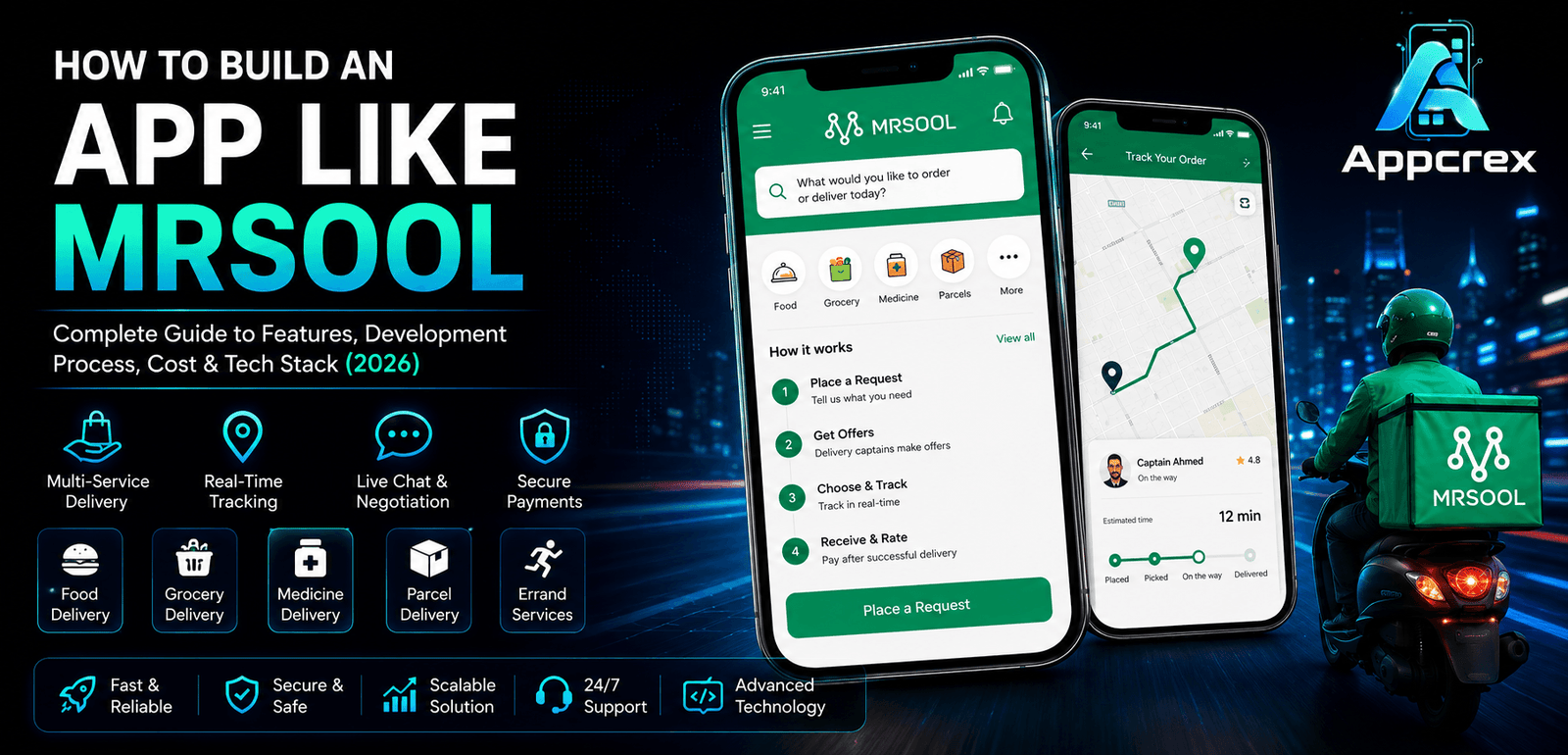
How the Customer Journey Works?
Unlike conventional delivery apps, Mrsool offers a highly interactive ordering process.
A typical customer journey looks like this:
Step 1
The customer creates an account.
Step 2
They enter a delivery request.
Instead of selecting only predefined products, users can describe exactly what they need.
Step 3
Nearby delivery captains receive the request.
Step 4
Delivery partners submit their offers.
Each captain may propose:
- Delivery fee
- Estimated arrival time
- Additional notes
Step 5
The customer selects the preferred delivery captain.
Step 6
The captain purchases or collects the requested items.
Step 7
The customer tracks delivery in real time.
Step 8
Payment is completed after successful delivery.
This flexible workflow makes the platform suitable for a wide variety of delivery scenarios.
Essential Modules Required in an App Like Mrsool
Rather than thinking only about individual features, successful marketplace applications are built around specialized functional modules.
Customer Module
The customer interface should provide everything needed to place and monitor requests efficiently.
Core capabilities include:
- Account Registration
- Profile Management
- Address Book
- Delivery Requests
- Live Tracking
- Secure Payments
- Order History
- Ratings & Reviews
Delivery Captain Module
Delivery partners require their own dedicated application experience.
Important functions include:
- Registration
- Identity Verification
- Request Management
- Offer Submission
- Navigation
- Earnings Dashboard
- Delivery History
- Availability Controls
A well-designed partner application increases operational efficiency while improving driver satisfaction.
Merchant Module
Businesses participating on the platform require tools for managing operations.
Key functions include:
- Store Profile
- Product Management
- Inventory Updates
- Order Notifications
- Performance Reports
- Customer Reviews
Communication Module
One feature that distinguishes Mrsool from many competitors is direct communication.
Instead of limiting interactions, users and delivery captains can communicate before accepting an order.
Typical capabilities include:
- Live Chat
- Voice Calls
- Delivery Instructions
- Image Sharing
- Location Sharing
This improves order accuracy while reducing misunderstandings.
Delivery Management Module
This module coordinates the complete logistics process.
Functions include:
- Order Assignment
- Delivery Scheduling
- Driver Allocation
- Route Monitoring
- Delivery Confirmation
- Exception Handling
Notification Module
Customers expect continuous updates throughout the delivery process.
Notifications may include:
- Captain Assigned
- Order Accepted
- Item Purchased
- Driver Arriving
- Delivery Completed
- Payment Confirmation
Timely notifications improve customer confidence and engagement.
Also Read : React Native App Development Company: Complete Guide to Cross-Platform App Development (2026)
Features That Differentiate Modern Delivery Apps
Today’s users expect far more than simple order placement.
Modern marketplace platforms include intelligent features that improve convenience and operational efficiency.
Examples include:
- Multi-Service Marketplace
- Flexible Delivery Requests
- Live Driver Tracking
- Secure Digital Payments
- In-App Communication
- Personalized Recommendations
- Saved Addresses
- Smart Search
- Delivery Scheduling
- Ratings & Reviews
These features contribute to a seamless customer experience while supporting long-term business growth.
Why User Experience Determines Marketplace Success?
Technology alone does not guarantee adoption.
The most successful delivery applications prioritize simplicity at every step.
Users should be able to:
- Register quickly
- Create requests effortlessly
- Compare delivery offers easily
- Track orders without confusion
- Complete payments securely
An intuitive interface reduces friction, increases completed transactions, and encourages repeat usage.
For this reason, experienced app developers place significant emphasis on UX research before development begins.
Why Choose AppCrex?
Developing a marketplace application like Mrsool requires expertise in logistics, mobile engineering, cloud infrastructure, payment integration, and scalable backend systems.
At AppCrex, our experienced app developers help startups and enterprises transform innovative delivery concepts into secure, scalable, and feature-rich mobile applications.
As a trusted app development company, we provide complete end-to-end services, including product consulting, UI/UX design, Android and iOS development, backend engineering, cloud deployment, testing, and post-launch maintenance.
Whether you’re building a food delivery platform, courier marketplace, or multi-service super app, our team ensures your product is ready to compete in today’s rapidly growing on-demand economy.
Also Read : AI Chatbot Integration Services: Benefits, Cost, Process & Business Use Cases (2026)
Designing the Technical Architecture of a Multi-Service Delivery Platform
A platform like Mrsool processes thousands of delivery requests, user interactions, payments, GPS updates, and notifications simultaneously. To ensure smooth performance, it requires a scalable architecture capable of handling heavy traffic while maintaining real-time responsiveness.
A well-designed delivery platform typically consists of the following components:
- Customer Mobile Application
- Delivery Partner Mobile Application
- Merchant Portal
- Admin Dashboard
- API Gateway
- Backend Services
- Cloud Infrastructure
- Database Cluster
- Payment Services
- Notification Engine
Each component performs a dedicated function, allowing the platform to scale efficiently as users and merchants increase.
Choosing the Right Mobile Development Framework
The choice of framework directly impacts development speed, maintenance costs, and user experience.
Flutter
Flutter is one of the most popular frameworks for mobile app development because it allows businesses to launch Android and iOS applications from a single codebase.
Benefits include:
- Faster development cycles
- Excellent UI consistency
- Native-like performance
- Lower maintenance costs
- Easy scalability
React Native
React Native is another strong option for marketplace applications.
Advantages include:
- Shared codebase
- Faster updates
- Large developer community
- Reduced development costs
Native Development
For businesses requiring maximum performance, native technologies remain an excellent choice.
Android
- Kotlin
- Java
iOS
- Swift
Native development is suitable for applications requiring deep integration with device hardware and operating system features.
Backend Infrastructure
The backend controls every operation taking place inside the application.
Responsibilities include:
- User Authentication
- Order Management
- Delivery Assignment
- GPS Tracking
- Chat Services
- Payment Processing
- Notification Delivery
- Merchant Management
Popular backend technologies include:
- Node.js
- Python
- Java Spring Boot
- .NET
These technologies provide the scalability needed for enterprise-grade delivery platforms.
Database Selection
Marketplace applications generate large amounts of operational data.
Typical databases include:
PostgreSQL
Ideal for:
- Orders
- Payments
- Customer Records
- Financial Transactions
MongoDB
Best suited for:
- Chat Messages
- Activity Logs
- Delivery Events
- Dynamic Content
Many businesses combine SQL and NoSQL databases to optimize performance.
Cloud Deployment Strategy
Cloud infrastructure enables delivery platforms to support rapid business growth.
Popular cloud providers include:
- Amazon Web Services (AWS)
- Microsoft Azure
- Google Cloud Platform
Benefits include:
- Auto Scaling
- High Availability
- Secure Data Storage
- Disaster Recovery
- Global Accessibility
Cloud-native architecture ensures uninterrupted service even during peak demand.
Real-Time Delivery Tracking
Live tracking is one of the defining features of modern delivery applications.
GPS technology enables customers to monitor their delivery partner throughout the journey.
The tracking system typically provides:
- Driver Location
- Estimated Arrival Time
- Route Progress
- Pickup Confirmation
- Delivery Completion
Real-time visibility improves customer confidence and reduces support requests.
Communication System
Unlike traditional food delivery platforms, Mrsool allows customers and delivery captains to communicate before accepting requests.
To support this experience, developers integrate:
- Real-Time Chat
- Voice Calling
- Push Messages
- Delivery Notes
- Image Sharing
These communication tools improve order accuracy and customer satisfaction.
Essential Third-Party Integrations
A marketplace application depends on multiple external services.
Important integrations include:
- Google Maps
- Mapbox
Used for:
- Route Planning
- Driver Navigation
- Distance Calculation
Payment Gateways
Examples include:
- Stripe
- HyperPay
- PayTabs
- Checkout.com
Secure payment integration is essential for customer trust.
Push Notification Services
- Firebase Cloud Messaging
- Apple Push Notification Service
Notifications keep users informed throughout the delivery process.
SMS Verification
OTP services help verify users during registration and password recovery.
Artificial Intelligence in Delivery Apps
Artificial Intelligence is changing how delivery platforms operate.
Modern app developers increasingly integrate AI into logistics applications to improve operational efficiency.
Intelligent Order Assignment
Instead of manually assigning delivery requests, AI selects the most suitable delivery partner based on:
- Distance
- Availability
- Historical Performance
- Traffic Conditions
This reduces delivery times.
Route Optimization
AI continuously analyzes road conditions to identify the fastest delivery routes.
Benefits include:
- Faster Deliveries
- Reduced Fuel Costs
- Improved Driver Productivity
Demand Forecasting
Machine learning predicts periods of high demand.
Businesses can prepare by:
- Increasing driver availability
- Managing promotional campaigns
- Improving operational planning
Customer Behavior Analysis
AI identifies purchasing patterns and recommends:
- Frequently ordered stores
- Personalized offers
- Nearby merchants
- Repeat purchases
This improves customer engagement and increases order frequency.
Security Architecture
Marketplace applications manage customer data, payment information, and delivery operations.
Security should be implemented across every layer.
Common practices include:
- HTTPS Encryption
- Secure APIs
- Multi-Factor Authentication
- Device Verification
- Data Encryption
- Role-Based Access Control
- Secure Cloud Storage
Security protects customers, merchants, and delivery partners alike.
Also Read : Custom Software Development Company: Complete Guide to Services, Process, Cost & Benefits (2026)
Development Workflow
Professional app development companies follow a structured workflow that minimizes delays and ensures product quality.
A typical development process includes:
Discovery & Planning
Understanding business goals and defining platform requirements.
Wireframing & UI Design
Designing intuitive user experiences for customers, merchants, and delivery partners.
Frontend Development
Building Android and iOS applications.
Backend Development
Creating APIs, databases, and marketplace logic.
Integration Phase
Connecting payment gateways, maps, notifications, and communication services.
Quality Assurance
Testing every feature for functionality, security, and performance.
Deployment
Publishing applications to Google Play and Apple App Store while configuring production infrastructure.
Why AppCrex?
Building an on-demand marketplace requires expertise across logistics, cloud computing, payments, AI, and mobile engineering.
At AppCrex, our experienced app developers build scalable marketplace applications that deliver excellent user experiences while supporting long-term business growth.
As a trusted app development company, we provide:
- Product Consulting
- UI/UX Design
- Flutter Development
- React Native Development
- Backend Engineering
- AI Integration
- Cloud Deployment
- Continuous Maintenance
Whether you’re launching a courier platform, grocery marketplace, or multi-service delivery ecosystem, AppCrex helps transform your vision into a market-ready product.
How Much Does It Cost to Build an App Like Mrsool?
One of the first questions every startup founder asks is:
“How much will it cost to build an app like Mrsool?”
The answer depends on your business goals, feature requirements, supported services, integrations, and long-term scalability.
Unlike a standard food delivery application, a marketplace like Mrsool includes multiple user roles, real-time communication, GPS tracking, payment processing, and advanced logistics management. These additional capabilities significantly influence the overall investment.
Below is a general development estimate for 2026.
| Platform Type | Estimated Cost | Timeline |
|---|---|---|
| MVP Delivery Marketplace | $20,000–$40,000 | 3–4 Months |
| Multi-Service Delivery Platform | $40,000–$85,000 | 5–7 Months |
| Enterprise Super App | $85,000–$180,000+ | 8–12+ Months |
The final investment depends on your business requirements and expansion plans.
What Influences Development Cost?
Several technical and business factors determine the total project budget.
Number of User Panels
A Mrsool-like platform includes multiple interfaces:
- Customer App
- Delivery Partner App
- Merchant Dashboard
- Admin Panel
Each additional module increases development effort.
Real-Time Technologies
Features such as:
- Live Tracking
- Instant Notifications
- Live Chat
- Dynamic Driver Allocation
require additional backend infrastructure.
Third-Party Integrations
Costs also increase when integrating:
- Payment Gateways
- GPS Services
- SMS Providers
- Analytics Platforms
- Cloud Storage
- Authentication Services
Scalability Requirements
If your goal is to support thousands of simultaneous deliveries, the backend architecture must be designed for high performance from day one.
Security & Compliance
Marketplace applications process sensitive customer information and financial transactions.
Implementing enterprise-grade security increases development costs but significantly improves customer trust.
Ongoing Maintenance Costs
Launching the application is only the beginning.
Successful marketplace businesses continue investing in:
- Feature Improvements
- Performance Optimization
- Server Monitoring
- Security Updates
- Operating System Compatibility
- Customer Support
- Bug Fixes
Regular maintenance ensures the application remains competitive and reliable.
Revenue Model of an App Like Mrsool
A delivery marketplace offers several monetization opportunities beyond delivery charges.
Delivery Commission
The platform earns a percentage from completed deliveries.
This remains the primary revenue stream for most marketplace businesses.
Merchant Subscription Plans
Businesses can subscribe to premium services including:
- Featured Listings
- Marketing Campaigns
- Sales Analytics
- Business Reports
Recurring subscriptions generate stable monthly income.
Delivery Partner Membership
Offer optional premium memberships providing:
- Priority Delivery Requests
- Lower Platform Fees
- Performance Insights
- Exclusive Rewards
In-App Advertising
Restaurants, grocery stores, and retail brands may pay to appear in:
- Featured Sections
- Search Results
- Promotional Campaigns
Value-Added Services
Additional services may include:
- Same-Day Express Delivery
- Scheduled Deliveries
- Business Delivery Accounts
- Logistics Management Solutions
These services increase overall platform profitability.
Also Read : Enterprise Software Development: Complete Guide for Growing Businesses
Common Challenges When Building a Delivery Marketplace
Every marketplace faces operational and technical challenges.
Planning for these challenges early helps avoid costly mistakes.
Maintaining Delivery Quality
Customer satisfaction depends heavily on delivery performance.
Businesses should continuously monitor:
- Delivery Time
- Order Accuracy
- Customer Ratings
- Driver Performance
Driver Acquisition
Without sufficient delivery partners, customer experience declines.
Successful platforms invest in:
- Driver Incentives
- Referral Programs
- Flexible Earnings Models
Managing Peak Demand
Seasonal promotions and holidays create sudden spikes in orders.
Scalable infrastructure prevents system failures during high-traffic periods.
Balancing Supply & Demand
Too many customers with too few delivery partners results in longer wait times.
Intelligent marketplace management helps maintain operational balance.
Future Trends in Delivery Applications
The delivery industry continues evolving rapidly.
Businesses planning long-term success should prepare for emerging technologies.
Autonomous Delivery
Future platforms may integrate:
- Delivery Robots
- Autonomous Vehicles
- Drone Deliveries
These innovations reduce operational costs while improving delivery speed.
AI-Powered Dispatch Systems
Artificial intelligence will continue improving:
- Driver Allocation
- Delivery Predictions
- Route Optimization
- Customer Recommendations
Hyperlocal Commerce
Consumers increasingly prefer ordering from nearby businesses.
Hyperlocal marketplaces will continue expanding across urban regions.
Sustainable Delivery
Businesses are adopting environmentally friendly delivery methods including:
- Electric Vehicles
- Bicycle Deliveries
- Carbon Offset Programs
Sustainability is becoming an important competitive advantage.
Super App Ecosystems
Future delivery platforms will combine:
- Shopping
- Food Delivery
- Grocery
- Financial Services
- Travel
- Local Services
into a single application.
This trend creates greater customer engagement and increases business opportunities.
Why Choose AppCrex?
Building a platform like Mrsool requires expertise in marketplace architecture, logistics management, cloud infrastructure, AI, and mobile engineering.
At AppCrex, we specialize in delivering scalable digital products that help businesses compete in fast-growing markets.
Our services include:
- Product Strategy
- Business Consulting
- UI/UX Design
- Android Development
- iOS Development
- Flutter Development
- React Native Development
- Backend Engineering
- Cloud Deployment
- AI Integration
- Ongoing Maintenance
Our experienced app developers work closely with clients throughout every stage of development, ensuring the final product is secure, scalable, and aligned with long-term business objectives.
Whether you’re planning a courier platform, grocery marketplace, food delivery service, or a complete super app, AppCrex provides the technical expertise needed to bring your vision to life.
Frequently Asked Questions
1. How long does it take to build an app like Mrsool?
Development timelines generally range from 3 to 12 months, depending on project complexity and feature requirements.
2. Which technology is best for delivery app development?
Flutter and React Native are excellent choices for cross-platform applications, while Kotlin and Swift are suitable for native development.
3. Can I support multiple delivery services in one app?
Yes.
A marketplace architecture allows you to manage food, grocery, pharmacy, courier, retail, and other delivery categories within a single platform.
4. Is GPS tracking mandatory?
Absolutely.
Real-time location tracking improves transparency, delivery accuracy, and customer satisfaction.
5. Can the platform support multiple payment methods?
Yes.
Modern delivery applications typically integrate:
- Credit/Debit Cards
- Digital Wallets
- Apple Pay
- Google Pay
- Local Payment Gateways
6. Can AI improve delivery efficiency?
Yes.
AI helps optimize delivery routes, predict demand, assign drivers intelligently, and improve customer recommendations.
7. Why should I hire professional app developers?
Experienced app developers understand marketplace architecture, logistics workflows, cloud infrastructure, and scalable software engineering, significantly reducing development risks.
8. Why choose AppCrex?
AppCrex combines technical expertise, modern technologies, AI integration, and end-to-end development services to build high-performance delivery applications tailored to your business goals.
Final Thoughts
On-demand delivery platforms have evolved from simple food-ordering applications into powerful digital marketplaces connecting customers, merchants, and delivery partners through one unified ecosystem.
Building an app like Mrsool requires strategic planning, modern technology, scalable infrastructure, secure payment systems, and exceptional user experiences.
Partnering with an experienced app development company ensures every component—from architecture and design to deployment and maintenance—is built for long-term success.
At AppCrex, our skilled app developers help startups and enterprises create innovative delivery platforms that are secure, scalable, and ready to grow alongside their business.
If you’re planning to launch the next generation of on-demand delivery solutions, our team is ready to turn your vision into reality.