📌 Key Takeaways
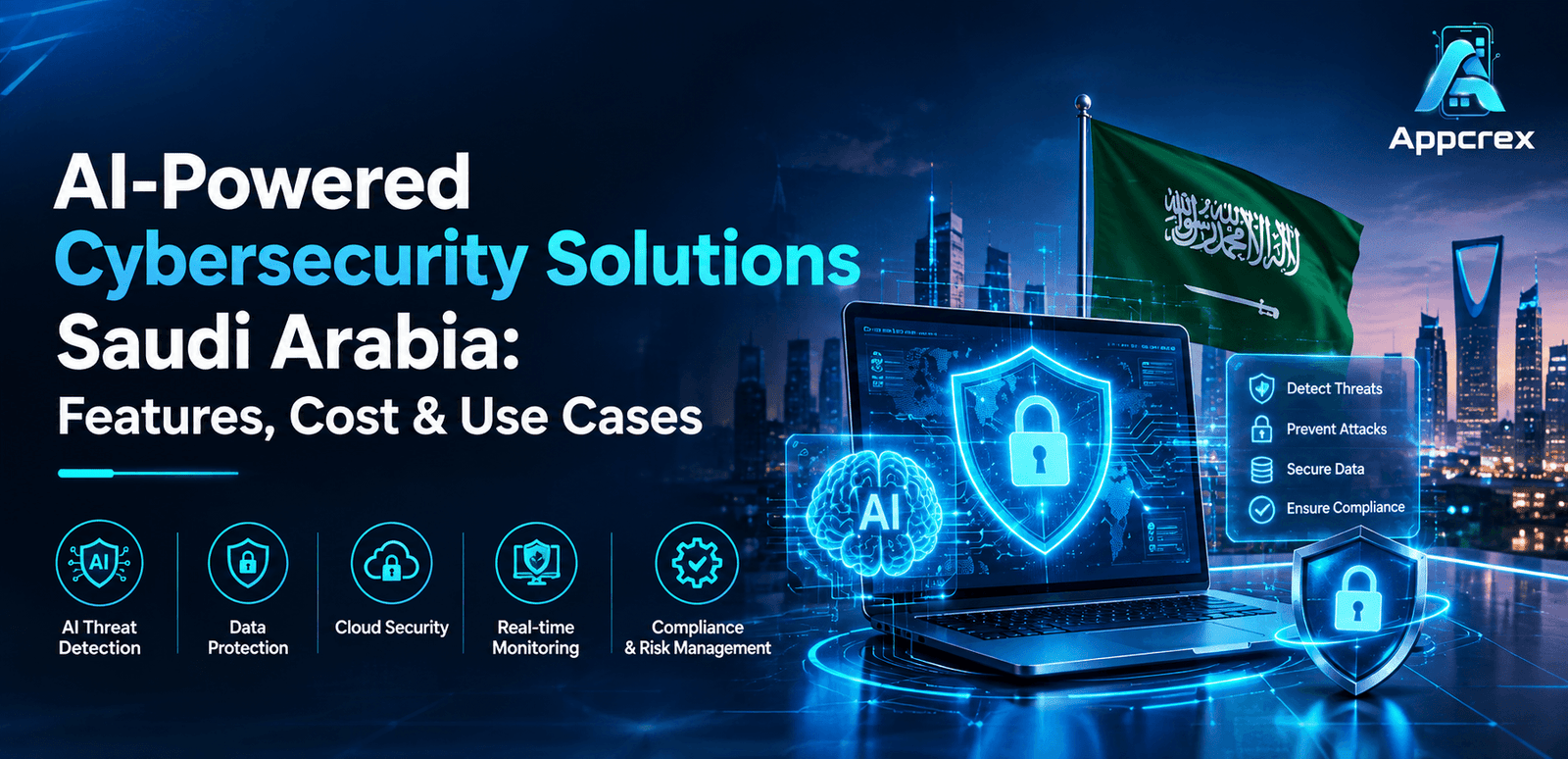
- AI-powered cybersecurity is becoming increasingly important in Saudi Arabia as organizations expand digital and cloud infrastructure.
- AI can detect behavioral anomalies and complex threats that traditional rule-based systems may struggle to identify.
- Key capabilities include threat detection, UEBA, AI risk scoring, phishing detection, automated response, and AI-powered SIEM.
- Saudi cybersecurity projects should consider applicable NCA controls, including ECC, DCC, CCC, and sector-specific requirements.
- AI cybersecurity development can cost approximately $25,000 to $500,000+, depending on the complexity, integrations, AI capabilities, and enterprise requirements.
Introduction
Saudi Arabia is rapidly becoming one of the most technology-driven markets in the Middle East. With businesses moving workloads to the cloud, expanding digital payments, launching AI-powered services, and connecting more devices and systems, cybersecurity has become a strategic business requirement rather than simply an IT function.
At the same time, conventional security tools are increasingly struggling with sophisticated attacks, identity abuse, ransomware, phishing, insider threats, and previously unknown attack patterns. AI-powered cybersecurity solutions address this challenge by combining artificial intelligence, machine learning, automation, behavioral analytics, and real-time threat detection.
For companies looking to build an AI-powered cybersecurity platform in Saudi Arabia, the opportunity is particularly strong. The National Cybersecurity Authority (NCA) continues to expand Saudi Arabia’s cybersecurity controls and frameworks. In 2026, the NCA also published an AI Cybersecurity Guidelines consultation covering governance, defense, resilience, and third-party cybersecurity, including generative and agentic AI.
This guide explains AI-powered cybersecurity solutions in Saudi Arabia, their features, use cases, development process, technology stack, compliance considerations, and estimated development cost.
Just Read : AI Fraud Detection Software Development Saudi Arabia: Complete Guide to Features, Cost & Development Process
What Are AI-Powered Cybersecurity Solutions?
AI-powered cybersecurity solutions use artificial intelligence and machine learning to identify, analyze, predict, and respond to cybersecurity threats.
Unlike traditional security systems that primarily depend on predefined rules and signatures, AI-based systems can learn from large volumes of security data and identify unusual behavior.
For example, an AI cybersecurity platform can detect that:
- An employee is logging in from an unusual location.
- A normally inactive account suddenly downloads thousands of files.
- A device begins communicating with suspicious domains.
- Multiple failed login attempts are followed by a successful login.
- A transaction or user behavior differs significantly from historical patterns.
- Several seemingly unrelated events are actually part of the same attack.
The system can then generate an alert or automatically initiate a predefined response.
AI Cybersecurity vs Traditional Cybersecurity
| Traditional Cybersecurity | AI-Powered Cybersecurity |
|---|---|
| Primarily rule/signature based | Behavior and intelligence based |
| Requires predefined rules | Learns from security data |
| Manual investigation | Automated investigation |
| Limited pattern recognition | Detects complex patterns |
| High alert volume | Intelligent alert prioritization |
| Mostly reactive | Can be predictive |
| Manual response | Automated response possible |
The best enterprise environments generally combine both approaches rather than replacing conventional security controls entirely.
Just Read : AI Automation Company UAE: Services, Use Cases, Cost & Development Process
Why AI Cybersecurity Solutions Are Important in Saudi Arabia?
Saudi Arabia’s digital transformation is increasing the amount of sensitive information and digital infrastructure that businesses need to protect.
Organizations across banking, fintech, healthcare, government, retail, logistics, energy, telecommunications, and e-commerce increasingly rely on connected digital systems.
The Saudi National Cybersecurity Authority is the country’s national authority for cybersecurity and maintains cybersecurity controls, frameworks, standards, and guidelines.
The NCA’s updated Essential Cybersecurity Controls (ECC 2-2024) are designed to strengthen cybersecurity and protect information and technology assets.
Saudi Arabia also has dedicated controls for areas including:
- Data cybersecurity
- Cloud cybersecurity
- Critical systems
- Operational technology
- Cybersecurity risk management
- Managed security operations
For example, the NCA’s Cloud Cybersecurity Controls (CCC-2:2024) address cybersecurity requirements for cloud service providers and cloud service tenants, while the Data Cybersecurity Controls establish minimum requirements for protecting data throughout its lifecycle.
This makes cybersecurity software development a particularly relevant technology opportunity for Saudi businesses.
Key Features of AI-Powered Cybersecurity Software
A modern AI cybersecurity platform can contain dozens of capabilities depending on the organization’s requirements.
1. AI-Based Threat Detection
The system continuously analyzes network traffic, devices, users, applications, and security events.
Machine learning models can identify unusual patterns and classify potential threats.
2. Behavioral Analytics
User and Entity Behavior Analytics (UEBA) can establish normal behavior for:
- Employees
- Administrators
- Customers
- Devices
- Applications
- Servers
- Network entities
When behavior significantly deviates from the baseline, the platform can generate a risk alert.
3. Real-Time Threat Monitoring
Security teams can monitor threats through a centralized dashboard.
The platform can display:
- Threat severity
- Attack source
- Affected devices
- User identity
- Location
- Attack type
- Detection time
- Risk score
- Response status
Real-time monitoring is particularly useful for enterprises that cannot afford prolonged security incidents.
4. AI Threat Scoring
Not every security event represents the same level of risk.
An AI-powered system can assign a risk score based on factors such as:
Risk Score = User Risk + Device Risk + Location Risk + Behavior Risk + Threat Intelligence
For example:
Login from unknown device + unusual country + suspicious IP + abnormal download behavior = High Risk
Security teams can therefore prioritize the most important alerts.
5. Anomaly Detection
Anomaly detection is one of the strongest AI cybersecurity use cases.
The model learns what normal activity looks like and identifies deviations.
It can detect:
- Abnormal login patterns
- Unusual network traffic
- Unexpected data transfers
- Suspicious API activity
- Abnormal database queries
- Unusual administrative actions
This can help detect threats that do not match previously known attack signatures.
6. AI-Powered Phishing Detection
AI can analyze:
- Emails
- URLs
- Attachments
- Sender behavior
- Domain reputation
- Message patterns
- Website content
The system can identify potentially malicious communication and automatically flag suspicious messages.
7. Malware Detection
Machine learning can be used to analyze files and application behavior to identify potentially malicious activity.
Advanced systems can combine:
- Static analysis
- Behavioral analysis
- Sandbox analysis
- Threat intelligence
- Machine learning classification
8. Automated Incident Response
AI cybersecurity platforms can go beyond detection.
Depending on business policies, the system can automatically:
- Block IP addresses
- Disable compromised accounts
- Isolate devices
- Block malicious domains
- Revoke sessions
- Create security tickets
- Notify security teams
- Trigger additional authentication
Human approval can still be required for high-impact actions.
9. AI-Powered SIEM
An AI-enhanced SIEM can collect and correlate security information from multiple sources.
For example:
Firewall → Cloud → Endpoint → Identity → Application → Database → SIEM → AI Analysis
Instead of requiring security analysts to manually examine thousands of events, AI can identify relationships between them.
10. Threat Intelligence Integration
The platform can integrate external and internal threat intelligence feeds to improve detection.
Possible intelligence sources include:
- Malicious IP databases
- Domain reputation
- Malware indicators
- Vulnerability information
- Attack patterns
- Security feeds
- Internal incident history
Advanced AI Technologies Used in Cybersecurity
AI cybersecurity software can use multiple technologies rather than one AI model.
Machine Learning
Used for:
- Threat classification
- Risk scoring
- Anomaly detection
- Behavioral analysis
Deep Learning
Useful for analyzing complex and high-volume security datasets.
Natural Language Processing
NLP can analyze:
- Emails
- Security reports
- Threat intelligence
- Logs
- Incident descriptions
Generative AI
Generative AI can help security analysts summarize incidents, explain alerts, create investigation reports, and assist with security operations.
AI Agents
AI agents can potentially perform multi-step security workflows such as:
- Detect suspicious event
- Investigate related activity
- Correlate logs
- Check threat intelligence
- Assign severity
- Recommend action
- Execute approved response
- Generate incident report
This is one of the emerging directions in enterprise cybersecurity.
Saudi Arabia’s 2026 AI Cybersecurity Guidelines consultation specifically included emerging technologies such as generative AI and agentic AI.
AI-Powered Cybersecurity Use Cases in Saudi Arabia
1. Banking and Fintech
Banks and fintech companies can use AI cybersecurity systems to protect:
- Digital banking platforms
- Mobile banking
- Payment systems
- Customer accounts
- APIs
- Transactions
- Authentication systems
AI can detect suspicious account behavior and unusual transaction patterns.
2. E-Commerce
Saudi e-commerce businesses can use AI to protect:
- Customer accounts
- Payment processes
- Checkout systems
- APIs
- Admin dashboards
- Customer databases
AI can also help detect account takeover and automated bot activity.
3. Healthcare
Healthcare organizations handle highly sensitive information.
AI cybersecurity can monitor:
- Electronic health records
- Hospital systems
- Medical devices
- Cloud infrastructure
- Employee accounts
- Patient portals
The objective is to identify suspicious activity without disrupting critical healthcare operations.
Also Read : AI-Powered Healthcare Platforms (2026): Features, Benefits & Development Guide
4. Government Organizations
Government entities can use AI cybersecurity platforms to monitor large digital infrastructures.
Potential use cases include:
- Identity security
- Network monitoring
- Endpoint security
- Data protection
- Threat detection
- Security operations
Saudi Arabia’s NCA specifically focuses on safeguarding government services, critical infrastructure, national interests, and priority sectors.
5. Energy and Industrial Organizations
Energy companies and industrial organizations often operate both IT and operational technology environments.
AI can help monitor:
- Industrial networks
- SCADA environments
- IoT devices
- Industrial control systems
- Network traffic
- Critical infrastructure
Saudi Arabia also maintains dedicated Operational Technology Cybersecurity Controls for protecting industrial control systems from cyber threats.
6. Telecom Companies
Telecommunications organizations can use AI to monitor huge volumes of network activity.
AI can identify:
- DDoS patterns
- Abnormal traffic
- SIM-related fraud patterns
- Network anomalies
- Suspicious devices
- Account abuse
AI Cybersecurity Architecture
A typical AI cybersecurity platform may follow this architecture:
Data Sources
↓
Endpoints + Cloud + Network + Applications + Identity + Databases
↓
Data Collection Layer
↓
Logs + Events + Telemetry + Threat Intelligence
↓
AI/ML Analytics Layer
↓
Anomaly Detection + Behavioral Analytics + Classification + Risk Scoring
↓
Security Intelligence Layer
↓
Threat Correlation + Prioritization + Investigation
↓
Response Engine
↓
Block + Isolate + Disable + Notify + Escalate
↓
Security Dashboard
↓
SOC Team / Security Administrators
This architecture can be customized depending on whether the product is intended for a startup, enterprise, bank, government organization, or managed security provider.
Saudi Arabia Cybersecurity Compliance Considerations
Compliance should be considered from the beginning of the project rather than added after development.
The NCA’s ECC 2-2024 is an important reference for applicable national entities, and the NCA has published an implementation guide to help organizations implement relevant ECC requirements.
Depending on the organization and environment, other NCA controls may also be relevant.
Important NCA frameworks and controls can include:
- Essential Cybersecurity Controls (ECC)
- Data Cybersecurity Controls (DCC)
- Cloud Cybersecurity Controls (CCC)
- Critical Systems Cybersecurity Controls (CSCC)
- Operational Technology Cybersecurity Controls (OTCC)
- National Framework for Cybersecurity Risk Management
The NCA’s National Framework for Cybersecurity Risk Management provides a reference and methodology for managing cybersecurity risks in Saudi Arabia.
Important: applicability depends on the organization’s sector, systems, classification, regulatory obligations, and relationship with relevant Saudi authorities. A development company should therefore conduct a requirements and compliance assessment before defining the final architecture.
How to Build an AI-Powered Cybersecurity Solution in Saudi Arabia?
Step 1: Define the Security Problem
Start by identifying what the platform is supposed to protect.
For example:
- Banking infrastructure
- SaaS applications
- E-commerce
- Government systems
- Healthcare systems
- Cloud infrastructure
Step 2: Conduct Threat and Risk Analysis
Identify:
- Potential attackers
- Assets
- Attack surfaces
- Vulnerabilities
- Security risks
- Compliance requirements
Step 3: Design the Cybersecurity Architecture
The development team defines:
- Data sources
- APIs
- Cloud infrastructure
- AI models
- Security controls
- Databases
- Monitoring
- Response mechanisms
Step 4: Collect and Prepare Security Data
AI requires high-quality data.
Data may include:
- System logs
- Authentication logs
- Network events
- Endpoint telemetry
- Security alerts
- Historical incidents
The data should be cleaned, normalized, secured, and appropriately governed before model training or analysis.
Step 5: Develop AI/ML Models
Depending on the requirements, developers can build models for:
- Anomaly detection
- Malware classification
- Risk scoring
- User behavior analysis
- Threat prediction
- Phishing detection
Step 6: Integrate Security Tools
The platform may integrate with:
- SIEM
- EDR
- XDR
- Firewalls
- IAM
- Cloud platforms
- Threat intelligence feeds
- Ticketing systems
- Communication platforms
Step 7: Build the Security Dashboard
A security dashboard should make complex information easy to understand.
Typical dashboard sections include:
Threats | Incidents | Users | Devices | Risk Score | Alerts | Investigations | Reports
Step 8: Implement Automated Response
Define which actions can be automated and which require human approval.
For example:
Low Risk → Automatic monitoring
Medium Risk → Analyst review
High Risk → Automated containment + analyst notification
Step 9: Test and Validate
Testing should include:
- Model accuracy
- False positives
- False negatives
- API security
- Access control
- Data protection
- Penetration testing
- Load testing
- Incident response testing
Step 10: Deploy and Continuously Improve
Cybersecurity is not a one-time project.
AI models and detection rules need continuous monitoring and improvement as threats evolve.
How Much Does AI Cybersecurity Software Development Cost in Saudi Arabia?
The cost depends heavily on the scope, AI complexity, integrations, compliance requirements, and security infrastructure.
| Solution Type | Estimated Cost |
|---|---|
| Basic AI security monitoring | $25,000 – $50,000 |
| AI threat detection platform | $50,000 – $100,000 |
| AI-powered SIEM/SOC platform | $80,000 – $160,000 |
| Advanced enterprise cybersecurity platform | $150,000 – $300,000+ |
| Large-scale banking/government cybersecurity platform | $250,000 – $500,000+ |
These are development estimates rather than fixed Saudi market prices. A detailed technical scope is required for an accurate quotation.
Main Factors Affecting Cost
The cost increases with:
- Number of integrations
- AI/ML model complexity
- Real-time processing
- Number of users/devices
- Cloud infrastructure
- SIEM/XDR integration
- Threat intelligence integrations
- Automated response
- Compliance requirements
- SOC functionality
- Custom dashboards
- Arabic/English support
- Enterprise scalability
AI Cybersecurity Software Development Team
A typical project may require:
- Business Analyst
- Cybersecurity Architect
- AI/ML Engineer
- Backend Developer
- Frontend Developer
- DevOps/Cloud Engineer
- Cybersecurity Engineer
- QA Engineer
- Project Manager
For an enterprise cybersecurity product, security expertise should be involved throughout architecture, development, testing, and deployment.
Also Read : DevOps Consulting Service Company: Services, Cost, Benefits & Development Process
Recommended Technology Stack
A possible technology stack includes:
AI & Machine Learning
- Python
- PyTorch
- TensorFlow
- Scikit-learn
- NLP frameworks
- LLM APIs/models where appropriate
Backend
- Node.js
- Python
- Java
- .NET
Databases
- PostgreSQL
- MongoDB
- Elasticsearch
- Redis
Security & Infrastructure
- SIEM
- EDR/XDR
- IAM
- API gateways
- Firewalls
- Cloud security tools
Cloud
- AWS
- Microsoft Azure
- Google Cloud
- Private or hybrid cloud infrastructure
The final technology stack should be selected according to the organization’s security, data residency, integration, performance, and regulatory requirements.
Benefits of AI-Powered Cybersecurity for Saudi Businesses
Faster Threat Detection
AI can analyze huge volumes of security events much faster than manual investigation.
Reduced Security Workload
Automated alert prioritization can help security teams focus on higher-risk incidents.
Better Threat Visibility
Organizations can bring multiple security signals into one environment.
Faster Incident Response
Automated workflows can reduce the time between detection and response.
Scalable Security
AI-based systems can scale as the number of users, devices, applications, and transactions increases.
Predictive Security
Historical and real-time data can be used to identify patterns associated with potential threats.
Challenges of AI Cybersecurity Development
AI cybersecurity is powerful, but it also introduces challenges.
False Positives
An overly sensitive model can generate too many alerts.
False Negatives
A sophisticated attack may evade detection.
Data Quality
Poor or incomplete security data can reduce model performance.
Explainability
Security teams may need to understand why AI classified an event as risky.
AI Model Security
The AI system itself must be protected against attacks such as data poisoning, prompt injection, model manipulation, and unauthorized access.
Privacy and Governance
Security data may contain sensitive information, requiring appropriate access controls, retention, governance, and regulatory consideration.
This is especially important as organizations increasingly introduce generative and agentic AI into enterprise environments. Saudi Arabia’s NCA has explicitly addressed cybersecurity risks associated with AI adoption through its 2026 AI Cybersecurity Guidelines consultation.
How to Choose an AI Cybersecurity Development Company in Saudi Arabia?
Before hiring a development partner, evaluate:
1. Cybersecurity Expertise
Do they understand security architecture, threat detection, identity, cloud security, and incident response?
2. AI/ML Experience
Can they develop and integrate models rather than simply connect an AI API?
3. Saudi Compliance Understanding
Can they design the platform with relevant NCA controls and sector-specific requirements in mind?
4. Integration Capability
Can the solution integrate with existing security infrastructure?
5. Enterprise Scalability
Can the platform handle millions of security events?
6. Secure Development
Does the company follow secure coding, testing, access control, encryption, and DevSecOps practices?
Why Build AI Cybersecurity Solutions With AppCrex?
AppCrex can help businesses design and develop AI-powered cybersecurity software tailored to their security requirements.
Our development approach can include:
- AI/ML-powered threat detection
- Security dashboards
- Anomaly detection
- Behavioral analytics
- AI-powered risk scoring
- SIEM integration
- Cloud security integration
- Automated incident workflows
- API security
- Enterprise cybersecurity platforms
- Generative AI security assistants
- AI agent-based security workflows
For Saudi businesses, the solution can be planned around applicable NCA cybersecurity requirements and the organization’s specific industry, infrastructure, and compliance needs.
FAQs
Q. What is AI-powered cybersecurity?
AI-powered cybersecurity uses artificial intelligence and machine learning to detect, analyze, prioritize, and respond to cybersecurity threats.
Q. How much does AI cybersecurity software cost in Saudi Arabia?
A basic solution may start around $25,000, while advanced enterprise cybersecurity platforms can exceed $300,000–$500,000, depending on scope and integrations.
Q. Is AI useful for cybersecurity?
Yes. AI can help analyze large volumes of security data, detect anomalies, prioritize alerts, identify suspicious behavior, and automate selected response actions.
Q. What industries can use AI cybersecurity solutions in Saudi Arabia?
Banking, fintech, healthcare, e-commerce, telecommunications, government, logistics, energy, manufacturing, SaaS, and other organizations can benefit from AI-powered security solutions.
Q. What Saudi cybersecurity regulations should businesses consider?
Depending on the organization and environment, relevant NCA requirements can include the Essential Cybersecurity Controls, Data Cybersecurity Controls, Cloud Cybersecurity Controls, Critical Systems Cybersecurity Controls, and Operational Technology Cybersecurity Controls. Applicability should be assessed for the specific organization and sector.
Q. Can AI cybersecurity software include Arabic support?
Yes. An AI cybersecurity platform can be designed with Arabic and English interfaces, reports, alerts, dashboards, and security workflows.
Q. How long does it take to build an AI cybersecurity platform?
A relatively focused MVP may take around 3–5 months, while a complex enterprise cybersecurity platform can require 6–12+ months, depending on integrations, AI requirements, testing, and compliance scope.
Conclusion
AI-Powered Cybersecurity Solutions Saudi Arabia is a strong technology opportunity for organizations looking to improve threat detection, security visibility, and automated response.
The next generation of cybersecurity is moving beyond simple firewalls and signature-based detection toward AI-driven behavioral analytics, intelligent threat correlation, automated response, generative AI security assistants, and agentic security workflows.
For Saudi businesses, however, AI capability should not be the only consideration. The solution must also be designed around security architecture, data governance, applicable NCA controls, enterprise integrations, explainability, and continuous monitoring.
For companies planning to build a customized cybersecurity product, starting with a clearly defined threat model and MVP is usually the best approach before expanding into a full AI-powered SOC or enterprise security platform.
Build Your AI Cybersecurity Solution With AppCrex
If you are planning an AI-powered cybersecurity platform in Saudi Arabia, AppCrex can help turn the concept into a scalable product—from AI/ML threat detection and security dashboards to automated incident response and enterprise integrations.
Talk to AppCrex about your AI cybersecurity project.