📌 Key Takeaways
- NLP helps UK businesses automate language-heavy tasks, including text classification, document processing and customer support.
- London businesses use NLP for intelligent search, customer feedback analysis, conversational applications and business process automation.
- AI app development integrates NLP capabilities into web applications, mobile apps and enterprise platforms.
- Agentic AI development extends language understanding by connecting AI systems to approved tools and business workflows.
- NLP development costs depend on project complexity, data quality, integrations, security requirements and ongoing maintenance.
Quick Answer: What Does a Natural Language Processing Services Company Do?
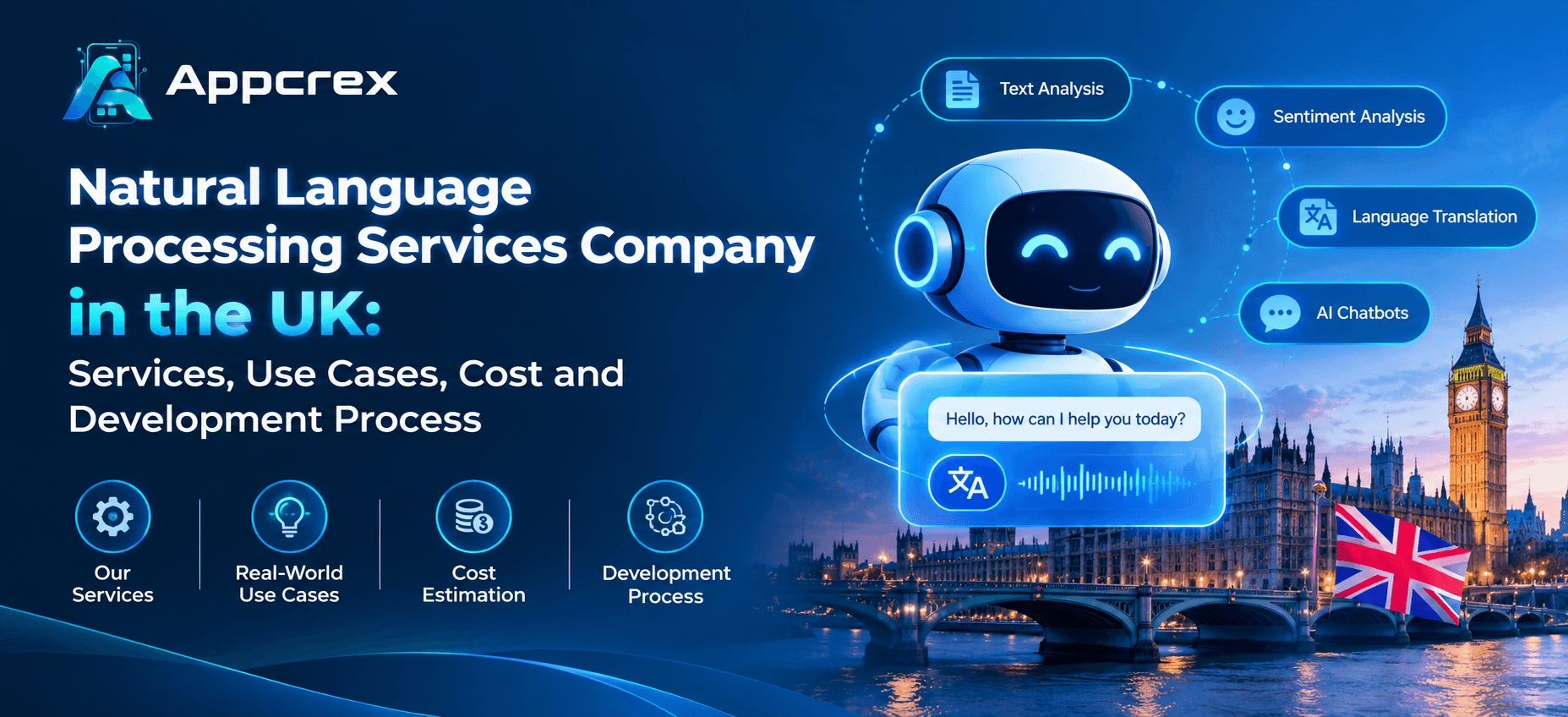
A natural language processing services company helps businesses use artificial intelligence to understand, analyse and generate human language. NLP solutions support chatbots, customer support automation, document processing, sentiment analysis, voice assistants, intelligent search and multilingual communication.
For UK businesses, NLP technology offers practical ways to improve customer experiences, process information faster and reduce repetitive work. Companies in London and other UK business centres use NLP as part of AI app development, enterprise software, customer service platforms and agentic AI development.
AppCrex helps businesses explore AI-powered application and software solutions tailored to their operational requirements, workflows and growth plans.
Introduction
Businesses generate large amounts of unstructured information every day. Customer emails, support conversations, contracts, product reviews, website searches and internal documents contain useful information, but extracting it manually takes time.
Natural language processing (NLP) helps software understand and work with this information. It combines artificial intelligence, machine learning and computational linguistics to process human language in a useful and structured way.
For example, an NLP-powered application can categorise incoming support requests, identify customer sentiment, extract information from documents or help employees find relevant answers across company knowledge bases.
The demand for intelligent business software has also increased interest in AI app development and agentic AI development. NLP plays an important role in these solutions because it allows people to interact with software using everyday language.
Businesses looking for a natural language processing services company in the UK need more than a language model or chatbot. They need a solution that fits their workflows, protects sensitive information, integrates with existing systems and delivers measurable business value.
This guide explains NLP development services, business applications, technologies, implementation steps and estimated development costs.
What Is Natural Language Processing?
Natural language processing is a branch of artificial intelligence that enables computers to work with written and spoken human language.
Traditional software usually relies on predefined rules and structured inputs. NLP systems process language that varies in wording, context, grammar and meaning.
Depending on the use case, an NLP solution might identify the purpose of a customer message, extract details from an invoice, summarise a report or generate a response based on approved business information.
How NLP Works?
Most NLP projects involve several stages.
- Data collection: Gather relevant text, documents, messages or transcripts.
- Data preparation: Clean, organise and format the information.
- Language processing: Apply suitable NLP models, rules or language-model techniques.
- Information extraction: Identify entities, intent, sentiment, topics or key details.
- System integration: Connect the NLP functionality to the required application or workflow.
- Testing and evaluation: Check accuracy, reliability, security and performance.
- Monitoring: Review results and update the solution as business needs change.
Not every project requires all these steps or a model trained from scratch. Some applications work well with existing models, retrieval-based systems and carefully designed business rules.
Natural Language Processing Services in the UK
A natural language processing services company should recommend technologies and development methods based on the business problem rather than selecting tools first.
1. NLP Consulting and Solution Planning
NLP consulting helps businesses identify suitable use cases and determine whether language-processing technology will solve a specific problem.
Consulting activities include:
- Business requirement analysis
- Use-case identification and prioritisation
- Data readiness assessment
- Technology and model selection
- Integration planning
- Security and compliance assessment
- Proof-of-concept development
- Project roadmap and cost estimation
For UK organisations, this planning stage should also consider data handling obligations, industry requirements and the intended users of the solution.
2. AI Chatbot and Conversational AI Development
NLP-powered chatbots interpret user questions and provide relevant responses. They support customer service, product discovery, appointment management and internal employee assistance.
Common capabilities include:
- Intent recognition
- Context-aware conversations
- Frequently asked question automation
- Knowledge-base search
- Conversation history
- Escalation to human support
- Integration with CRM and ticketing systems
For example, a UK retailer could use an NLP chatbot to answer delivery questions, explain return policies and direct customers to the appropriate support team.
Complex chatbots need clear escalation rules. They should recognise when a question falls outside their knowledge or requires human review.
3. Text Classification and Intent Recognition
Text classification assigns labels to written information. Intent recognition identifies what a person wants to achieve through a message or request.
Businesses use these capabilities to:
- Categorise support tickets
- Route emails to relevant departments
- Identify sales enquiries
- Classify feedback by topic
- Prioritise urgent messages
- Organise documents by type
An insurance business, for instance, could classify incoming messages as claims enquiries, policy questions, renewal requests or complaints.
This reduces manual sorting and helps teams direct work to the correct people.
4. Sentiment Analysis and Opinion Mining
Sentiment analysis identifies the tone or opinion expressed in text. Depending on the model and configuration, it can classify feedback as positive, negative or neutral and identify specific topics associated with customer experiences.
Potential applications include:
- Customer feedback analysis
- Product review monitoring
- Brand sentiment reporting
- Complaint identification
- Customer experience research
- Service quality analysis
A London-based hospitality group could analyse reviews from multiple locations to identify recurring complaints about bookings, waiting times or service.
Sentiment analysis is not a perfect measure of customer satisfaction. Sarcasm, mixed opinions and industry-specific language can affect accuracy. Human review remains useful for sensitive decisions.
Just Read : Arabic AI Development Company: Services, Cost, Use Cases & Development Process
5. Document Processing and Information Extraction
Businesses often manage contracts, invoices, application forms, reports and other documents containing valuable information.
NLP solutions extract relevant details and convert unstructured content into searchable or structured data.
Features include:
- Named entity recognition
- Key information extraction
- Document classification
- Contract analysis support
- Automatic summarisation
- Metadata generation
- Document search and indexing
For example, a professional services firm could use document processing to identify contract dates, renewal clauses and named parties.
When documents contain tables, scanned pages or complex layouts, NLP might need to work alongside optical character recognition (OCR) and document-processing technology.
6. Semantic Search and Knowledge Management
Traditional keyword search often struggles when users describe an idea differently from the wording in a document.
Semantic search identifies relationships between concepts and the intended meaning of a query. It helps users find relevant information even when the exact words do not match.
Common applications include:
- Internal company knowledge bases
- Customer support portals
- Product catalogues
- Legal and policy document search
- Technical documentation
- Enterprise information retrieval
A UK technology company could use semantic search to help employees locate information across product documentation, internal policies and support records.
Retrieval-augmented generation (RAG) combines document retrieval with a language model to generate answers grounded in selected information sources. Access controls and source references help users verify the information.
7. Text Summarisation and Content Analysis
NLP summarisation reduces lengthy content into shorter, more manageable outputs.
Businesses use it to review meeting transcripts, customer conversations, research reports, support cases and internal documents.
A summarisation solution might produce:
- Executive summaries
- Meeting notes
- Action-item lists
- Customer conversation summaries
- Research overviews
- Case summaries
Summaries should preserve important details and distinguish confirmed facts from generated interpretations. High-impact business documents should be reviewed before teams rely on them.
8. Multilingual NLP Solutions
Businesses serving international audiences often need applications that support more than one language.
Multilingual NLP solutions support tasks such as text classification, translation workflows, search, content analysis and conversational assistance.
For UK organisations serving customers across different countries, these capabilities help create more consistent digital experiences.
Language coverage and quality vary by model. Regional expressions, accents, specialised terminology and mixed-language content should be tested before deployment.
NLP Use Cases Across UK Industries
NLP is useful wherever businesses need to process language at scale. The right implementation depends on the information available, the business workflow and the consequences of an incorrect result.
Financial Services and FinTech
Financial services businesses handle customer enquiries, compliance documents, reports and transaction-related information.
NLP applications include:
- Customer service automation
- Financial document classification
- Complaint analysis
- Internal policy search
- Report summarisation
- Compliance workflow support
Financial organisations should apply strict access controls and review procedures. NLP outputs should not replace required professional judgement or regulatory controls.
Healthcare and Digital Health
Healthcare organisations work with clinical notes, patient communications, administrative records and medical documentation.
Potential NLP applications include:
- Clinical document summarisation
- Medical terminology extraction
- Patient enquiry routing
- Healthcare knowledge search
- Administrative workflow automation
Healthcare NLP requires careful handling of personal and special-category data. Clinical use cases need appropriate validation, professional oversight and safeguards against incorrect outputs.
Retail and E-commerce
Retailers process product reviews, customer messages, search queries and order-related enquiries.
NLP can support:
- Product search improvements
- Review analysis
- Customer support chatbots
- Product categorisation
- Customer feedback reporting
- Personalised content workflows
An e-commerce business could analyse customer reviews to identify recurring concerns about product quality, sizing or delivery.
Legal and Professional Services
Legal firms, consultants and other professional services organisations often work with lengthy documents and large knowledge repositories.
NLP applications include:
- Contract clause extraction
- Document classification
- Legal research support
- Case document summarisation
- Internal knowledge retrieval
- Email categorisation
These tools should assist qualified professionals rather than make unreviewed legal decisions.
Manufacturing and Logistics
Manufacturers and logistics companies manage maintenance records, operational reports, supplier communications and incident documentation.
NLP can help teams:
- Classify maintenance requests
- Extract information from inspection reports
- Search technical manuals
- Analyse operational feedback
- Summarise incident reports
- Route supplier enquiries
Connecting NLP to existing enterprise systems helps make the extracted information useful within day-to-day operations.
Education and Training
Education providers use NLP for learning support, administrative assistance and information retrieval.
Possible applications include:
- Student enquiry chatbots
- Course information search
- Learning content classification
- Feedback analysis
- Study material summarisation
- Administrative email routing
Education providers should consider accessibility, student privacy and the risk of inaccurate generated information.
Why London Businesses Are Investing in NLP?
London has a diverse business environment that includes financial services, technology firms, retail businesses, professional services and digital startups.
These organisations manage large volumes of customer communication and business documentation. NLP offers ways to improve information access and automate selected language-heavy tasks.
For London businesses, common project priorities include:
- Reducing customer support response times
- Improving search across internal information
- Automating document classification
- Extracting insights from customer feedback
- Integrating AI into existing business applications
- Supporting multilingual customer interactions
A business should define its expected outcomes before investing. Useful measures include processing time, classification accuracy, search success, support resolution time and the percentage of tasks requiring human intervention.
The same approach applies to organizations across Manchester, Birmingham, Edinburgh, Bristol and other UK business centres.
NLP in AI App Development
AI app development integrates artificial intelligence into mobile applications, web platforms and enterprise software. NLP gives these applications the ability to process natural-language instructions and information.
Examples include:
- Mobile apps with conversational search
- Customer portals with intelligent support
- Business applications with document summarisation
- Recruitment platforms with CV information extraction
- E-commerce apps with natural-language product search
- Employee applications with knowledge assistants
An AI app development project usually involves interface design, backend development, model integration, data management, testing and deployment.
The NLP component should fit the application’s wider architecture. For example, a chatbot connected to order records needs secure API access, permission checks and reliable handling of unavailable data.
Businesses planning AI app development should also decide whether the solution needs real-time responses, offline functionality, multilingual support or integration with existing mobile and web systems.
NLP and Agentic AI Development
NLP helps an AI system understand user requests. Agentic AI development extends this capability by allowing an AI agent to plan and perform defined tasks through approved tools and workflows.
An agentic AI solution might interpret a customer request, retrieve account information, check an order status and prepare a response. If authorised, it might also initiate a permitted action.
Typical components include:
- Language understanding
- Task planning
- Tool and API integration
- Business rules
- Memory or workflow state
- Identity and access controls
- Human approval steps
- Logging and monitoring
For example, a customer service agent could categorise a request, retrieve relevant policy information and draft a reply for a support representative.
NLP alone does not make an application agentic. An agent requires additional capabilities for task execution, tool use, state management and control.
Businesses considering agentic AI development should begin with a clearly bounded workflow. Actions involving payments, sensitive records, legal commitments or other high-impact outcomes need stronger permissions and human approval.
Technologies Used in NLP Development
The technology stack depends on the task, available data, expected scale and deployment environment.
| Technology | Typical use |
|---|---|
| Python | NLP application and model development |
| spaCy | Linguistic processing and entity recognition |
| NLTK | Text-processing research and educational applications |
| Hugging Face Transformers | Working with pretrained language models |
| Large language models | Text generation, classification and conversational tasks |
| Embedding models | Semantic search and similarity matching |
| Vector databases | Storing and retrieving text embeddings |
| OCR tools | Extracting text from scanned documents |
| Cloud AI services | Managed language processing and model access |
| REST APIs | Integrating NLP with applications and business systems |
The team should select tools based on accuracy, latency, operating costs, licensing, privacy and maintenance requirements. A simple classification project might not need a large language model, while a document assistant might benefit from retrieval and generation.
NLP Development Process: Step by Step
A structured development process helps businesses reduce project risk and validate results before a full rollout.
Step 1: Define the Business Problem
Identify the workflow that needs improvement. Establish the intended users, current process, business constraints and expected outcomes.
For example, the goal might be to reduce manual support-ticket classification rather than build a general-purpose chatbot.
Step 2: Assess Data Availability and Quality
Review the available documents, messages, transcripts or other language data.
Check for missing information, inconsistent formats, duplicates, sensitive data and potential bias. Confirm that the organisation has an appropriate basis and permissions for processing the data.
Step 3: Choose the NLP Approach
Select the method that fits the use case.
Options include rule-based processing, traditional machine learning, pretrained language models, embeddings, RAG and fine-tuning where appropriate.
Avoid unnecessary model training if an existing model and well-designed workflow meet the requirements.
Step 4: Build a Proof of Concept
Create a small working version using representative data.
Test whether the proposed solution performs the intended task and identify the main limitations. A proof of concept should answer a specific technical or business question.
Step 5: Develop the Application and Integrations
Build the user interface, backend services, data connections and NLP pipeline.
Integrate the solution with relevant systems such as CRM platforms, helpdesk software, document repositories or internal databases.
Step 6: Test Accuracy, Security and Performance
Test the solution using realistic scenarios and edge cases.
Evaluation should include:
- Precision and recall for classification or extraction
- Answer relevance and factual grounding for question-answering systems
- Response time and system reliability
- Access-control behaviour
- Handling of unsupported requests
- Resistance to prompt injection and inappropriate data disclosure
The right metrics depend on the use case. A system that extracts contract dates needs different evaluation criteria from one that classifies customer sentiment.
Step 7: Deploy and Monitor
Release the solution to the intended users, provide training and monitor real-world performance.
Track error patterns, usage, operating costs, latency and user feedback. Establish a process for correcting problems and updating the system as requirements change.
How Much Does NLP Development Cost in the UK?
NLP development costs depend on the scope of the project, data preparation, model choice, integrations, security requirements and ongoing support.
The following figures are illustrative planning estimates, not verified UK market averages or official AppCrex quotations.
| Project type | Illustrative cost in GBP |
|---|---|
| Basic NLP proof of concept | £3,000–£10,000 |
| Text classification or extraction tool | £8,000–£25,000 |
| NLP chatbot or knowledge assistant | £15,000–£45,000 |
| Integrated business NLP application | £30,000–£80,000 |
| Complex enterprise NLP platform | £80,000+ |
Actual costs vary significantly. A narrowly scoped classifier using existing data might cost less than a multi-system enterprise assistant requiring extensive governance and integration.
Factors That Affect NLP Development Costs
Project complexity: A single classification workflow requires less work than a system supporting multiple languages and complex conversations.
Data preparation: Poorly structured or inconsistent data increases cleaning, annotation and validation work.
Model selection: Existing models often reduce initial development effort. Fine-tuning, custom training or specialised infrastructure adds cost.
Application development: A complete web or mobile application requires interface design, backend services, authentication and testing.
System integration: Connecting NLP to CRM, ERP, helpdesk or document systems increases development and testing requirements.
Security and compliance: Sensitive information, access controls, audit trails and industry-specific safeguards require additional planning and implementation.
Ongoing operations: Hosting, model usage, monitoring, maintenance and periodic evaluation contribute to the total cost of ownership.
Businesses should request a scoped estimate based on their requirements, expected usage and integration needs rather than relying on a generic price alone.
How to Choose a Natural Language Processing Services Company in the UK
Selecting an NLP development partner requires a clear assessment of technical capability, delivery processes and business fit.
1. Review Relevant Technical Experience
Look for experience in NLP, machine learning, language models, semantic search and application integration. Ask how the team evaluates accuracy and handles limitations.
2. Assess Business Understanding
The provider should understand the workflow, intended users and success criteria. A technology demonstration is not enough to prove business value.
3. Check Integration Capabilities
Confirm that the team understands your existing applications, APIs, databases and authentication requirements.
4. Discuss Data Protection and Security
Ask how the solution handles personal data, data retention, access permissions, encryption and third-party model providers.
UK organisations should consider applicable UK GDPR and Data Protection Act 2018 obligations. Depending on the project, they might also need a data protection impact assessment and additional sector-specific controls.
5. Ask About Testing and Human Oversight
Find out how the provider measures model performance, detects errors and escalates uncertain outputs. Human review is especially important for high-impact decisions.
6. Understand the Total Cost
Request a breakdown of development, integration, hosting, model usage, maintenance and support. Clarify assumptions and what falls outside the proposed scope.
7. Start with a Defined Pilot
A small pilot helps establish feasibility before a larger investment. Agree on measurable acceptance criteria and use representative data to assess results.
AppCrex offers an application development perspective for businesses exploring AI-enabled software. When evaluating any development partner, confirm the specific NLP capabilities, delivery scope and support arrangements relevant to your project.
Common Challenges in NLP Development
NLP projects face technical and operational challenges that need to be addressed during planning.
Ambiguous language: Words and phrases have different meanings depending on context. Use representative examples and domain-specific evaluation.
Poor data quality: Incomplete or inconsistent data affects model output. Clean and validate data before deployment.
Hallucinations: Generative models sometimes produce unsupported information. Use retrieval, source references, validation and clear fallback behaviour.
Privacy risks: Language data often contains personal or confidential information. Apply data minimisation, appropriate permissions and access controls.
Integration complexity: Legacy systems might use incompatible formats or limited APIs. Assess dependencies before development begins.
Changing business needs: Language patterns, products and workflows change over time. Monitor performance and maintain a documented update process.
Unclear return on investment: Automation does not guarantee savings. Measure the time, quality and operational outcomes that matter to the business.
FAQs
1. What does a natural language processing services company do?
A natural language processing services company develops software that processes human language. Services include chatbots, text classification, sentiment analysis, document extraction, semantic search, summarisation and NLP integration.
2. How much does NLP development cost in the UK?
Illustrative planning estimates range from £3,000–£10,000 for a basic proof of concept to £80,000 or more for a complex enterprise platform. Final costs depend on scope, data quality, integrations, security and model requirements.
3. How long does it take to develop an NLP solution?
A small proof of concept might take a few weeks. A production-ready business application might require several months. Complex enterprise systems often take longer because of integration, testing, governance and deployment requirements.
4. What is the difference between NLP and generative AI?
NLP is a broad field focused on processing human language. Generative AI creates new content, such as text or summaries. Many generative AI systems use NLP techniques, but NLP also includes tasks such as classification, entity extraction and sentiment analysis.
5. How does NLP support AI app development?
NLP allows mobile apps, web applications and enterprise platforms to understand natural-language queries, classify information, summarise documents and support conversational interfaces. It works alongside the application’s backend, database and user interface.
6. What is the relationship between NLP and agentic AI development?
NLP helps an AI system understand language-based requests. Agentic AI development adds capabilities for planning tasks, using approved tools, interacting with business systems and carrying out defined actions. Secure permissions and human oversight remain important.
7. Is NLP suitable for small businesses in London?
Yes. Small businesses might start with a customer support chatbot, email classification, document extraction or intelligent website search. A focused project with clear success criteria helps control costs and validate the business case.
8. Does NLP require custom AI model training?
No. Many applications use existing models, pretrained language models, rules or APIs. Custom training or fine-tuning is worth considering when standard approaches do not meet the required accuracy, domain coverage or operational constraints.
9. How does NLP support UK GDPR compliance?
NLP software should be designed around appropriate data processing, access controls, data minimisation, retention policies and security measures. Compliance depends on how the organisation uses the solution, the data involved and the legal basis for processing. Technical safeguards alone do not guarantee compliance.
10. Can NLP work with existing business software?
Yes. NLP capabilities integrate with suitable CRM platforms, helpdesk systems, websites, mobile applications, document repositories and enterprise systems through APIs or other supported connectors. The available integration options depend on the existing software.
Conclusion
Natural language processing helps UK businesses turn unstructured language into useful information and more efficient workflows. From customer support and document processing to semantic search and AI-powered applications, NLP supports a wide range of business requirements.
For organisations in London and across the UK, the right approach starts with a clearly defined problem, suitable data, an appropriate technology stack and measurable outcomes.
NLP also provides a foundation for more advanced AI app development and agentic AI development. However, reliable results depend on sound integration, thorough testing, data protection and human oversight where required.
AppCrex helps businesses explore application development approaches that align with their technical needs and operational goals. Start with a focused use case, validate its value and expand the solution when the results justify further investment.
Planning an NLP-powered application? Contact AppCrex to discuss your requirements, potential use cases and development scope.