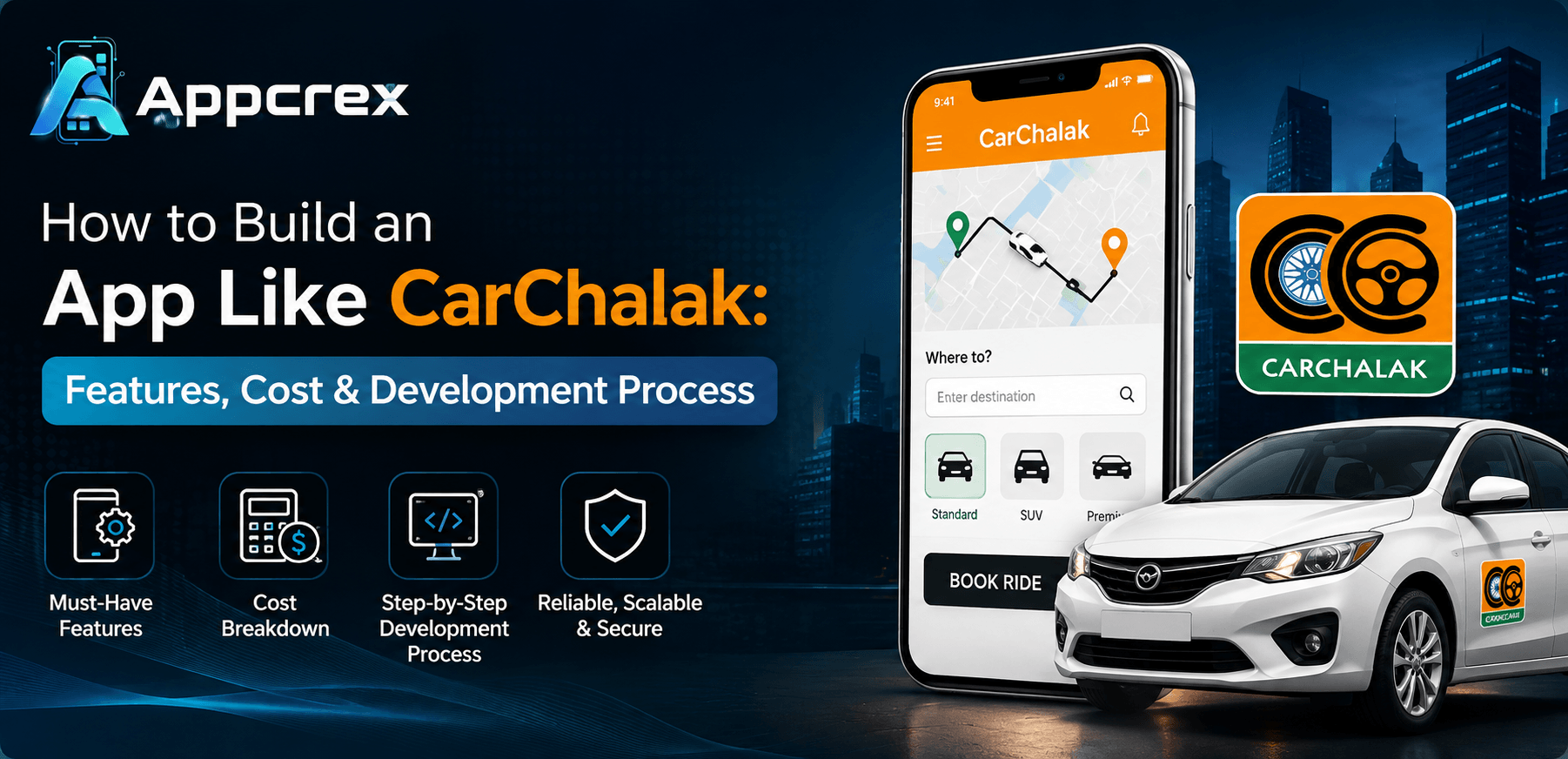
📌 Key Takeaways
- A CarChalak-style app lets customers hire drivers for their own cars.
- The platform usually needs customer, driver, and admin applications.
- GPS, booking, payments, verification, and notifications are core features.
- AI can improve driver matching, support, pricing, and analytics.
- A basic MVP can start around $20,000–$35,000 depending on scope.
Introduction
Not everyone who owns a car wants to drive it all the time.
There are days when traffic is exhausting, a family member needs to travel, an outstation trip is planned, or someone simply needs a professional driver for a few hours. Hiring a full-time driver is not always practical either.
This is where the on-demand driver booking model comes in.
CarChalak is an example of this type of service. Instead of booking a car with a driver, users can book a professional driver for their own car. The company currently presents services such as hourly drivers, personal drivers, outstation drivers, airport-related driver services, and other driver-on-demand options.
This business model creates an interesting opportunity for entrepreneurs who want to build a similar driver booking app for a city, region, or multiple markets.
In this guide, we will explain how to build an app like CarChalak, what features you need, how the business model works, the technology involved, development cost, timeline, and ways to make the app different from existing driver-booking platforms.
What Is a CarChalak-Like App?
A CarChalak-like app is an on-demand driver hiring platform where customers can book a professional driver to drive their own vehicle.
The basic idea is simple:
Customer needs a driver → Customer opens the app → Selects service → Adds location and trip details → Driver is assigned → Driver reaches the customer → Customer travels in their own car.
CarChalak’s official booking flow follows a similar approach: users select their location and driver requirement, provide trip details, confirm the booking, and are matched with a driver according to their requirements.
The important difference from a traditional taxi application is that the vehicle belongs to the customer.
That makes this model suitable for:
- Daily commuters
- Families
- Senior citizens
- Business professionals
- Airport travelers
- Outstation travelers
- People attending events
- Customers who need temporary driving assistance
How Does an App Like CarChalak Work?
The customer journey does not need to be complicated.
1. Customer Creates an Account
The user registers using a mobile number, email, or another supported authentication method.
2. Customer Selects a Location
The user enters the pickup location where the driver needs to arrive.
3. User Selects a Driver Service
Depending on the business model, users may be able to choose:
- Hourly driver
- Daily driver
- Personal driver
- Outstation driver
- Airport driver
- Night driver
- Corporate driver
CarChalak currently lists several of these service categories on its platform.
4. User Adds Trip Details
The customer can provide information such as:
- Date
- Pickup time
- Vehicle type
- Destination
- Trip type
- Duration
- Special requirements
5. Driver Matching
The platform finds an available driver based on factors such as:
- Location
- Availability
- Service type
- Schedule
- Driver profile
- Customer requirements
6. Booking Confirmation
The customer receives booking information and driver details through the application.
7. Driver Reaches the Customer
The assigned driver arrives at the requested location and drives the customer’s vehicle.
8. Payment and Completion
After the service is completed, the customer can pay through the supported payment method and receive an invoice or booking summary.
Why Build an App Like CarChalak?
The driver-on-demand model solves a very specific problem: people sometimes need a driver without needing another vehicle.
This makes it different from conventional taxi or ride-hailing applications.
Flexible Driver Hiring
Customers can hire a driver only when they need one rather than maintaining a full-time driver.
Useful for Different Situations
The same platform can serve:
- Office travel
- Family trips
- Airport visits
- Weddings
- Events
- Night travel
- Outstation journeys
- Temporary driving requirements
Multiple Revenue Opportunities
A business can earn through hourly bookings, service fees, commissions, subscriptions, corporate accounts, or other pricing models.
Easy to Expand
A successful city-based model can later be expanded to other cities and regions.
Important Features for an App Like CarChalak
A strong driver-booking application needs separate experiences for customers, drivers, and administrators.
Customer App Features
Easy Registration
Users should be able to create an account quickly using phone number, email, or OTP.
Location Selection
GPS and map integration allows customers to select their pickup location.
Driver Service Selection
Users can select the type of driver they need.
For example:
- Hourly
- Daily
- Outstation
- Airport
- Personal
- Night
- Corporate
Schedule a Driver
Customers should be able to book immediately or schedule a driver for a future date and time.
Fare Estimate
Before confirming the booking, users can see an estimated price.
Driver Profile
The app can show relevant driver information such as:
- Name
- Experience
- Rating
- Verification status
- Profile photo
- Service history
Live Driver Tracking
GPS tracking can allow customers to see where their assigned driver is and estimate arrival time.
Booking History
Users should be able to see previous and upcoming bookings.
Online Payments
The app can support:
- Cards
- UPI
- Digital wallets
- Net banking
- Other regional payment methods
Ratings and Reviews
After completing the service, customers can rate the driver and provide feedback.
Notifications
Push notifications can inform customers about:
- Booking confirmation
- Driver assignment
- Driver arrival
- Booking changes
- Payment
- Cancellation
Driver App Features
The driver application is equally important because it manages the supply side of the business.
Driver Registration
Drivers can submit:
- Name
- Phone number
- Address
- Driving experience
- License information
- Identity documents
- Other required documents
Driver Verification
A verification workflow can be used to review submitted documents and approve drivers before they become available for bookings.
CarChalak states on its official website that its drivers undergo verification and training.
Driver Availability
Drivers can switch between:
Online → Available for bookings
and
Offline → Not accepting bookings
Booking Requests
Drivers can receive nearby booking requests and accept or reject them based on platform rules.
Map integration helps drivers reach the customer’s pickup location.
Earnings Dashboard
Drivers can view:
- Completed bookings
- Current earnings
- Pending payments
- Service history
- Incentives
Driver Ratings
Drivers can view ratings and feedback received from customers.
Support
The app can provide driver support through chat, call, FAQs, or ticketing.
Admin Panel for a Driver Booking App
The admin dashboard is where the business manages the entire platform.
Important modules include:
Customer Management
Admins can view and manage customer accounts.
Driver Management
Admins can:
- Approve drivers
- Verify documents
- Suspend accounts
- Manage availability
- Review ratings
Booking Management
Admins can monitor:
- New bookings
- Active bookings
- Completed bookings
- Cancelled bookings
- Scheduled bookings
Pricing Management
The business can configure pricing according to:
- Hours
- Distance
- Service type
- City
- Time
- Peak demand
Payment Management
Admins can monitor transactions, refunds, invoices, and settlements.
Analytics
The dashboard can provide information about:
- Total bookings
- Revenue
- Active drivers
- Customers
- Cancellation rate
- Popular services
- City-wise performance
Advanced Features to Add
Once the basic application is working, advanced functionality can make the platform more useful.
AI-Based Driver Matching
AI can analyze factors such as:
- Distance
- Driver availability
- Historical acceptance
- Customer preferences
- Service requirements
to improve driver matching.
Demand Prediction
The system can analyze booking patterns to estimate when demand is likely to increase.
This can help businesses manage driver availability.
Smart Pricing
Dynamic pricing can be introduced based on:
- Demand
- Time
- Location
- Driver availability
- Trip type
The pricing model should be transparent to customers.
Fraud Detection
AI and rule-based systems can help identify unusual booking or payment behavior.
Automated Customer Support
An AI chatbot can answer common questions about:
- Bookings
- Pricing
- Cancellation
- Driver availability
- Payments
Corporate Booking
Companies can receive dedicated accounts to book drivers for employees, executives, clients, and business travel.
This can create an additional B2B revenue channel.
Safety and Driver Verification
Driver-booking platforms deal with real-world transportation, so trust is an important part of the product.
The platform can include:
- Identity verification
- Driving license verification
- Background checks
- Document verification
- Driver ratings
- Emergency contact
- SOS functionality
- Trip sharing
- Customer support
- Driver activity monitoring
The exact verification and operational requirements should be designed according to the market and applicable local laws.
CarChalak publicly describes its drivers as verified and trained, showing how trust and verification can be positioned as part of this type of service.
Technology Stack
A CarChalak-like application can be built using native or cross-platform technologies.
Mobile App
For Android and iOS:
- Flutter
- React Native
- Kotlin
- Swift
Backend
Depending on the project:
- Node.js
- Python
- Java
- .NET
Database
Common options include:
- PostgreSQL
- MySQL
- MongoDB
Maps and Location
The application can integrate mapping and geolocation services for:
- Pickup location
- Driver tracking
- Routing
- Distance calculation
- ETA
Payments
Payment gateway integration can support online payments and automated transaction processing.
Cloud
AWS, Google Cloud, or Microsoft Azure can be used for hosting, storage, monitoring, and scalable infrastructure.
How to Build an App Like CarChalak?
The development process can be divided into several practical stages.
Step 1: Define the Business Model
First decide what your platform will offer.
Will you provide:
- Hourly drivers?
- Daily drivers?
- Outstation drivers?
- Permanent drivers?
- Airport drivers?
- Corporate drivers?
Starting with a clear service model makes development easier.
Step 2: Select the Target Market
You can launch in one city first and expand later.
For example, the model can be adapted for:
- Delhi NCR
- Mumbai
- Bengaluru
- Hyderabad
- Pune
- Chennai
- Jaipur
- Ahmedabad
The exact launch location should depend on your driver supply, customer demand, competition, and operational strategy.
Step 3: Design the User Experience
Create separate flows for:
- Customer
- Driver
- Admin
The booking process should remain short and easy.
Step 4: Build the MVP
The first version can include:
- Registration
- Location
- Driver service selection
- Booking
- Driver matching
- Push Notifications
- Payment
- Ratings
- Admin dashboard
More advanced features can be added later.
Step 5: Develop Customer and Driver Apps
Both applications are connected to the same backend but have different workflows.
Step 6: Add APIs and Integrations
Integrate:
- Maps
- Payments
- SMS/OTP
- Push notifications
- Analytics
- Customer support
Step 7: Test the Platform
Testing should cover:
- Booking
- Driver matching
- Payments
- GPS Tracking
- Notifications
- Cancellation
- Account security
- Different device sizes
Step 8: Launch and Monitor
After launch, track customer behavior, driver availability, cancellations, booking completion, and technical issues.
The platform can then be improved based on real usage.
How Much Does It Cost to Build an App Like CarChalak?
The cost depends on the number of apps, features, backend complexity, integrations, design, and development location.
A general estimate is:
| Development Level | Estimated Cost |
|---|---|
| Basic MVP | $20,000 – $35,000 |
| Medium Complexity | $35,000 – $70,000 |
| Advanced Platform | $70,000 – $130,000+ |
| Enterprise-Level Platform | $130,000 – $250,000+ |
A basic MVP with customer app, driver app, admin panel, booking, GPS, notifications, and payments will cost less than a large multi-city platform with AI, advanced analytics, corporate accounts, dynamic pricing, and complex integrations.
These figures are planning estimates rather than fixed quotations.
How Long Does It Take to Build?
The development timeline generally depends on the scope.
| Project | Approximate Timeline |
|---|---|
| Basic MVP | 3–5 months |
| Medium Platform | 5–7 months |
| Advanced Platform | 7–10+ months |
| Enterprise Platform | 10–15+ months |
A city-focused MVP can be launched first and expanded after validating the business model.
How Does a Driver Booking App Make Money?
There are several ways to monetize the platform.
Commission
The platform can keep a percentage from every completed booking.
Service Fee
A fixed service fee can be added to bookings.
Hourly Pricing
The business can charge customers based on the driver’s booked hours.
Subscription
Frequent customers can be offered monthly or annual plans.
Corporate Accounts
Businesses can pay for employee or executive driver services.
Premium Drivers
Customers may be charged more for highly experienced or preferred drivers.
Cancellation Charges
Reasonable cancellation fees can be applied according to the platform’s terms.
Also Read : Top 10 Taxi Apps in Dubai for Tourists & Residents (2026 Guide)
How Can You Make Your App Different?
Building another driver-booking app does not mean copying every feature of an existing platform.
Instead, look for a specific customer problem.
For example, your app could focus on:
Corporate Drivers
Target businesses that frequently need drivers for employees and executives.
Senior Citizens
Create a simple interface with additional support options for older customers.
Women Travelers
Build additional safety and driver-preference features where operationally appropriate.
Airport Driver Services
Focus on airport pickups and drop-offs.
Outstation Driver Booking
Specialize in long-distance trips using the customer’s own car.
Premium Chauffeur Services
Offer professionally managed premium driver services.
Subscription-Based Drivers
Allow customers to book recurring driver services for regular commuting.
A focused business model can make the platform easier to position in the market.
CarChalak-Like App vs Taxi App
These two business models may look similar but work differently.
| Feature | Driver Booking App | Taxi App |
|---|---|---|
| Customer’s own car | Yes | No |
| Platform provides vehicle | Usually no | Yes |
| Main service | Driver | Ride |
| Driver matching | Required | Required |
| GPS | Useful | Essential |
| Hourly booking | Common | Possible |
| Outstation service | Common | Common |
| Vehicle ownership | Customer | Driver/platform partner |
The biggest difference is simple:
Taxi app = Book a vehicle with a driver.
Driver booking app = Book a driver for your vehicle.
Why Choose AppCrex to Build a Driver Booking App?
AppCrex can develop custom on-demand driver and transportation applications for startups and businesses.
The development can include:
- Customer app
- Driver app
- Admin dashboard
- Driver verification
- GPS and location services
- Booking management
- Online payments
- Push notifications
- Ratings and reviews
- Driver matching
- Corporate booking
- AI integration
- Analytics
- API development
- Cloud backend
- Maintenance and support
Whether you want to build an app inspired by the driver-on-demand model of CarChalak or create a completely different driver-service business model, the application can be designed around your target customers and operating market.
FAQs
Q. What is an app like CarChalak?
It is an on-demand driver booking application where customers can hire a professional driver to drive their own vehicle.
Q. How much does it cost to build an app like CarChalak?
A basic MVP can cost around $20,000–$35,000, while an advanced platform may cost $70,000–$130,000 or more depending on features and integrations.
Q. How long does it take to build a driver booking app?
A basic MVP may take around 3–5 months, while a more advanced platform can take 7–10+ months.
Q. What apps are required?
A complete platform normally requires a customer app, driver app, and admin dashboard.
Q. Can I add GPS tracking?
Yes. GPS can be used for driver location, navigation, ETA, pickup management, and trip monitoring.
Q. Can customers book drivers for their own cars?
Yes. This is the core business model behind a CarChalak-style driver-on-demand application. CarChalak itself describes its service as helping customers hire drivers for their own vehicles.
Q. Can I offer hourly and outstation driver services?
Yes. The platform can support multiple service types, including hourly and outstation bookings. CarChalak currently lists both types of services.
Q. Can AI be added to a driver booking app?
Yes. AI can be used for driver matching, demand prediction, customer support, fraud monitoring, and operational analytics.
Conclusion
A CarChalak-like driver booking app is different from a conventional taxi or ride-hailing application. Instead of providing the vehicle, the platform connects customers who already have a car with professional drivers who can drive it for them.
That makes the model useful for hourly requirements, office travel, family trips, airport journeys, outstation travel, and regular driver services.
If you are planning to build this type of application, it is better to start with a focused MVP containing customer booking, driver management, verification, GPS, payments, notifications, and an admin dashboard. Once the model gains traction, features such as AI matching, corporate accounts, subscriptions, smart pricing, and advanced analytics can be introduced.
Build Your Driver Booking App with AppCrex
Want to build an app like CarChalak or launch your own on-demand driver booking platform?
AppCrex provides end-to-end driver booking app development services, including customer and driver apps, admin panels, GPS tracking, payment integration, driver verification, AI features, APIs, cloud backend, and ongoing support.
Talk to AppCrex to turn your driver booking idea into a scalable mobile platform.