📌 Key Takeaways
- 3PL apps connect warehousing, transportation, fulfillment, and customers in one platform.
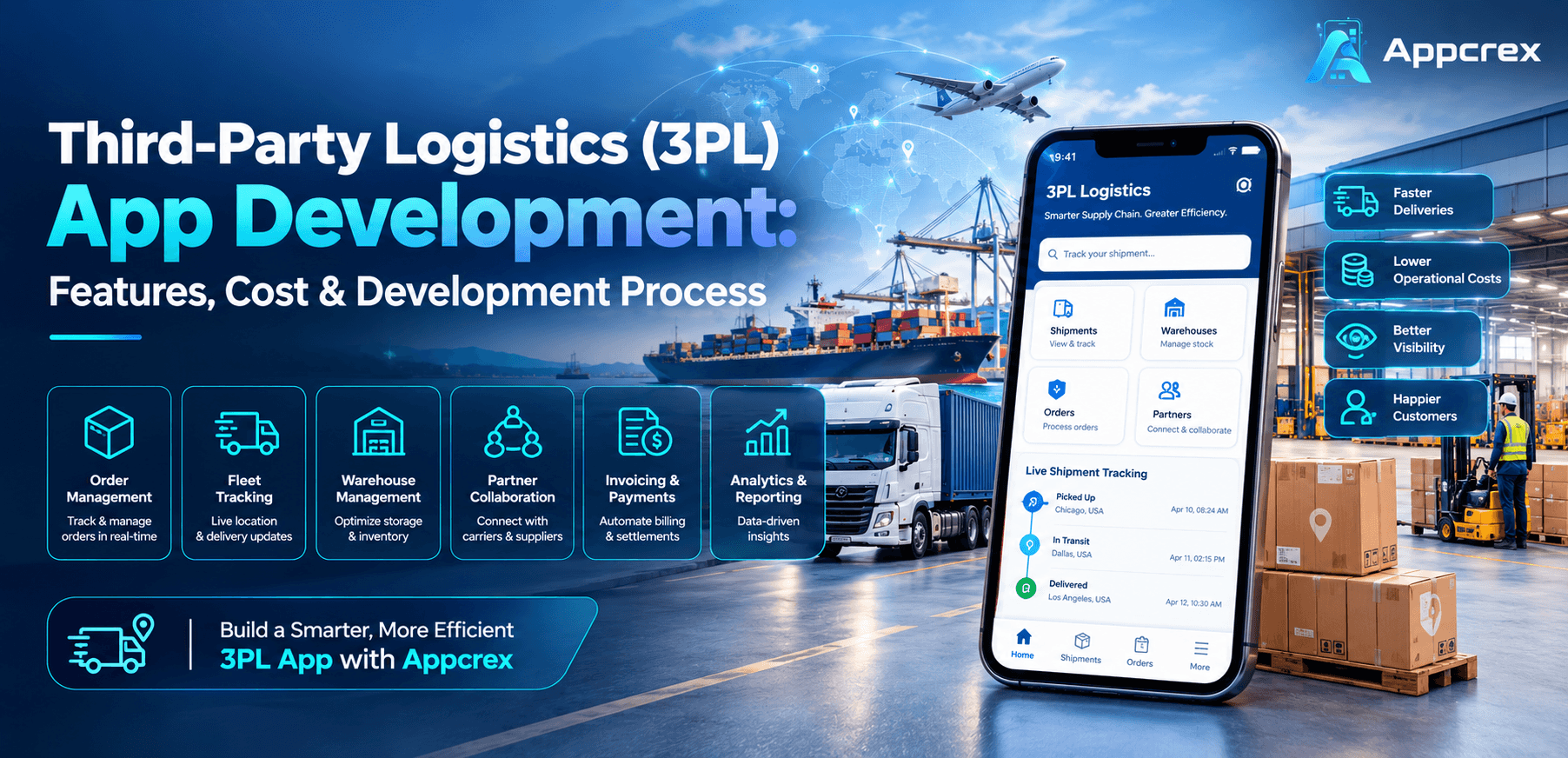
- Order, inventory, warehouse, carrier, GPS, and billing management are core components.
- Multi-tenant architecture is important when serving multiple logistics customers.
- AI can add forecasting, routing, ETA prediction, and automation capabilities.
- Starting with an MVP can help a 3PL business validate its platform before expanding into advanced features.
Introduction
Third-party logistics has become an important part of modern supply chain management. Instead of handling transportation, warehousing, inventory, order fulfillment, and delivery operations completely in-house, businesses can outsource some or all of these activities to a third-party logistics provider.
As logistics operations become more complex, 3PL companies are increasingly using digital platforms to manage shipments, warehouses, carriers, inventory, customers, invoices, and deliveries from a single system.
A 3PL app can bring these operations together through mobile applications, web dashboards, cloud infrastructure, APIs, GPS tracking, automation, and analytics. For logistics businesses, retailers, manufacturers, e-commerce companies, and supply chain operators, this creates an opportunity to improve visibility and reduce manual work.
In this guide, we will explore 3PL app development, including its features, benefits, business models, technology stack, development process, integrations, and the cost of building a third-party logistics application.
Just Read : Freight & Transportation App Development: Features, Cost & Development Process
What Is Third-Party Logistics (3PL)?
Third-party logistics, commonly known as 3PL, refers to outsourcing logistics and supply chain activities to an external logistics provider.
A 3PL company can manage one or multiple services, such as:
- Transportation
- Warehousing
- Inventory management
- Order fulfillment
- Freight management
- Packaging
- Distribution
- Reverse logistics
- Last-mile delivery
- Shipment tracking
For example, an e-commerce company may sell products through its online store but use a 3PL provider to store products in warehouses, process orders, pack items, arrange transportation, and deliver products to customers.
The 3PL provider becomes an important operational layer between the business, warehouse, transportation network, and final customer.
What Is a 3PL App?
A 3PL app is a mobile or web-based logistics platform that helps third-party logistics companies manage their operations digitally.
Depending on the business model, the platform can connect:
Business → 3PL Provider → Warehouse → Carrier/Driver → Customer
A complete 3PL solution may contain several interfaces:
- Customer or shipper app
- Driver app
- Warehouse application
- Carrier portal
- 3PL admin dashboard
- Operations/dispatcher dashboard
- Customer support interface
The objective is to create a centralized system where logistics activities can be monitored and managed in real time.
How Does a 3PL App Work?
A typical 3PL workflow can look like this:
Step 1: Business Sends an Order
A merchant, manufacturer, or retailer sends order information to the 3PL platform.
Step 2: Inventory Is Checked
The system identifies the warehouse and available inventory associated with the order.
Step 3: Order Is Processed
Warehouse staff receive the order and begin picking and packing.
Step 4: Shipment Is Created
The system generates shipment information and assigns a carrier or transportation provider.
Step 5: Driver Picks Up the Shipment
The driver receives the delivery assignment and navigation information.
Step 6: Shipment Is Tracked
GPS and transportation integrations provide shipment visibility.
Step 7: Delivery Is Completed
The driver completes delivery and uploads proof of delivery where required.
Step 8: Billing Is Generated
The platform records logistics charges and generates invoices or payment records.
This workflow can be automated significantly through APIs and integrations.
Types of 3PL Apps
Not every 3PL company needs the same software. The application should be designed around the services being provided.
1. Transportation Management 3PL App
This type focuses on:
- Freight booking
- Carrier management
- Dispatch
- GPS tracking
- Route management
- Delivery status
- Driver management
It is particularly useful for logistics providers managing transportation networks.
2. Warehouse-Based 3PL App
A warehouse-focused solution manages:
- Inventory
- Receiving
- Storage
- Picking
- Packing
- Order processing
- Warehouse transfers
- Stock movement
It can be integrated with warehouse management systems and barcode scanners.
3. E-commerce 3PL App
E-commerce-focused platforms connect online stores with fulfillment centers and delivery networks.
The system can automate:
Online order → Inventory → Warehouse → Packing → Shipping → Delivery
Integrations with e-commerce platforms can reduce manual order entry.
4. Freight Management 3PL Platform
A freight-focused platform can manage:
- Shipment creation
- Carrier selection
- Freight quotes
- Load management
- Documents
- Tracking
- Freight invoices
- Delivery confirmation
5. End-to-End 3PL Platform
Larger logistics companies may need a complete ecosystem covering:
- Warehousing
- Inventory
- Transportation
- Order fulfillment
- Carrier management
- Customer management
- Billing
- Analytics
This type of platform requires considerably more backend architecture and integration work.
Essential Features of a 3PL App
A successful 3PL platform should provide different functionality to different users.
Customer/Business Dashboard
Businesses using the 3PL service should have access to their logistics operations.
They can:
- Create orders
- View inventory
- Request fulfillment
- Track shipments
- Download invoices
- Monitor delivery status
- View reports
- Manage locations
A dashboard can also show important operational information such as active orders, shipments in transit, delivered orders, and inventory levels.
Order Management
Order management is a core component of a 3PL platform.
Businesses should be able to:
- Create orders
- Import orders
- Edit orders
- Cancel orders
- Assign fulfillment locations
- Track order status
- View order history
For larger platforms, APIs can automatically synchronize orders from external systems.
Inventory Management
A 3PL provider may manage inventory belonging to multiple businesses.
The platform therefore needs proper inventory segregation and visibility.
Important functionality can include:
- Stock levels
- SKU management
- Warehouse locations
- Batch tracking
- Stock transfers
- Low-stock alerts
- Inventory adjustments
- Inventory history
Barcode or QR code scanning can make warehouse operations faster and reduce manual data entry.
Warehouse Management
The warehouse module can manage the movement of goods from receiving through fulfillment.
Typical processes include:
Receiving → Putaway → Storage → Picking → Packing → Dispatch
Warehouse staff can use mobile devices to scan products and update inventory instantly.
The system can also provide warehouse managers with information about:
- Incoming shipments
- Pending orders
- Available storage
- Pick lists
- Packing status
- Dispatch queues
Carrier Management
A 3PL platform may work with multiple transportation providers.
The carrier management module can maintain:
- Carrier profiles
- Vehicle information
- Service areas
- Pricing
- Availability
- Performance records
- Documents
- Shipment history
The platform can use predefined rules to select suitable carriers for individual shipments.
Driver App
Drivers need a simpler interface focused on transportation tasks.
The driver application can include:
- Login
- Driver profile
- Assigned deliveries
- Pickup information
- Delivery information
- GPS navigation
- Live location sharing
- Shipment status
- Customer contact
- Proof of delivery
- Digital signature
- Photo upload
- Delivery history
Push notifications can alert drivers when new assignments are available.
Real-Time Shipment Tracking
Real-time visibility is one of the most valuable capabilities of modern logistics software.
GPS tracking can show:
- Current vehicle location
- Route
- Pickup status
- Delivery status
- Estimated arrival
- Route deviations
- Completed stops
Customers and logistics teams can use this information to monitor shipments without relying entirely on phone calls.
Proof of Delivery
A 3PL application can digitally capture proof of delivery through:
- Customer signature
- Delivery photo
- Timestamp
- GPS location
- Digital receipt
- Delivery notes
This information can be attached to the shipment record for future reference.
Billing and Payment Management
A 3PL business may need to manage multiple types of charges.
The platform can support:
- Shipping charges
- Storage fees
- Handling charges
- Packaging charges
- Fuel surcharges
- Delivery fees
- Carrier payments
- Customer invoices
Automated billing can reduce the amount of manual accounting work required by operations teams.
Also Read : Transport Management Software (TMS) Development Company: Features, Cost & Process
Multi-Tenant Architecture for 3PL Software
One important consideration in 3PL software development is multi-tenancy.
A 3PL provider may serve dozens or hundreds of businesses. Each customer needs access to its own:
- Orders
- Inventory
- Warehouses
- Shipments
- Users
- Reports
- Billing data
At the same time, the 3PL administrator needs a centralized view across customers.
A properly designed multi-tenant architecture allows the platform to isolate customer data while maintaining centralized operational control.
This becomes especially important when building an enterprise-level 3PL solution.
Advanced Features for a 3PL App
Once the core platform is established, advanced technologies can add additional automation.
AI-Powered Demand Forecasting
Machine learning can analyze historical order patterns to estimate future demand.
This can help businesses make better decisions around:
- Inventory
- Warehouse capacity
- Staffing
- Transportation
- Seasonal demand
AI-Based Route Optimization
AI and optimization algorithms can analyze:
- Distance
- Traffic
- Delivery windows
- Vehicle capacity
- Number of stops
- Driver availability
The system can recommend efficient routes for delivery operations.
Intelligent Carrier Selection
A 3PL platform can analyze carrier data and match shipments based on:
- Location
- Cost
- Capacity
- Service area
- Delivery requirements
- Historical performance
Predictive ETA
Instead of relying only on static distance calculations, predictive ETA systems can consider traffic, historical travel times, route conditions, and other available data to estimate delivery times.
AI Customer Support
An AI chatbot can handle routine logistics questions such as:
- Where is my shipment?
- When will my order arrive?
- Has my order been dispatched?
- What is my tracking number?
- What is the delivery status?
Complex issues can then be transferred to human support staff.
Benefits of Developing a 3PL App
Improved Operational Visibility
A centralized platform gives logistics managers a clearer view of orders, inventory, warehouses, shipments, and deliveries.
Reduced Manual Work
Automation can reduce repetitive data entry and communication between different teams.
Faster Order Fulfillment
Integrated order and warehouse workflows can help reduce delays between order placement and dispatch.
Better Customer Experience
Customers can track their orders and access information without repeatedly contacting the logistics provider.
Scalable Operations
Cloud-based software can make it easier to add warehouses, customers, carriers, and geographic markets as the business grows.
Data-Driven Decisions
Analytics can help logistics companies understand:
- Delivery performance
- Warehouse utilization
- Inventory movement
- Carrier performance
- Revenue
- Operational costs
3PL App Development: Technology Stack
A possible technology architecture can include:
| Layer | Technologies |
|---|---|
| iOS | Swift |
| Android | Kotlin |
| Cross-Platform | Flutter / React Native |
| Backend | Node.js / Python / Java |
| Database | PostgreSQL / MySQL / MongoDB |
| APIs | REST / GraphQL |
| Cloud | AWS / Azure / Google Cloud |
| Maps | Google Maps / Mapbox |
| Notifications | Firebase Cloud Messaging |
| Analytics | Firebase / Custom Analytics |
| AI/ML | Python / TensorFlow / PyTorch |
| Real-Time Communication | WebSockets |
| Authentication | OAuth / JWT / MFA |
The technology stack should ultimately be selected according to the project’s expected scale, integrations, security requirements, and development strategy.
Also Read : Freight & Transportation App Development: Features, Cost & Development Process
Important 3PL Integrations
A modern 3PL application normally needs to communicate with other business systems.
E-commerce Integrations
The platform can connect with online stores and marketplaces to automatically receive orders.
ERP Integration
ERP systems can synchronize:
- Orders
- Products
- Customers
- Inventory
- Financial data
WMS Integration
Warehouse management systems can exchange inventory and fulfillment information.
TMS Integration
Transportation management systems can help synchronize freight and transportation operations.
Payment Integration
Payment gateways can support online payments, refunds, invoices, and transaction records.
Maps and GPS
Mapping APIs can provide:
- Geocoding
- Routes
- Distance
- Navigation
- Location tracking
- ETA calculations
Communication APIs
SMS, email, and push notification services can automatically send shipment and order updates.
3PL App Development Process
Developing a 3PL application requires careful planning because it connects multiple operational systems.
1. Business Analysis
The first step is understanding the logistics company’s actual workflow.
The development team identifies:
- Services offered
- Target customers
- Warehouses
- Transportation model
- User roles
- Revenue model
- Required integrations
2. Feature Planning
Features are divided into:
MVP Features → Advanced Features → Future Automation
This prevents unnecessary complexity during the initial release.
3. UI/UX Design
Separate interfaces are designed for customers, warehouse staff, drivers, carriers, and administrators.
4. Backend Development
The backend handles:
- Orders
- Inventory
- Shipments
- Users
- Warehouses
- Carriers
- Payments
- Notifications
- Tracking
5. Mobile App Development
Depending on the business model, developers can build:
- Customer app
- Driver app
- Warehouse app
A responsive web application may also be developed for businesses and administrators.
6. API & System Integration
External systems such as ERP, WMS, e-commerce, payment, GPS, and communication services are connected.
7. Testing
The application should be tested for:
- Functional issues
- API reliability
- Security
- GPS performance
- Payment processing
- Multi-user access
- Data isolation
- Device compatibility
- Load performance
8. Launch
After testing, the application can be deployed to production and the required app stores.
9. Continuous Improvement
Post-launch improvements can include:
- AI automation
- New integrations
- Advanced analytics
- New warehouse support
- Internationalization
- Performance optimization
How Much Does It Cost to Develop a 3PL App?
The cost of developing a third-party logistics app depends on the application’s scope and architecture.
A basic 3PL MVP may cost approximately $35,000–$60,000.
A medium-complexity platform with order management, inventory, warehouse management, driver functionality, GPS tracking, payments, and an admin dashboard may cost approximately $60,000–$120,000.
A large enterprise 3PL ecosystem with multi-tenant architecture, advanced integrations, AI, analytics, multiple applications, and extensive automation can exceed $120,000–$200,000+.
| 3PL Solution | Approximate Development Cost |
|---|---|
| Basic MVP | $35,000–$60,000 |
| Mid-Level 3PL Platform | $60,000–$120,000 |
| Advanced 3PL Platform | $120,000–$200,000+ |
| Enterprise 3PL Ecosystem | $200,000+ |
These are approximate planning ranges. A proper estimate requires a detailed feature list, platform requirements, integrations, user roles, and target market.
What Factors Affect 3PL App Development Cost?
Number of Applications
Building separate customer, driver, warehouse, carrier, and admin applications increases development effort.
Integration Requirements
ERP, WMS, TMS, e-commerce, payment, GPS, and accounting integrations can significantly affect the budget.
Real-Time Tracking
Continuous GPS tracking requires additional backend architecture and infrastructure.
Multi-Tenant Architecture
A platform serving multiple businesses with isolated data requires more sophisticated backend design than a single-company logistics app.
AI Features
AI-based forecasting, routing, carrier matching, and predictive analytics require additional data and machine-learning development.
Security
Enterprise logistics platforms may handle sensitive business, financial, customer, and operational data, making security an important part of development.
3PL App Monetization Models
If you are building a commercial 3PL SaaS platform rather than software exclusively for your own logistics company, several revenue models are possible.
Monthly Subscription
Businesses pay a recurring fee based on their plan.
Per-Order Pricing
The platform charges a fee for every processed shipment or order.
Transaction Commission
A percentage can be charged on transactions facilitated through the platform.
Premium Modules
Advanced features such as analytics, AI forecasting, automation, and advanced reporting can be offered as premium modules.
Enterprise Licensing
Large logistics businesses can purchase customized enterprise solutions with dedicated integrations and support.
3PL App vs Traditional Logistics Management
| Traditional Operations | 3PL Digital Platform |
|---|---|
| Manual order entry | Automated order management |
| Phone-based updates | Real-time notifications |
| Paper documents | Digital documentation |
| Manual tracking | GPS shipment tracking |
| Spreadsheet inventory | Centralized inventory |
| Manual carrier assignment | Automated matching |
| Separate systems | Integrated ecosystem |
| Limited reporting | Real-time analytics |
The objective isn’t simply to replace paperwork with an app. A well-designed 3PL platform connects different logistics processes so information can move between teams and systems automatically.
How to Build an MVP for a 3PL Business?
A practical MVP could focus on the most important operational workflows.
Customer Side
- Account management
- Order creation
- Shipment tracking
- Order history
- Documents
- Notifications
Warehouse Side
- Inventory
- Receiving
- Picking
- Packing
- Dispatch
Driver Side
- Job assignment
- Navigation
- GPS tracking
- Status updates
- Proof of delivery
Admin Side
- Customer management
- Order management
- Warehouse management
- Carrier management
- Billing
- Reports
Once the MVP is validated, advanced features such as AI forecasting, automated carrier selection, predictive ETA, and advanced analytics can be introduced.
Future of Third-Party Logistics Technology
The 3PL industry is moving toward increasingly connected and automated operations.
Several technologies are likely to remain important:
- Artificial intelligence
- Machine learning
- IoT
- Warehouse automation
- Predictive analytics
- Digital freight platforms
- Real-time supply chain visibility
- Robotic process automation
- Cloud logistics platforms
- Connected vehicles
The combination of AI, IoT, GPS, warehouse systems, and cloud infrastructure can enable 3PL providers to move from basic shipment management toward more predictive and automated supply chain operations.
FAQs
Q. What is a 3PL app?
A 3PL app is a digital logistics platform that helps third-party logistics providers manage services such as transportation, warehousing, inventory, fulfillment, shipment tracking, carriers, and billing.
Q. How much does it cost to build a 3PL app?
A basic MVP can cost around $35,000–$60,000, while an advanced or enterprise 3PL platform can cost $120,000–$200,000 or more depending on features and integrations.
Q. How long does it take to develop a 3PL app?
A basic MVP may take around 4–6 months. A large multi-platform 3PL ecosystem with complex integrations can take 8–12 months or longer.
Q. Can a 3PL app integrate with Shopify or other e-commerce platforms?
Yes. APIs can be used to synchronize orders, products, inventory, shipping information, and fulfillment updates with supported e-commerce platforms.
Q. Can AI be used in 3PL software?
Yes. AI can support demand forecasting, route optimization, carrier matching, ETA prediction, customer support, and operational analytics.
Q. Does a 3PL app need a driver application?
Not always. However, a dedicated driver app can be useful when the 3PL provider directly manages drivers or transportation operations.
Q. Can a 3PL app manage multiple businesses?
Yes. A multi-tenant architecture can allow one platform to serve multiple businesses while keeping their operational and business data appropriately separated.
Q. Can I hire mobile app developers to build a custom 3PL platform?
Yes. A specialized development team can build the customer, driver, warehouse, and admin interfaces along with the backend, APIs, integrations, GPS tracking, payments, and analytics required for a custom 3PL solution.
Conclusion
Third-party logistics is becoming increasingly technology-driven as businesses demand faster fulfillment, real-time visibility, automated operations, and better supply chain control. A custom 3PL app can bring order management, inventory, warehouses, transportation, carriers, drivers, tracking, billing, and analytics into a connected digital ecosystem.
The right solution depends on whether you’re building software for your own 3PL company, a logistics marketplace, an e-commerce fulfillment business, or a multi-tenant SaaS platform. Defining the operational workflow and MVP first can help control development complexity while creating a foundation for future automation.
Build a Custom 3PL App with AppCrex
AppCrex can help businesses build custom 3PL app development solutions with customer and driver applications, warehouse management, inventory tracking, GPS integration, carrier management, payment systems, APIs, analytics, and AI-powered automation. If you’re planning a scalable logistics platform, you can hire mobile app developers to turn your 3PL workflow into a secure and scalable digital product.