📌 Key Takeaways
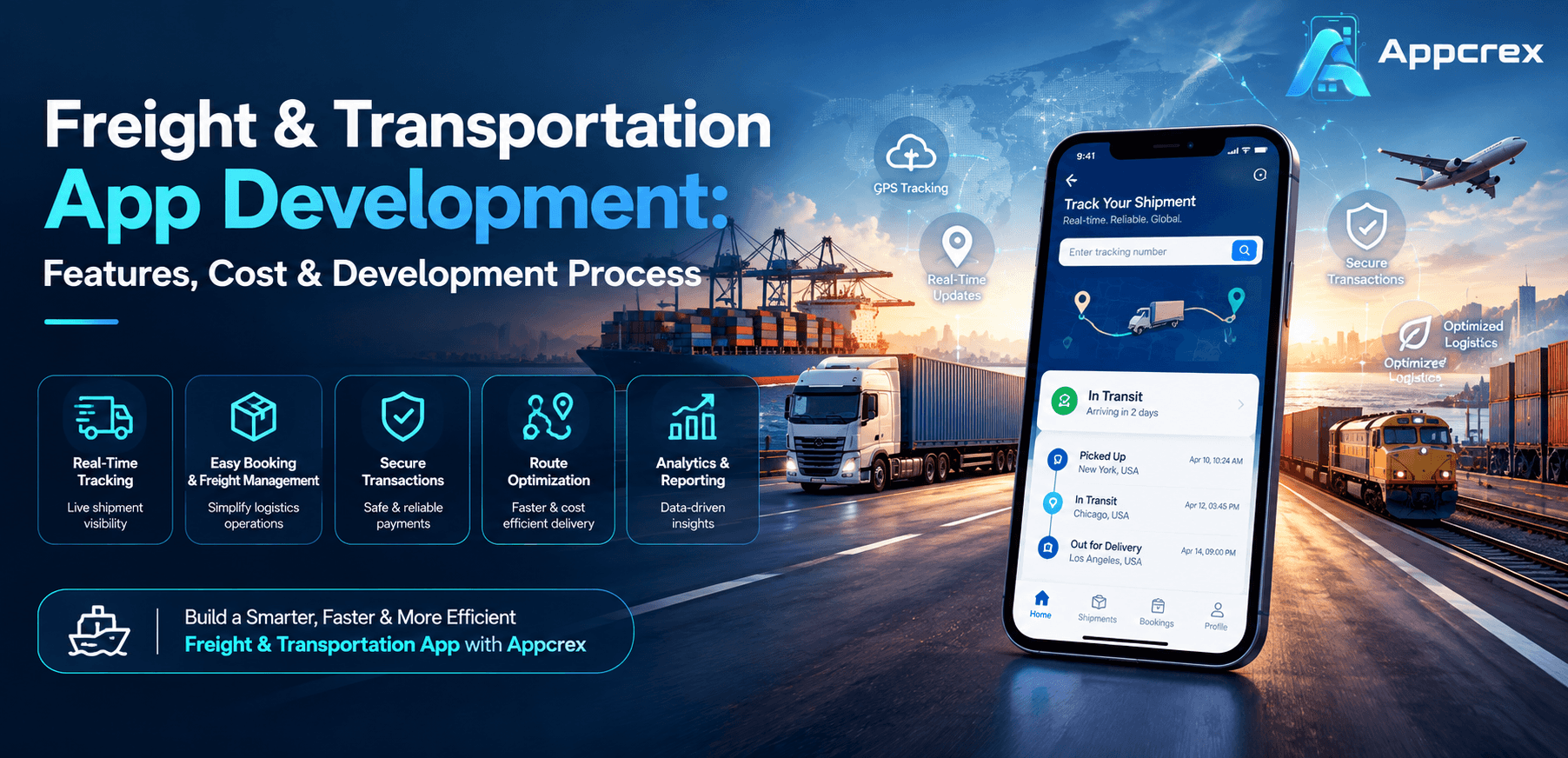
- Freight apps connect transportation operations through one digital platform.
- GPS tracking, dispatching, booking, and proof of delivery are core capabilities.
- AI can improve routing, ETA prediction, freight matching, and fleet management.
- Development costs increase with platforms, integrations, real-time tracking, and advanced features.
- Starting with an MVP can make it easier to launch, test, and scale the transportation platform.
Introduction
The freight and transportation industry is moving rapidly from traditional phone calls, paperwork, spreadsheets, and manual dispatching toward digital platforms. Businesses now expect to track shipments in real time, manage fleets, automate dispatch, communicate with drivers, and provide customers with accurate delivery updates from a single application.
A freight & transportation app can connect shippers, carriers, fleet operators, drivers, brokers, and customers through one digital ecosystem. Depending on the business model, the application can support freight booking, load management, route optimization, GPS tracking, proof of delivery, payments, fleet management, and analytics.
For logistics companies planning digital transformation, working with an experienced mobile app development company can help turn these requirements into a scalable transportation platform.
This guide explains the major features, development process, technology stack, business models, and freight and transportation app development cost.
What Is a Freight & Transportation App?
A freight and transportation app is a digital platform designed to manage the movement of goods from one location to another.
It can be built for different stakeholders, including:
- Freight and logistics companies
- Shippers and manufacturers
- Fleet owners
- Trucking companies
- Freight brokers
- Drivers
- Retail businesses
- E-commerce companies
- Third-party logistics providers (3PL)
- Customers receiving shipments
A transportation platform may include multiple applications or interfaces, such as:
- Customer/shipper app
- Driver app
- Transporter or carrier app
- Admin dashboard
- Dispatcher panel
- Warehouse or operations interface
For example, a shipper can enter pickup and delivery information, receive a freight quote, book transportation, and track the shipment. The driver can accept the assigned load, navigate to the pickup location, update shipment status, and upload proof of delivery.
Just Read : Transport Management Software (TMS) Development Company: Features, Cost & Process
Why Build a Freight & Transportation App?
Transportation companies deal with multiple moving parts every day. Loads, drivers, vehicles, routes, fuel costs, delivery schedules, documents, payments, and customer communications all need to be coordinated.
A dedicated application can centralize these operations.
1. Real-Time Shipment Tracking
GPS-based tracking allows customers and logistics teams to monitor vehicles and shipments while they are in transit.
Businesses can view:
- Current vehicle location
- Estimated arrival time
- Route progress
- Delivery status
- Driver status
- Pickup and drop-off locations
This reduces the need for customers to repeatedly contact dispatch teams for shipment updates.
2. Better Fleet Management
Fleet operators can manage vehicles, drivers, maintenance schedules, documents, and assignments from one dashboard.
The system can also provide alerts for:
- Vehicle servicing
- Insurance expiry
- Registration renewal
- Driver documentation
- Unexpected route deviations
3. Automated Dispatching
Instead of assigning every shipment manually, the application can use predefined rules to match loads with suitable drivers or vehicles.
Matching can consider:
- Vehicle type
- Driver availability
- Location
- Capacity
- Delivery deadline
- Route
- Shipment requirements
4. Faster Communication
Drivers, dispatchers, customers, and administrators can communicate through in-app messaging, push notifications, or automated alerts.
5. Reduced Operational Work
Digital workflows can replace many manual processes involving spreadsheets, phone calls, and paper documents.
6. Better Customer Experience
Customers can book freight, receive quotes, track shipments, download documents, and confirm deliveries directly through the application.
Types of Freight & Transportation Apps
Before starting development, it is important to determine what type of platform you want to build.
1. Freight Marketplace App
This model connects shippers with carriers or transportation providers.
Typical workflow:
Shipper posts load → Carriers view load → Carrier submits offer → Shipper selects carrier → Shipment is tracked → Delivery completed
The platform can earn revenue through commissions, booking fees, subscriptions, or transaction charges.
2. Trucking Management App
A trucking company can use the application to manage its own fleet.
Features may include:
- Driver management
- Vehicle management
- Trip management
- Fuel tracking
- Maintenance
- Dispatch
- GPS tracking
- Documents
- Payments
- Reports
3. Freight Booking App
A freight booking platform allows businesses to schedule transportation online.
Users can enter:
- Pickup address
- Delivery address
- Cargo type
- Weight
- Dimensions
- Vehicle requirements
- Pickup date
- Delivery date
The system can then calculate or display available transportation options.
4. Last-Mile Transportation App
This type of platform focuses on the final stage of delivery.
It can be useful for:
- E-commerce businesses
- Retailers
- Grocery companies
- Warehouses
- Courier companies
- Local delivery businesses
5. Fleet Tracking App
A fleet tracking application primarily focuses on vehicle location, driver activity, routes, and operational visibility.
GPS and telematics integrations can provide information about vehicle movement and performance.
Essential Features of a Freight & Transportation App
The feature set depends on the business model, but a scalable freight application generally needs features for customers, drivers, transportation companies, and administrators.
Customer/Shipper Features
User Registration and Login
Users can create accounts using:
- Phone number
- Password
- Social login
- Business account credentials
Two-factor authentication can be added for additional account security.
Freight Booking
Customers should be able to create a shipment request by entering:
- Pickup location
- Drop-off location
- Cargo details
- Weight
- Dimensions
- Vehicle type
- Pickup date
- Delivery requirements
Instant Freight Quote
The platform can calculate an estimated transportation price based on parameters such as:
- Distance
- Cargo weight
- Vehicle type
- Fuel rates
- Route
- Delivery urgency
- Additional services
Shipment Tracking
Customers can monitor shipments through an interactive map.
The tracking screen can display:
- Vehicle location
- Shipment status
- Driver information
- Estimated arrival
- Route
- Delivery progress
Booking History
Customers can access previous and active shipments from their account.
Digital Documents
The application can allow users to upload and download documents such as:
- Invoices
- Delivery receipts
- Bills of lading
- Shipping documents
- Proof of delivery
Driver App Features
The driver application is one of the most important components of a freight transportation platform.
Driver Registration
Drivers can submit:
- Personal details
- Driving license
- Vehicle information
- Insurance documents
- Identification documents
- Certifications where applicable
Administrators can review and approve driver accounts.
Job Management
Drivers can view available or assigned transportation jobs.
Each job can include:
- Pickup location
- Drop-off location
- Shipment details
- Customer information
- Delivery deadline
- Special instructions
Accept or Reject Jobs
Drivers can accept assigned jobs or communicate their availability through the platform.
Integration with mapping and navigation services can help drivers navigate pickup and delivery routes.
Status Updates
Drivers can update shipment status, for example:
Assigned → Accepted → Arriving for Pickup → Picked Up → In Transit → Arriving → Delivered
Proof of Delivery
Drivers can upload:
- Customer signature
- Delivery photo
- Digital receipt
- Timestamp
- GPS location
This creates a digital record of delivery completion.
Also Read : Vehicle Tracking Software Development Company: Complete Guide to Features, Cost & Development Process
Admin & Dispatcher Dashboard
A powerful admin panel is essential for managing a transportation platform.
Administrators can manage:
Users
- Customers
- Drivers
- Carriers
- Fleet operators
- Staff
Vehicles
- Vehicle profiles
- Vehicle availability
- Capacity
- Maintenance records
- Documentation
Shipments
Admins can view and manage every shipment, including its status, assigned driver, route, and delivery information.
Dispatch Management
Dispatchers can assign loads to drivers and monitor active transportation operations.
Pricing Management
Administrators can configure pricing rules based on:
- Distance
- Vehicle category
- Cargo type
- Weight
- Service type
- Location
- Additional charges
Analytics
The dashboard can provide reports for:
- Total shipments
- Completed deliveries
- Active trips
- Revenue
- Driver performance
- Fleet utilization
- Delivery delays
- Cancellation rates
Advanced Features for Freight Transportation Apps
Once the core platform is working, advanced technologies can make the system more efficient.
AI-Based Route Optimization
AI and optimization algorithms can analyze:
- Traffic
- Distance
- Delivery windows
- Multiple stops
- Vehicle capacity
- Driver availability
The system can recommend efficient routes and reduce unnecessary mileage.
AI Freight Matching
AI can help match shipments with appropriate carriers or vehicles based on historical and real-time operational data.
Predictive Maintenance
Machine learning models can analyze vehicle data and identify potential maintenance requirements before a major breakdown occurs.
ETA Prediction
AI-based ETA systems can use historical traffic and transportation data to improve estimated arrival times.
Automated Customer Support
An AI chatbot can answer questions related to:
- Shipment status
- Booking
- Delivery times
- Pricing
- Documentation
- Cancellation policies
For businesses planning AI app development, these capabilities can be integrated gradually rather than making AI mandatory for the first release.
How Does a Freight & Transportation App Work?
A typical freight marketplace or transportation application can follow this workflow:
Step 1: Customer Creates a Shipment
The shipper enters pickup, delivery, cargo, and vehicle information.
Step 2: System Calculates the Freight Price
The application calculates an estimated price using configured pricing rules.
Step 3: Transportation Provider Is Selected
The system or dispatcher assigns a suitable carrier or driver.
Step 4: Driver Receives the Job
The driver receives a push notification and views the shipment details.
Step 5: Pickup
The driver reaches the pickup location and updates the shipment status.
Step 6: Shipment Tracking
GPS tracking allows the customer and operations team to monitor the shipment.
Step 7: Delivery
The driver reaches the destination and completes delivery.
Step 8: Proof of Delivery
The customer signature, photo, or digital confirmation is uploaded.
Step 9: Payment and Invoice
The platform processes payment and generates the required invoice or transaction record.
Technology Stack for Freight & Transportation App Development
The technology stack depends on the application’s complexity, expected traffic, integrations, and business requirements.
A possible stack can include:
| Component | Technologies |
|---|---|
| Android App | Kotlin |
| iOS App | Swift |
| Cross-Platform | Flutter / React Native |
| Backend | Node.js / Python / Java |
| Database | PostgreSQL / MySQL / MongoDB |
| APIs | REST / GraphQL |
| Maps | Google Maps Platform / Mapbox |
| Cloud | AWS / Google Cloud / Azure |
| Notifications | Firebase Cloud Messaging |
| Real-Time Tracking | WebSockets / real-time APIs |
| Payments | Stripe / regional payment gateways |
| Analytics | Firebase / custom analytics |
| AI/ML | Python / TensorFlow / PyTorch |
The final stack should be selected according to the project’s specific requirements rather than simply choosing the most popular technology.
Third-Party Integrations
Freight applications often require several external integrations.
Mapping and GPS
Mapping APIs can provide:
- Geocoding
- Distance calculation
- Route planning
- Navigation
- Location tracking
Payment Gateway
Payment integration can support:
- Cards
- Digital wallets
- Bank payments
- Refunds
- Automated payouts
SMS and Email
These integrations can send:
- Booking confirmations
- OTPs
- Delivery updates
- Payment notifications
- Account alerts
Accounting Software
Businesses can integrate accounting systems to synchronize:
- Invoices
- Expenses
- Payments
- Customer records
Telematics and IoT
Fleet businesses can connect vehicle devices to collect information such as:
- GPS position
- Vehicle status
- Fuel consumption
- Mileage
- Diagnostic information
Freight & Transportation App Development Process
Developing a transportation platform requires more than creating mobile screens. The application needs business logic, real-time tracking, integrations, security, and scalable infrastructure.
1. Business and Market Research
The first stage is understanding:
- Target customers
- Transportation model
- Geographic market
- Competitors
- Revenue model
- Regulatory requirements
- Operational workflow
2. Requirement Planning
The development team defines the required applications and features.
For example:
Customer App + Driver App + Admin Panel + Backend
For a marketplace, a carrier application may also be required.
3. UI/UX Design
Designers create user flows and interfaces for each role.
Important screens may include:
- Registration
- Shipment booking
- Freight quote
- Driver jobs
- Live tracking
- Payments
- Documents
- Notifications
- Admin dashboard
4. MVP Development
A minimum viable product can initially focus on essential functionality:
- Registration
- Shipment booking
- Driver management
- Dispatch
- GPS tracking
- Status updates
- Proof of delivery
- Basic payments
- Admin management
5. Backend Development
The backend handles:
- User management
- Shipment logic
- Driver assignments
- Pricing
- Payments
- Notifications
- GPS data
- APIs
- Analytics
6. Integration
Required third-party services are integrated with the platform.
7. Testing
The application should be tested for:
- Functional issues
- GPS accuracy
- API performance
- Security
- Payment processing
- Device compatibility
- Load handling
- Real-time tracking
- User experience
8. Deployment
After testing and approval, the applications can be deployed to the required app stores and cloud infrastructure.
9. Maintenance and Scaling
After launch, ongoing development may include:
- Bug fixes
- Security updates
- New features
- Performance improvements
- AI capabilities
- Additional integrations
- Expansion into new markets
How Much Does It Cost to Develop a Freight & Transportation App?
The freight and transportation app development cost depends heavily on the number of applications, feature complexity, integrations, design requirements, and development location.
A basic MVP may cost around $30,000–$60,000, while a feature-rich transportation platform with customer and driver apps, advanced dispatching, real-time GPS tracking, payment integration, analytics, and an extensive admin system can move into the $70,000–$150,000+ range.
| Development Level | Approx. Cost |
|---|---|
| Basic MVP | $30,000–$60,000 |
| Medium-Level Platform | $60,000–$100,000 |
| Advanced Freight Platform | $100,000–$150,000+ |
| Enterprise Transportation Ecosystem | $150,000+ |
These are planning-level estimates rather than fixed quotes. The actual cost should be calculated after defining the required platforms, features, integrations, and target market.
Factors That Affect Transportation App Development Cost
Several factors can significantly change the budget.
Number of Platforms
Building Android, iOS, web, driver, customer, and admin applications requires more development than building one application.
Real-Time GPS Tracking
Continuous location tracking requires additional backend infrastructure and optimization.
Third-Party APIs
Maps, payments, telematics, communication, accounting, and other APIs can increase both development and ongoing operating costs.
AI Features
AI-based routing, ETA prediction, fraud detection, demand forecasting, and predictive maintenance require additional data engineering and machine learning work.
UI/UX Complexity
A simple logistics application and a large multi-role marketplace can have very different design requirements.
Backend Architecture
A platform expected to handle thousands or millions of transportation transactions needs scalable backend architecture.
Security
Transportation platforms can process sensitive business, location, financial, and customer information, making security an important development consideration.
How to Monetize a Freight Transportation App?
A transportation application can use several revenue models.
Commission
The platform charges a percentage of each successful booking or transportation transaction.
Subscription
Carriers, fleet operators, or businesses pay a monthly or annual subscription.
Booking Fee
A fixed service fee can be added to each shipment.
Premium Features
Advanced features such as analytics, fleet intelligence, priority support, or automated optimization can be offered through premium plans.
Enterprise Licensing
Large logistics businesses can pay for customized software and enterprise integrations.
A hybrid model can also combine subscriptions with transaction fees.
Security Considerations
Security should be incorporated from the beginning of development.
Important measures include:
- Secure authentication
- Role-based access control
- Data encryption
- Secure API communication
- Payment security
- Audit logs
- Secure document storage
- Session management
- Regular security testing
- Backup and disaster recovery
Location data also needs careful handling because transportation platforms may continuously process vehicle and driver locations.
How to Build a Successful Freight & Transportation App?
Instead of trying to build every possible feature at launch, companies can start with a focused MVP.
A practical roadmap is:
Phase 1: Research and business model
↓
Phase 2: UI/UX design
↓
Phase 3: Customer + driver MVP
↓
Phase 4: Admin and dispatch system
↓
Phase 5: GPS and payment integrations
↓
Phase 6: Testing and launch
↓
Phase 7: AI, analytics, automation and scaling
This approach can reduce initial development complexity while allowing the platform to evolve based on real user feedback.
Future of Freight & Transportation Apps
The transportation sector is increasingly becoming data-driven. Future platforms are likely to focus on automation, connected vehicles, predictive analytics, and intelligent logistics management.
Some important areas include:
- AI-powered dispatching
- Predictive ETAs
- Autonomous fleet technologies
- IoT-enabled vehicles
- Digital freight marketplaces
- Automated documentation
- Smart warehouse integration
- Predictive maintenance
- Dynamic freight pricing
- Real-time supply chain visibility
AI can become particularly useful when a platform has enough operational data to support meaningful predictions and automation.
FAQs
Q. How much does it cost to build a freight transportation app?
A basic MVP may cost approximately $30,000–$60,000, while advanced platforms can cost $100,000 or more. The final cost depends on features, platforms, integrations, and complexity.
Q. How long does it take to develop a freight transportation app?
A basic MVP may take around 4–6 months. A larger platform with multiple applications, real-time tracking, payments, advanced dispatching, and integrations can take 6–12 months or longer.
Q. What features should a freight app have?
Core features generally include freight booking, driver management, dispatching, GPS tracking, shipment status, proof of delivery, notifications, payments, documents, and an admin dashboard.
Q. Can AI be integrated into a freight transportation app?
Yes. AI can be used for route optimization, ETA prediction, freight matching, demand forecasting, predictive maintenance, customer support, and operational analytics.
Q. Should I build separate customer and driver apps?
For many transportation platforms, separate interfaces are useful because customers and drivers have very different workflows. However, the exact architecture depends on the business model.
Q. Can a freight app support multiple countries?
Yes. A scalable architecture can support multiple countries, currencies, languages, payment methods, transportation rules, and regional logistics providers.
Q. Can I hire mobile app developers to build a custom freight platform?
Yes. A dedicated development team can build the customer application, driver application, backend, admin dashboard, integrations, and cloud infrastructure according to the transportation company’s requirements.
Conclusion
A freight and transportation app can transform how logistics companies manage shipments, drivers, vehicles, customers, and delivery operations. From online freight booking and real-time GPS tracking to automated dispatching, digital proof of delivery, analytics, and AI-powered optimization, the right technology can connect multiple parts of the transportation workflow.
The best architecture depends on whether you’re building a freight marketplace, trucking management system, fleet tracking solution, last-mile platform, or enterprise transportation ecosystem. Defining the business model and MVP before development can help control both complexity and cost.
Build Your Freight & Transportation App with AppCrex
If you’re planning to launch a freight & transportation app, AppCrex can help you design and develop a custom platform with customer and driver applications, real-time GPS tracking, dispatch management, payment integration, cloud backend, analytics, and AI-powered features. You can also hire mobile app developers to build a scalable transportation solution around your specific logistics workflow.