📌 Key Takeaways
- AI can improve claims, underwriting, fraud detection, document processing, and customer service.
- UAE insurers can build AI capabilities into existing insurance systems through APIs and integrations.
- Arabic and English support can be valuable for UAE-facing insurance applications.
- AI insurance software should include security, governance, monitoring, and human-review mechanisms from the beginning.
- Development costs can range from $15,000 to $300,000+, depending on the scope and complexity.
Introduction
The insurance industry in the UAE is becoming increasingly digital, and artificial intelligence is creating new opportunities for insurers, brokers, TPAs, InsurTech startups, and other insurance businesses. Instead of relying entirely on manual underwriting, claims processing, document verification, customer support, and risk assessment, insurance companies can now build intelligent software that automates repetitive work and helps employees make faster, data-driven decisions.
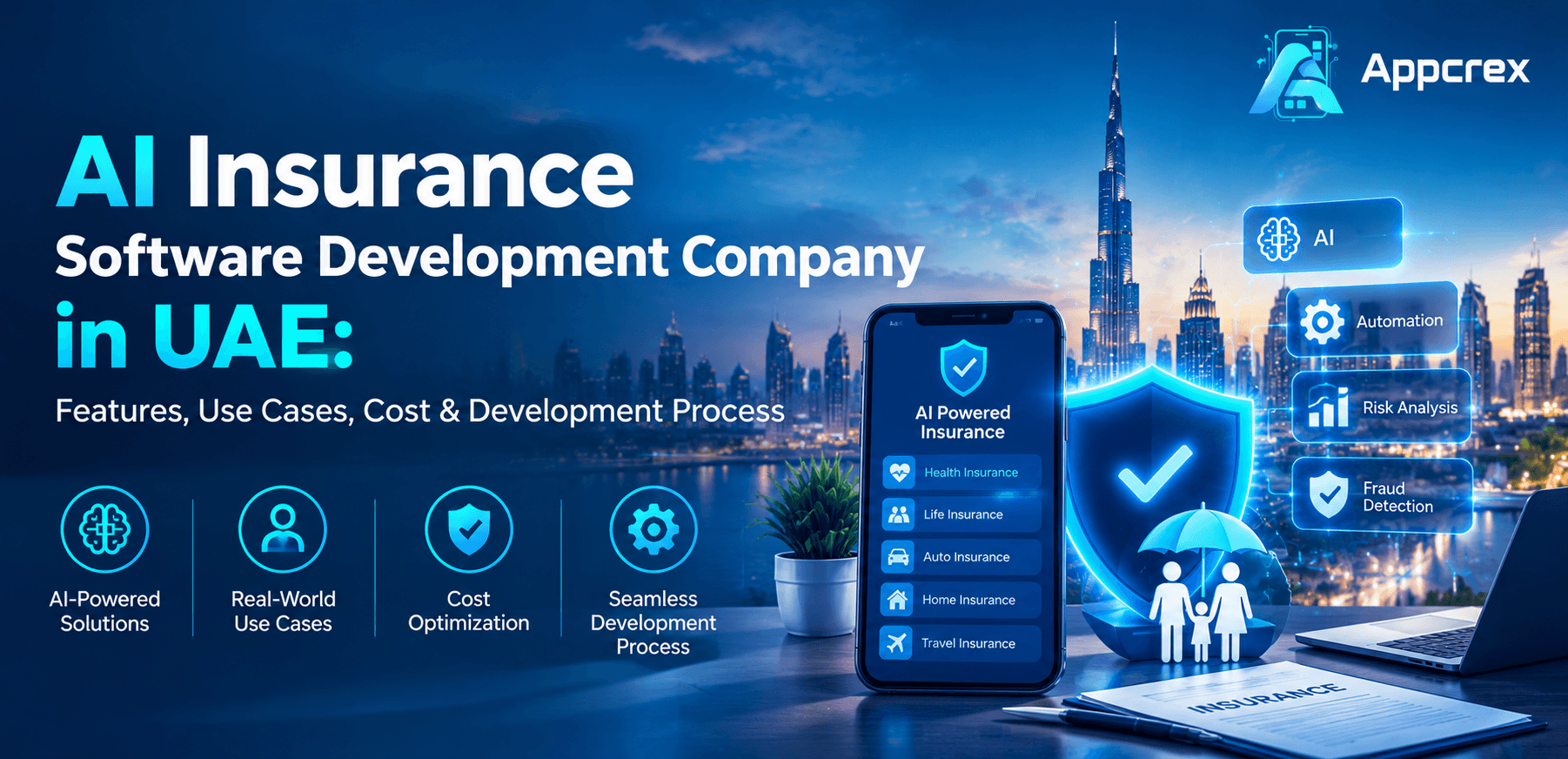
An AI insurance software development company in UAE can help businesses create customized platforms that combine insurance workflows with artificial intelligence, machine learning, predictive analytics, NLP, computer vision, generative AI, and automation.
The opportunity is particularly relevant now because the Central Bank of the UAE (CBUAE) issued guidance in 2026 covering the responsible adoption and use of AI and machine learning by licensed financial institutions, explicitly including insurance providers. The guidance addresses governance, fairness, explainability, data quality, security, continuous monitoring, and human oversight.
For businesses, this means AI insurance software should not simply be designed to automate as much as possible. It should be designed to automate the right processes while keeping appropriate controls around customer-impacting decisions.
Also Read : AI Customer Support Automation Services: Complete Guide to Benefits, Features, Implementation & Cost
What Is AI Insurance Software Development in UAE?
AI insurance software development means creating digital insurance platforms that use AI technologies to improve how insurance companies manage customers, policies, claims, risk, documents, fraud, and internal operations.
A solution can be built for a particular insurance business or developed as a complete InsurTech platform.
For example, an insurance company may want software that allows customers to purchase policies online, upload documents, submit claims, track claim status, communicate with support, and receive policy notifications. Behind that customer-facing application, AI can help employees process documents, identify unusual claims, summarize customer information, classify requests, predict risk, and prioritize cases.
The same technology can also be used by insurance brokers and TPAs. A broker may need a platform for managing customers, comparing policies, generating quotations, tracking renewals, and communicating with insurers. A TPA may need claims management, provider management, document processing, analytics, and fraud-monitoring capabilities.
This makes AI insurance software different from a simple insurance mobile app. A traditional app may digitize an existing process, while an AI-powered platform can also analyze information, identify patterns, automate workflows, and assist employees with decision-making.
In the UAE, insurance businesses also operate within a regulated environment. The CBUAE supervises the UAE insurance sector and maintains insurance guidelines covering areas such as risk management, reporting, licensing, and insurance operations.
That is why an insurance software project should consider regulatory and risk requirements during architecture and product planning rather than adding them after development.
Why Are UAE Insurance Companies Investing in AI?
Insurance involves large amounts of structured and unstructured data. Customer applications, policy documents, claim forms, invoices, medical records, vehicle photographs, emails, payment information, and historical claims can all become part of the insurance workflow.
When this information is processed manually, employees spend considerable time collecting, checking, classifying, and transferring data between systems.
AI can reduce some of this operational workload.
One of the most valuable applications is claims automation. An AI-powered claims platform can accept a digital claim, extract information from uploaded documents, classify the claim, identify missing information, analyze relevant images or records, and send the case to the appropriate workflow. Simple, low-risk tasks can be automated while more complex cases can be escalated to employees.
Fraud detection is another important use case. Instead of relying only on predefined rules, machine-learning models can analyze patterns across historical claims, customer activity, transaction behavior, locations, policy information, and claim frequency. Suspicious cases can then be flagged for investigation.
AI can also improve underwriting. Insurance employees can receive a structured view of relevant customer and risk information, along with AI-generated analysis or recommendations. This can reduce the amount of manual data gathering involved in underwriting while keeping the final decision with an appropriately authorized person.
Customer service is another area where AI can make a difference. An AI assistant can answer routine questions about policies, claims, renewals, required documents, coverage, and service requests. For UAE businesses, supporting Arabic and English can be particularly valuable. The CBUAE’s 2026 AI guidance also emphasizes transparency and understandable disclosures in Arabic and English when AI is used by regulated institutions.
AI can also help insurance companies understand their portfolios. Predictive analytics can be used to identify changing customer behavior, claim trends, renewal patterns, and other business indicators that may help management make better decisions.
The objective should not be to replace every insurance employee with AI. The more practical approach is to use AI for repetitive analysis and assistance while keeping human judgment where the financial or customer impact is significant.
Also Read : Arabic AI Development Company: Services, Cost, Use Cases & Development Process
AI Insurance Software Services and Features
A modern AI insurance platform can be designed around the exact insurance workflow instead of using a generic software model.
The core platform can include customer registration, policy management, quotations, premium information, payments, claims, renewals, notifications, document management, customer support, agent management, broker management, reporting, and administrative controls.
On top of these traditional capabilities, AI can introduce additional functionality.
AI claims processing can extract information from claim forms, invoices, reports, photographs, and other documents. The system can classify claims, identify missing information, summarize case details, and route claims to the correct employee.
AI fraud detection can analyze claim and transaction patterns to identify unusual activity. Rather than automatically rejecting a customer, the system can generate a risk score or alert that allows an investigator to review the case.
AI underwriting can bring relevant customer and risk information together and provide recommendations based on configured business rules and approved models. This can help underwriters spend more time on complex cases instead of repetitive data collection.
Document AI is particularly useful because insurance companies deal with a large number of documents. OCR, NLP, computer vision, and LLM-based extraction can be combined to convert unstructured information into usable data.
AI customer support can provide 24/7 assistance through web applications, mobile apps, WhatsApp-style interfaces, or other communication channels. It can answer common questions, retrieve relevant information from authorized systems, and transfer complex cases to human representatives.
AI-powered search can also make internal insurance systems easier to use. Instead of searching multiple databases manually, employees can ask questions in natural language and receive information from approved sources.
AI agents can eventually coordinate multiple steps in a workflow. For example, an AI agent could receive a service request, retrieve policy information, identify the required documents, check whether the request is complete, update the appropriate system, and send the case to an employee when human approval is required.
However, agent-based automation should be introduced carefully. For high-impact insurance decisions, the CBUAE guidance expects meaningful human oversight, and customers should have channels for human review and challenge where appropriate.
Insurance Software Can Support Multiple Business Models
The same technology can be customized for different insurance organizations.
Insurance companies can use it for policy administration, claims, underwriting, customer service, fraud detection, and analytics.
Insurance brokers can use it for customer management, policy comparison, quotation workflows, document collection, renewals, and communication.
TPAs can use it for claims management, provider management, document processing, approvals, and reporting.
InsurTech startups can build completely new insurance products around AI, mobile applications, APIs, automated underwriting, embedded insurance, or digital claims.
Corporate insurance platforms can provide employees or business customers with centralized policy, claims, and service management.
This flexibility is one reason custom insurance software can be more valuable than simply purchasing a generic application.
AI Insurance Use Cases Across UAE
AI can be applied differently depending on the insurance product.
Health Insurance
Health insurance platforms can use AI for document processing, claims classification, provider analytics, customer support, fraud detection, and claims prioritization.
Medical documents and invoices can be processed using OCR and NLP, while machine-learning models can help identify unusual patterns that deserve further review.
The system can also provide customer-facing assistance for policy information, claim status, provider information, and required documents.
Motor Insurance
Motor insurance is another strong area for AI.
A customer can submit an accident claim through a mobile application and upload photographs of vehicle damage. Computer vision can assist with image analysis, while the backend can combine claim information with policy data and previous records.
AI can also support fraud detection, claims prioritization, risk analytics, and customer communication.
For insurers operating large motor portfolios, AI can help turn large volumes of historical claims and vehicle-related information into actionable insights.
Life Insurance
Life insurance platforms can use AI for customer onboarding, document processing, risk analysis, customer segmentation, service automation, and fraud monitoring.
Because life insurance can involve significant customer and financial consequences, AI-supported decisions should be appropriately governed and reviewed.
Property Insurance
AI can assist with property claims by analyzing images, documents, historical claims, property information, and other relevant data.
For example, computer vision can help identify visible damage in photographs, while AI document processing can extract information from inspection reports and invoices.
Travel and Other Insurance
AI can also support travel insurance, business insurance, marine insurance, and other products through automated customer support, claims processing, document analysis, fraud monitoring, and personalized services.
The important point is that AI functionality should be selected according to the insurance product and business problem rather than adding AI simply because it is trending.
Also Read : AI-Powered Healthcare Platforms (2026): Features, Benefits & Development Guide
Technology, Integrations, Security and Compliance
The technology architecture for an AI insurance platform depends on the expected users, transaction volume, AI requirements, existing insurance systems, and security requirements.
For the frontend, businesses may use React, Next.js, Angular, Flutter, React Native, Swift, or Kotlin depending on whether the product requires a web application, iOS application, Android application, or cross-platform solution.
The backend can be developed using technologies such as Python, Node.js, Java, or .NET. Python is particularly useful where machine learning, data processing, NLP, and AI services are central to the application.
The AI layer can include machine-learning models, LLMs, NLP, computer vision, predictive analytics, recommendation engines, or AI agents.
A typical insurance platform may also need integration with:
- CRM systems
- ERP systems
- Payment gateways
- KYC systems
- Customer databases
- Policy administration platforms
- Claims management systems
- Accounting software
- Communication platforms
- Analytics systems
- Third-party APIs
API integration is important because most established insurance companies already have existing systems. Completely replacing these systems may be unnecessary and expensive. An AI layer can instead connect to existing infrastructure and gradually introduce automation.
Security Should Be Built Into the Architecture
Insurance software handles sensitive customer and financial information, so security cannot be treated as an optional feature.
The platform may require encrypted data transmission, secure authentication, role-based access control, API security, audit logging, monitoring, backup systems, secure cloud infrastructure, vulnerability testing, and controlled access to AI models and datasets.
AI-specific controls are also important.
The CBUAE’s 2026 guidance states that AI systems used by licensed financial institutions should have appropriate governance, data quality, transparency, monitoring, security, and accountability. It also calls for ongoing review of AI systems and appropriate controls over third-party AI providers.
For high-impact decisions, the guidance emphasizes meaningful human oversight. It also states that customers should have the ability to request human review or explanation of AI-generated decisions and challenge inaccurate data or decisions where applicable.
This has an important implication for AI insurance software: the system architecture should include human-review workflows, audit trails, model monitoring, and clear escalation mechanisms from the beginning.
How to Develop AI Insurance Software in UAE?
The development process should start with the insurance business problem rather than with the AI technology.
First, the development team analyzes the organization’s existing workflows, users, insurance products, systems, data sources, and operational bottlenecks. The objective is to identify where AI can create measurable value.
Next, the highest-value AI use cases are prioritized. For example, an insurer may start with document processing and claims classification before moving to fraud detection, predictive analytics, and AI agents.
The next stage is product and architecture planning. This defines the customer application, employee dashboard, admin system, APIs, databases, AI services, integrations, security controls, and reporting requirements.
UI/UX design then focuses on the different user groups. A customer needs a simple interface for policies and claims, while an insurance employee may require a much more information-rich dashboard.
After that, developers build the backend, applications, APIs, databases, and AI components. Existing insurance systems can be integrated through secure APIs where required.
The AI models then need testing and validation. This is especially important for insurance because inaccurate or biased AI outputs can create customer and regulatory risks.
The CBUAE guidance says AI and ML systems should use accurate, relevant, and representative data and should be periodically tested for unintended bias or discriminatory outcomes. It also calls for continuous monitoring and the ability to stop or modify AI systems when necessary.
After testing, the software can be deployed to the selected cloud or enterprise environment. But deployment is not the end of an AI project. Models need continuous monitoring because customer behavior, data, business conditions, and third-party AI services can change over time.
For regulated insurance businesses, new technologies also need appropriate risk assessment before implementation. CBUAE guidance for insurance operators specifically addresses risk assessment around new products, practices, delivery mechanisms, and developing technologies.
How Much Does AI Insurance Software Development Cost in UAE?
The cost depends on the software scope, AI functionality, number of platforms, integrations, data requirements, security, and customization.
| AI Insurance Solution | Estimated Development Cost |
|---|---|
| Basic Insurance Management Platform | $25,000–$50,000 |
| AI Insurance Chatbot | $15,000–$35,000 |
| AI Claims Processing Software | $30,000–$70,000 |
| AI Fraud Detection Platform | $40,000–$90,000 |
| AI Underwriting Software | $50,000–$120,000 |
| AI Insurance Mobile + Web Platform | $50,000–$120,000 |
| Enterprise AI Insurance Platform | $120,000–$300,000+ |
These figures are indicative development ranges, not fixed UAE market prices.
A small InsurTech MVP with an AI chatbot and basic policy management will have a very different budget from an enterprise insurance platform integrating claims, underwriting, fraud detection, mobile applications, multiple third-party systems, and advanced analytics.
The biggest cost factors usually include AI complexity, data preparation, number of user roles, mobile and web platforms, API integrations, cloud infrastructure, security requirements, custom model development, and ongoing maintenance.
For many businesses, a phased approach is more practical. They can launch an MVP around one high-value workflow, measure the results, and then expand the platform.
Future of AI Insurance Software in UAE
The next phase of insurance technology will likely involve deeper integration between AI, automation, data analytics, mobile applications, APIs, and enterprise systems.
Instead of using separate tools for claims, customer support, document processing, fraud detection, and analytics, insurers can build connected platforms where these capabilities work together.
Generative AI can make insurance information easier to access and understand. AI agents can automate multi-step internal workflows. Computer vision can support visual claims. Predictive models can help identify patterns in customer and portfolio data.
But responsible implementation will become increasingly important as these systems become more capable.
The CBUAE’s current guidance makes governance, accountability, transparency, fairness, data quality, monitoring, and human oversight important parts of AI adoption for regulated financial institutions, including insurers.
Therefore, the future of AI insurance software in the UAE is not simply about more automation. It is about building intelligent systems that are scalable, secure, explainable, monitored, and appropriately controlled.
Also Read : AI Automation Company UAE: Services, Use Cases, Cost & Development Process
Why Choose AppCrex for AI Insurance Software Development?
AppCrex can help insurance companies, brokers, TPAs, and InsurTech businesses design and develop custom AI-powered insurance platforms based on their specific workflows.
The development scope can include AI claims processing, fraud detection, underwriting support, document intelligence, predictive analytics, AI chatbots, AI agents, customer applications, employee dashboards, broker portals, API integrations, CRM/ERP connectivity, and cloud-based enterprise systems.
The technology stack can be selected according to the project’s requirements, including Python, Node.js, React, Flutter, React Native, machine learning, NLP, LLMs, computer vision, cloud platforms, databases, and enterprise APIs.
For UAE insurance businesses, the goal should be to build software that combines business functionality, AI capabilities, security, integrations, and responsible AI controls rather than treating AI as an isolated feature.
If you are planning an AI-powered insurance product, AppCrex can help turn the concept into a scalable web, mobile, or enterprise insurance solution.
FAQs
Q. How much does AI insurance software development cost in UAE?
AI insurance software development can range from around $15,000 for a focused AI feature to $300,000+ for a large enterprise platform. The final cost depends on features, AI complexity, integrations, security, platforms, and data requirements.
Q. What can AI automate in insurance?
AI can assist with claims processing, document extraction, fraud detection, customer support, underwriting analysis, risk scoring, policy servicing, data classification, and workflow automation.
Q. Can AI be used for insurance fraud detection?
Yes. Machine-learning models can analyze historical claims and customer behavior to identify unusual patterns and generate alerts for investigation.
Q. Can AI insurance software support Arabic?
Yes. An insurance platform can support Arabic and English interfaces, RTL design, Arabic NLP, multilingual chatbots, and localized customer communication.
Q. Can AI insurance software integrate with existing insurance systems?
Yes. APIs can connect the new AI platform with existing policy administration systems, CRM, ERP, payment systems, claims platforms, databases, and third-party services.
Q. Is human approval required for AI insurance decisions?
The appropriate level of human oversight depends on the risk and impact of the AI use case. The CBUAE’s 2026 guidance specifically emphasizes meaningful human oversight for decisions with significant consumer implications.
Q. How long does it take to develop AI insurance software?
A focused MVP may take a few months, while a comprehensive enterprise insurance platform can require substantially more time because of integrations, AI validation, security, testing, compliance requirements, and multiple user applications.
Conclusion
AI insurance software is becoming an important part of digital transformation for insurers, brokers, TPAs, and InsurTech companies in the UAE. The strongest opportunities are not limited to chatbots. Claims automation, document intelligence, fraud detection, underwriting support, predictive analytics, AI agents, and intelligent customer service can all become part of a modern insurance platform.
For UAE businesses, however, building successful AI insurance software requires a balanced approach. The platform needs useful AI capabilities, reliable data, secure integrations, strong user experience, and appropriate governance for customer-impacting decisions.
Starting with a clearly defined insurance workflow and expanding gradually can help businesses control development costs while creating a foundation for a larger AI-powered insurance ecosystem.
Build AI Insurance Software with AppCrex
Looking to develop an AI insurance platform in UAE for claims, underwriting, fraud detection, customer service, document processing, or insurance automation?
AppCrex can help you plan, design, develop, integrate, and scale a custom AI insurance software solution for your business.