Businesses generate enormous amounts of data from sales, customers, finance, operations, websites, mobile apps, and enterprise systems. The challenge is no longer simply collecting this data—it is understanding what it means and predicting what may happen next.
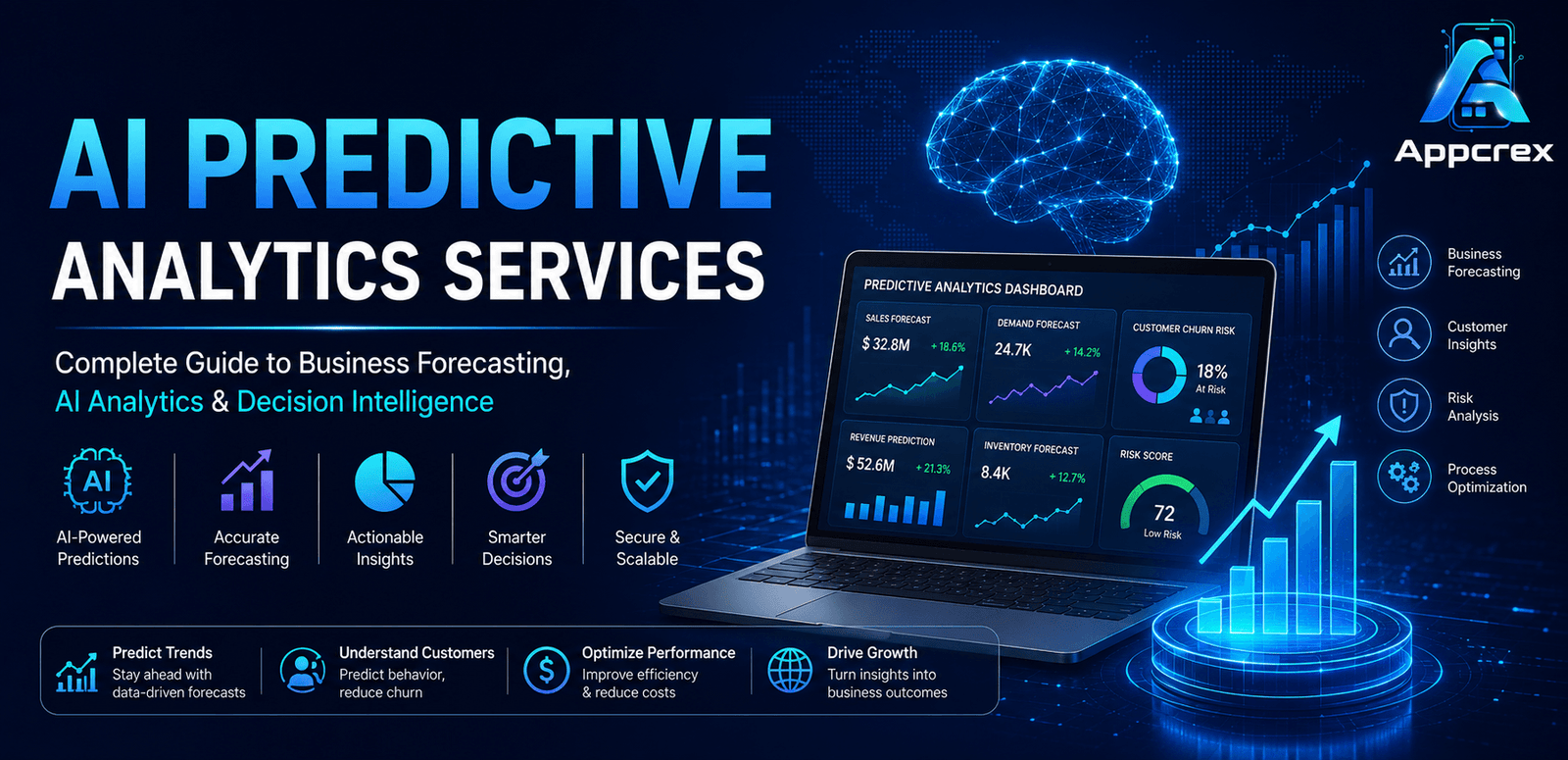
AI Predictive Analytics Services combine artificial intelligence, machine learning, statistical techniques, and business data to identify patterns, forecast future outcomes, and support better business decisions.
From sales forecasting and customer churn prediction to demand forecasting, fraud detection, risk analysis, and predictive maintenance, AI predictive analytics can help organizations move from reactive decision-making toward more proactive strategies.
AppCrex provides custom AI Predictive Analytics Services for startups, SMEs, enterprises, SaaS companies, financial organizations, retailers, manufacturers, healthcare businesses, logistics companies, and other data-driven organizations.
What Is AI Predictive Analytics?
AI predictive analytics is the use of artificial intelligence and machine learning to analyze historical and current data and predict potential future outcomes.
A simplified process looks like:
Business Data → Data Processing → AI/ML Models → Predictions → Business Decisions
For example, an eCommerce business can analyze previous purchases, customer behavior, seasonal trends, and product demand to predict which products may be in demand in the coming weeks.
Predictive analytics can be used for:
- Sales forecasting
- Demand prediction
- Customer churn prediction
- Fraud detection
- Risk assessment
- Financial forecasting
- Predictive maintenance
- Customer behavior prediction
- Inventory forecasting
- Workforce planning
The quality of predictions depends heavily on data quality, model selection, business context, and ongoing monitoring.
AI Predictive Analytics vs Traditional Analytics
Traditional analytics generally focuses on understanding what has already happened.
For example:
“How much did we sell last quarter?”
Predictive analytics goes a step further:
“Based on historical patterns and current signals, what are we likely to sell next quarter?”
| Analytics Type | Main Question |
|---|---|
| Descriptive Analytics | What happened? |
| Diagnostic Analytics | Why did it happen? |
| Predictive Analytics | What may happen next? |
| Prescriptive Analytics | What action should we consider? |
AI can strengthen predictive analytics by processing larger datasets and identifying complex patterns that may be difficult to capture through simple rule-based analysis.
Why Businesses Need AI Predictive Analytics?
Businesses often make decisions using historical reports, spreadsheets, and manual forecasts. These methods can become difficult to maintain as data volumes increase.
AI predictive analytics can help businesses:
- Forecast demand
- Identify potential risks
- Predict customer behavior
- Improve sales planning
- Optimize inventory
- Detect unusual patterns
- Forecast revenue
- Improve resource allocation
- Support proactive decision-making
- Reduce uncertainty in business planning
The goal is not to eliminate human decision-making but to provide decision-makers with additional evidence and insights.
AI Predictive Analytics Services
Predictive Business Analytics
Businesses can use AI models to identify patterns in operational and financial data.
Potential applications include:
- Revenue forecasting
- Sales forecasting
- Expense forecasting
- Business performance prediction
- KPI forecasting
- Scenario analysis
AI Sales Forecasting
AI can analyze historical sales, customer activity, product performance, seasonality, and other relevant signals to support sales forecasting.
Businesses can use predictive sales analytics to:
- Estimate future revenue
- Identify high-performing products
- Forecast sales by region
- Prioritize opportunities
- Analyze seasonal patterns
- Improve sales planning
Customer Churn Prediction
Customer churn can have a significant impact on recurring-revenue businesses.
AI models can analyze available customer signals to identify accounts that may be at higher risk of leaving.
Potential signals include:
- Product usage
- Purchase history
- Customer support activity
- Engagement levels
- Subscription activity
- Previous interactions
Businesses can then use these insights to design retention strategies.
Demand Forecasting
Demand forecasting is particularly useful for retail, manufacturing, eCommerce, logistics, and supply chain businesses.
AI can analyze:
- Historical sales
- Seasonal trends
- Product demand
- Inventory movement
- Regional patterns
- Business events
This can help organizations plan inventory and procurement more effectively.
AI Predictive Analytics for Finance
Financial teams can use predictive analytics to support forecasting and risk-related analysis.
Potential applications include:
- Cash-flow forecasting
- Revenue prediction
- Expense forecasting
- Budget analysis
- Financial trend prediction
- Anomaly detection
- Risk scoring
For regulated financial decisions, predictive models should be validated and governed appropriately rather than treated as automatically correct.
AI Predictive Analytics for Fraud Detection
AI predictive analytics can help identify unusual transaction or behavioral patterns.
A system can analyze signals such as:
- Transaction frequency
- Transaction value
- Account behavior
- Location-related signals
- Historical activity
- Device or session patterns
The model can then flag potentially unusual activity for further review.
Predictive fraud systems should be designed to minimize false positives and should not rely on a single automated prediction for high-impact decisions without appropriate controls.
AI Predictive Analytics for Healthcare
Healthcare organizations can use predictive analytics for operational and analytical use cases where appropriate data and governance are available.
Potential applications include:
- Patient demand forecasting
- Resource planning
- Appointment forecasting
- Hospital capacity planning
- Operational analytics
- Readmission risk analysis
Healthcare applications require careful handling of sensitive information and compliance with applicable laws and regulations.
AI Predictive Analytics for Manufacturing
Manufacturing companies generate data from production systems, equipment, inventory, quality processes, and supply chains.
AI predictive analytics can support:
- Predictive maintenance
- Production forecasting
- Demand planning
- Quality prediction
- Equipment monitoring
- Supply chain forecasting
Predictive Maintenance
Machine data can be analyzed to identify patterns associated with potential equipment problems.
This can help maintenance teams plan inspections or servicing before an unexpected failure occurs.
AI Predictive Analytics for Retail & eCommerce
Retail businesses can use AI to understand customer and product behavior.
Common applications include:
- Demand forecasting
- Customer purchase prediction
- Product recommendations
- Inventory forecasting
- Sales prediction
- Customer segmentation
- Churn prediction
For example, predictive models can help retailers estimate which products may experience increased demand during seasonal periods.
AI Predictive Analytics for Logistics & Supply Chain
Logistics companies can use predictive analytics to improve planning and operational visibility.
Possible applications include:
- Delivery forecasting
- Demand prediction
- Shipment volume forecasting
- Inventory planning
- Supplier analysis
- Warehouse optimization
- Fleet-related analytics
AI can combine historical operational data with current signals to support more proactive planning.
Key Features of AI Predictive Analytics Solutions
A custom predictive analytics platform can include:
- Predictive dashboards
- Sales forecasting
- Demand forecasting
- Revenue prediction
- Customer churn prediction
- Risk scoring
- Fraud detection
- Predictive maintenance
- Customer behavior prediction
- Inventory forecasting
- Anomaly detection
- Scenario analysis
- Real-time analytics
- Automated alerts
- Data visualization
- KPI forecasting
- AI-generated insights
- Business intelligence integration
- API integration
- Role-based access
- Reporting and analytics
The exact feature set depends on the organization’s data and business objectives.
How AI Predictive Analytics Works
A predictive analytics system generally follows several stages.
1. Data Collection
Data is collected from relevant sources such as:
- CRM
- ERP
- Websites
- Mobile applications
- Databases
- IoT devices
- Financial systems
- Marketing platforms
2. Data Preparation
Raw data is cleaned, structured, transformed, and prepared for analysis.
3. Feature Engineering
Relevant variables or signals are selected or created to help the model learn useful patterns.
4. Model Development
Machine learning or statistical models are trained using historical data.
5. Model Evaluation
The model is evaluated against appropriate metrics and validation datasets.
6. Prediction
The trained model generates forecasts or risk scores from new data.
7. Business Integration
Predictions can be integrated into dashboards, CRM, ERP, mobile applications, or business workflows.
8. Continuous Monitoring
Model performance should be monitored because data patterns can change over time.
AI Technologies Used in Predictive Analytics
The technology stack varies by use case and data type.
Machine Learning
- Regression
- Classification
- Decision trees
- Random forests
- Gradient boosting
- Neural networks
- Time-series models
Deep Learning
Deep learning can be useful for complex datasets and certain large-scale prediction problems.
Generative AI
Generative AI can complement predictive analytics by helping users understand predictions and generate natural-language summaries.
Large Language Models
LLMs can provide conversational access to analytics and help summarize business insights when appropriately connected to approved data sources.
Time-Series Forecasting
Time-series models are commonly used for:
- Sales forecasting
- Demand forecasting
- Revenue forecasting
- Inventory prediction
- Traffic forecasting
Benefits of AI Predictive Analytics
Better Business Forecasting
Businesses can use historical and current data to develop more informed forecasts.
Proactive Decision-Making
Instead of reacting only after an event occurs, businesses can identify potential future scenarios.
Improved Customer Retention
Churn prediction can help organizations identify customers who may need additional attention.
Better Inventory Planning
Demand forecasts can support inventory and procurement decisions.
Risk Identification
Predictive models can identify patterns associated with potential risks for further investigation.
Increased Operational Efficiency
Predictive insights can help businesses allocate resources more effectively.
Data-Driven Strategy
Management can use predictive insights alongside business expertise to make more informed decisions.
Also Read : AI ERP Integration Services: Complete Guide to Intelligent Business Automation
AI Predictive Analytics Development Process
Step 1: Business Requirement Analysis
We identify the business problem, desired outcomes, data sources, users, and success metrics.
Step 2: Data Assessment
Existing datasets are evaluated for quality, availability, completeness, and relevance.
Step 3: Data Engineering
Relevant data pipelines are developed to collect, transform, and prepare the required information.
Step 4: Model Selection
The appropriate machine learning or statistical approach is selected based on the prediction problem.
Step 5: Model Training
Models are trained using historical data.
Step 6: Model Testing & Validation
The system is evaluated using appropriate validation methods and business metrics.
Step 7: Integration
Predictions are integrated into dashboards, applications, ERP systems, CRM platforms, or other business workflows.
Step 8: Deployment
The predictive analytics system is deployed to the required cloud or enterprise environment.
Step 9: Monitoring & Optimization
Model performance, data changes, prediction quality, and business outcomes are monitored over time.
Also Read : AI & ML Development Company: Complete Guide to Services, Cost & Development Process
Technology Stack for AI Predictive Analytics
Programming Languages
- Python
- R
- Java
- JavaScript/Node.js
Machine Learning
- Scikit-learn
- TensorFlow
- PyTorch
- XGBoost
Data Processing
- Pandas
- NumPy
- Apache Spark
Databases
- PostgreSQL
- MySQL
- MongoDB
- Data warehouses
- Data lakes
Visualization
- Power BI
- Tableau
- Custom analytics dashboards
Cloud Platforms
- AWS
- Microsoft Azure
- Google Cloud
The technology stack should be selected according to data size, latency requirements, model complexity, existing infrastructure, and business objectives.
AI Predictive Analytics Integration With ERP & CRM
Predictive analytics becomes more valuable when it is connected to existing business systems.
ERP Integration
AI can analyze ERP information to support:
- Inventory forecasting
- Financial forecasting
- Procurement planning
- Supply chain analytics
- Production forecasting
CRM Integration
AI can analyze CRM data to support:
- Lead scoring
- Customer churn prediction
- Sales forecasting
- Customer segmentation
- Opportunity analysis
This allows predictive insights to become part of everyday business workflows instead of remaining isolated in a separate analytics dashboard.
How Much Does AI Predictive Analytics Cost?
The cost of developing an AI predictive analytics solution depends on the data infrastructure, prediction requirements, model complexity, integrations, dashboard functionality, and deployment environment.
| Project Type | Estimated Cost |
|---|---|
| Basic Predictive Analytics Solution | $8,000 – $15,000 |
| Predictive Dashboard & Forecasting | $12,000 – $25,000 |
| Custom AI Prediction Platform | $20,000 – $45,000 |
| Advanced Enterprise Predictive Analytics | $40,000 – $80,000+ |
These are indicative development estimates, not fixed quotations.
Factors Affecting Development Cost
- Data volume
- Data quality
- Number of data sources
- Model complexity
- Real-time requirements
- Dashboard requirements
- API integrations
- Cloud infrastructure
- Custom ML models
- Security requirements
- Number of users
- Ongoing model monitoring
Also Read : AI Sales Agent Development Company in UAE: Complete Guide to Features, Cost, Benefits & Business Use Cases
AI Predictive Analytics Company for Global Markets
AppCrex provides AI and predictive analytics solutions for businesses targeting major international markets.
USA
Predictive analytics for SaaS, financial services, retail, healthcare, manufacturing, and enterprise businesses.
UK
AI forecasting and predictive analytics for sales, finance, customer behavior, operations, and supply chain management.
Canada
Custom predictive analytics solutions for startups, SMEs, SaaS companies, and enterprises.
Dubai & UAE
Predictive analytics for retail, logistics, real estate, finance, eCommerce, and enterprise operations.
Saudi Arabia
AI predictive analytics for businesses in Riyadh and across Saudi Arabia, supporting forecasting, automation, customer analytics, and operational intelligence.
India
Predictive analytics solutions for startups, manufacturers, retailers, fintech businesses, SaaS companies, and enterprises.
Singapore
AI-powered forecasting and predictive analytics for finance, logistics, eCommerce, manufacturing, and technology companies.
Australia
Predictive analytics solutions for retail, finance, logistics, healthcare, manufacturing, and enterprise businesses.
These are target service markets and do not imply a physical AppCrex office in every listed location.
Common Challenges in AI Predictive Analytics
Poor Data Quality
Incomplete or inconsistent data can reduce model reliability.
Data Integration
Businesses may have information distributed across multiple systems.
Model Accuracy
No predictive model can guarantee future outcomes. Models should be evaluated using appropriate metrics and business context.
Data Drift
Customer behavior, market conditions, and operational patterns can change over time.
Explainability
For important business decisions, organizations may need to understand why a model generated a particular prediction.
Privacy & Security
Sensitive customer, financial, employee, or healthcare information requires appropriate safeguards.
Also Read : AI Software Development Company: Custom AI Solutions, Cost & Development Process
Why Choose AppCrex for AI Predictive Analytics Services?
AI & Machine Learning Expertise
AppCrex can design and develop predictive analytics solutions using machine learning, AI, and data engineering technologies.
Custom Predictive Models
Models can be developed around specific business objectives rather than relying only on generic analytics.
Business System Integration
Predictive insights can be connected with ERP, CRM, SaaS platforms, websites, mobile applications, and enterprise systems.
Scalable Architecture
Solutions can be designed to support increasing data volumes, users, and prediction workloads.
Data-Focused Approach
Data preparation, model validation, integration, and monitoring are considered throughout the development lifecycle.
Flexible Engagement Models
Businesses can work with:
- AI developers
- Machine learning developers
- Data scientists
- Data engineers
- AI consultants
- Dedicated development teams
FAQs
Q. What are AI Predictive Analytics Services?
AI predictive analytics services use artificial intelligence, machine learning, and business data to identify patterns and forecast potential future outcomes.
Q. What can predictive analytics be used for?
Common applications include sales forecasting, demand prediction, customer churn, fraud detection, financial forecasting, inventory planning, risk analysis, and predictive maintenance.
Q. How much does AI predictive analytics cost?
A basic solution may cost around $8,000–$15,000, while advanced enterprise predictive analytics platforms can cost significantly more depending on data, models, integrations, and infrastructure.
Q. Can predictive analytics integrate with CRM and ERP systems?
Yes. Predictive analytics can be integrated with CRM, ERP, databases, SaaS platforms, mobile applications, and other enterprise systems.
Q. Can AI predict customer churn?
Yes. Machine learning models can analyze relevant customer behavior and historical patterns to identify customers who may have a higher likelihood of churn.
Q. How accurate are AI predictive models?
Accuracy varies significantly depending on the data, prediction problem, model, and business environment. Predictive models should be validated and monitored rather than treated as guaranteed forecasts.
Q. How long does it take to develop a predictive analytics solution?
The timeline depends on data availability, model complexity, number of integrations, dashboard requirements, and deployment scope. A project-specific timeline can be estimated after requirements analysis.
Conclusion
AI Predictive Analytics Services help businesses use historical and current data to make more informed decisions about the future. From sales and demand forecasting to customer churn, fraud detection, financial planning, inventory management, and predictive maintenance, AI can support a wide range of business use cases.
The real value of predictive analytics comes from connecting predictions to business workflows. When AI insights are integrated with CRM, ERP, dashboards, mobile applications, and enterprise platforms, organizations can use predictions as part of their everyday decision-making processes.
However, successful predictive analytics requires more than selecting an AI model. Businesses need high-quality data, appropriate algorithms, reliable data pipelines, proper validation, secure infrastructure, and continuous model monitoring.
Build a Predictive Analytics Solution With AppCrex
AppCrex provides AI Predictive Analytics Services for startups, SMEs, and enterprises looking to turn business data into actionable predictive insights.
Whether you need sales forecasting, demand prediction, customer churn analytics, financial forecasting, fraud detection, predictive maintenance, or a custom AI analytics platform, our team can help you design and develop a solution around your business requirements.
Ready to Turn Your Data Into Predictive Insights?
Talk to AppCrex about building a scalable, secure, and business-focused AI predictive analytics solution.