📌 Key Takeaways
- Custom drone applications help businesses automate inspections, mapping, monitoring, and operational workflows.
- AI, computer vision, GPS, GIS, and cloud technologies are shaping the future of intelligent drone software.
- Drone app development costs depend on features, SDK integration, AI capabilities, supported platforms, and cloud infrastructure.
- Investing in a custom drone solution provides greater flexibility, scalability, security, and long-term ROI than ready-made software.
- AppCrex delivers end-to-end drone app development services for businesses worldwide, helping organizations build secure, scalable, and future-ready UAV solutions.
Introduction
Drone technology has rapidly evolved from a niche innovation into a critical business tool across industries worldwide. Today, organizations use drones to inspect infrastructure, monitor crops, survey construction sites, deliver packages, manage mining operations, capture aerial imagery, and improve public safety. As businesses increasingly rely on drone technology, the demand for intelligent drone applications has grown significantly.
Modern drone applications are powered by Artificial Intelligence (AI), GPS, GIS mapping, cloud computing, IoT, computer vision, and real-time analytics. These technologies enable businesses to automate operations, improve decision-making, reduce operational costs, and collect accurate field data faster than ever before.
Whether you’re building a drone fleet management platform, an agriculture drone solution, a mapping application, or an inspection system, partnering with an experienced Drone Mobile App Development Company ensures your solution is secure, scalable, and built for long-term success.
At AppCrex, we develop custom drone applications for startups, enterprises, and government organizations. Our team builds Android, iOS, web, and cloud-based drone software with AI-powered automation, live video streaming, GPS navigation, GIS mapping, and enterprise-grade security.
In this complete guide, you’ll discover everything about drone app development, including must-have features, app types, development process, technology stack, development costs, future trends, and business benefits.
What is a Drone App?
A drone app is a software application that allows users to control, monitor, automate, and manage drones using mobile devices, tablets, or web dashboards. These applications communicate with drones through software development kits (SDKs), GPS, cloud infrastructure, wireless communication, and onboard sensors.
A modern drone application does far more than simply fly a drone. It enables businesses to:
- Plan automated flight missions
- Monitor live drone locations
- Stream HD video
- Capture aerial imagery
- Analyze data using AI
- Generate inspection reports
- Manage multiple drones
- Monitor battery health
- Schedule maintenance
- Store flight history
Most enterprise drone solutions include:
- Mobile Application
- Web Dashboard
- Admin Panel
- Cloud Backend
- AI Analytics
- GPS & GIS Mapping
- Live Streaming
- Fleet Management
Together, these components provide businesses with a centralized platform to manage drone operations efficiently.
Also Read : How Much Does It Cost to Develop an App in 2026? Complete Pricing Guide
Why Businesses Are Investing in Drone App Development?
Drone technology has become an essential part of digital transformation across multiple industries. Businesses invest in custom drone applications because they provide faster operations, improved safety, and better data accuracy compared to traditional methods.
Here are the primary reasons organizations are investing in drone app development.
Improved Operational Efficiency
Drone applications automate inspections, surveys, mapping, and monitoring tasks, reducing manual work and increasing productivity.
Reduced Operational Costs
Drones minimize labor-intensive inspections, travel expenses, and equipment downtime, helping businesses lower operational costs.
Improved Workplace Safety
Employees no longer need to climb towers, inspect rooftops, enter hazardous mining zones, or access dangerous infrastructure manually.
Real-Time Monitoring
Live drone tracking enables businesses to monitor remote locations instantly, improving response times and operational visibility.
Better Decision-Making
AI-powered analytics and real-time reporting help organizations make informed business decisions based on accurate aerial data.
Automation
Businesses can automate flight missions, inspections, reporting, and image analysis, reducing human error and improving consistency.
Industries That Use Drone Apps
Drone technology is transforming numerous industries around the world.
Agriculture
Agriculture businesses use drone applications for:
- Crop Monitoring
- Precision Farming
- NDVI Analysis
- Irrigation Planning
- Pest Detection
- Fertilizer Optimization
- Yield Estimation
Construction
Construction companies use drones for:
- Site Surveys
- Construction Progress Monitoring
- Safety Inspections
- Equipment Monitoring
- 3D Mapping
Mining
Mining organizations rely on drones for:
- Land Surveys
- Stockpile Measurement
- Site Inspection
- Safety Monitoring
- Environmental Analysis
Oil & Gas
Drone software supports:
- Pipeline Inspection
- Leak Detection
- Offshore Monitoring
- Infrastructure Inspection
- Emergency Response
Energy & Utilities
Utility companies use drones for:
- Power Line Inspection
- Wind Turbine Inspection
- Solar Panel Monitoring
- Grid Maintenance
- Asset Inspection
Logistics & Delivery
Drone applications improve logistics through:
- Package Delivery
- Route Planning
- Fleet Tracking
- Delivery Monitoring
Real Estate
Real estate businesses use drones for:
- Property Photography
- Virtual Property Tours
- Land Surveys
- Marketing Videos
Public Safety
Government organizations deploy drones for:
- Disaster Management
- Search & Rescue
- Traffic Monitoring
- Emergency Response
- Law Enforcement
Environmental Monitoring
Environmental agencies use drones for:
- Wildlife Monitoring
- Forest Surveys
- Climate Research
- Water Resource Monitoring
- Coastal Inspection
Types of Drone Apps
Not every drone application serves the same purpose. Depending on the industry and business requirements, drone software can be designed for different operational needs.
Drone Control Apps
These applications allow users to manually or automatically control drone movements, camera functions, flight paths, and navigation.
Common features include:
- Flight Controls
- Camera Controls
- GPS Navigation
- Return-to-Home
- Emergency Landing
Drone Mapping Apps
Mapping applications help organizations create highly accurate maps using aerial imagery.
They are widely used in:
- Construction
- Mining
- Agriculture
- Urban Planning
- Land Surveying
Drone Inspection Apps
Inspection software enables businesses to inspect assets remotely.
Common use cases include:
- Bridges
- Buildings
- Solar Farms
- Wind Turbines
- Pipelines
- Cell Towers
- Power Lines
Agriculture Drone Apps
Agriculture-focused drone applications help farmers monitor crop health, irrigation, diseases, soil conditions, and harvesting activities.
Features often include:
- Crop Health Analysis
- NDVI Mapping
- AI Disease Detection
- Smart Irrigation
- Yield Prediction
Drone Fleet Management Apps
Enterprise businesses operating multiple drones require centralized fleet management software.
Typical features include:
- Fleet Dashboard
- Pilot Management
- Mission Scheduling
- Battery Monitoring
- Flight Logs
- Maintenance Records
Drone Delivery Apps
Delivery platforms use drones for transporting products efficiently.
Industries include:
- Healthcare
- Food Delivery
- E-commerce
- Medical Supplies
- Emergency Services
Drone Surveillance Apps
Security organizations use drone applications for:
- Live Surveillance
- Border Monitoring
- Crowd Management
- Event Security
- Facility Monitoring
Drone Photography & Media Apps
Media companies use drones for:
- Film Production
- Sports Coverage
- Tourism
- Weddings
- Commercial Advertising
What Features Should a Drone App Have?
A successful drone application should do much more than simply control a drone. Modern businesses expect secure, scalable, and intelligent software that automates flight operations, collects real-time data, analyzes aerial imagery, and manages multiple drones from a centralized platform.
Whether you’re building a drone inspection app, mapping solution, agriculture platform, or UAV fleet management system, the following features are essential.
1. User Registration & Authentication
A secure authentication system protects sensitive flight data and ensures that only authorized users can access drone operations.
Key Features
- Email & Password Login
- Mobile OTP Verification
- Google & Apple Sign-In
- Multi-Factor Authentication (MFA)
- Role-Based User Access
- Password Recovery
This improves security while allowing administrators, pilots, and managers to access only the modules relevant to their roles.
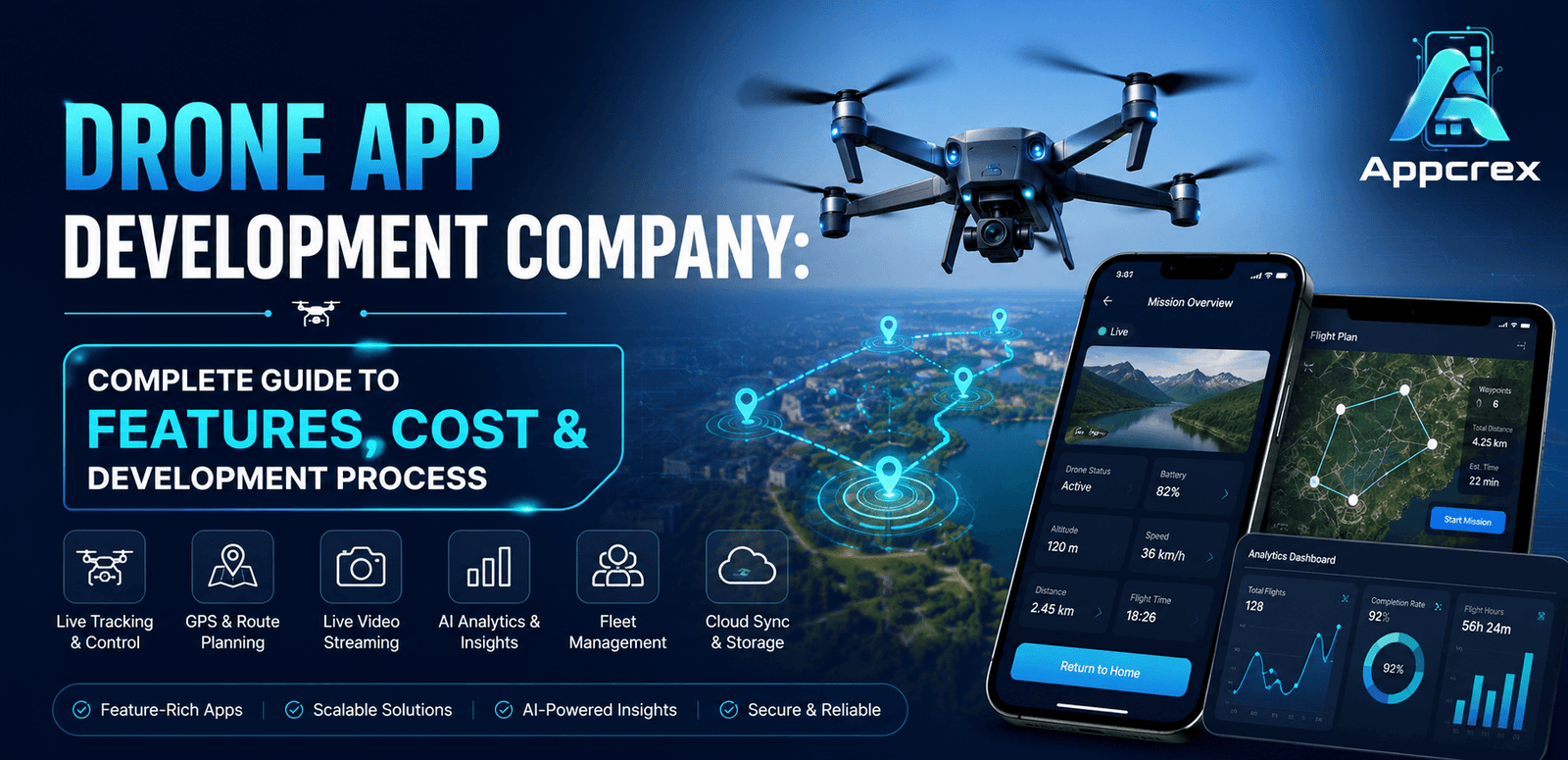
2. Drone Dashboard
The dashboard acts as the control center of the application, giving users a real-time overview of drone activities.
The dashboard typically displays:
- Active Missions
- Drone Status
- Battery Percentage
- GPS Location
- Flight Time
- Weather Conditions
- Fleet Health
- Recent Alerts
- Analytics & Reports
A centralized dashboard helps businesses monitor operations efficiently.
3. Live Drone Tracking
Real-time drone tracking enables operators to monitor drone movement during missions.
Capabilities include:
- Live GPS Tracking
- Altitude Monitoring
- Flight Speed
- Route History
- Current Location
- Distance Covered
- Return-to-Home Status
This feature is particularly useful for logistics, agriculture, mining, and inspection companies.
4. Flight Planning & Mission Management
Instead of manually controlling every flight, operators can automate drone missions using predefined flight paths.
Key capabilities include:
- Waypoint Navigation
- Automated Flight Routes
- Mission Scheduling
- Flight Templates
- Repeat Missions
- Area Coverage Planning
Mission automation increases efficiency while reducing manual errors.
GPS technology enables drones to fly accurately while geo-fencing keeps them within approved operating zones.
Features include:
- Live GPS Navigation
- Geo-Fencing
- No-Fly Zone Alerts
- Route Optimization
- Safe Landing Zones
- Distance Measurement
This improves operational safety and regulatory compliance.
6. Live Video Streaming
Many industries require real-time aerial footage for inspections and monitoring.
The app should support:
- HD Video Streaming
- Live Camera Feed
- Video Recording
- Screenshot Capture
- Cloud Video Storage
- Multi-Viewer Support
This feature is widely used in construction, public safety, surveillance, and infrastructure inspection.
7. Drone Camera Controls
Drone operators should have complete control over onboard cameras.
Essential camera controls include:
- Zoom
- Camera Rotation
- Photo Capture
- Video Recording
- Image Stabilization
- Exposure Settings
These capabilities improve inspection accuracy and content quality.
8. Drone Fleet Management
Organizations operating multiple drones require centralized fleet management.
Fleet management features include:
- Multi-Drone Monitoring
- Fleet Dashboard
- Drone Assignment
- Pilot Management
- Flight Logs
- Battery Status
- Maintenance Records
- Drone Availability
Fleet management simplifies operations for enterprise businesses.
9. Battery & Maintenance Monitoring
Battery failures can interrupt missions and damage expensive equipment.
A professional drone application should monitor:
- Battery Health
- Charging Status
- Remaining Flight Time
- Motor Health
- Maintenance Schedule
- Service Alerts
Preventive maintenance reduces downtime and extends drone lifespan.
10. Weather Integration
Weather conditions have a significant impact on drone flights.
The application should display:
- Wind Speed
- Rain Forecast
- Temperature
- Humidity
- Visibility
- Storm Warnings
Weather integration helps operators schedule safer and more efficient missions.
11. Reports & Analytics
Analytics help businesses evaluate drone performance and improve operational efficiency.
Reports may include:
- Flight Reports
- Mission Reports
- Drone Utilization
- Battery Reports
- Pilot Performance
- Inspection Reports
- Maintenance History
Interactive dashboards provide valuable business insights.
Third-Party Integrations
A robust drone application should integrate seamlessly with third-party services to extend functionality and improve operational efficiency.
Drone SDKs
Drone SDKs enable communication between the application and drone hardware.
Popular SDKs include:
- DJI Mobile SDK
- DJI UX SDK
- PX4 SDK
- ArduPilot
- MAVSDK
These SDKs provide access to flight controls, telemetry, camera functions, live video, and autonomous mission capabilities.
Maps & GIS Platforms
Mapping services help visualize drone flights and survey data.
Popular integrations include:
- Google Maps Platform
- Mapbox
- ArcGIS
- OpenStreetMap
These tools support route planning, land surveys, geo-fencing, and asset mapping.
Cloud Platforms
Cloud infrastructure enables secure storage, scalability, and real-time synchronization.
Popular cloud providers include:
- Amazon Web Services (AWS)
- Microsoft Azure
- Google Cloud Platform
Cloud services support video storage, analytics, AI processing, and fleet management.
Weather APIs
Weather APIs provide accurate environmental data before and during drone operations.
Common integrations include:
- OpenWeather API
- WeatherAPI
- Tomorrow.io
These services improve flight planning and operational safety.
Communication Services
Real-time communication improves collaboration between pilots, managers, and field teams.
Popular integrations include:
- Twilio
- Firebase Cloud Messaging
- SendGrid
- WebRTC
These tools enable notifications, messaging, voice calls, and live communication.
Also Read : AI Customer Support Automation Services: Complete Guide to Benefits, Features, Implementation & Cost
AI Features in Drone Apps
Artificial Intelligence has transformed drone applications from basic flight-control tools into intelligent business platforms capable of automation, predictive analysis, and advanced image processing.
AI Object Detection
AI models automatically identify objects captured by drone cameras.
Examples include:
- Vehicles
- Buildings
- Roads
- Crops
- Animals
- People
- Infrastructure Assets
Object detection reduces manual inspection time while improving accuracy.
Computer Vision
Computer vision enables drones to understand and analyze visual information.
Applications include:
- Crack Detection
- Solar Panel Inspection
- Building Damage Assessment
- Road Analysis
- Crop Health Monitoring
- Quality Inspection
This technology is widely used in construction, agriculture, energy, and manufacturing.
Autonomous Flight Assistance
AI helps drones make intelligent flight decisions by analyzing surroundings in real time.
Capabilities include:
- Obstacle Detection
- Collision Avoidance
- Smart Route Optimization
- Automatic Return-to-Home
- Intelligent Landing Assistance
These features improve safety and reduce pilot workload.
Predictive Analytics
AI analyzes historical flight data, sensor readings, and environmental conditions to predict future outcomes.
Businesses can use predictive analytics for:
- Equipment Maintenance
- Mission Planning
- Resource Allocation
- Risk Assessment
- Performance Optimization
Image Recognition
AI-powered image recognition processes aerial images to identify patterns, defects, or abnormalities.
Common use cases include:
- Crop Disease Detection
- Roof Damage Inspection
- Pipeline Corrosion Analysis
- Wildlife Monitoring
- Construction Progress Tracking
AI-Based Automated Reporting
Instead of manually reviewing thousands of images, AI automatically generates inspection reports containing:
- Defect Detection
- Image Comparisons
- Risk Assessment
- Maintenance Recommendations
- Performance Insights
This saves significant time while improving reporting accuracy.
How to Build a Drone App?
Building a successful drone application requires more than just developing a mobile app. It involves selecting the right drone hardware, integrating flight control SDKs, implementing AI capabilities, designing scalable cloud architecture, and ensuring compliance with aviation regulations.
At AppCrex, we follow a structured development process that helps businesses build secure, scalable, and future-ready drone applications tailored to their industry needs.
Step 1: Define Your Business Requirements
Every successful drone application starts with a clear understanding of business objectives.
During this phase, we identify:
- Business Goals
- Target Users
- Industry Use Cases
- Required Features
- Supported Drone Models
- Compliance Requirements
- Budget & Timeline
Proper planning reduces development risks and ensures the solution aligns with your business needs.
Step 2: Choose the Right Drone Hardware
Selecting the appropriate drone hardware is essential because each drone supports different sensors, cameras, payload capacities, and SDK capabilities.
Popular drone categories include:
- Camera Drones
- Survey Drones
- Agriculture Drones
- Delivery Drones
- Inspection Drones
- Security Drones
- Industrial UAVs
The hardware selection depends on your industry and operational requirements.
Step 3: Select the Right Drone SDK
A Drone Software Development Kit (SDK) allows your application to communicate with drone hardware and access advanced flight capabilities.
Popular SDKs include:
- DJI Mobile SDK
- DJI UX SDK
- PX4 SDK
- ArduPilot
- MAVSDK
These SDKs enable:
- Flight Control
- Camera Management
- Live Telemetry
- Waypoint Navigation
- Autonomous Missions
- Video Streaming
Choosing the right SDK ensures compatibility, scalability, and reliable drone performance.
Step 4: Design UI/UX
An intuitive user interface improves productivity for drone pilots, administrators, and business users.
The design process focuses on:
- Easy Navigation
- Interactive Maps
- Live Dashboard
- Mission Planning Screens
- Analytics Dashboard
- Mobile Responsiveness
- Dark & Light Modes
A well-designed interface reduces training time and improves user adoption.
Step 5: Develop the Drone Application
Once the design is approved, our developers begin building the application.
Depending on business requirements, we develop:
- Android Applications
- iOS Applications
- Web Dashboards
- Admin Panels
- Cloud Platforms
- APIs
During development, we also integrate authentication, notifications, reporting, security, and cloud synchronization.
Also Read : AI Software Development Company: Custom AI Solutions, Cost & Development Process
Step 6: Integrate AI & Computer Vision
Artificial Intelligence transforms traditional drone software into an intelligent automation platform.
We integrate AI capabilities such as:
- Object Detection
- Computer Vision
- Defect Recognition
- Autonomous Navigation
- Predictive Analytics
- Image Processing
These features help businesses automate inspections and make data-driven decisions.
Step 7: Integrate GPS & GIS
Mapping and navigation play a critical role in drone operations.
GPS and GIS integration enables:
- Flight Mapping
- Route Optimization
- Geo-Fencing
- Terrain Mapping
- Survey Planning
- Asset Tracking
These capabilities improve navigation accuracy and mission efficiency.
Step 8: Test the Drone Application
Before deployment, every drone application undergoes extensive quality assurance testing.
Testing includes:
- Functional Testing
- Flight Simulation
- Performance Testing
- Security Testing
- SDK Compatibility Testing
- Device Compatibility Testing
- User Acceptance Testing
This ensures the application performs reliably in real-world environments.
Step 9: Launch & Deployment
Once testing is complete, the application is deployed based on business requirements.
Deployment options include:
- Google Play Store
- Apple App Store
- Enterprise Distribution
- Private Cloud
- AWS
- Microsoft Azure
- Google Cloud Platform
Deployment is followed by monitoring to ensure smooth performance after launch.
Step 10: Maintenance & Continuous Improvement
Drone technology evolves rapidly, making ongoing maintenance essential.
Our post-launch services include:
- Feature Enhancements
- Security Updates
- SDK Upgrades
- Performance Optimization
- Cloud Monitoring
- AI Model Improvements
- Technical Support
Continuous updates help businesses stay competitive and ensure long-term software reliability.
Best Technology Stack for Drone App Development
Choosing the right technology stack is essential for building a secure, scalable, and high-performance drone application.
| Category | Technologies |
|---|---|
| Mobile Development | Flutter, React Native, Kotlin, Swift |
| Frontend | React.js, Next.js, Angular |
| Backend | Node.js, Python (FastAPI), .NET |
| Database | PostgreSQL, MongoDB, MySQL |
| Cloud | AWS, Microsoft Azure, Google Cloud |
| AI & Machine Learning | OpenAI, TensorFlow, PyTorch, OpenCV, YOLO |
| Drone SDKs | DJI SDK, PX4, ArduPilot, MAVSDK |
| Maps & GIS | Google Maps API, Mapbox, ArcGIS |
| Live Streaming | WebRTC, RTMP, HLS |
| DevOps | Docker, Kubernetes, GitHub Actions |
This modern technology stack ensures your drone application remains scalable, secure, and capable of handling real-time operations across industries.
Custom Drone App vs Ready-Made Drone Software
Many businesses wonder whether they should build a custom drone application or use an existing off-the-shelf solution. While ready-made software may be suitable for basic operations, custom drone applications provide greater flexibility, scalability, and long-term business value.
| Feature | Custom Drone App | Ready-Made Drone Software |
|---|---|---|
| Custom Features | ✅ Built for your business | ❌ Limited customization |
| Ownership | ✅ Full ownership of source code | ❌ Vendor-owned |
| Scalability | ✅ Easily scalable | ❌ Limited scalability |
| Third-Party Integrations | ✅ Easy API integration | ❌ Limited integration support |
| AI & Automation | ✅ Fully customizable | ❌ Basic capabilities |
| Branding | ✅ Complete white-label solution | ❌ Vendor branding |
| Security | ✅ Enterprise-grade security | ❌ Standard security features |
| Long-Term ROI | ✅ Higher ROI | ❌ Ongoing licensing costs |
Why Choose Custom Drone App Development?
Custom drone applications provide:
- Business-specific workflows
- Better security and compliance
- Seamless integration with existing systems
- Scalable architecture
- Competitive advantage
- Full ownership and control
- Flexibility for future upgrades
For organizations planning long-term digital transformation, investing in a custom drone application delivers greater value than relying on generic software.
How Much Does It Cost to Develop a Drone App?
The cost of drone app development depends on various factors, including the application’s complexity, supported drone hardware, AI capabilities, cloud infrastructure, third-party integrations, and the platforms you want to target. A simple drone control app requires less investment than an enterprise-grade drone management platform with AI-powered analytics, fleet management, live video streaming, and GIS mapping.
Whether you’re building a drone inspection app, agriculture drone platform, mapping software, or delivery solution, understanding the cost breakdown helps you plan your budget more effectively.
Below is an estimated pricing guide for custom drone app development.
| Drone App Type | Estimated Cost | Development Timeline |
|---|---|---|
| Basic Drone App | $20,000 – $40,000 | 2–3 Months |
| Standard Drone App | $40,000 – $80,000 | 3–5 Months |
| Advanced Drone Platform | $80,000 – $150,000 | 5–8 Months |
| Enterprise Drone Solution | $150,000 – $250,000+ | 8–12 Months |
Note: The actual development cost may vary based on business requirements, feature complexity, AI integration, supported drone models, security requirements, and third-party services.
Factors That Affect Drone App Development Cost
No two drone applications are exactly alike. Several technical and business factors influence the overall project budget.
1. App Complexity
The biggest factor affecting cost is the overall complexity of the application.
A basic app with flight controls and GPS tracking requires fewer development hours than an enterprise platform featuring AI automation, fleet management, cloud synchronization, and advanced reporting.
Higher complexity means:
- More development hours
- Advanced architecture
- Additional testing
- Higher maintenance costs
2. Supported Platforms
The number of platforms you choose directly impacts development costs.
You can build for:
- Android
- iOS
- Web Dashboard
- Admin Panel
- Cross-Platform (Flutter/React Native)
Developing a single-platform application is generally more affordable than supporting multiple platforms.
3. Drone SDK Integration
Drone applications rely on Software Development Kits (SDKs) to communicate with drone hardware.
Popular SDKs include:
- DJI SDK
- PX4
- ArduPilot
- MAVSDK
Advanced SDK features like autonomous flight, obstacle avoidance, camera control, and telemetry require additional development effort.
4. AI & Machine Learning Features
Artificial Intelligence significantly enhances drone applications but also increases development complexity.
Common AI capabilities include:
- Object Detection
- Computer Vision
- Image Recognition
- Predictive Analytics
- Automated Inspections
- Crop Health Analysis
- Defect Detection
These features require AI model training, cloud processing, and additional testing.
5. Live Video Streaming
If your application supports real-time video transmission, you’ll need a robust streaming infrastructure.
This may include:
- HD Live Streaming
- Video Recording
- Cloud Storage
- Remote Monitoring
- Video Compression
Streaming functionality adds both development and infrastructure costs.
6. GIS & Mapping Integration
Advanced mapping capabilities are essential for industries such as agriculture, construction, and surveying.
Typical GIS features include:
- Satellite Maps
- Route Planning
- Geo-Fencing
- Terrain Mapping
- Area Measurement
- Survey Visualization
Professional GIS integration requires specialized APIs and mapping technologies.
7. Cloud Infrastructure
Enterprise drone applications require scalable cloud infrastructure to support large volumes of data and users.
Cloud services handle:
- Image Storage
- Video Storage
- AI Processing
- Real-Time Synchronization
- User Management
- Fleet Management
- Analytics
Choosing the right cloud architecture impacts both initial development and long-term operational costs.
8. Security & Compliance
Drone applications often manage sensitive operational data, making security a top priority.
Essential security measures include:
- End-to-End Encryption
- Multi-Factor Authentication
- Role-Based Access Control
- Secure APIs
- Audit Logs
- Secure Cloud Storage
Strong security features increase development effort but protect valuable business data.
Also Read : End-to-End App Development Company: The Complete Guide to Building Successful Mobile Apps
Drone App Monetization Models
If you’re planning to launch a commercial drone platform, selecting the right monetization strategy is just as important as building the app itself. A well-defined revenue model ensures sustainable growth and long-term profitability.
Subscription-Based Model (SaaS)
This is one of the most popular monetization models for drone software.
Customers pay a monthly or annual subscription to access premium features such as:
- Fleet Management
- AI Analytics
- Cloud Storage
- Inspection Reports
- Advanced Dashboards
This model generates predictable recurring revenue.
Also Read : What is SaaS Application Development? A Complete Guide (2026)
Enterprise Licensing
Large organizations often prefer enterprise licenses that provide access to custom features, dedicated support, and enhanced security.
Enterprise plans may include:
- Unlimited Users
- Custom Integrations
- White-Label Solutions
- Dedicated Infrastructure
- Priority Support
Pay-Per-Use Model
Instead of charging a fixed subscription, businesses can charge users based on usage.
Examples include:
- Per Flight
- Per Survey
- Per Inspection
- Per Mapping Project
- Per Report Generated
This model works well for businesses with occasional users.
White-Label Solutions
You can offer your drone platform as a white-label product, allowing other businesses to rebrand and use the software under their own name.
This model is popular among:
- Drone Service Providers
- Technology Companies
- Enterprises
- Government Contractors
Premium Features
Offer a free version with basic functionality and charge users for advanced capabilities such as:
- AI-Powered Image Analysis
- Advanced Reporting
- Multi-Drone Management
- Offline Maps
- Extended Cloud Storage
- Advanced Analytics
This freemium approach helps attract users while creating opportunities for upgrades.
API & Data Services
Drone platforms collect valuable aerial and operational data. Businesses can monetize this by offering secure API access or data services to enterprise clients.
Potential offerings include:
- Mapping Data APIs
- Inspection Data
- Analytics Dashboards
- Reporting APIs
- Third-Party Integrations
Benefits of Drone App Development
Investing in a custom drone application offers more than just remote flight control. It helps businesses automate operations, improve data accuracy, reduce operational costs, and make faster decisions using real-time insights. Whether you’re in agriculture, construction, logistics, energy, or public safety, a custom drone app can deliver measurable business value.
Increased Operational Efficiency
Drone applications automate repetitive tasks such as inspections, surveying, monitoring, and data collection, allowing teams to complete projects faster with fewer resources.
Businesses can:
- Reduce manual inspections
- Automate recurring missions
- Increase workforce productivity
- Improve project turnaround time
Enhanced Workplace Safety
Many industries require inspections in hazardous environments such as rooftops, transmission towers, mines, wind turbines, and oil pipelines.
Drone applications enable remote inspections, reducing the need for employees to work in dangerous conditions and improving workplace safety.
Better Data Accuracy
Modern drones collect high-resolution images, videos, GPS coordinates, thermal data, and sensor information.
With AI-powered analytics, businesses receive accurate reports that improve planning, maintenance, and operational decision-making.
Lower Operational Costs
Drone applications help reduce expenses by minimizing manual labor, travel costs, equipment downtime, and inspection time.
Organizations can complete more work in less time while improving overall resource utilization.
Real-Time Decision Making
Live drone tracking, video streaming, and analytics dashboards provide instant visibility into field operations.
Managers can quickly respond to incidents, monitor progress, and make informed decisions using real-time data.
Scalable Business Operations
Cloud-based drone platforms allow organizations to manage hundreds of drones, pilots, and missions from a centralized system.
As the business grows, the software can easily scale without major infrastructure changes.
Challenges in Drone App Development
Although drone technology offers significant advantages, developing a robust drone application comes with technical and operational challenges.
Hardware Compatibility
Different drone manufacturers use different hardware, communication protocols, and SDKs.
A custom drone application must ensure seamless compatibility with supported drone models.
Real-Time Communication
Drone applications require stable communication between the drone, mobile device, and cloud servers.
Developers must optimize the application for low latency and reliable data transmission, especially during live missions.
Battery Limitations
Limited battery life can affect long-duration missions.
Features like battery health monitoring, low-power alerts, and intelligent return-to-home functionality help reduce operational risks.
GPS Accuracy
Poor GPS signals can impact navigation, especially in dense urban environments or remote locations.
Integrating advanced mapping technologies and fallback positioning methods improves flight accuracy.
Large Data Processing
Drone applications often handle large volumes of images, videos, and sensor data.
Efficient cloud storage, data compression, and AI-powered processing are essential for maintaining application performance.
Security & Privacy
Drone platforms often manage sensitive business information.
Implementing encryption, secure APIs, role-based access control, and audit logs helps protect data and ensure compliance with organizational security standards.
Future Trends in Drone App Development (2026–2030)
The drone industry continues to evolve with advancements in Artificial Intelligence, cloud computing, and automation. Businesses investing today should build platforms that are ready for future innovations.
AI-Powered Autonomous Flights
Future drone applications will rely heavily on AI to automate navigation, obstacle avoidance, and mission planning with minimal human intervention.
Drone Swarm Technology
Instead of operating a single drone, businesses will increasingly manage multiple drones working together on large-scale inspections, surveillance, agriculture, and disaster response.
5G Connectivity
High-speed 5G networks will improve live video streaming, remote drone operations, and real-time communication by reducing latency and increasing reliability.
Edge AI Processing
Rather than sending all data to the cloud, drones will process images and sensor data directly on the device, enabling faster analysis and quicker decision-making.
Digital Twin Integration
Digital twin technology will allow businesses to create virtual models of buildings, infrastructure, and industrial assets using drone-collected data for predictive maintenance and planning.
Advanced Computer Vision
AI-powered computer vision will become even more accurate, enabling drones to automatically detect defects, monitor assets, recognize objects, and generate detailed inspection reports.
Smart Fleet Automation
Future fleet management systems will automate scheduling, maintenance planning, battery optimization, and mission assignments using AI and predictive analytics.
Why Choose AppCrex for Drone App Development?
At AppCrex, we specialize in building custom drone applications that combine cutting-edge technologies with scalable architecture to help businesses streamline operations and drive innovation.
End-to-End Development Services
From idea validation and UI/UX design to development, testing, deployment, and post-launch maintenance, we manage every stage of the drone app development lifecycle.
AI & Computer Vision Expertise
We integrate advanced technologies such as:
- Artificial Intelligence (AI)
- Computer Vision
- Machine Learning
- Predictive Analytics
- Object Detection
- Image Recognition
to deliver intelligent drone solutions tailored to your business needs.
Experienced Development Team
Our experts specialize in:
- Android App Development
- iOS App Development
- Flutter Development
- React Native Development
- Web Applications
- Cloud Platforms
- Drone SDK Integration
- GIS & Mapping Solutions
Scalable & Secure Solutions
We build enterprise-grade drone applications with secure cloud infrastructure, robust APIs, real-time synchronization, and high-performance architecture to support businesses as they grow.
Industry-Focused Solutions
Our drone software development services cater to industries including:
- Agriculture
- Construction
- Logistics
- Energy & Utilities
- Mining
- Oil & Gas
- Real Estate
- Public Safety
- Environmental Monitoring
(FAQs)
1. How much does it cost to develop a drone app?
The cost of developing a drone app typically ranges from $20,000 to $250,000+, depending on features, AI integration, supported drone hardware, cloud infrastructure, and project complexity.
2. How long does it take to build a drone app?
A basic drone application can be developed in 2–3 months, while an enterprise-grade drone platform may take 6–12 months, depending on the project scope.
3. Which industries benefit the most from drone applications?
Drone apps are widely used in agriculture, construction, logistics, mining, oil & gas, utilities, public safety, real estate, and environmental monitoring.
4. Can AI be integrated into a drone app?
Yes. AI enables advanced features such as object detection, computer vision, automated inspections, predictive analytics, autonomous flight assistance, and intelligent reporting.
5. Which drone SDKs do you support?
We develop drone applications using leading SDKs such as DJI SDK, PX4, ArduPilot, and MAVSDK, based on your business and hardware requirements.
6. Can you build cross-platform drone applications?
Absolutely. We build custom drone applications for Android, iOS, web platforms, and enterprise dashboards, ensuring seamless user experiences across devices.
Conclusion
Drone technology is transforming industries by enabling smarter inspections, automated workflows, real-time monitoring, and data-driven decision-making. As businesses continue to adopt AI, GIS, cloud computing, and automation, custom drone applications have become essential tools for improving efficiency, reducing costs, and enhancing operational safety.
Whether you’re developing a drone inspection platform, an agriculture monitoring solution, a fleet management system, or a delivery application, investing in a scalable and secure drone app positions your business for long-term success. Partnering with an experienced Drone App Development Company ensures your solution is built to meet current needs while remaining adaptable to future innovations.
Build Your Custom Drone App with AppCrex
Looking for a trusted Drone App Development Company to bring your UAV solution to life?
At AppCrex, we design and develop custom drone applications powered by AI, GPS, GIS mapping, cloud computing, live video streaming, and enterprise-grade security. From concept and strategy to deployment and ongoing support, our team delivers scalable solutions tailored to your industry and business goals.
Contact AppCrex today to discuss your drone app development project and build an intelligent solution that drives innovation and business growth.