📌 Key Takeaways
- ERP software connects business operations into one centralized platform for better efficiency.
- Custom ERP solutions help businesses automate workflows and improve productivity.
- Modern ERP systems include AI, cloud technology, and advanced analytics.
- ERP development cost depends on features, integrations, and customization needs.
- AppCrex builds scalable and secure ERP solutions for growing enterprises.
Introduction
Businesses today operate in a highly competitive digital environment where speed, efficiency, and accurate decision-making play a critical role in success. As companies grow, managing different departments such as finance, human resources, inventory, sales, customer relationships, and supply chain operations becomes increasingly challenging.
Many organizations still depend on multiple disconnected software systems or manual processes to manage their operations. This often creates problems such as:
- Duplicate data entry
- Poor communication between departments
- Delayed reporting
- Lack of real-time insights
- Increased operational costs
- Inefficient workflows
To overcome these challenges, businesses are adopting Enterprise Resource Planning (ERP) software.
ERP software connects different business functions into a single centralized platform, allowing organizations to automate processes, manage data efficiently, and improve overall productivity.
A professional ERP Software Development Company helps businesses create customized ERP solutions designed according to their unique workflows, industry requirements, and long-term goals.
Unlike traditional software solutions, modern ERP platforms are becoming more intelligent with technologies like Artificial Intelligence (AI), cloud computing, automation, and advanced analytics. These capabilities allow businesses to predict trends, automate repetitive tasks, and make smarter decisions.
This complete guide explains everything about ERP software development, including features, benefits, development process, cost, technology stack, integrations, and future trends.
Why Businesses Need ERP Software?
Increasing Business Complexity
Modern businesses manage multiple operations simultaneously. As organizations expand, their processes become more complicated.
For example:
- A retail company needs inventory, sales, and customer management.
- A manufacturing company needs production planning and supply chain management.
- A healthcare organization needs patient records, billing, and resource management.
Managing all these activities separately becomes inefficient.
ERP software provides a unified system where every department can access and share accurate information.
Demand for Real-Time Business Insights
Business decisions depend on accurate and updated information.
Traditional systems often require employees to collect data manually from different sources, which takes time and increases the possibility of errors.
ERP platforms provide real-time dashboards that help businesses monitor:
- Revenue performance
- Inventory levels
- Customer behavior
- Employee productivity
- Operational efficiency
This allows managers to make faster and more informed decisions.
Automation of Manual Processes
Many businesses spend significant time performing repetitive tasks such as:
- Creating reports
- Managing invoices
- Updating inventory
- Processing approvals
- Tracking employee information
ERP automation reduces manual effort by creating intelligent workflows.
For example:
When a sales order is completed, ERP software can automatically:
- Update inventory
- Generate invoices
- Notify the finance team
- Update customer records
This improves productivity and reduces human errors.
What is ERP Software?
Enterprise Resource Planning (ERP) software is an integrated business management solution that allows organizations to manage their core operations through a single platform.
An ERP system combines multiple business functions, including:
- Finance
- Human resources
- Sales
- Inventory
- Procurement
- Customer relationship management
- Manufacturing
- Reporting
Instead of using separate applications for each department, ERP creates a connected environment where information flows automatically.
How Does ERP Software Work?
ERP software works through different modules connected to a centralized database.
Each department uses specific modules, but all information is synchronized.
Example workflow:
- Customer places an order through the sales department.
- Inventory automatically checks product availability.
- Warehouse receives fulfillment instructions.
- Finance generates the invoice.
- Management views sales performance through analytics dashboards.
This connected workflow improves efficiency and reduces delays.
Also Read : Custom Software Development Company: Complete Guide to Services, Process, Cost & Benefits (2026)
What is ERP Software Development?
ERP software development is the process of designing, building, and implementing a customized ERP system according to a company’s specific requirements.
A custom ERP solution is created after analyzing:
- Business operations
- Existing challenges
- Department workflows
- User requirements
- Integration needs
- Security requirements
A reliable ERP Software Development Company focuses on creating scalable solutions that can grow with the business.
Custom ERP Software Development vs Standard ERP Solutions
Businesses often choose between purchasing ready-made ERP software or investing in custom ERP development.
Custom ERP Software
Custom ERP software is designed specifically for a company’s requirements.
Advantages include:
- Complete customization
- Better scalability
- Flexible workflows
- Advanced integrations
- Full ownership
- Industry-specific features
It is suitable for businesses with unique processes that cannot be handled efficiently by generic solutions.
Standard ERP Software
Standard ERP platforms provide pre-built features for general business operations.
Advantages:
- Faster implementation
- Lower initial cost
- Ready-to-use modules
However, businesses may face limitations regarding customization and flexibility.
Why Choose Custom ERP Software Development?
Designed Around Business Processes
Every business operates differently. A manufacturing company, healthcare provider, and retail organization have completely different workflows.
Custom ERP software is built around your exact requirements instead of forcing your business to adjust according to software limitations.
Better Scalability
Businesses grow over time, and their software requirements change.
Custom ERP solutions allow organizations to add:
- New modules
- Additional users
- Advanced features
- Third-party integrations
without replacing the complete system.
Improved Integration Capabilities
Modern businesses use multiple digital tools.
A custom ERP system can integrate with:
- CRM platforms
- Payment gateways
- Accounting software
- Banking systems
- HR platforms
- eCommerce solutions
- Business intelligence tools
This creates a connected digital ecosystem.
Higher Operational Efficiency
Custom ERP software eliminates unnecessary processes and focuses only on features that provide business value.
Benefits include:
- Faster workflows
- Reduced manual work
- Better collaboration
- Improved productivity
Better Data Control and Security
Enterprise data requires strong protection.
Custom ERP solutions can include:
- Role-based access control
- Data encryption
- Authentication systems
- Audit tracking
- Secure backups
This helps organizations maintain better control over sensitive information.
ERP Modules & Key Features
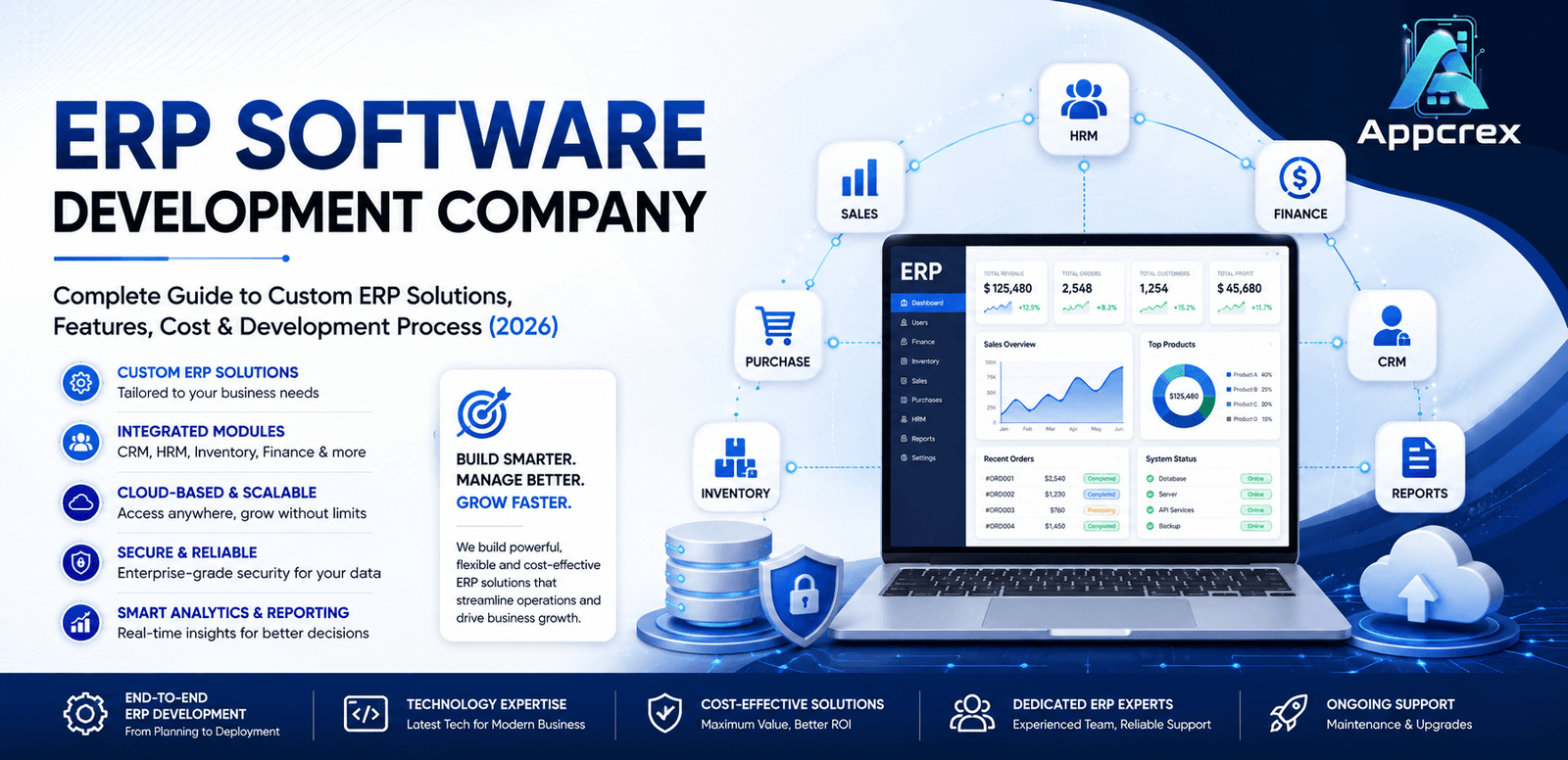
A successful ERP system combines multiple business functions into one centralized platform. The modules included in an ERP solution depend on business requirements, industry type, and operational complexity.
A professional ERP Software Development Company develops customized modules that help businesses automate processes and improve efficiency.
Essential Modules of ERP Software
Financial Management Module
The finance module is one of the most important components of ERP software. It helps businesses manage financial operations accurately and efficiently.
Key features include:
- Accounting management
- Expense tracking
- Invoice generation
- Tax management
- Budget planning
- Cash flow monitoring
- Financial reporting
- Payment tracking
With real-time financial insights, businesses can monitor their performance and make better financial decisions.
Human Resource Management (HRM) Module
Managing employees manually becomes difficult as organizations grow. ERP-based HR management simplifies employee-related processes.
Important features include:
- Employee database
- Payroll management
- Attendance tracking
- Leave management
- Recruitment management
- Performance evaluation
- Employee onboarding
- Training management
HR automation reduces administrative workload and improves employee management.
Also Read : HR Management Software Development: Complete Guide to Features, Cost, Benefits & Development Process (2026)
Customer Relationship Management (CRM) Module
An integrated CRM module helps businesses manage customer interactions and improve relationships.
Features include:
- Customer profiles
- Lead management
- Sales tracking
- Customer communication history
- Support requests
- Marketing automation
- Customer analytics
CRM integration allows sales teams to understand customer needs and improve conversions.
Inventory Management Module
Inventory management is essential for businesses dealing with products and supply chains.
ERP inventory modules provide:
- Real-time stock tracking
- Warehouse management
- Product management
- Barcode integration
- Stock alerts
- Inventory forecasting
- Purchase tracking
This helps businesses avoid stock shortages and reduce unnecessary inventory costs.
Supply Chain Management Module
Supply chain operations involve multiple activities, including suppliers, warehouses, logistics, and delivery.
ERP supply chain solutions help manage:
- Supplier information
- Procurement processes
- Logistics tracking
- Order management
- Demand forecasting
- Warehouse operations
Businesses can improve supply chain visibility and reduce operational delays.
Sales and Order Management Module
The sales module manages the complete customer order lifecycle.
It includes:
- Product catalog management
- Sales quotations
- Order processing
- Invoice creation
- Payment tracking
- Sales reports
This allows businesses to manage sales operations more efficiently.
Manufacturing ERP Module
Manufacturing companies require specialized ERP features to manage production activities.
Important capabilities include:
- Production planning
- Material requirement planning
- Bill of Materials (BOM)
- Quality control
- Work order management
- Machine tracking
- Production analytics
Manufacturing ERP improves production efficiency and reduces waste.
Reporting and Analytics Module
Data-driven decision-making is essential for modern businesses.
ERP analytics provides:
- Real-time dashboards
- Business reports
- Performance tracking
- Sales analysis
- Financial insights
- Operational reports
Managers can identify problems quickly and take strategic actions.
Benefits of ERP Software Development
Improved Business Efficiency
ERP software connects all departments and removes disconnected workflows.
Employees can access required information quickly without depending on multiple systems.
This improves:
- Communication
- Productivity
- Process accuracy
- Operational speed
Better Collaboration Between Departments
When different departments use separate systems, information sharing becomes difficult.
ERP creates a centralized environment where teams can work together using the same data.
For example:
- Sales can view inventory availability.
- Finance can track payments.
- Management can monitor performance.
Real-Time Data Access
One of the biggest advantages of ERP software is real-time information availability.
Businesses can instantly access:
- Sales reports
- Financial information
- Inventory status
- Customer data
- Employee records
This improves decision-making and business planning.
Reduced Operational Costs
ERP automation reduces expenses by minimizing:
- Manual work
- Data duplication
- Process delays
- Human errors
Businesses can achieve better resource utilization and improved profitability.
Enhanced Customer Experience
ERP systems help businesses provide better customer service by giving employees access to complete customer information.
Teams can quickly check:
- Order status
- Purchase history
- Customer requests
- Payment details
This improves response time and customer satisfaction.
Industries Using ERP Software
ERP solutions are used by organizations across multiple industries.
Manufacturing
Manufacturers use ERP systems for:
- Production planning
- Inventory management
- Supply chain control
- Quality management
- Equipment monitoring
Healthcare
Healthcare organizations use ERP software for:
- Hospital administration
- Inventory management
- Billing
- Staff management
- Procurement
Retail and E-commerce
Retail companies use ERP solutions for:
- Product management
- Inventory tracking
- Customer management
- Sales analytics
- Order processing
Logistics and Transportation
ERP helps logistics companies manage:
- Fleet operations
- Shipment tracking
- Warehouse management
- Delivery processes
Education
Educational institutions use ERP platforms for:
- Student management
- Fee management
- Faculty management
- Attendance tracking
- Reporting
Real Estate
Real estate companies use ERP solutions for:
- Property management
- Customer management
- Sales tracking
- Financial reporting
ERP Software Development Process
Building a successful ERP solution requires proper planning and a structured development approach.
Requirement Analysis
The first step is understanding business requirements.
The development team analyzes:
- Current processes
- Business challenges
- Required modules
- User roles
- Integration requirements
This helps create a clear development roadmap.
ERP Planning and Architecture
Developers create the technical structure of the ERP system.
This includes:
- Database architecture
- Module planning
- Security framework
- API structure
- Cloud strategy
A strong architecture ensures better scalability and performance.
UI/UX Design
ERP software must be easy for employees to use.
Design teams focus on:
- Simple navigation
- Interactive dashboards
- Responsive design
- User-friendly workflows
A better user experience improves ERP adoption.
Development Phase
During development, programmers build ERP modules according to business needs.
Development includes:
- Backend development
- Frontend development
- Database creation
- API integration
- Security implementation
Testing
Before deployment, ERP software goes through multiple testing stages:
- Functional testing
- Performance testing
- Security testing
- Integration testing
- User acceptance testing
Testing ensures the system works reliably.
Deployment and Maintenance
After successful testing, the ERP system is deployed.
Post-launch services include:
- Technical support
- Updates
- Performance optimization
- Security improvements
- Feature enhancements
Technology Stack for ERP Software Development
Choosing the right technology stack is important for building a secure, scalable, and high-performance ERP system. A professional ERP Software Development Company selects technologies based on business requirements, expected users, integrations, and future growth plans.
Frontend Technologies
The frontend creates the user interface that employees interact with daily.
Popular technologies include:
React.js
React helps build fast and interactive ERP dashboards with reusable components.
Benefits:
- High performance
- Responsive interfaces
- Easy maintenance
- Rich user experience
Angular
Angular is widely used for large enterprise applications because of its structured architecture.
It supports:
- Complex dashboards
- Enterprise-level applications
- Scalable development
Vue.js
Vue.js is a lightweight framework suitable for creating modern ERP interfaces.
Benefits include:
- Faster development
- Simple integration
- Flexible design
Also Read : React Native App Development Company: Complete Guide to Cross-Platform App Development (2026)
Backend Technologies
The backend manages business logic, security, data processing, and integrations.
Common backend technologies include:
Node.js
Node.js is popular for building scalable ERP applications with real-time capabilities.
It supports:
- API development
- Real-time communication
- High performance
Python
Python frameworks such as Django and FastAPI are commonly used for ERP development.
Benefits:
- Faster development
- AI integration support
- Strong security features
Java
Java is widely used for enterprise ERP solutions because of its stability and scalability.
It is suitable for:
- Large organizations
- Complex business systems
- High-volume applications
.NET
Microsoft .NET is commonly used for enterprise software development.
Advantages:
- Strong security
- High performance
- Enterprise support
Database Technologies
ERP systems manage large amounts of business data, so selecting the right database is essential.
Popular options include:
PostgreSQL
Used for complex business applications requiring reliability and scalability.
MySQL
A popular database choice for cost-effective ERP solutions.
Microsoft SQL Server
Commonly used by large enterprises.
MongoDB
Useful for flexible data structures and modern applications.
Cloud Platforms for ERP Development
Cloud technology has become a major part of modern ERP solutions.
Popular cloud platforms include:
Amazon Web Services (AWS)
AWS provides:
- Scalable infrastructure
- Data security
- Backup solutions
- High availability
Microsoft Azure
Azure is widely used by enterprises because of its integration with Microsoft business tools.
Google Cloud Platform (GCP)
GCP provides:
- Advanced analytics
- Machine learning capabilities
- Cloud infrastructure
Also Read : Flutter App Development Company: Complete Guide to Cross-Platform App Development (2026)
ERP Integration Technologies
Modern businesses require ERP systems to connect with other platforms.
Common integrations include:
- REST APIs
- GraphQL APIs
- Webhooks
- Third-party SDKs
- Cloud services
These integrations help ERP software communicate with external applications.
ERP Software Development Cost in 2026
The cost of developing a custom ERP solution depends on several factors.
There is no fixed price because every business requires different features and customization levels.
Factors Affecting ERP Development Cost
Number of Modules
A basic ERP system with limited modules costs less compared to a complete enterprise ERP platform.
Common modules include:
- Finance
- HR
- CRM
- Inventory
- Manufacturing
- Analytics
Customization Requirements
The more customized features required, the higher the development cost.
Examples:
- Custom workflows
- Industry-specific features
- Advanced dashboards
- AI automation
- Custom reporting
Integration Requirements
ERP integration affects both development time and cost.
Common integrations include:
- Payment gateways
- Banking APIs
- CRM systems
- Accounting platforms
- eCommerce platforms
- HR systems
Deployment Model
The deployment method also impacts cost.
Cloud ERP:
- Lower infrastructure investment
- Easier maintenance
- Flexible scaling
On-Premise ERP:
- Higher setup cost
- Complete infrastructure control
Security Requirements
Enterprise ERP systems require strong security features.
Additional requirements may include:
- Data encryption
- Access management
- Compliance features
- Security monitoring
Estimated ERP Development Cost
| ERP Type | Estimated Cost |
|---|---|
| Small Business ERP | $15,000 – $40,000 |
| Medium Business ERP | $40,000 – $100,000 |
| Enterprise ERP Solution | $100,000 – $250,000+ |
The final cost depends on business requirements, features, integrations, and technology choices.
AI-Powered ERP Solutions: The Future of Enterprise Software
Artificial Intelligence is transforming traditional ERP systems into intelligent business platforms.
Modern organizations are adopting AI ERP solutions to automate processes, improve forecasting, and generate valuable insights.
AI Business Analytics
AI analyzes business data and identifies important patterns.
Businesses can use AI analytics for:
- Sales forecasting
- Customer behavior analysis
- Revenue prediction
- Performance monitoring
AI ERP Assistants
AI assistants allow employees to interact with ERP systems using natural language.
Users can ask:
- “Show monthly sales performance.”
- “Which products need restocking?”
- “Generate financial reports.”
The AI assistant provides instant insights.
Predictive Analytics
AI-powered ERP can predict future business requirements.
Examples:
- Inventory demand forecasting
- Sales prediction
- Resource planning
- Risk analysis
This helps businesses prepare better strategies.
Intelligent Automation
AI automates repetitive processes such as:
- Invoice processing
- Document verification
- Report generation
- Data entry
- Approval workflows
This improves efficiency and reduces manual effort.
Future Trends in ERP Software Development (2026)
Generative AI Integration
Generative AI will become a standard feature in ERP systems.
Businesses will use AI for:
- Automated reports
- Business summaries
- Data analysis
- Intelligent recommendations
Agentic AI in ERP
AI agents will perform complex business tasks automatically.
Examples:
- Managing inventory alerts
- Processing invoices
- Creating reports
- Optimizing workflows
Mobile ERP Applications
Mobile ERP allows employees and managers to access business information from anywhere.
Features include:
- Real-time notifications
- Remote approvals
- Sales tracking
- Performance monitoring
IoT Integration
IoT-connected ERP systems will help industries monitor real-time operations.
Manufacturing and logistics companies can use IoT for:
- Equipment monitoring
- Predictive maintenance
- Smart inventory tracking
Why Choose AppCrex as Your ERP Software Development Company?
AppCrex helps businesses build customized ERP solutions designed according to their operational requirements.
Our ERP development services include:
- Custom ERP Software Development
- Cloud ERP Development
- ERP Integration Services
- AI-Powered ERP Solutions
- Enterprise Software Development
- ERP Migration and Modernization
- ERP Maintenance and Support
We focus on creating secure, scalable, and intelligent ERP platforms that help businesses automate operations and achieve digital transformation.
(FAQs)
What does an ERP Software Development Company do?
An ERP Software Development Company designs, develops, integrates, and maintains customized ERP solutions according to business requirements.
How much does custom ERP software development cost?
Custom ERP development can cost between $15,000 and $250,000+, depending on features, complexity, integrations, and customization.
How long does it take to build an ERP system?
A small ERP system may take 2–4 months, while a complex enterprise ERP platform may require 6–12 months or more.
What industries use ERP software?
ERP solutions are used in:
- Manufacturing
- Healthcare
- Retail
- Logistics
- Education
- Finance
- Real Estate
- Construction
Can ERP software integrate with existing systems?
Yes. ERP systems can integrate with CRM, payment gateways, accounting tools, APIs, eCommerce platforms, and other enterprise applications.
Why is AI important in ERP software?
AI improves ERP systems through automation, predictive analytics, intelligent reporting, and better business decision-making.
Conclusion
ERP software has become a critical solution for businesses that want to improve efficiency, automate operations, and manage their growing business needs through a single platform.
A customized ERP solution provides better flexibility, scalability, security, and integration capabilities compared to traditional software systems.
With advancements in AI, cloud computing, and automation, ERP platforms are becoming smarter and more powerful, helping organizations improve productivity and make data-driven decisions.
Choosing an experienced ERP Software Development Company like AppCrex allows businesses to build future-ready ERP solutions that support long-term growth and digital transformation.