
📌 Key Takeaways
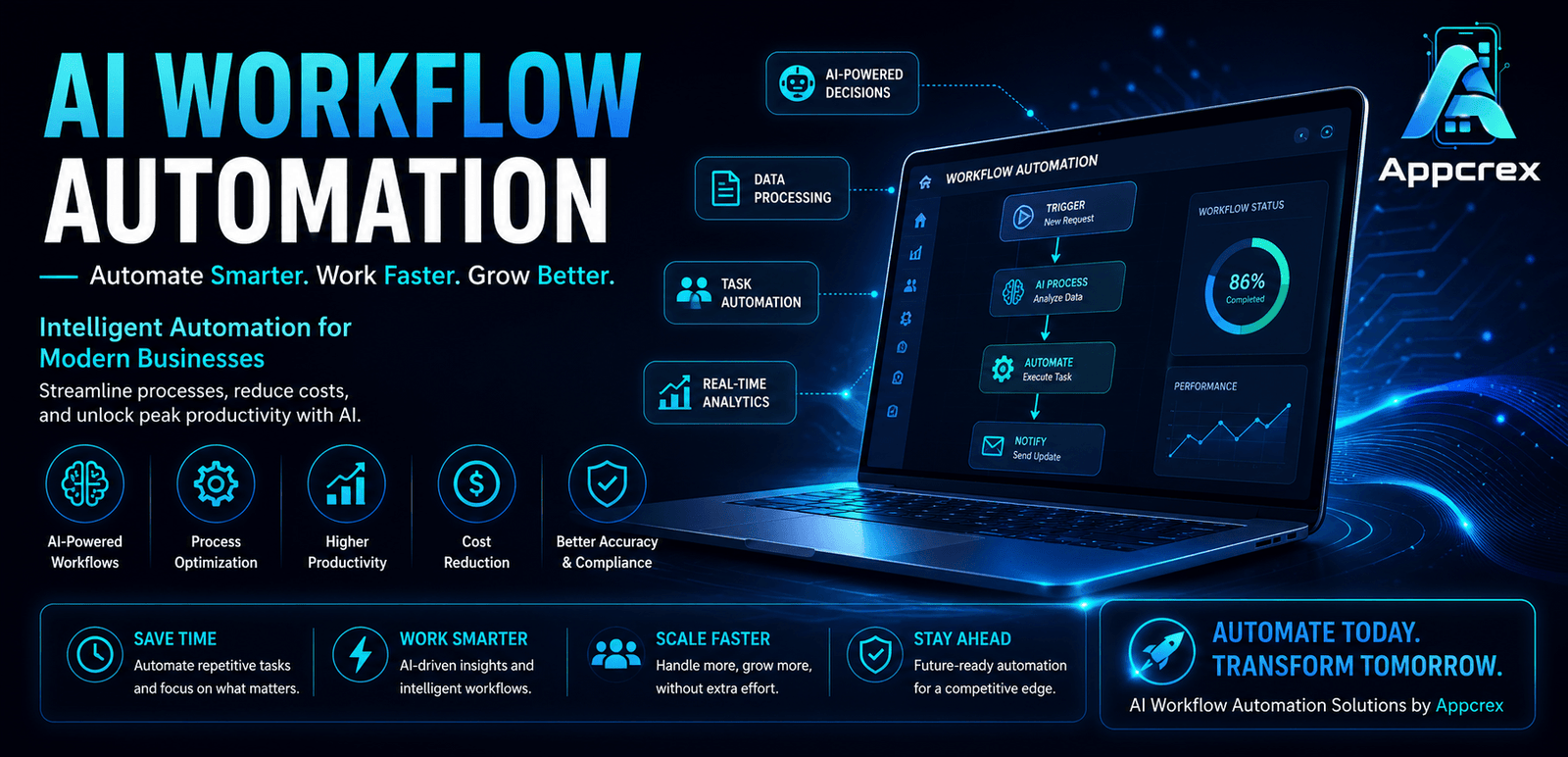
- AI workflow automation eliminates repetitive tasks and improves operational efficiency.
- Businesses can reduce costs and increase productivity through intelligent automation.
- AI-powered workflows improve accuracy, speed, and decision-making.
- Industries like healthcare, finance, retail, and logistics are rapidly adopting AI automation.
- A strategic AI workflow automation solution helps businesses scale faster and stay competitive.
Introduction
Businesses today operate in an increasingly competitive and fast-paced digital environment. Organizations are constantly searching for ways to improve productivity, reduce operational costs, and deliver better customer experiences. However, many companies still rely on manual processes that consume valuable time and resources.
Tasks such as data entry, invoice processing, customer support, employee onboarding, document management, reporting, and approvals often require significant human effort. These repetitive activities can slow down operations, increase costs, and lead to costly errors.
This is where AI Workflow Automation is transforming modern businesses.
Artificial Intelligence is no longer limited to chatbots or virtual assistants. Today, AI can automate entire business workflows, streamline decision-making, optimize processes, and enable organizations to operate more efficiently than ever before.
At AppCrex, we help businesses leverage AI Workflow Automation solutions that eliminate inefficiencies, improve accuracy, and accelerate digital transformation initiatives.
In this comprehensive guide, we’ll explore everything you need to know about AI Workflow Automation in 2026, including benefits, use cases, implementation strategies, technologies, costs, challenges, and future trends.
What is AI Workflow Automation?
AI Workflow Automation refers to the use of Artificial Intelligence technologies to automate business processes, tasks, and workflows with minimal human intervention.
Unlike traditional automation, which follows predefined rules, AI-powered automation can learn, adapt, analyze data, and make intelligent decisions based on real-time information.
AI Workflow Automation combines technologies such as:
- Artificial Intelligence (AI)
- Machine Learning (ML)
- Natural Language Processing (NLP)
- Robotic Process Automation (RPA)
- Predictive Analytics
- Generative AI
- Intelligent Document Processing
These technologies work together to automate complex workflows and improve operational efficiency.
Why AI Workflow Automation Matters in 2026
Digital transformation has become a top priority for organizations worldwide. Businesses are handling larger volumes of data, managing distributed teams, and serving customers across multiple channels.
Traditional workflows often struggle to keep up with these demands.
AI Workflow Automation helps organizations:
- Improve Efficiency
- Reduce Costs
- Increase Accuracy
- Enhance Customer Experiences
- Accelerate Decision-Making
- Scale Operations
As AI technologies continue to evolve, businesses that embrace workflow automation will gain a significant competitive advantage.
How AI Workflow Automation Works
AI workflow automation follows a structured process.
Step 1: Data Collection
AI systems gather information from:
- Emails
- Documents
- Databases
- CRM Systems
- ERP Platforms
- Customer Interactions
Step 2: Data Analysis
AI analyzes collected data to identify patterns and trends.
Step 3: Decision-Making
Machine learning models evaluate information and determine appropriate actions.
Step 4: Task Execution
The system automatically performs tasks such as:
- Sending Notifications
- Approving Requests
- Updating Records
- Assigning Tasks
Step 5: Continuous Learning
AI continuously improves performance based on outcomes and new data.
Benefits of AI Workflow Automation
Increased Productivity
Employees spend less time on repetitive tasks and more time on strategic work.
Benefits include:
- Faster Processes
- Improved Efficiency
- Better Resource Allocation
Reduced Operational Costs
Automation significantly reduces labor-intensive activities.
Businesses save money through:
- Lower Administrative Costs
- Reduced Errors
- Improved Resource Utilization
Improved Accuracy
AI minimizes human errors by following consistent processes.
Examples include:
- Data Processing
- Financial Reporting
- Compliance Checks
Faster Decision-Making
AI analyzes data in real time and provides actionable insights.
Better Customer Experience
Automated workflows improve response times and service quality.
Scalability
Organizations can handle increased workloads without proportionally increasing staffing levels.
Key Components of AI Workflow Automation
Artificial Intelligence
Provides intelligent decision-making capabilities.
Machine Learning
Allows systems to learn and improve over time.
Robotic Process Automation (RPA)
Automates repetitive rule-based tasks.
Natural Language Processing (NLP)
Enables systems to understand human language.
Predictive Analytics
Forecasts future outcomes based on historical data.
Generative AI
Creates content, reports, responses, and summaries automatically.
Also Read : React Native vs Flutter: Which Framework Should You Choose for Mobile App Development in 2026?
Common AI Workflow Automation Use Cases
Customer Support Automation
AI can automate:
- Customer Inquiries
- Ticket Routing
- Chat Support
- FAQ Responses
Benefits:
- Faster Support
- Reduced Costs
- Improved Satisfaction
Sales Automation
AI helps sales teams by:
- Qualifying Leads
- Scheduling Meetings
- Managing Follow-Ups
- Generating Sales Reports
HR Workflow Automation
Human resource departments automate:
- Employee Onboarding
- Leave Management
- Recruitment Processes
- Performance Reviews
Finance Automation
Financial organizations use AI for:
- Invoice Processing
- Expense Management
- Fraud Detection
- Financial Reporting
Marketing Automation
AI supports:
- Campaign Management
- Content Personalization
- Lead Nurturing
- Customer Segmentation
Healthcare Workflow Automation
Healthcare providers automate:
- Appointment Scheduling
- Patient Records Management
- Claims Processing
- Telemedicine Workflows
Supply Chain Automation
Businesses optimize:
- Inventory Management
- Procurement
- Shipment Tracking
- Demand Forecasting
Industry Applications of AI Workflow Automation
Healthcare
AI automates clinical and administrative processes while improving patient outcomes.
Retail & eCommerce
Retailers streamline operations through inventory management, customer support, and personalized recommendations.
Finance & Banking
Financial institutions improve security, compliance, and customer service through intelligent automation.
Manufacturing
Manufacturers optimize production, quality control, and maintenance schedules.
Logistics
AI improves route optimization, warehouse operations, and fleet management.
Education
Educational institutions automate admissions, learning management, and student support.
AI Workflow Automation Technologies
OpenAI
Popular for:
- ChatGPT Integration
- Content Generation
- Customer Support Automation
Microsoft Azure AI
Provides enterprise-grade AI services and workflow automation capabilities.
Google AI
Supports NLP, machine learning, and data analysis.
AWS AI Services
Offers scalable AI infrastructure and automation tools.
UiPath
Leading Robotic Process Automation platform.
Automation Anywhere
Enterprise workflow automation solution.
LangChain
Popular framework for AI-powered workflow development.
Also Read : AI Integration Services: Complete Guide to Benefits, Use Cases, Cost & Implementation (2026)
AI Workflow Automation Implementation Process
Step 1: Process Assessment
Identify repetitive and time-consuming workflows.
Questions to consider:
- Which tasks consume the most time?
- Where do bottlenecks occur?
- Which processes have high error rates?
Step 2: Define Business Objectives
Establish measurable goals such as:
- Cost Reduction
- Faster Processing
- Improved Customer Satisfaction
Step 3: Choose AI Technologies
Select appropriate solutions based on business needs.
Step 4: Design Workflow Architecture
Create scalable and secure workflow structures.
Step 5: Development & Integration
Integrate AI solutions into existing systems.
Step 6: Testing
Perform:
- Functional Testing
- Security Testing
- Performance Testing
- User Acceptance Testing
Step 7: Deployment
Launch workflows into production environments.
Step 8: Optimization
Continuously improve workflows using AI analytics and performance monitoring.
Challenges of AI Workflow Automation
Data Quality Issues
Poor data can reduce AI effectiveness.
Integration Complexity
Legacy systems often require additional development effort.
Security Concerns
Organizations must protect sensitive business information.
Compliance Requirements
Industries such as healthcare and finance face strict regulations.
Change Management
Employees may require training and support during adoption.
Cost of AI Workflow Automation
The cost depends on workflow complexity, integrations, AI models, and customization requirements.
| Solution Type | Estimated Cost |
|---|---|
| Basic Workflow Automation | $10,000 – $25,000 |
| Department-Level Automation | $25,000 – $75,000 |
| Enterprise AI Automation | $75,000 – $250,000+ |
| Advanced AI-Powered Automation Platform | $250,000 – $1M+ |
Factors Affecting Cost
- Number of Workflows
- AI Complexity
- Integrations
- Data Volume
- Cloud Infrastructure
- Security Requirements
- Compliance Standards
Future Trends in AI Workflow Automation
AI Agents
Autonomous systems capable of executing complete workflows independently.
Hyperautomation
Combining AI, RPA, and analytics to automate end-to-end business processes.
Generative AI Automation
AI-generated reports, content, documentation, and communications.
Predictive Workflows
AI proactively identifies issues before they occur.
Intelligent Decision-Making
AI systems increasingly support executive-level business decisions.
Industry-Specific Automation
Tailored AI workflow solutions for healthcare, finance, logistics, and retail.
Also Read : AI Chatbot Development Company: Complete Guide to Features, Benefits, Cost & Trends (2026)
Why Choose AppCrex for AI Workflow Automation?
AppCrex helps businesses design, develop, and implement intelligent workflow automation solutions that improve efficiency and accelerate growth.
Our AI Workflow Automation Services Include
- Business Process Automation
- AI Integration Services
- Generative AI Solutions
- AI Agent Development
- Intelligent Document Processing
- Workflow Optimization
- Custom Automation Platforms
- Enterprise AI Consulting
- Cloud Automation Solutions
- Ongoing Support & Maintenance
Why Businesses Choose AppCrex
- Experienced AI Engineers
- Custom Automation Solutions
- Scalable Architecture
- Enterprise Security
- Agile Development Process
- Industry Expertise
- End-to-End Project Delivery
We help organizations automate complex workflows, improve productivity, and unlock new opportunities through AI-powered innovation.
Frequently Asked Questions
What is AI Workflow Automation?
AI Workflow Automation uses Artificial Intelligence technologies to automate business processes, tasks, and decision-making workflows.
How does AI Workflow Automation differ from traditional automation?
Traditional automation follows predefined rules, while AI automation can learn, adapt, and make intelligent decisions based on data.
Which industries benefit from AI Workflow Automation?
Healthcare, finance, retail, logistics, manufacturing, education, and many other industries use AI automation to improve efficiency.
How much does AI Workflow Automation cost?
Projects typically range from $10,000 to over $1 million depending on complexity and business requirements.
Can AI Workflow Automation integrate with existing software?
Yes. AI solutions can integrate with CRM systems, ERP platforms, cloud applications, databases, and enterprise software.
How long does implementation take?
Simple workflow automation projects may take a few weeks, while enterprise-scale implementations can take several months.
Final Thoughts
AI Workflow Automation is rapidly becoming one of the most valuable investments businesses can make in 2026. By automating repetitive tasks, improving decision-making, reducing costs, and increasing productivity, AI enables organizations to operate smarter and scale faster.
Whether you’re looking to automate customer service, finance, HR, healthcare operations, or enterprise workflows, adopting AI-powered automation can unlock significant business value.
At AppCrex, we help businesses transform operations through intelligent automation solutions tailored to their unique needs. From strategy and development to implementation and ongoing optimization, our team delivers scalable AI workflow solutions that drive measurable results.
Ready to automate your business with AI? Contact AppCrex today and discover how AI Workflow Automation can improve efficiency, reduce costs, and accelerate growth in 2026 and beyond.