📌 Key Takeaways
- RAG connects LLMs with business knowledge. It enables AI applications to retrieve relevant information from approved documents and databases before generating answers.
- Use cases should drive architecture. Customer support, enterprise search, document analysis, and internal knowledge assistants have different data and performance requirements.
- Data quality influences results. Clean documents, effective retrieval, source citations, and regular evaluation are essential for reliable answers.
- RAG costs depend on scope. Integrations, security, data preparation, hosting, and ongoing model usage all affect the total investment.
- Security must be built in. Australian businesses should evaluate privacy obligations, access controls, data handling, and human oversight before deployment.
Introduction
Australian businesses are increasingly exploring generative AI to improve customer service, automate internal workflows, and make better use of their business data. However, traditional large language models (LLMs) can struggle when they need accurate answers from private company documents, updated information, or industry-specific knowledge. This is where Retrieval-Augmented Generation (RAG) becomes valuable.
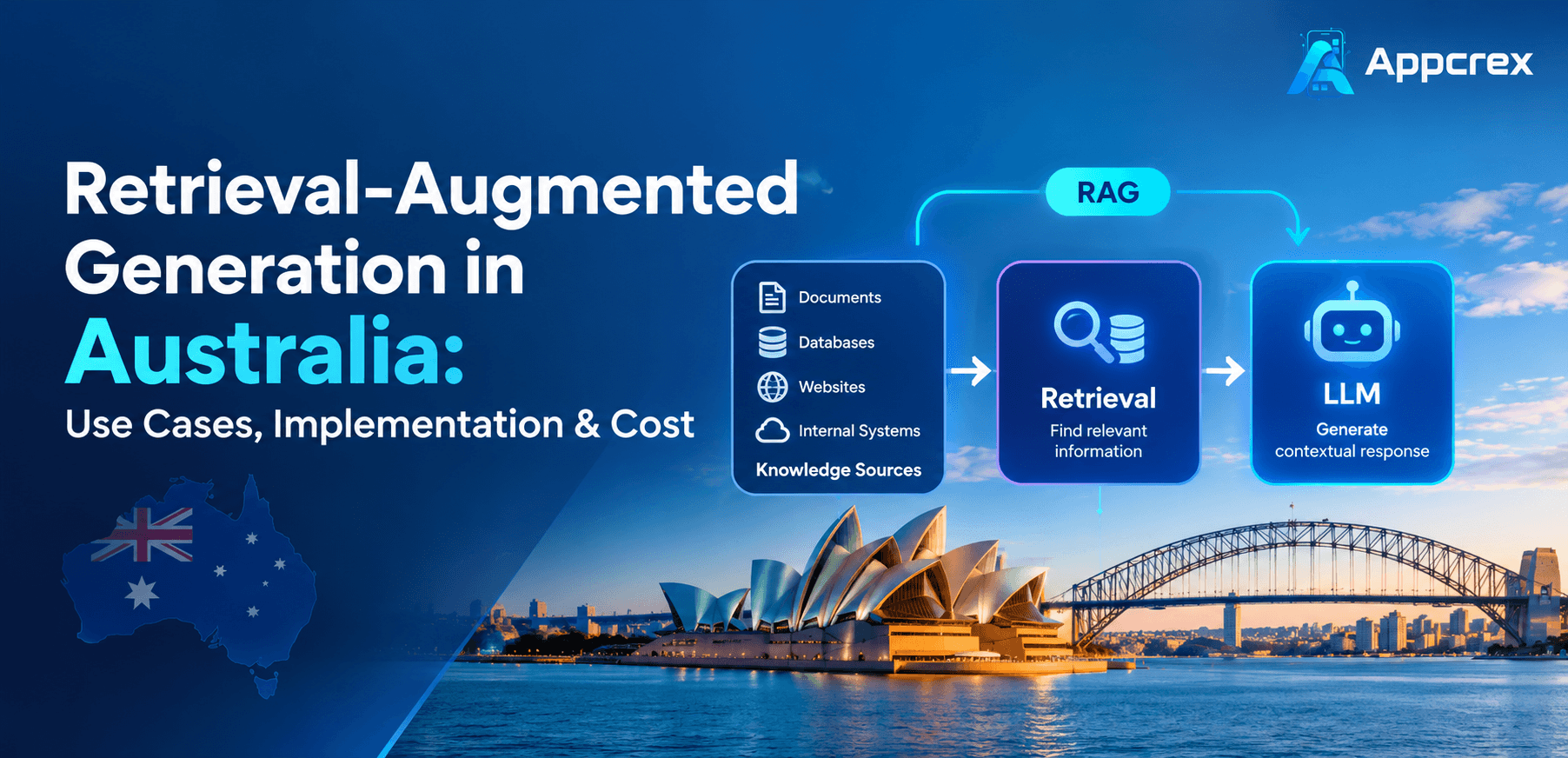
Retrieval-Augmented Generation combines information retrieval with generative AI. Instead of relying only on the information learned during model training, a RAG system retrieves relevant information from approved data sources and uses it to generate a contextual response.
For businesses in Australia, this approach can support AI-powered customer service, enterprise search, document analysis, employee knowledge assistants, and industry-specific applications. It can also help organisations build AI solutions around their own data without necessarily training a large language model from scratch.
With the right architecture, a RAG solution can improve answer relevance, provide references to source documents, and make business knowledge easier to access. However, results depend on data quality, retrieval design, security controls, and ongoing evaluation.
This guide explains how Retrieval-Augmented Generation works in Australia, where businesses can use it, how implementation works, what affects development costs, and how to evaluate a RAG development partner.
What Is Retrieval-Augmented Generation (RAG)?
Retrieval-Augmented Generation (RAG) is an AI architecture that connects a large language model with an external knowledge source. Before generating an answer, the system searches for relevant information and provides the retrieved content to the model as context.
This allows an AI application to answer questions using information such as company policies, product catalogues, technical manuals, internal reports, customer support documentation, and approved databases.
For example, an Australian insurance company could use a RAG-powered assistant to answer employee questions about policy documents. Instead of asking the AI model to rely on general knowledge, the system retrieves the relevant sections from the company’s approved documentation before generating a response.
A typical RAG system includes:
-
Knowledge sources: Documents, databases, websites, FAQs, and other approved information.
-
Retrieval system: Searches the knowledge base for relevant information.
-
Large language model: Uses retrieved information to generate a natural-language answer.
-
Security and access controls: Ensure users only retrieve information they are authorised to access.
-
Evaluation and monitoring: Measure answer quality, relevance, reliability, and system performance.
RAG is useful when an organisation needs an AI application to work with changing or specialised information. It can reduce dependence on model training for every knowledge update, although it does not automatically eliminate hallucinations or guarantee that every answer is correct.
How Does RAG Work with Large Language Models?
A RAG system connects a company’s knowledge sources with an LLM through a retrieval pipeline. When a user asks a question, the system searches for relevant information, selects useful passages, and supplies them to the model as context.
For example, a Melbourne-based software company could build an internal AI assistant that answers questions about product specifications, onboarding procedures, support policies, and technical documentation.
1. Business Knowledge Sources
PDFs, databases, websites, manuals and internal documents
2. Data Processing and Embeddings
Clean, split, organise and index information
3. Retrieval and Ranking
Find and rank relevant information for the user’s query
4. LLM Response Generation
Generate a contextual answer using retrieved evidence
5. Answer with Sources
Return an answer, relevant citations and appropriate limitations
Step 1: Collect and prepare business data
The first step is to identify which information the AI application needs. This may include company documents, product information, support tickets, knowledge bases, or selected business databases.
The data must be cleaned and organised before indexing. Duplicate files, outdated policies, inconsistent formatting, and irrelevant information can reduce retrieval quality.
Step 2: Create embeddings and index the information
Documents are divided into manageable sections, often called chunks. An embedding model converts text into numerical representations that help the system identify semantically related content.
These representations are stored in a vector database or another suitable search index. The right chunk size and indexing strategy depend on the content and the questions users are expected to ask.
Step 3: Retrieve relevant information
When a user submits a question, the system searches the indexed content and ranks the most relevant results.
A RAG development team may use vector search, keyword search, metadata filtering, or hybrid search. For enterprise systems, retrieval should also respect document permissions and user access rights.
Step 4: Generate a contextual response
The retrieved passages are included in the LLM prompt. The model then generates an answer based on the supplied evidence and the application’s instructions.
Developers can add safeguards to reduce unsupported claims, instruct the model to acknowledge missing information, and require source references where appropriate.
Step 5: Evaluate and improve the system
A RAG system needs ongoing evaluation. Teams should test whether it retrieves the correct documents, answers questions accurately, respects access controls, and performs well under real-world workloads.
Monitoring user feedback, retrieval failures, response latency, and model usage helps improve the system after deployment.
RAG vs. Traditional LLMs vs. Fine-Tuning
Australian businesses considering generative AI should understand the differences between retrieval-augmented generation, standalone LLMs, and fine-tuning.
| Factor | Traditional LLM | RAG | Fine-tuning |
|---|---|---|---|
| Main purpose | General language tasks | Answers grounded in external information | Adapts model behaviour or task performance |
| Uses private business knowledge | Only when supplied through context or integrations | Retrieves information from connected knowledge sources | May learn patterns from training examples, but is not a reliable live knowledge store |
| Updating knowledge | Requires updated context or connected sources | Update or re-index the knowledge base | Usually requires another fine-tuning process for learned changes |
| Source citations | Must be implemented separately | Can provide references to retrieved sources | Not inherently provided |
| Best suited for | General assistants and language tasks | Knowledge assistants, document search and enterprise Q&A | Consistent formats, specialised task behaviour and domain adaptation |
When should a business choose RAG?
RAG is a strong option when the application needs to answer questions about changing company information, retrieve evidence from documents, or work with a knowledge base that can be updated independently of the model.
Fine-tuning may be useful when a model needs to follow a specialised output format, adopt consistent domain-specific behaviour, or perform a task more effectively. It does not automatically give a model reliable access to current private information.
In some projects, businesses may benefit from combining RAG with fine-tuning or other AI techniques. The choice should depend on the business problem, data requirements, evaluation results, and total cost of ownership rather than the popularity of a particular technology.
Why Are Australian Businesses Exploring RAG Solutions?
Organisations across Australia manage large amounts of information in documents, business applications, customer service platforms, and operational databases. Finding the right information quickly can be difficult, particularly when different departments use separate systems.
RAG offers a way to make this information accessible through natural-language questions while retaining the underlying knowledge sources.
1. Better access to internal knowledge
Employees often spend time searching through policies, manuals, reports, and shared folders. An AI-powered knowledge assistant can retrieve relevant passages and summarise them in a conversational format.
For businesses with distributed teams in Sydney, Melbourne, Brisbane, Perth, and other Australian locations, this can make internal information easier to access.
2. More useful customer support
A RAG-powered chatbot can retrieve answers from approved product documentation, troubleshooting guides, service terms, and frequently asked questions.
It can support customer service teams by handling routine enquiries and preparing answers for human agents. Complex complaints, sensitive cases, and decisions requiring judgement should still be escalated appropriately.
3. Faster document analysis
Businesses may need to review contracts, technical specifications, product documents, compliance policies, or operational reports. RAG applications can help employees locate relevant sections and summarise key information.
The system should provide traceable sources and preserve human review for important legal, financial, and operational decisions.
4. More practical use of enterprise data
Many businesses want to adopt generative AI but cannot rely on a public chatbot to answer questions about their own operations.
Enterprise RAG solutions can connect approved knowledge sources with an LLM, allowing businesses to build AI experiences around their internal information without automatically retraining the foundation model whenever a document changes.
5. A more manageable approach to AI knowledge updates
Traditional model training is not always the right way to introduce new business facts. With RAG, organisations can update source documents and re-index the relevant information.
However, changes are not necessarily available instantly. The indexing pipeline, caching, permissions, and data refresh schedule must be designed to keep retrieved information current.
RAG Use Cases Across Australian Industries
The value of RAG depends on the industry, the quality of available data, and the workflow the business wants to improve. Below are practical use cases for Australian organisations.
Healthcare and health technology
Healthcare organisations may use RAG to search approved clinical guidelines, internal procedures, administrative policies, and operational documentation.
Potential applications include:
-
Internal knowledge assistants for approved clinical and administrative resources.
-
Search tools for healthcare policies and standard operating procedures.
-
Document retrieval for medical administration and staff training.
-
Patient information assistants using reviewed, authorised content.
Healthcare implementations require particular care around sensitive personal information, clinical accuracy, access control, and professional oversight. A RAG chatbot should not be treated as a substitute for qualified clinical judgement.
Financial services and insurance
Banks, fintech businesses, lenders, and insurers can explore RAG for information-heavy workflows.
Examples include:
-
Retrieving information from product terms and approved policy documents.
-
Supporting staff with internal compliance and procedure searches.
-
Helping insurance teams locate relevant sections in claims documentation.
-
Assisting customers with questions about published product information.
Financial organisations should carefully control access to customer data and ensure that generated responses do not make unsupported financial or eligibility decisions.
Retail and eCommerce
Retailers can use RAG to connect product catalogues, specifications, return policies, delivery information, and customer support documentation.
For example, an Australian online retailer could offer an AI shopping assistant that answers questions about product compatibility, materials, warranty conditions, and delivery policies.
Useful applications include product discovery, customer support, internal product knowledge, and assistance for sales teams.
Education and training
Educational institutions and training providers can use RAG to make approved course material, institutional policies, learning resources, and administrative information easier to search.
Possible solutions include student support assistants, staff knowledge portals, course-content search, and training assistants.
Access restrictions must ensure that users only see the material they are entitled to access.
Manufacturing, mining, and engineering
Australian manufacturers, mining operators, and engineering businesses often maintain technical manuals, safety procedures, maintenance records, and equipment documentation.
RAG can help authorised employees find the relevant instructions, locate troubleshooting guidance, and retrieve information from approved technical sources.
For safety-critical operations, the system should clearly cite authoritative documents, display document versions, and avoid replacing established safety procedures or expert approval.
Legal and professional services
Law firms, accounting practices, consultancies, and other professional service providers can use RAG to search internal knowledge repositories and approved client documents.
Potential applications include precedent search, policy retrieval, contract research assistance, and internal knowledge management.
Client confidentiality, document-level permissions, source verification, and professional review are essential.
Government and public services
Public-sector organisations can explore RAG for internal policy search, staff assistance, public information services, and document discovery.
Implementations should account for records management, privacy, accessibility, security, and the requirements applicable to the specific organisation. Public-facing answers should be grounded in current, approved information.
RAG Architecture: Key Components and Technologies
A reliable RAG application requires more than connecting an LLM to a vector database. Its architecture must support data ingestion, retrieval quality, access control, model integration, monitoring, and future expansion.
1. Data ingestion and processing
The ingestion layer collects information from approved sources and prepares it for retrieval. Depending on the business, sources may include PDFs, Word documents, websites, cloud storage, CRM platforms, ERP systems, and relational databases.
Useful capabilities include automated document ingestion, OCR for scanned files, duplicate detection, metadata extraction, scheduled updates, and error handling.
For Australian enterprises, the architecture should also account for document ownership, retention policies, data residency requirements where applicable, and the removal of outdated information.
2. Embedding models and vector databases
Embedding models convert text into numerical representations that support semantic similarity searches. A vector database stores these representations and helps retrieve relevant content.
Common technology choices include:
-
Vector databases: Pinecone, Weaviate, Qdrant, and Milvus.
-
Search platforms: Elasticsearch and OpenSearch, including hybrid search capabilities.
-
Managed data services: Cloud-hosted database and search solutions selected according to the existing infrastructure.
The best choice depends on the volume of information, retrieval latency, access-control requirements, operational skills, and hosting preferences.
3. Large language models and LLM integration
The LLM generates responses using the retrieved context. Businesses may choose a hosted model through an API or a self-hosted model, depending on accuracy, cost, infrastructure, and data-handling requirements.
A RAG development company should evaluate models against actual business questions instead of selecting one based only on general benchmarks.
Relevant options may include GPT, Gemini, Claude, and open-weight models such as Llama or Mistral, subject to the chosen deployment and licensing requirements.
4. Retrieval, reranking, and response generation
Retrieval determines which information reaches the model. Hybrid search can combine keyword matching with semantic search, while reranking can reorder candidate passages according to their relevance.
Other useful techniques include query rewriting, metadata filtering, contextual compression, and citation generation. These techniques should be selected based on measured improvements, since adding more components can also increase latency and cost.
5. Security, monitoring, and deployment
Production systems need authentication, authorisation, encryption, audit logging, rate limiting, monitoring, and appropriate secrets management.
They should also defend against prompt injection in retrieved documents, prevent users from accessing unauthorised content, and test how the application behaves when its sources are incomplete or contradictory.
For a business in Australia, deployment choices may include an Australian cloud region, another approved cloud region, or a private environment. The right option depends on contractual obligations, applicable laws, security requirements, and operational needs.
How to Implement RAG for an Australian Business?
A structured implementation process helps businesses avoid investing in a technically impressive system that does not solve a meaningful problem.
Step 1: Define the business use case
Identify the problem RAG should solve, the people who will use it, the questions they need answered, and the expected business outcome. Establish baseline measures such as time spent searching for information or the percentage of support enquiries resolved without escalation.
Step 2: Audit the available data
Review the documents and systems the application will use. Identify missing information, duplicate content, outdated records, restricted data, and source formats that require additional processing.
Step 3: Design the RAG architecture
Select the embedding model, retrieval approach, vector or search database, LLM, application framework, and hosting environment. Define how permissions, citations, data updates, and failure handling will work.
Step 4: Build a proof of concept
Start with one well-defined workflow and a limited number of knowledge sources. Build a functional application and test it using representative questions, including difficult queries and questions that cannot be answered from the available data.
Step 5: Validate accuracy and security
Evaluate retrieval relevance, answer correctness, source citations, response latency, access permissions, prompt-injection resistance, and performance on sensitive queries. Ask subject-matter experts to review important results.
Step 6: Deploy and integrate
Connect the system to the relevant business application, such as a website, customer support portal, CRM, or internal knowledge platform. Introduce appropriate authentication, logging, monitoring, and rollback procedures.
Step 7: Monitor and optimise
Review failed searches, user feedback, model usage, changing data, and operating costs. Update the knowledge base and retrieval pipeline as business requirements evolve.
A small proof of concept can help validate the approach before a company commits to a larger enterprise deployment. However, a successful demo does not prove production readiness: permissions, data governance, monitoring, and realistic load testing must also be addressed.
How Much Does RAG Development Cost in Australia?
The cost of Retrieval-Augmented Generation development in Australia depends on the complexity of the application, the condition of business data, the number of integrations, security requirements, hosting choices, and expected usage.
As a preliminary budgeting guide, an Australian RAG project may range from tens of thousands of Australian dollars for a limited pilot to several hundred thousand dollars or more for a complex enterprise platform. Published Australian estimates vary considerably because the scope of a document chatbot differs from that of a multi-system enterprise knowledge platform.
Estimated RAG implementation cost
The following ranges are indicative planning estimates, not a fixed AppCrex quotation or a guarantee of current market pricing.
| Project type | Indicative development cost (AUD) | Typical scope |
|---|---|---|
| Proof of concept | $25,000–$50,000 | One use case, limited documents, basic interface and testing |
| Department-level RAG system | $60,000–$150,000 | Multiple sources, business integrations, access controls and monitoring |
| Enterprise RAG platform | $150,000–$350,000+ | Multiple systems, advanced permissions, audit logs, extensive testing and scaling |
Estimates are indicative and may exclude GST, cloud hosting, model usage, third-party licences, ongoing maintenance and major data-cleaning work. Actual pricing requires project discovery.
Factors that affect RAG development costs
1. Data quality and preparation
Clean, structured documents are generally easier to process than large collections of scanned files, inconsistent records, or duplicate documents. OCR, data cleansing, metadata enrichment, and complex ingestion pipelines can add substantial engineering effort.
2. Number of data sources and integrations
Connecting a single document repository is usually simpler than integrating multiple CRM, ERP, ticketing, document management, and database systems. Each integration may require authentication, data mapping, permission handling, and ongoing synchronisation.
3. Security and compliance requirements
Systems that handle confidential business information or personal data may need advanced identity management, document-level permissions, encryption, audit trails, security testing, and carefully controlled hosting.
4. Retrieval and answer-quality requirements
Basic semantic search may be sufficient for some applications. Others may need hybrid search, reranking, specialised chunking, query rewriting, citation validation, and extensive evaluation datasets.
5. User volume and performance
A system supporting a small internal team has different infrastructure and scaling needs from a customer-facing platform receiving thousands of queries. Response-time targets and peak traffic also influence architecture and operating costs.
6. Ongoing AI and infrastructure expenses
The total cost of ownership includes model API usage or model hosting, embeddings, database and cloud services, monitoring, support, data refreshes, and continued evaluation. These recurring costs should be budgeted separately from initial development.
How to reduce RAG implementation costs?
Australian businesses can manage project costs by starting with one measurable use case, reusing existing infrastructure where appropriate, cleaning priority data first, and testing retrieval quality before expanding to more departments.
It is also useful to compare hosted LLMs with self-hosted options based on the full cost of ownership rather than model pricing alone. A more complex architecture is not always a better architecture.
For a reliable estimate, a RAG development partner should review the intended workflow, data sources, access rules, integration needs, expected usage, and success criteria before proposing a budget.
RAG Security, Data Privacy and AI Governance in Australia
Security should be considered from the beginning of a RAG project, particularly when the system processes personal information, confidential business records, financial documents, or sensitive operational data.
The Australian Office of the Australian Information Commissioner (OAIC) explains that privacy obligations can apply to personal information entered into AI systems and information generated by them. Its guidance also recommends due diligence, appropriate safeguards, transparency, and human oversight when adopting commercial AI products.
Key security measures for enterprise RAG solutions
Role-based access control: Users should only retrieve information they are authorised to access. Permissions must be enforced during retrieval, not merely through instructions given to the LLM.
Data encryption: Protect information in transit and at rest, with secure key management and access policies.
Privacy-aware data processing: Review which personal information is necessary for the intended purpose. Apply appropriate minimisation, retention, deletion, and de-identification practices where relevant.
Prompt-injection protection: Retrieved documents may contain malicious or misleading instructions. Treat retrieved content as untrusted data and test whether it can manipulate the model or trigger unauthorised actions.
Audit logging: Record relevant retrieval events, access decisions, system errors, and administrative changes while ensuring the logs themselves do not expose unnecessary sensitive information.
Human oversight: Require qualified review for high-impact decisions, sensitive customer matters, and responses where an error could cause significant harm.
Does RAG automatically make business data private?
No. RAG is an architecture, not a security certification. Connecting a model to private documents does not automatically protect those documents or guarantee that data will remain within Australia.
Businesses should assess the model provider’s data-handling terms, retention practices, hosting arrangements, subcontractors, access controls, and any applicable cross-border disclosure obligations.
Australian data residency may be an important requirement for some projects, but it should not be confused with complete privacy or regulatory compliance. Legal and security requirements depend on the organisation, the data, and the intended use.
Common Challenges in RAG Implementation
Although RAG can make enterprise AI more useful, it introduces engineering challenges that need to be addressed before deployment.
| Challenge | Why it matters | Practical approach |
|---|---|---|
| Poor data quality | Outdated or inconsistent documents produce weak answers | Clean, validate, version and maintain source data |
| Incorrect retrieval | The right information may not reach the LLM | Test hybrid search, chunking, metadata filters and reranking |
| Hallucinations | The model may generate unsupported details | Ground responses in evidence, validate citations and allow abstention |
| Permission leakage | Users may access restricted documents | Enforce access controls before context reaches the model |
| High operating costs | Long contexts and frequent queries increase spending | Monitor usage, optimise retrieval and select suitable models |
| Slow responses | Complex pipelines increase latency | Measure each stage and optimise bottlenecks |
| Changing business information | Stale indexes can return obsolete answers | Schedule updates and track document versions |
| Prompt injection | Malicious content may influence model behaviour | Treat retrieved text as untrusted and test security controls |
How can businesses improve RAG accuracy?
Start by creating a representative evaluation dataset based on actual user questions. Include straightforward questions, ambiguous queries, questions involving multiple documents, outdated information, and questions for which no supported answer exists.
Measure retrieval quality separately from answer quality. A model cannot reliably answer from evidence it never retrieves.
Teams should also review citations, test access permissions, compare model responses with reference answers, and track regressions after changes to prompts, embeddings, or retrieval settings.
These steps help turn RAG from a demonstration into a system that can be evaluated and improved over time.
How to Measure the ROI of a RAG Solution?
A RAG project should be judged by business outcomes, not simply by how well the chatbot communicates.
Before development begins, define a baseline and select metrics that reflect the intended use case.
Useful measures include:
-
Time saved: How much less time employees spend searching for information?.
-
Support efficiency: Changes in handling time for routine enquiries.
-
Answer quality: Whether responses are accurate, relevant, and supported by appropriate sources.
-
Task completion: Whether users can successfully complete the intended workflow.
-
Escalation rate: How often questions still require a human specialist?.
-
Cost per resolved query: Model, infrastructure, and operational costs relative to useful outcomes.
-
User adoption: Whether employees or customers use the system regularly.
-
Security performance: Whether access controls and data-handling safeguards work as intended.
For example, a company may find that staff spend substantial time searching internal policies. A RAG assistant could reduce search time, but the actual financial benefit should be measured through a pilot rather than assumed in advance.
A simple ROI calculation is:
Annual benefits might include measurable productivity gains, reduced support effort, and avoided operational expenses. Annual costs should include ongoing infrastructure, model usage, maintenance, evaluation, and internal oversight, as well as an appropriate allocation of initial development costs.
The most useful approach is to validate benefits in a limited deployment before expanding the system across the organisation.
How to Choose a RAG Development Company in Australia?
Selecting the right RAG development partner requires evaluating more than technical familiarity with LLMs. The provider should understand the business workflow, data environment, security requirements, and operational goals.
Consider these factors before making a decision.
1. Experience with RAG and generative AI
Ask how the team approaches document ingestion, retrieval, vector databases, LLM integration, citations, evaluation, and ongoing optimisation. Request relevant examples of its work without assuming that a generic chatbot demonstrates enterprise RAG expertise.
2. Data engineering and integration capabilities
A reliable implementation often depends more on data preparation and system integration than on the model itself. Check whether the team can work with your existing applications, databases, APIs, and document repositories.
3. Security and governance approach
Ask how the proposed architecture handles user permissions, sensitive data, audit logs, prompt injection, model-provider data policies, and retention requirements.
4. Evaluation and monitoring
The provider should explain how it will measure retrieval relevance, answer correctness, response latency, system reliability, and cost. A production proposal should include ongoing monitoring rather than treating deployment as the end of the project.
5. Transparent scope and pricing
Request a breakdown of discovery, development, integrations, security testing, deployment, support, and recurring costs. Clarify what is excluded from the quotation and how scope changes will be managed.
6. Ability to support future growth
The architecture should accommodate additional data sources, more users, new workflows, and model changes without unnecessary redevelopment.
FAQs
1. What is Retrieval-Augmented Generation (RAG)?
Retrieval-Augmented Generation is an AI architecture that retrieves relevant information from external knowledge sources and supplies it to a large language model to generate a contextual answer. It is commonly used for enterprise search, document assistants, and AI-powered knowledge management.
2. Why do Australian businesses use RAG?
Businesses can use RAG to make internal knowledge easier to access, support customer service, analyse documents, and build AI assistants around approved company information. The benefits depend on data quality, retrieval accuracy, security, and the suitability of the use case.
3. How much does RAG development cost in Australia?
A limited RAG proof of concept may cost approximately AUD $25,000–$50,000, while a departmental system may cost $60,000–$150,000. More complex enterprise systems can cost $150,000–$350,000 or more. These are indicative estimates; actual pricing depends on project scope and exclusions.
4. How long does it take to build a RAG application?
A limited proof of concept may take several weeks, while production systems can require several months. Data preparation, integrations, security requirements, testing, and deployment approvals can significantly affect the timeline.
5. Which industries can benefit from RAG solutions?
Healthcare, financial services, retail, education, manufacturing, mining, legal services, professional consulting, and government organisations may benefit from RAG when they need to retrieve information from large or frequently updated knowledge sources.
6. What is the difference between RAG and fine-tuning?
RAG retrieves relevant information at query time and supplies it to an LLM. Fine-tuning adjusts a model using additional training examples to influence its behaviour or task performance. RAG is often suitable for frequently changing knowledge, while fine-tuning may help with specialised behaviour. Some applications use both.
7. Which technologies are used to develop RAG applications?
RAG systems may use Python, embedding models, vector databases, hybrid search platforms, LLM APIs, orchestration frameworks, cloud infrastructure, and application APIs. The specific stack should be selected according to data, performance, security, and budget requirements.
8. Is RAG secure for enterprise data?
RAG can be designed with enterprise security controls, but it is not secure automatically. Implementations need appropriate authentication, document-level permissions, encryption, monitoring, secure model-provider arrangements, and testing against data leakage and prompt injection.
9. Does RAG eliminate AI hallucinations?
No. RAG can improve grounding by providing relevant source material, but the model can still misinterpret evidence or produce unsupported claims. Evaluation, citations, refusal behaviour, and human review are important safeguards.
10. Should a business use RAG or build a custom LLM?
Many businesses should evaluate an existing LLM connected to a well-designed RAG pipeline before considering custom model training. This approach may be more practical when the main requirement is access to company-specific information. Specialised requirements may justify fine-tuning or other approaches.
11. Can RAG integrate with existing business software?
Yes. Depending on available interfaces and permissions, a RAG application can connect to document management platforms, CRM systems, ERP software, support tools, databases, websites, and internal portals. Each integration should be assessed for security and data freshness.
12. Does an Australian business need to host RAG locally?
Not necessarily. Hosting requirements depend on the organisation’s contractual commitments, data sensitivity, applicable legal obligations, and security policies. Some businesses may require Australian data residency, while others may use approved international cloud services after appropriate assessment.
Conclusion
Retrieval-Augmented Generation offers Australian businesses a practical way to connect generative AI with their own information. By combining retrieval systems with large language models, organisations can develop knowledge assistants, customer support tools, document analysis applications, and enterprise search solutions that respond using relevant business context.
However, successful RAG implementation requires more than selecting an LLM or vector database. Businesses need a clear use case, reliable data sources, an appropriate retrieval architecture, effective security controls, and measurable evaluation criteria. They should also consider the ongoing costs of hosting, model usage, maintenance, and knowledge-base updates.
For organisations in Sydney, Melbourne, Brisbane, Perth, and across Australia, a focused proof of concept can help establish whether RAG is the right approach before committing to a larger enterprise deployment.
AppCrex helps businesses explore custom AI applications, generative AI development, enterprise AI, and data engineering. If you are planning a knowledge assistant or an AI solution connected to your business data, explore our AI development services to discuss your requirements, technical options, and implementation roadmap.