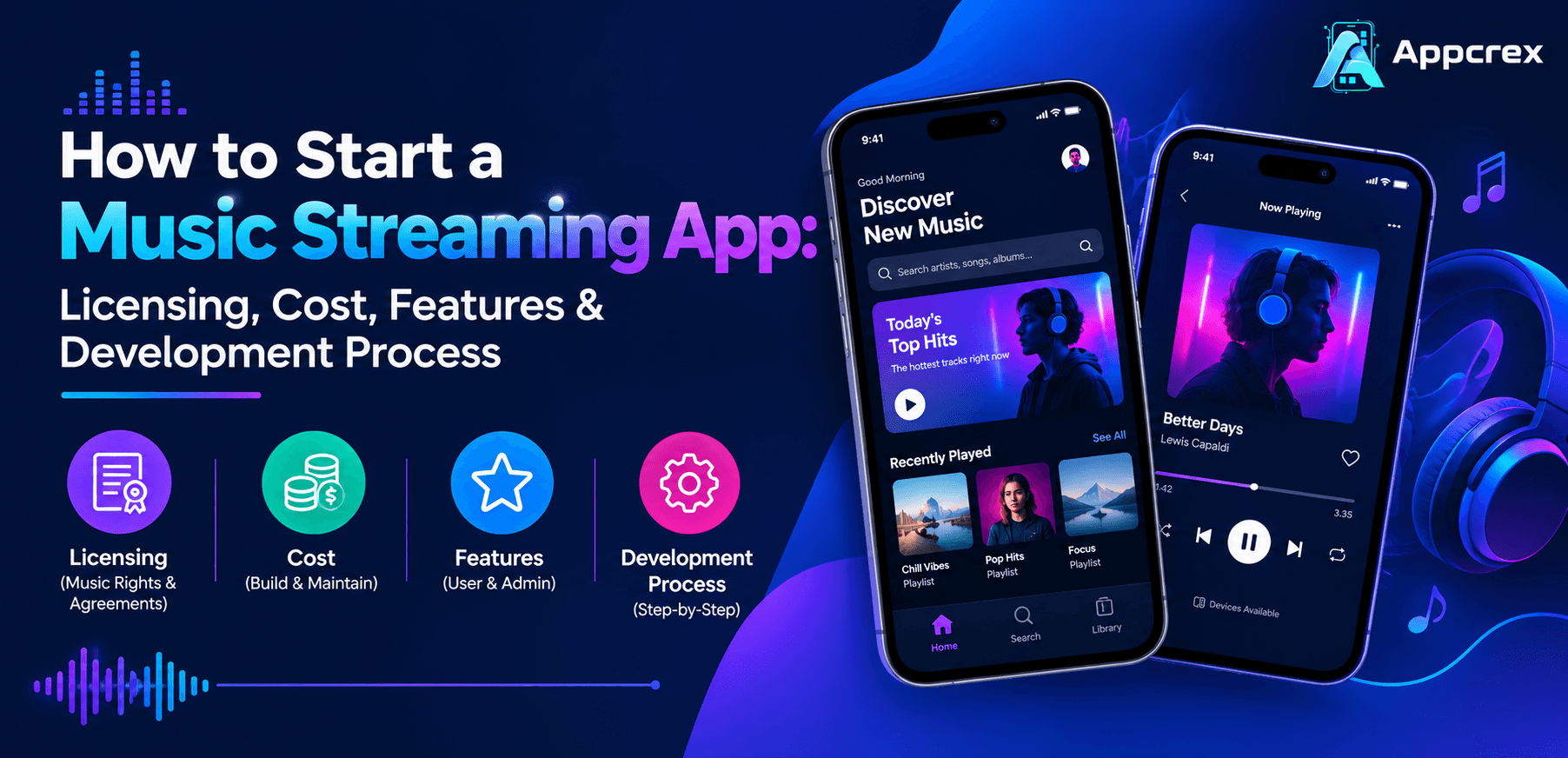
📌 Key Takeaways
- Starting a music streaming app requires both technology and a clear music-rights strategy.
- Licensing and royalties can become major costs beyond the software development budget.
- An MVP can start with a catalog, search, player, playlists, subscriptions and basic recommendations.
- Flutter and React Native can support cross-platform development, while native development may be useful for specialized audio requirements.
- A focused niche—such as independent, regional or genre-specific music—can provide a clearer differentiation strategy than trying to replicate a major platform.
Introduction
Music streaming has become one of the most convenient ways for people to discover, listen to, save and share music. Instead of downloading individual tracks, users can access large catalogs through mobile apps and web platforms, often supported by subscriptions, advertising or a combination of both.
This creates an opportunity for entrepreneurs, media companies, independent labels and entertainment businesses to launch their own music streaming app.
However, starting a music streaming platform is very different from building a regular media application. The technology is only one part of the project. Music rights, licensing, royalties, audio delivery, catalog management, subscriptions, recommendations and content security all need to be considered before development begins.
So, how do you start a music streaming app?
The process generally involves defining your target audience, choosing a music business model, securing the appropriate rights, planning the features, selecting the technology stack, developing the platform, integrating streaming infrastructure and launching a monetization strategy.
This guide explains how to start a music streaming app, what features you need, how music licensing works, what technology is required, how much development can cost and how to build a scalable platform.
What Is a Music Streaming App?
A music streaming app allows users to listen to audio content over the internet without necessarily downloading the complete music files to their devices.
Depending on the business model, users may be able to:
- Search for songs and artists
- Stream albums
- Create playlists
- Follow artists
- Discover new music
- Download music for offline listening
- Listen to podcasts or other audio
- Receive personalized recommendations
- Share tracks
- Subscribe to premium plans
A platform can focus on mainstream music, independent artists, regional music, a specific genre or an entirely different niche.
That distinction is important because your catalog strategy will directly influence licensing, technology requirements, operating costs and the overall business model.
Just Read : How Much Does It Cost to Develop an App in 2026? Complete Pricing Guide
How to Start a Music Streaming App?
Starting a music streaming app requires more planning than simply developing a mobile player.
A practical process looks like this:
Market Research → Business Model → Music Rights → Product Planning → UI/UX → Backend → Streaming Infrastructure → Mobile App → Testing → Launch → Monetization
Each stage affects the next one.
For example, if you plan to offer mainstream commercial music, licensing requirements may be significantly different from a platform that exclusively hosts independent artists who have signed agreements directly with you.
Step 1: Choose Your Music Streaming Business Model
Before hiring developers, decide exactly what kind of platform you want to build.
Subscription-Based Music Streaming
Users pay a monthly or annual subscription for access to premium content.
Possible plans include:
- Individual
- Family
- Student
- Business
- Premium
The subscription can provide benefits such as ad-free listening, higher audio quality, offline downloads and unlimited skips.
Ad-Supported Music Streaming
Users listen for free while the platform generates revenue through advertising.
Possible advertising formats include:
- Audio ads
- Display ads
- Sponsored playlists
- Native promotions
- Artist promotions
This model can help reduce the barrier to user acquisition but requires sufficient listening volume to generate meaningful advertising revenue.
Freemium Model
A freemium platform combines free and paid access.
For example:
Free users:
Ads, limited skips and standard audio quality.
Premium users:
Ad-free listening, offline mode, higher quality and additional features.
This model can allow users to experience the platform before deciding whether to subscribe.
Independent Artist Platform
Instead of competing directly for a massive mainstream catalog, you can create a platform focused on independent musicians.
Artists can upload music, create profiles and potentially receive analytics or monetization tools.
This can create a more focused product and may allow you to develop a differentiated catalog strategy.
Niche Music Platform
Another option is to focus on a particular audience.
Examples include:
- Regional music
- Classical music
- Devotional music
- Electronic music
- Indie music
- Children’s music
- Fitness music
- Meditation and relaxation audio
A niche platform can have a smaller catalog but a more specific audience.
Step 2: Understand Music Licensing Before Development
This is one of the most important parts of starting a music streaming business.
You cannot simply collect commercially released songs from the internet and place them inside your application.
Music involves multiple rights and rights holders. Depending on the market and how your service operates, you may need agreements covering the underlying musical composition and the sound recording, along with other rights relevant to the service and territory.
Current industry guidance emphasizes that licensing can be one of the most complicated non-development costs of a mainstream music streaming platform.
Your licensing strategy may involve:
- Record labels
- Music publishers
- Artists
- Rights-management organizations
- Licensing agencies
- Music aggregators
- Independent labels
The exact rights and agreements required depend on your catalog, territory, service type and distribution model.
Why licensing matters?
Suppose you develop an excellent music streaming app but do not have the necessary rights to stream the catalog.
The technology may work perfectly, but the business still cannot legally offer those recordings to users.
Therefore, music licensing should be planned before finalizing the product scope and development budget.
Can You Use Spotify APIs to Build Your Own Music Streaming Service?
This is an important distinction for entrepreneurs.
Spotify provides APIs intregration that allow developers to access certain music metadata and interact with Spotify functionality. Its Web API can retrieve information about artists, albums and tracks and can manage certain user-related functionality.
However, developers should not assume that Spotify APIs provide a legal catalog for launching their own commercial Spotify-style streaming service.
Spotify’s current developer documentation explicitly states that its platform cannot be used to develop commercial streaming integrations.
Therefore, if you want to launch your own commercial music streaming platform, you need a separate content and licensing strategy rather than simply building your business on Spotify’s streaming catalog.
Step 3: Define Your Target Audience
Your target audience determines the features you actually need.
For example, a regional music platform may prioritize:
- Regional languages
- Local artists
- Regional playlists
- Local payment methods
- Artist discovery
An international platform may need:
- Multiple languages
- Multiple currencies
- Global content licensing
- Regional catalogs
- Country-specific subscriptions
- Global CDN infrastructure
A platform for independent artists may instead prioritize:
- Artist onboarding
- Music uploads
- Royalty tracking
- Artist analytics
- Fan engagement
Defining this audience before development prevents unnecessary features from increasing your initial budget.
Essential Features of a Music Streaming App
1. User Registration and Login
Users should be able to create accounts through:
- Phone number
- Social login
- Passwordless authentication
Account functionality also enables personalized playlists, listening history and recommendations.
2. Home Screen
The home screen can display:
- Recently played
- Trending songs
- New releases
- Recommended playlists
- Popular artists
- Personalized music
- Featured albums
The content can be dynamically managed through the backend.
3. Music Search
Search is one of the core features of any music streaming application.
Users should be able to search by:
- Song
- Artist
- Album
- Playlist
- Genre
- Lyrics
- Podcast
For large catalogs, search infrastructure needs to be optimized for speed and relevance.
4. Audio Player
The player is the central component of the application.
It can support:
- Play
- Pause
- Previous
- Next
- Seek
- Shuffle
- Repeat
- Queue
- Volume
- Playback progress
Premium users may also receive additional playback controls.
5. Playlists
Users should be able to create and manage playlists.
Features can include:
- Create playlist
- Rename playlist
- Add songs
- Remove songs
- Reorder tracks
- Share playlist
- Collaborative playlists
6. Favorites and Library
Users can save:
- Songs
- Albums
- Artists
- Playlists
The personal library gives users a central place to access their preferred content.
7. Artist Profiles
Artist pages can contain:
- Profile image
- Biography
- Popular tracks
- Albums
- Singles
- Playlists
- Followers
- Latest releases
For independent music platforms, artist profiles can become a major part of the product.
8. Offline Music
Offline listening allows users to download authorized content for playback without an internet connection.
This feature requires additional considerations around:
- Encryption
- Access control
- Subscription status
- Device storage
- License restrictions
- Expiration rules
It should be designed carefully because offline access is not simply a matter of downloading MP3 files to a phone.
9. Push Notifications
Notifications can inform users about:
- New releases
- New albums
- Playlist updates
- Recommended music
- Subscription events
- Artist activity
Personalized notifications can be more effective than sending the same message to every user.
Advanced Features for a Music Streaming App
Once the MVP is established, advanced functionality can be added.
AI Music Recommendation Engine
Personalization can become one of the most valuable features of a streaming platform.
The recommendation engine can consider:
- Listening history
- Skips
- Likes
- Playlist behavior
- Genres
- Artists
- Listening duration
- Time of day
- User preferences
The system can then recommend songs and playlists that are more relevant to individual listeners.
AI-Powered Music Discovery
AI can also support:
- Mood-based recommendations
- Similar artists
- Similar songs
- Personalized playlists
- Genre discovery
- Natural-language music search
For example, a user could search for music based on a mood or activity rather than a specific artist.
Social Features
You can add:
- User profiles
- Following
- Shared playlists
- Collaborative playlists
- Music sharing
- Activity feeds
- Comments
Social functionality can help turn a streaming application into a broader music community.
Podcasts and Other Audio
The platform can eventually expand beyond music.
Additional content may include:
- Podcasts
- Audiobooks
- Interviews
- Radio
- Live audio
- Educational content
This can diversify the content catalog and create additional monetization opportunities.
Also Read : AI App Development Guide: Features, Cost & Process (2026)
How Does Music Streaming Technology Work?
A scalable music streaming platform generally has several layers.
Mobile/Web Application
The user interacts with the application through Android, iOS or web interfaces.
Backend
The backend manages:
- Users
- Music metadata
- Playlists
- Subscriptions
- Payments
- Recommendations
- Analytics
Storage
Audio files and media assets can be stored using cloud storage infrastructure.
Transcoding
Audio may need to be processed into appropriate formats and quality levels.
CDN
A Content Delivery Network helps deliver audio efficiently to users across different geographic regions.
Streaming Layer
The application requests authorized audio content and streams it to the user’s device.
Recommendation Engine
AI/ML services analyze user behavior and generate personalized recommendations.
Technology Stack for Music Streaming App Development
The exact technology stack depends on the product requirements.
| Layer | Possible Technologies |
|---|---|
| Android | Kotlin |
| iOS | Swift / SwiftUI |
| Cross-platform | Flutter / React Native |
| Backend | Node.js / Python / Java |
| Database | PostgreSQL / MySQL / MongoDB |
| Search | Elasticsearch / OpenSearch |
| Cloud | AWS / Google Cloud / Azure |
| Storage | Amazon S3 or equivalent |
| CDN | CloudFront or equivalent |
| APIs | REST / GraphQL |
| AI/ML | Python / ML frameworks |
| Analytics | Firebase / cloud analytics tools |
For a startup MVP, the technology stack should be kept practical rather than unnecessarily complex.
Native vs React Native vs Flutter for Music Apps
You can build a music streaming application using native technologies or a cross-platform framework.
Native Development
Android: Kotlin
iOS: Swift
Native development can be useful when the application requires extensive platform-specific audio functionality.
React Native
React Native can reduce duplicated development work when building Android and iOS applications from a shared codebase.
Flutter
Flutter is another cross-platform option that can provide a shared application codebase and consistent UI.
Which Approach Should You Choose?
There is no universal answer.
A basic content-driven music application may work well with a cross-platform approach.
A highly advanced streaming platform with specialized audio functionality, complex background playback, DRM or extensive native integrations may require more platform-specific engineering.
The decision should be based on the product specification rather than choosing a framework simply because it appears cheaper.
How to Build a Music Streaming App Step by Step?
Step 1: Market Research
Research:
- Target users
- Competitors
- Music genres
- Geographic market
- Pricing models
- Existing pain points
Step 2: Define the Business Model
Choose between:
- Subscription
- Advertising
- Freemium
- Niche platform
- Independent artist platform
- Hybrid model
Step 3: Plan Licensing
Identify:
- Music sources
- Rights holders
- Territories
- Distribution rights
- Royalty obligations
Step 4: Create the MVP Scope
Prioritize:
- Login
- Music catalog
- Search
- Player
- Playlists
- Favorites
- Basic recommendations
- Subscription
- Admin panel
Step 5: Design the Product
Create:
- User flows
- Wireframes
- UI design
- Player experience
- Subscription screens
- Artist screens
Step 6: Develop Backend and APIs
Build the infrastructure for:
- User accounts
- Music catalog
- Streaming
- Playlists
- Payments
- Analytics
Step 7: Develop Mobile Applications
Build Android and iOS applications using the selected development approach.
Step 8: Integrate Streaming Infrastructure
Configure:
- Cloud storage
- CDN
- Audio processing
- Streaming
- Security
- Monitoring
Step 9: Test
Perform:
- Functional testing
- Audio testing
- Performance testing
- Security testing
- Device testing
- Subscription testing
Step 10: Launch and Improve
After launch, monitor:
- Active users
- Listening time
- Retention
- Subscription conversion
- Churn
- Popular content
- Search behavior
Use this data to improve recommendations and future features.
How Much Does It Cost to Develop a Music Streaming App?
The music streaming app development cost depends heavily on the catalog strategy, licensing, platforms, streaming infrastructure and features.
For development planning, a typical range can look like this:
| App Type | Estimated Development Cost | Approx. Timeline |
|---|---|---|
| Basic Music MVP | $20,000–$40,000 | 3–5 months |
| Standard Streaming App | $40,000–$80,000 | 5–7 months |
| Advanced Music Platform | $80,000–$150,000+ | 7–10 months |
| Enterprise Streaming Platform | $150,000–$300,000+ | 10–15+ months |
These figures are development estimates only. Music licensing, royalties, catalog acquisition, cloud infrastructure, CDN usage, third-party services and ongoing maintenance can be additional costs.
Industry development estimates also show that licensing can become one of the largest non-development expenses for platforms seeking mainstream catalogs.
Music Streaming App Cost Breakdown
A typical development budget may include:
| Component | Approximate Share |
|---|---|
| Business Analysis | 5–10% |
| UI/UX Design | 10–15% |
| Mobile App Development | 25–35% |
| Backend & APIs | 20–25% |
| Streaming Infrastructure | 10–15% |
| Admin Panel | 5–10% |
| QA & Testing | 10–15% |
| Deployment | 3–5% |
The actual percentage depends on your architecture and feature scope.
A music platform with AI, offline playback and sophisticated recommendations will require substantially more engineering than a simple catalog-and-player MVP.
What Factors Affect Music Streaming App Development Cost?
Number of Platforms
Building Android only is less work than building:
- Android
- iOS
- Web
- Smart TV
- Car platforms
Music Catalog
A platform using a small licensed catalog can have very different requirements from a service targeting millions of commercial tracks.
Licensing
Licensing and royalty arrangements can become a major operating expense and should not be confused with software development cost.
Streaming Infrastructure
More listeners mean more:
- Bandwidth
- CDN usage
- Storage
- Audio processing
- Infrastructure monitoring
Offline Playback
Offline downloads introduce additional security and access-control requirements.
AI Recommendations
Advanced personalization requires data pipelines, recommendation logic and ongoing optimization.
Subscription System
Paid plans require:
- Payment integration
- Subscription management
- Billing
- Entitlements
- Refund handling
- Revenue analytics
How to Monetize a Music Streaming App?
1. Premium Subscriptions
Charge users monthly or annually for premium access.
2. Advertising
Offer free streaming supported by advertisements.
3. Freemium
Provide a free tier and encourage users to upgrade.
4. Artist Promotion
Artists or labels can pay for promotional placements, subject to the platform’s business and disclosure policies.
5. Exclusive Content
Premium users can receive exclusive albums, interviews, playlists or other audio content.
6. B2B Licensing
A platform with a specialized catalog could potentially provide music or audio services to businesses under appropriate agreements.
How to Make a Music Streaming App Scalable?
A music platform needs to be designed for unpredictable traffic.
For example, a newly released album or viral song can suddenly generate thousands or millions of playback requests.
A scalable architecture can include:
- Cloud infrastructure
- CDN
- Auto-scaling
- Caching
- Load balancing
- Database optimization
- Queue systems
- Monitoring
- Analytics
- Disaster recovery
The streaming layer should also be separated from core business logic where appropriate so that a sudden increase in playback does not unnecessarily overload user-management or payment services.
Security Considerations for Music Streaming Apps
Security should be considered from the beginning.
Important areas include:
- Secure authentication
- API authorization
- Encryption
- Payment security
- Access control
- Token management
- Secure media delivery
- Anti-abuse mechanisms
- Subscription validation
- Data protection
If offline listening is offered, downloaded content should be protected against unauthorized extraction and access.
Common Challenges When Starting a Music Streaming App
Music Licensing
Securing appropriate rights can be complex, especially when targeting commercial catalogs.
Royalty Management
The business may need systems for tracking usage and calculating payments according to its agreements.
Streaming Costs
Bandwidth and CDN usage can increase as the listener base grows.
Competition
Large platforms already have massive catalogs and established user bases.
User Retention
Simply offering music is not enough. Discovery, personalization and user experience can become important differentiators.
Catalog Management
Metadata, artwork, artist information, territories and availability need to remain accurate.
Scalability
The architecture needs to handle traffic spikes without affecting playback quality.
How to Compete With Large Music Streaming Platforms?
A startup does not necessarily need to build another general-purpose Spotify-style service.
A more focused strategy may be easier to differentiate.
You could focus on:
- Independent artists
- Regional music
- Emerging musicians
- Specific genres
- Local-language content
- Music discovery
- Community playlists
- Artist-fan interaction
- High-quality audio
- Specialized music experiences
The goal should be to solve a specific user problem rather than simply replicate every feature of a major platform.
How to Start a Music Streaming App for Independent Artists?
An independent-artist platform can use a different model.
The platform could allow artists to:
- Create an account
- Build an artist profile
- Upload music
- Submit metadata
- Manage releases
- View analytics
- Build playlists
- Engage with listeners
- Monetize authorized content
This model can create a direct relationship between artists and listeners.
It can also provide opportunities to differentiate through artist discovery rather than competing entirely on catalog size.
FAQs
Q. How much does it cost to start a music streaming app?
The software development portion can range from around $20,000 for a basic MVP to $150,000–$300,000+ for an advanced or enterprise platform. Licensing, royalties, infrastructure and ongoing operating expenses can be additional.
Q. How do I legally start a music streaming app?
You need to identify the rights required for your specific catalog, territories and service model and negotiate appropriate agreements with relevant rights holders or authorized licensing partners. Legal requirements vary by market, so professional legal advice should be obtained for the target territories.
Q. Can I build a music streaming app like Spotify?
Yes, you can build a music streaming platform with similar categories of functionality, such as playlists, recommendations, subscriptions and streaming. However, you should develop your own product, branding, UX and technology and secure the necessary music rights rather than copying Spotify’s protected assets or assuming its catalog can be reused.
Q. Can I use Spotify’s API for my own music streaming business?
Spotify provides APIs for interacting with its platform and accessing certain metadata and user functionality. However, Spotify’s current developer documentation states that the Spotify Platform cannot be used to develop commercial streaming integrations.
Q. What features should a music streaming MVP have?
A practical MVP can include registration, music catalog, search, audio player, playlists, favorites, basic recommendations, subscription functionality and an admin panel.
Q. Can I build a music streaming app using Flutter?
Yes. Flutter can be used for cross-platform Android and iOS development. The final architecture should account for platform-specific audio requirements and integrations.
Q. Is React Native suitable for music streaming apps?
React Native can be suitable for many music applications, particularly where much of the product is driven by APIs, catalogs, accounts and standard mobile functionality. Advanced audio functionality may require native modules.
Q. How do music streaming apps make money?
Common models include subscriptions, advertising, freemium plans, sponsored content, premium content and other authorized commercial arrangements.
Q. How long does it take to develop a music streaming app?
A basic MVP may take around 3–5 months, while an advanced platform can require 7–10 months or longer. Enterprise products with sophisticated streaming, AI, multiple platforms and complex integrations can take more than a year.
Q. Is music licensing more important than app development?
Both are important, but licensing can become a major business constraint for a commercial catalog. Building the application does not give you the right to stream copyrighted music. Licensing should therefore be addressed before the final product scope and budget are approved.
Conclusion
Starting a music streaming app is a combination of software development, content strategy, licensing, infrastructure and business planning.
The first decision should not be which programming language to use. It should be understanding what kind of music platform you want to create and what content you have the legal right to distribute.
Once the business model and licensing strategy are clear, you can define the MVP around essential functionality such as music discovery, search, playlists, audio playback, user accounts and subscriptions.
From there, features such as AI recommendations, offline listening, social functionality, podcasts and advanced personalization can be introduced as the platform grows.
For technology, you can choose native Android and iOS development or a cross-platform approach using Flutter or React Native. The right choice depends on your audio requirements, product roadmap, integrations and budget.
Most importantly, don’t calculate your business only around the music streaming app development cost. Your overall budget can also include music licensing, royalties, cloud infrastructure, CDN usage, payment processing, customer support, maintenance and ongoing product development.
Build Your Music Streaming App With AppCrex
AppCrex provides music streaming app development services for startups, entertainment app companies, media businesses, independent music platforms and digital content brands.
Our team can help with music app UI/UX, Android and iOS development, Flutter and React Native development, backend APIs, audio streaming infrastructure, subscriptions, payment integration, recommendation systems, admin panels, cloud deployment and analytics.
Whether you want to launch a niche music platform, independent artist streaming service, regional music application or a large-scale subscription-based audio platform, AppCrex can help you plan the product, define the MVP and develop the technology around your business model.
Have a music streaming app idea? Contact AppCrex to discuss your requirements and get a customized development estimate.