📌 Key Takeaways
- Start with a clear business model: Decide whether you need a crypto investment app, portfolio tracker, broker-integrated product, or full exchange.
- Prioritise essential features: Secure onboarding, market data, portfolio tracking, transaction history, and clear user journeys should come before optional extras.
- Plan the budget around complexity: Integrations, trading architecture, security, and ongoing operations have a major impact on total cost.
- Treat compliance and security as core requirements: Assess applicable Indian requirements before launch and build the necessary workflows into the product.
- Choose a development partner carefully: Evaluate technical experience, security practices, ownership terms, documentation, and post-launch support.
Introduction
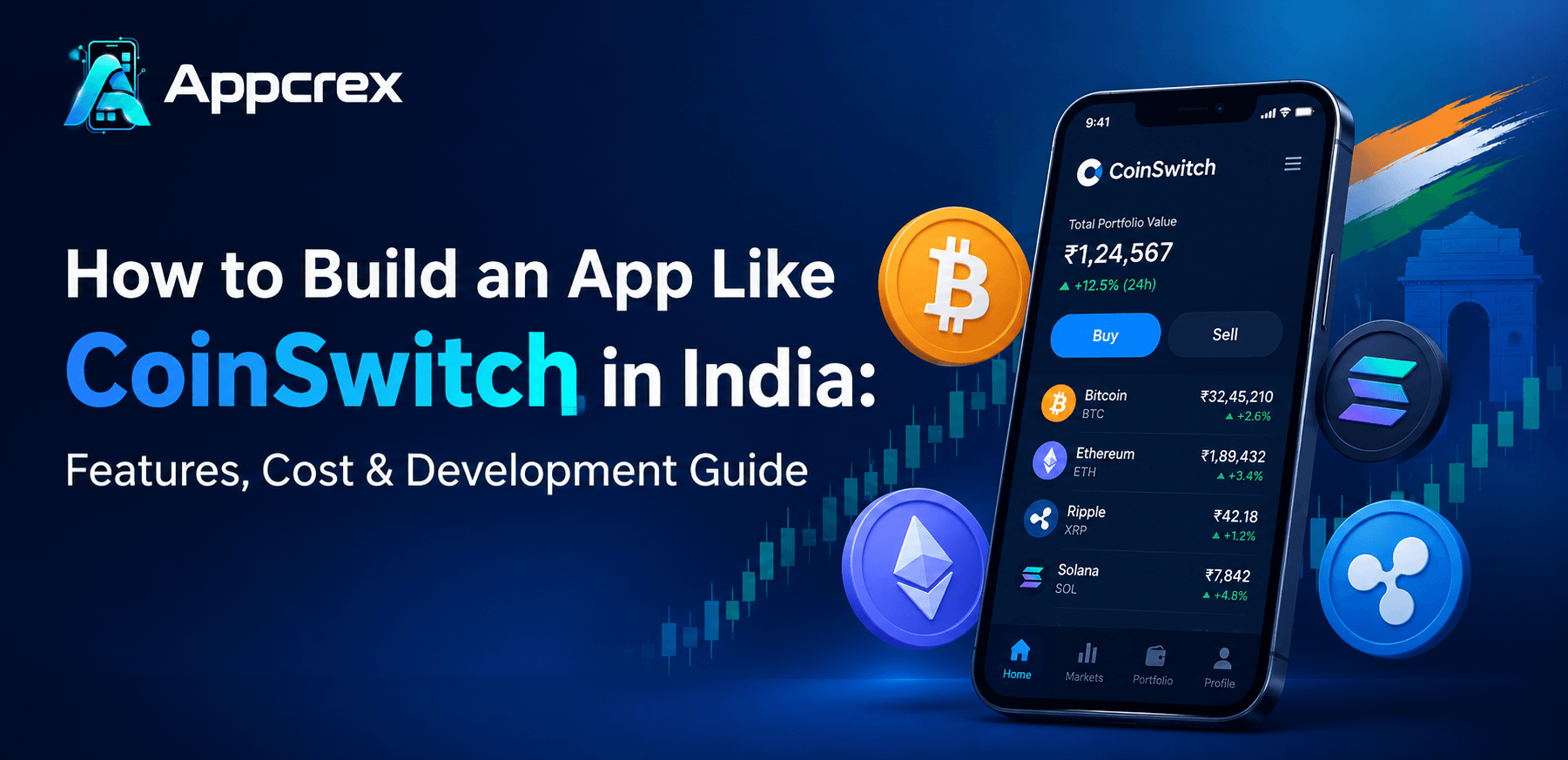
Building an app like CoinSwitch in India requires more than a cryptocurrency buying and selling interface. A successful crypto investment app needs a simple onboarding process, real-time crypto prices, secure transactions, portfolio tracking, identity verification, reliable payment integrations, and a compliance framework designed for the Indian market.
Businesses planning to enter this space should begin by defining their business model, target audience, supported cryptocurrencies, and operating requirements. The development process then covers UI/UX design, backend engineering, exchange or liquidity integrations, security testing, and app deployment.
A crypto investment app development project can start with a focused MVP and expand as user demand grows. The overall cost depends on trading functionality, integrations, security requirements, and operational complexity.
In this guide, we explain how to build an app like CoinSwitch in India, which features to prioritise, how much development may cost, and how to select the right cryptocurrency app development company.
What Is an App Like CoinSwitch?
An app like CoinSwitch is a cryptocurrency investment and trading platform that allows users to explore digital assets, check market prices, buy and sell supported cryptocurrencies, and monitor their portfolios through a mobile or web interface.
The primary goal is to make crypto investing accessible through a straightforward user experience. Instead of overwhelming users with advanced trading tools, an investment-focused app can offer a clean dashboard, clear asset information, transaction history, and portfolio insights.
A CoinSwitch-style app may include:
- User registration and identity verification
- Cryptocurrency price tracking
- Crypto buying and selling
- Portfolio management
- Order and transaction history
- Payment and settlement integrations
- Push notifications and market alerts
- Customer support and help resources
- Administrative and compliance dashboards
The exact feature set depends on the business model. A platform designed for beginners may focus on simplicity and guided investing, while a platform targeting experienced traders may require advanced order types, charts, and market analytics.
Important: The goal should be to build an original cryptocurrency investment platform inspired by common market features, not to copy CoinSwitch’s branding, proprietary interface, or protected assets.
Why Build a Crypto Investment App for the Indian Market?
India-focused crypto platforms need to account for local user expectations, payment experiences, security concerns, and applicable regulatory obligations.
1. A mobile-first investment experience
Many users prefer managing their financial activities through mobile apps. A well-designed cryptocurrency investment app can make it easier to review prices, understand holdings, and access account information from a single dashboard.
Businesses can differentiate their products through faster onboarding, accessible navigation, transparent transaction information, and responsive customer support.
2. Simplified cryptocurrency buying and selling
New users may find cryptocurrency markets difficult to understand. A straightforward interface can reduce unnecessary complexity by displaying asset prices, relevant fees, order details, and transaction status clearly.
A simple user journey can help users understand each step before they confirm a transaction.
3. Portfolio visibility and tracking
Users often want to understand how their holdings change over time. Portfolio tracking features can display asset allocation, current valuation, transaction history, and performance indicators.
These features can also help users organise their activity without relying on multiple applications.
4. Opportunities for product differentiation
A new business does not need to replicate every feature offered by an established platform. It can focus on a specific audience or experience, such as beginner-friendly investing, advanced portfolio insights, educational content, or multilingual support.
The right positioning depends on user research, competitive analysis, operational feasibility, and compliance requirements.
Just Read : Crypto Exchange App Development Company: Services, Features & Development Guide
How to Build an App Like CoinSwitch in India?
Developing a crypto investment application involves several connected stages. A structured process helps businesses control costs, reduce technical risk, and prepare for future growth.
Step 1: Define the Business Model
Start by deciding what kind of cryptocurrency platform you want to build.
Common options include:
| Business model | How it works | Main development considerations |
|---|---|---|
| Crypto investment app | Focuses on buying, selling, and tracking supported digital assets | Simple user experience, onboarding, transaction records |
| Crypto exchange platform | Supports trading between users or through an exchange mechanism | Order matching, liquidity, trading engine, market data |
| Broker-style platform | Routes or facilitates transactions through integrated providers | Provider integrations, pricing, transaction execution |
| Crypto portfolio app | Tracks assets and provides portfolio insights | Wallet connections, data integrations, analytics |
| Crypto trading platform | Supports more advanced trading workflows | Order types, charts, risk controls, market infrastructure |
These models are not interchangeable. A portfolio tracker that does not execute transactions has a different technical and regulatory profile from a custodial exchange.
For a first-time founder, it may be more practical to validate a focused product before investing in complex trading infrastructure.
Step 2: Research the Target Audience and Competitors
Analyse the expectations of the users you want to serve. Consider beginners, active traders, long-term investors, and users who primarily need portfolio visibility.
Study competing applications to identify common features, usability problems, onboarding friction, and opportunities to offer a better experience.
Research should examine:
- Registration and verification flows
- Supported assets and displayed market information
- Deposit, withdrawal, and transaction experiences
- Fee transparency
- Security and account recovery
- Customer support
- Accessibility and regional language needs
- App performance and user feedback
Competitor research should inform product decisions rather than lead to direct copying. An original user experience and a clear value proposition are essential.
Step 3: Select the Right Development Approach
Businesses generally have three approaches to crypto app development.
Custom development: The team builds the application and its business logic around specific requirements. This offers flexibility but may require more time and investment.
White-label solution: A prebuilt platform is customised for branding and selected workflows. It can reduce initial development effort, but businesses must evaluate code ownership, security, vendor dependence, integration limits, and upgrade costs.
Hybrid development: The product uses custom interfaces and selected business components while relying on established providers for specific functions. This can be suitable when speed and control both matter.
The best option depends on the product scope, budget, security requirements, and the team’s long-term plans.
Step 4: Plan the UI/UX Design
A crypto investment app should make financial information easy to understand. Users need to know what they are viewing, what a transaction will do, and what fees or risks may apply.
The design phase should include:
- User journey mapping
- Wireframes and interactive prototypes
- Dashboard and portfolio layouts
- Asset detail screens
- Buy and sell flows
- Verification and account recovery screens
- Transaction confirmation screens
- Error, loading, and empty states
- Accessibility and usability testing
Avoid adding too many charts or trading controls to the initial interface if the target audience consists mainly of beginners.
Step 5: Build the Frontend and Backend
The frontend is the part users interact with. It includes the mobile application or web interface, navigation, dashboards, forms, charts, and transaction screens.
The backend manages account information, business rules, market data, transaction records, integrations, notifications, and administrative functions.
A production-ready platform may also require:
- Secure authentication and session management
- Role-based access controls
- API integrations
- Transaction reconciliation
- Audit logs
- Monitoring and alerting
- Rate limiting
- Backup and recovery procedures
- Fraud detection workflows
The system architecture should be designed around the chosen business model. For example, a platform integrating an external exchange may not require the same order-matching infrastructure as a proprietary exchange.
Step 6: Integrate Cryptocurrency Market Data
Users need timely and accurate market information. A cryptocurrency app can obtain data through suitable market-data APIs or other authorised providers.
Depending on the product, data may include:
- Current cryptocurrency prices
- Historical price movements
- Trading volume
- Market capitalisation
- Price charts
- Supported trading pairs
- Asset information
The development team should evaluate API reliability, data coverage, update frequency, commercial licensing, rate limits, and outage behaviour.
Market prices and executable transaction prices may differ. The app should clearly communicate price updates, spreads, fees, and any applicable execution conditions.
Step 7: Integrate Trading, Liquidity, or Transaction Providers
The required integrations depend on whether the app uses a third-party provider, operates an exchange, or offers portfolio tracking only.
Possible integrations include:
- Exchange or broker APIs
- Liquidity providers
- Crypto wallet infrastructure
- Blockchain network services
- Payment and banking partners
- Identity verification services
- Transaction monitoring tools
- Email, SMS, and push notification services
Each provider should be evaluated for security, supported assets, API documentation, reliability, commercial terms, and legal suitability for the intended operating model.
Never assume that connecting a payment gateway automatically enables cryptocurrency transactions. Provider policies and applicable rules must be checked before implementation.
Step 8: Implement Identity Verification and Compliance Workflows
Identity verification and compliance requirements should be considered during product planning, not added as an afterthought.
Depending on the services offered, the platform may need identity checks, customer due diligence, sanctions screening, transaction monitoring, suspicious activity escalation, recordkeeping, and reporting workflows.
In India, the Financial Intelligence Unit–India has issued requirements and guidance relating to virtual digital asset service providers under the applicable anti-money-laundering framework. Businesses should determine whether their proposed activities fall within the relevant requirements and obtain professional advice before launch. See the official FIU-India guidance and resources.
The implementation plan should also address personal data handling, user consent where applicable, data retention, access controls, and incident response. Review the relevant Digital Personal Data Protection Act and applicable rules and commencement notifications.
Requirements can change. A development partner can help implement technical workflows, but software development alone does not establish regulatory compliance.
Step 9: Test Security, Performance, and Transaction Flows
Testing is particularly important for apps that handle financial activity or sensitive identity information.
The QA process should cover:
- Functional testing
- API and integration testing
- Authentication and access-control testing
- Vulnerability assessment
- Penetration testing
- Transaction accuracy and reconciliation
- Error handling and duplicate-request prevention
- Load and performance testing
- Device and operating-system compatibility
- Backup and disaster recovery
- User acceptance testing
Security controls may include encryption, secure key management where applicable, multi-factor authentication, rate limiting, session controls, anomaly detection, and monitoring.
A platform should also have a documented response plan for suspicious activity, data exposure, service disruption, and failed transactions.
Step 10: Launch, Monitor, and Improve the App
Before launch, complete the necessary operational, legal, security, and app-store reviews. Prepare customer support processes and clear user-facing explanations of transaction status, fees, limitations, and risks.
After launch, monitor:
- Registration and verification completion
- App crashes and API latency
- Transaction failure rates
- Support requests
- Suspicious activity alerts
- User retention
- Infrastructure costs
- User feedback and feature requests
Use this information to prioritise improvements. A phased rollout can help identify problems before the application is exposed to a larger user base.
Essential Features of a CoinSwitch-Style App
Feature selection should match the intended audience and business model. The following table separates core launch features from functionality that can be introduced later.
| Feature | Purpose | Priority |
|---|---|---|
| User registration and login | Creates and protects user accounts | MVP |
| Identity verification workflow | Supports applicable verification requirements | Based on operating model |
| Crypto market dashboard | Displays supported assets and prices | MVP |
| Asset details | Shows asset information and price movements | MVP |
| Buy and sell workflow | Enables supported transactions | Core for trading apps |
| Portfolio tracking | Displays holdings and allocation | MVP for investment apps |
| Transaction history | Helps users review account activity | MVP |
| Notifications | Communicates relevant account and transaction updates | MVP |
| Customer support | Helps resolve account and transaction issues | MVP |
| Admin dashboard | Supports operational monitoring and user management | MVP |
| Advanced charts | Offers deeper market analysis | Later phase |
| Price alerts | Notifies users of selected market movements | Later phase |
| Recurring purchases | Supports scheduled investment workflows where permitted | Later phase |
| Advanced order types | Enables more sophisticated trading | Depends on product |
| AI-powered insights | Summarises information or highlights patterns | Optional |
1. User Registration and Login
Provide a clear registration process with secure authentication, account verification, password recovery, and session management.
The app should explain why requested information is needed and how users can get help if verification fails.
2. Cryptocurrency Dashboard
The dashboard can display supported assets, current prices, price changes, favourites, and market summaries.
For beginners, prioritise readable information and simple navigation over a crowded trading interface.
3. Crypto Buying and Selling
The transaction flow should present the asset, quantity or amount, applicable price information, fees, and final confirmation before the user submits an order.
The app must also communicate whether an order is pending, completed, rejected, or cancelled, based on the actual transaction state.
4. Portfolio Management
Portfolio tools can show holdings, asset allocation, transaction history, and valuation trends. Where cost-basis or profit-and-loss calculations are offered, explain their methodology and limitations.
Portfolio information should be presented as data rather than a promise of future returns.
5. Payment and Settlement Integrations
Payment functionality depends on the business model, partner availability, and applicable requirements. Build clear payment-status handling and reconciliation into the system.
The app should not show a deposit or withdrawal as completed until the relevant provider or system confirms the status.
6. Notifications and Alerts
Push Notifications can cover account security events, verification updates, transaction statuses, and user-configured price alerts.
Avoid excessive notifications. Users should be able to manage preferences, and sensitive information should not appear unnecessarily on lock screens.
7. Admin and Operations Dashboard
An internal dashboard helps authorised staff manage support requests, review transaction states, investigate anomalies, monitor service health, and maintain audit trails.
Access should be restricted by role, with sensitive actions logged and reviewed.
Advanced Features That Can Differentiate Your Crypto App
Once the core product is stable, additional features may improve usability and help the platform stand out.
AI-Powered Portfolio Insights
AI can summarise historical portfolio changes, explain market terminology, or help users explore information about supported assets. Outputs should be grounded in reliable data and clearly labelled.
AI should not make unsupported guarantees about returns or present generated information as personalised financial advice.
Personalised Price Alerts
Users can set alerts for selected assets or price movements. The app can notify them when a defined condition is met, subject to data freshness and notification delivery.
Multilingual Interface
A multilingual interface can make an Indian-market product easier to use for people who prefer languages other than English. Language selection should cover essential journeys, including verification, transaction confirmation, error messages, and customer support.
Advanced Market Charts
Candlestick charts, historical performance, trading volume, and technical indicators can support users who need deeper market information.
These features should be added when user research justifies the extra interface complexity and data requirements.
Educational Content
Beginner guides, definitions, risk explanations, and product walkthroughs can help users understand how the application works.
Educational material should be reviewed for accuracy and updated when relevant product or regulatory information changes.
Recommended Technology Stack for Crypto Investment App Development
The right technology stack depends on the required platforms, expected traffic, security model, and integrations.
| Technology layer | Potential options | Main purpose |
|---|---|---|
| Cross-platform mobile app | Flutter, React Native | Shared development across supported mobile platforms |
| Native mobile app | Swift, Kotlin | Platform-specific mobile experiences |
| Web frontend | React or Next.js | Browser-based user interface |
| Backend | Node.js, Java, Python, Go | Business logic, APIs, and integrations |
| Database | PostgreSQL, Redis | Persistent records and caching |
| Market data | Authorised market-data APIs | Prices and historical information |
| Cloud infrastructure | AWS, Azure, Google Cloud, or suitable alternatives | Hosting, scaling, monitoring, and recovery |
| Security and identity | Suitable authentication, KYC, and monitoring providers | Account protection and verification workflows |
| Observability | Centralised logs, metrics, and alerting tools | Operational visibility and incident response |
This is an example stack, not a mandatory combination. Technology selection should follow the product requirements rather than popularity alone.
For example, Flutter can be suitable when a business wants to deliver an Android and iOS experience with a shared codebase. A web application may be important if users also need desktop access.
How Much Does It Cost to Build an App Like CoinSwitch in India?
The cost of building a CoinSwitch-style app depends on its features, architecture, external integrations, security requirements, and operational complexity.
For early budgeting, the following are illustrative planning ranges, not verified market quotations or fixed AppCrex prices.
| Development scope | Illustrative cost in India | Typical scope |
|---|---|---|
| Basic crypto portfolio or market-tracking app | ₹8 lakh–₹18 lakh | Market data, watchlists, portfolio views, basic accounts |
| Crypto investment app MVP | ₹18 lakh–₹40 lakh | Onboarding, selected trading integrations, portfolio, transaction history, admin tools |
| Advanced crypto investment platform | ₹40 lakh–₹80 lakh | More integrations, richer analytics, expanded security and operational features |
| Complex exchange or trading ecosystem | ₹80 lakh–₹1.5 crore+ | Advanced trading infrastructure, extensive integrations, higher operational complexity |
Actual quotations can fall outside these ranges. A non-custodial portfolio tracker, a broker-integrated app, and a full exchange require different engineering and operational investments.
Cost Breakdown by Development Activity
| Activity | Illustrative budget range |
|---|---|
| Discovery and requirements | ₹1 lakh–₹3 lakh |
| UI/UX design | ₹1.5 lakh–₹4 lakh |
| Mobile or web frontend | ₹3 lakh–₹8 lakh |
| Backend and API development | ₹4 lakh–₹12 lakh |
| Trading, wallet, or provider integrations | ₹2 lakh–₹10 lakh+ |
| Admin panel and operations tools | ₹1.5 lakh–₹5 lakh |
| QA and security testing | ₹2 lakh–₹6 lakh |
| Deployment and launch preparation | ₹1 lakh–₹3 lakh |
These are broad planning estimates. Activities may overlap, and some projects will require more substantial investment in security, integrations, infrastructure, and testing.
What Factors Affect the Cost?
Feature complexity: Advanced charts, multiple order types, automated workflows, and additional account controls increase development effort.
Trading architecture: Integrating an established provider differs significantly from building and operating a trading engine.
Security requirements: Independent security testing, key-management architecture, monitoring, and incident-response planning can add substantial cost.
Third-party services: Market-data feeds, identity verification, cloud infrastructure, analytics, and other services may involve setup fees and recurring charges.
Platform coverage: Building Android, iOS, and web experiences can require additional design, development, and QA work.
Compliance and operations: Legal advice, compliance systems, reporting workflows, customer support, and ongoing monitoring need separate budget planning.
How Can You Reduce Initial Development Costs?
Businesses can control the initial budget without compromising essential security.
- Launch with a clearly defined MVP.
- Prioritise a limited, validated set of features.
- Use established integrations where appropriate.
- Avoid building proprietary trading infrastructure before it is justified.
- Reuse tested components where security and licensing allow.
- Test critical transaction flows early.
- Plan infrastructure and monitoring around realistic usage.
- Keep future expansion in mind without building every future feature at launch.
Do not reduce costs by skipping security reviews, transaction reconciliation, required compliance work, or testing of critical workflows.
How Long Does It Take to Develop a Crypto Investment App?
Timelines depend on the selected business model, team size, integrations, and readiness of business requirements.
| Project stage | Illustrative timeline |
|---|---|
| Discovery and planning | 2–4 weeks |
| UI/UX design | 2–5 weeks |
| MVP frontend and backend | 8–16 weeks |
| Integrations and admin tools | 4–10 weeks |
| Testing and security review | 3–6 weeks |
| Launch preparation | 1–3 weeks |
Some activities can run in parallel, so these ranges should not simply be added together to produce a guaranteed launch date. A focused MVP may take approximately 3–5 months, while a complex platform can take six months or longer.
Provider onboarding, legal reviews, security remediation, and other external dependencies can extend the schedule.
Security Requirements for a Crypto Investment App
Security should be part of the architecture from the beginning. A visually polished app is not ready for launch if account access, transaction processing, or sensitive data handling is unreliable.
Secure Authentication
Use secure authentication, session controls, account recovery safeguards, and multi-factor authentication where appropriate. Sensitive administrative actions should receive additional protection.
Encryption and Data Protection
Protect sensitive data during transmission and storage. Restrict access to personal information and ensure that logs do not unnecessarily expose credentials, identity documents, or other confidential data.
Wallet and Key Management
If the platform handles digital assets or private keys, use an architecture appropriate to the custody model. Evaluate key storage, access separation, recovery procedures, transaction authorisation, and independent security reviews.
Never assume that a standard database or application server is sufficient for managing private keys.
Transaction Monitoring
Monitor unusual activity, repeated failed attempts, suspicious account behaviour, and inconsistent transaction patterns. Detection rules should support investigation and escalation rather than relying on automated flags alone.
Regular Security Testing
Conduct security assessments before launch and after significant changes. Review dependencies, API access, permissions, cloud configuration, backup procedures, and incident-response plans.
India-Specific Compliance Considerations
Compliance planning is a critical part of launching a crypto investment app in India. The applicable obligations depend on the exact services offered, how transactions are facilitated, custody arrangements, and the legal structure of the business.
Before development begins, seek advice from qualified legal and compliance professionals on the following areas.
FIU-IND and Anti-Money-Laundering Requirements
Certain virtual digital asset activities are covered by India’s anti-money-laundering framework. FIU-India publishes official material concerning registration and AML/CFT requirements for virtual digital asset service providers. Review the current guidance and assess the proposed business model before launch. Official FIU-India resources.
KYC and Customer Due Diligence
Determine what identity checks, customer due diligence, recordkeeping, screening, and transaction-monitoring processes apply to the business. Design the technical workflow to support the confirmed requirements.
Tax and Transaction Records
Crypto-related tax and reporting rules may affect how users and platform operators need to record transactions. The Income Tax Department provides official information about virtual digital assets and related tax provisions. Consult current guidance, including the relevant provisions in force for the transaction date. Income Tax Department resources.
Personal Data Protection
The platform may collect identity documents, contact information, financial transaction records, and device-related data. Assess applicable personal data protection requirements, notices, consent mechanisms, retention practices, and security safeguards. Review the DPDP Act and the applicable rules and implementation notifications before finalising the system.
Payment and Banking Partner Policies
Confirm that intended payment, banking, and settlement partners permit the proposed use case. Their onboarding criteria, supported flows, and ongoing monitoring requirements can affect product design and launch readiness.
Important: This section is a development-planning overview, not legal advice. Regulatory obligations and implementation timelines can change. Do not assume that building the app or completing a technical integration automatically authorises the business to operate.
How to Choose a Crypto App Development Company in India?
Selecting the right development partner can influence product quality, launch timing, security, and future maintenance.
1. Evaluate Relevant Technical Experience
Ask the company to explain its experience with financial applications, sensitive-data workflows, API integrations, transaction records, and security-focused development.
A general mobile app portfolio may not, by itself, demonstrate experience with cryptocurrency platform requirements.
2. Review Architecture and Security Practices
Ask how the team will handle authentication, access control, sensitive information, transaction consistency, logging, monitoring, backups, and security testing.
The answers should be specific to your product rather than a generic list of technologies.
3. Understand Integration Responsibilities
Clarify which providers are required, who will manage provider onboarding, and how the system will handle outages, API limits, failed transactions, and reconciliation.
4. Confirm Ownership and Documentation
The contract should clarify ownership of custom source code, design assets, infrastructure configuration, documentation, and project deliverables.
Also discuss third-party licences, maintenance, handover, and vendor dependence.
5. Ask for a Transparent Project Plan
A reliable proposal should describe the MVP scope, milestones, assumptions, exclusions, team responsibilities, testing plan, and estimated costs.
Compare proposals by what they deliver, not only by the lowest quoted price.
6. Plan for Long-Term Maintenance
After launch, the application will need monitoring, dependency updates, bug fixes, security reviews, provider integration maintenance, and feature improvements.
Ask for a clear support model and understand which recurring costs are included or billed separately.
Why Consider AppCrex for Crypto Investment App Development?
AppCrex can be considered for businesses planning a cryptocurrency investment application, crypto trading platform, or related fintech product.
The project can be scoped around your business model, target audience, preferred platforms, required integrations, and launch priorities.
Potential areas of development support include:
- Custom mobile app and web development
- Crypto investment app UI/UX
- Backend and API development
- Third-party service integrations
- Portfolio and market-data features
- Administrative dashboards
- Testing and deployment support
- Ongoing product improvements
The final scope, delivery timeline, and cost should be determined after a technical discovery process. Compliance obligations, provider eligibility, and legal approvals should be assessed separately with qualified professionals.
FAQs
1. How much does it cost to build an app like CoinSwitch in India?
A basic crypto portfolio app may require a smaller budget than a full trading platform. For early planning, a focused investment app MVP could fall around ₹18 lakh–₹40 lakh, while more advanced systems may cost ₹40 lakh–₹80 lakh or more. These are illustrative estimates; actual costs depend on scope, integrations, security, and operating requirements.
2. How long does it take to develop an app like CoinSwitch?
A focused MVP may take around 3–5 months. A complex trading platform may take six months or longer. Provider onboarding, compliance reviews, and security requirements can affect the timeline.
3. What features should an MVP crypto investment app include?
A typical MVP may include secure registration, applicable identity verification, market prices, asset details, portfolio tracking, transaction history, customer support, notifications, and an admin dashboard. Buying and selling functionality requires additional transaction, provider, and operational planning.
4. Do I need to build my own crypto exchange?
Not necessarily. Depending on the business model, you may integrate with a suitable exchange, broker, or other authorised provider. Building a proprietary trading engine can provide more control but introduces additional engineering and operational complexity.
5. Can I build a CoinSwitch-style app using Flutter?
Yes. Flutter can be a suitable option for cross-platform mobile development when its capabilities fit the product requirements. The backend, security architecture, market-data integrations, and transaction infrastructure must still be designed separately.
6. Is a crypto app legally ready to launch once development is complete?
No. Technical completion does not establish legal or regulatory readiness. Businesses should assess applicable FIU-IND, anti-money-laundering, data protection, tax, payment partner, and other requirements based on their actual operating model.
7. Can AI features be added to a crypto investment app?
Yes. AI can support educational assistance, market information summaries, portfolio explanations, and customer support workflows. Such features need reliable data, appropriate safeguards, clear limitations, and human review where necessary. AI-generated insights should not promise returns.
8. What is the difference between a CoinSwitch-style app and a crypto exchange?
A CoinSwitch-style investment app may prioritise a simple investing experience, buying and selling, and portfolio visibility. A crypto exchange may require more extensive trading infrastructure, such as order matching and liquidity management. The exact distinction depends on how each platform executes and facilitates transactions.
9. What ongoing costs should I plan for after launch?
Recurring costs can include cloud hosting, market-data APIs, identity verification, security monitoring, provider fees, maintenance, customer support, and compliance operations. Budget for these separately from the initial development investment.
10. How do I start a crypto app development project with AppCrex?
Start by defining your target users, business model, essential features, target platforms, and preferred launch timeline. AppCrex can then assess the technical scope and prepare a project proposal based on the requirements.
Conclusion
Building an app like CoinSwitch in India can be a substantial software project, but a focused product strategy can help businesses manage the initial investment and validate their idea before expanding.
The key is to define the operating model early, design a simple user experience, select suitable market-data and transaction providers, and plan security, compliance, and ongoing operations from the start. Development cost and delivery time should follow the actual scope rather than an assumed feature checklist.
If you are planning a crypto investment app, a crypto trading platform, or a broader fintech product, AppCrex can help you assess the requirements and plan a custom development approach.
Explore AppCrex’s app development services to discuss your project scope, integrations, estimated budget, and development roadmap.