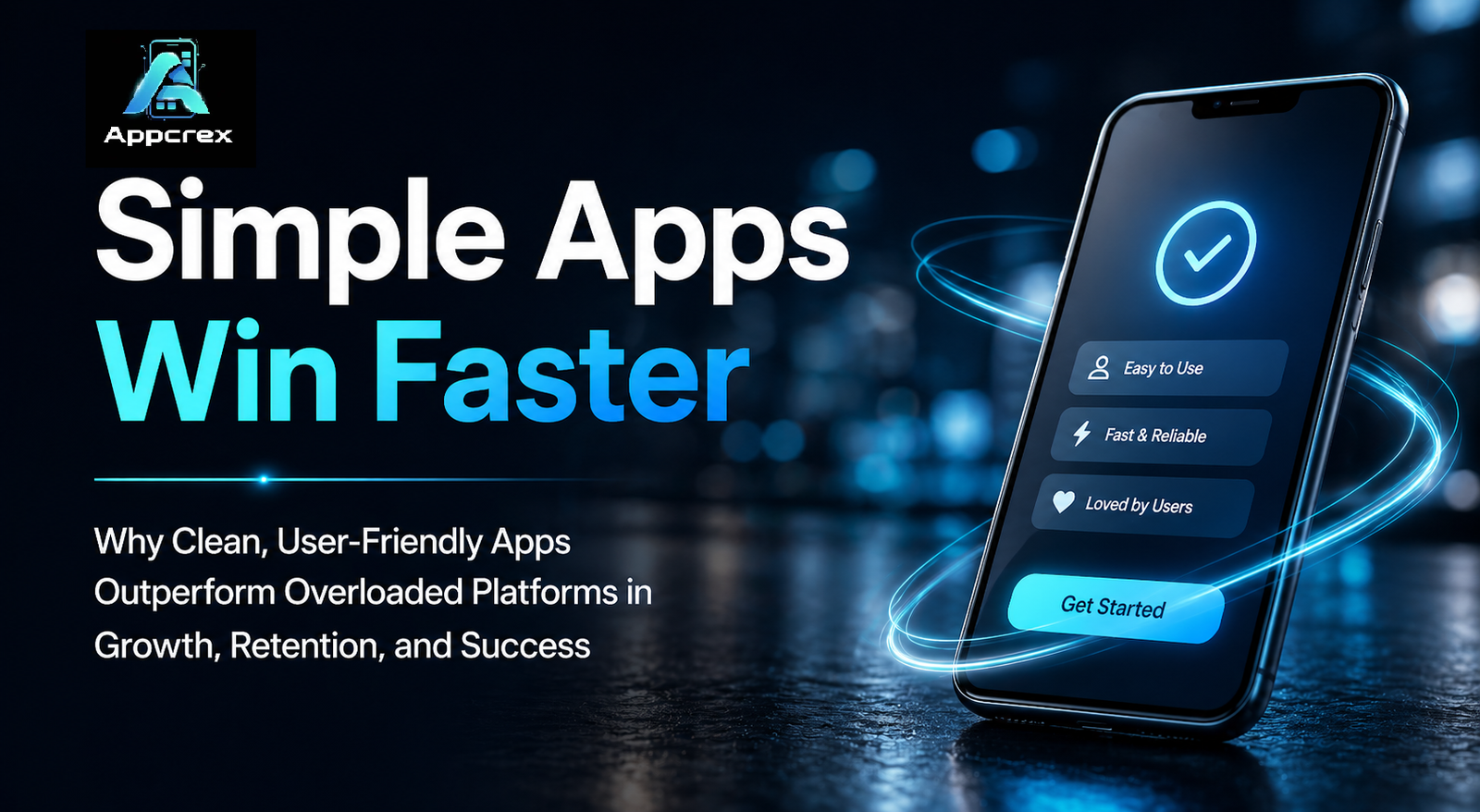
More Features Doesn’t Always Mean Better Apps
When businesses plan an app, excitement often leads to one common mistake:
“Let’s add everything.”
More tools.
More screens.
More options.
More features.
It sounds ambitious.
But users usually experience it differently:
Too much to learn.
Too many steps.
Too many distractions.
And that is why many complex apps struggle.
The apps people love most are often not the ones with the most features.
They are the ones that feel easiest to use.
In modern app development., simplicity is not basic.
It is strategic.
Why Simplicity Matters More Than Ever
Users have endless choices.
If one app feels confusing, they can switch instantly.
That means apps must earn attention quickly.
Simple apps succeed because they help users:
- Understand value fast
- Complete tasks quickly
- Feel confident immediately
- Return without frustration
Complexity creates hesitation.
Simplicity creates momentum.
The Real Meaning of Simplicity
Simplicity does not mean weak functionality.
It means removing what does not help the user.
A simple app can still be powerful.
It simply presents power in a clear and usable way.
That includes:
- Clean navigation
- Logical flows
- Focused features
- Clear buttons
- Fast actions
- Minimal friction
Simple experiences often require smarter thinking behind the scenes.
Why Complex Apps Often Fail
Many apps become overloaded because businesses try to satisfy every possible idea at once.
The result can include:
- Too many menus
- Crowded screens
- Confusing onboarding
- Slow performance
- Unclear priorities
- Feature bloat
Users do not reward effort they cannot feel.
They reward usefulness they can access easily.
1. Simple Apps Reduce Learning Time
When users download a new app, they do not want homework.
They want results.
If they need long tutorials or too much exploration, many leave.
Simple apps help users understand quickly:
- Where to tap
- What to do next
- How to get value fast
Fast learning increases retention.
2. Simplicity Improves User Retention
People return to apps that feel easy.
When an app saves time consistently, it becomes part of routine.
Examples:
- Ordering food in seconds
- Booking appointments easily
- Paying instantly
- Tracking tasks quickly
Ease creates habits.
Complexity breaks habits.
3. Clean UX Builds Trust
Users often judge quality by experience.
If an app feels cluttered or confusing, they may assume the brand is disorganized.
If it feels clean and smooth, confidence rises.
Simple UX communicates:
- Professionalism
- Reliability
- Thoughtfulness
- Quality control
That trust helps conversions and loyalty.
4. Simpler Apps Perform Better
Heavy apps packed with unnecessary features often become slower.
That can cause:
- Long load times
- Lagging screens
- Crashes
- Battery drain
Users rarely tolerate technical frustration.
Focused apps are often faster and more stable.
Performance is part of simplicity.
5. Development Becomes Smarter and Faster
Complex products often take longer to build, test, maintain, and update.
That increases:
- Costs
- Delays
- Bugs
- Team stress
- Launch risk
A simpler roadmap allows faster release cycles and better iteration.
Sometimes launching a strong core product beats delaying a giant unfinished one.
Why MVP Strategy Works
Many successful apps start with a Minimum Viable Product (MVP).
That means launching core value first.
Not every feature.
This helps businesses:
- Validate demand
- Learn user behavior
- Improve based on real feedback
- Save resources
- Reach market faster
Simplicity creates learning speed.
Examples of Simplicity Winning
Some of the most successful digital products grew because they focused clearly on one primary job before expanding.
Users love products that:
- Solve one thing well
- Feel intuitive
- Save time instantly
- Stay reliable
People rarely recommend apps by saying:
“It has 100 features.”
They say:
“It’s so easy to use.”
How to Build Simplicity Into App Development
1. Define the Core Problem
What user pain point matters most?
2. Prioritize Primary Actions
What should users do most often?
3. Remove Unnecessary Steps
Every extra tap should justify itself.
Make movement predictable.
5. Test With Real Users
Users reveal confusion quickly.
6. Expand Carefully
Add features only when they improve value.
The Difference Between Simple and Empty
Some businesses fear simplicity means too little.
It does not.
A weak app lacks value.
A simple app delivers value efficiently.
The goal is not less for the sake of less.
It is less friction for more results.
Why Business Owners Should Care
App simplicity affects real business metrics:
- Higher user retention
- Better reviews
- Lower support issues
- Faster onboarding
- Stronger conversions
- Lower development waste
This is not only a design preference.
It is a growth strategy.
How Appcrex Builds Smart, Simple Apps
At Appcrex, simplicity means building products users actually enjoy using.
That includes:
- User-first planning
- Clean UI/UX systems
- Focused feature roadmaps
- Scalable architecture
- Fast performance
- Conversion-ready flows
- Growth-focused iteration
Because successful apps are not measured by how much they contain.
They are measured by how well they work.
The Future of App Success
As attention spans shorten and competition grows, users will reward apps that feel effortless.
Winning apps will focus on:
- Faster actions
- Smarter personalization
- Cleaner interfaces
- Frictionless flows
- Purposeful features
The future belongs to apps that respect user time.
Conclusion: Simplicity Is a Competitive Advantage
Complexity often looks impressive in planning meetings.
Simplicity wins in the real world.
If users can understand faster, trust faster, and succeed faster-
They stay longer.
The best apps are not the ones with the most features.
They are the ones people keep using.
That is the power of simplicity.
Want to Build an App Users Love to Use?
Partner with Appcrex to create clean, scalable, high-performing apps built for real users and long-term growth.
Let’s turn your idea into a simple success story.
FAQ
1. Why do simple apps perform better?
Because users prefer fast, clear, low-friction experiences.
2. Does simplicity mean fewer features forever?
No. It means starting focused and expanding strategically.
3. What is feature bloat?
Adding too many unnecessary features that hurt usability.
4. Is MVP development a smart choice?
Yes. It helps launch faster and learn from real users.
5. How can Appcrex help?
Appcrex builds user-friendly apps focused on performance, retention, and scalable growth.