
📌 Key Takeaways
- A custom job portal provides complete control over branding, recruitment workflows, and candidate management.
- AI-powered features such as resume screening, job recommendations, and candidate matching improve hiring efficiency.
- Flutter and React Native enable faster, cost-effective cross-platform development.
- Revenue models include premium listings, subscriptions, featured employers, and recruitment services.
- Partnering with an experienced Job Portal App Development Company like AppCrex helps businesses build scalable, secure, and future-ready recruitment platforms.
Hiring Has Changed—Has Your Business Kept Up?
The recruitment industry has undergone a dramatic transformation over the past decade. Traditional hiring methods that relied on newspaper advertisements, recruitment agencies, and manual resume screening have been replaced by intelligent digital platforms capable of connecting employers and job seekers within seconds.
Today, businesses don’t simply post job openings—they build digital ecosystems that attract talent, automate recruitment workflows, and deliver exceptional hiring experiences.
This growing demand has significantly increased the need for professional Job Portal App Development Companies capable of building scalable recruitment platforms for startups, enterprises, recruitment agencies, HR consultancies, educational institutions, and government organizations.
Whether you’re planning to launch the next regional employment marketplace, create a niche hiring platform, or digitize your recruitment process, choosing the right development partner plays a critical role in your success.
At AppCrex, we specialize in developing intelligent, secure, and scalable job portal applications that simplify hiring while creating better experiences for recruiters and job seekers alike.
This guide explains everything businesses need to know before investing in job portal app development in 2026.
Why Job Portal Apps Are Becoming Essential for Modern Businesses?
Recruitment is no longer just an HR function—it’s a business growth strategy.
Companies compete globally for skilled professionals, making speed, convenience, and technology major competitive advantages.
Modern job portal applications help organizations:
- Reach qualified candidates faster
- Reduce hiring costs
- Improve recruitment efficiency
- Automate repetitive HR tasks
- Build stronger employer branding
- Shorten hiring cycles
- Improve candidate experience
Instead of managing recruitment manually, businesses can streamline the complete hiring journey using a centralized digital platform.
What Is a Job Portal App?
A job portal app is a digital platform that connects employers with job seekers through web and mobile applications.
It enables employers to publish job openings while allowing candidates to search, apply, communicate with recruiters, and track application status.
Unlike traditional recruitment software, modern job portals use artificial intelligence, automation, cloud technology, and real-time communication to improve the hiring process for both parties.
A successful job portal serves three primary users:
- Employers
- Job Seekers
- Platform Administrators
Each user requires dedicated features designed specifically for their needs.
Just Read : Cost to Develop a FinTech App: Complete Development Guide, Features & Pricing (2026)
The Growing Demand for Digital Recruitment Platforms
The recruitment technology market continues to expand rapidly due to:
- Remote hiring
- Hybrid workplaces
- Global recruitment
- AI-driven hiring
- Mobile-first job searching
- Digital workforce transformation
Businesses increasingly prefer custom recruitment platforms because they provide complete control over branding, workflows, candidate databases, and business growth.
Instead of depending entirely on third-party marketplaces, organizations are investing in their own recruitment ecosystems.
Types of Job Portal Applications
Every recruitment platform serves a different business objective.
Choosing the right model is the first step toward building a successful application.
General Job Marketplace
These platforms serve multiple industries and connect thousands of employers with millions of candidates.
Examples include:
- SEEK
- Indeed
- Monster
Suitable for:
- Startups
- Recruitment Businesses
- Employment Marketplaces
Industry-Specific Job Portals
Some businesses focus on particular industries.
Examples include:
- Healthcare Recruitment
- IT Hiring
- Construction Jobs
- Hospitality Careers
- Legal Recruitment
These platforms attract highly targeted candidates.
Corporate Career Portals
Large organizations often build dedicated recruitment applications for their own hiring needs.
Benefits include:
- Better Employer Branding
- Lower Recruitment Costs
- Centralized Candidate Database
- Direct Communication
Campus Recruitment Platforms
Educational institutions use specialized portals that connect students with employers.
Common features include:
- Internship Listings
- Graduate Programs
- Campus Hiring
- Employer Events
Internal Employee Recruitment Apps
Large enterprises also build internal job marketplaces allowing employees to explore new roles within the organization.
This encourages career growth while reducing external hiring costs.
Core Features Every Modern Job Portal Must Include
Successful recruitment platforms focus on creating seamless experiences for both employers and candidates.
Below are the essential features every job portal should include.
Job Seeker Features
Easy Registration
Users should be able to register using:
- Phone Number
- Google Login
- Apple Login
- LinkedIn Login
Simple onboarding increases user adoption.
Personal Profile
Candidates can create detailed profiles containing:
- Personal Information
- Work Experience
- Education
- Skills
- Certifications
- Languages
- Portfolio Links
A comprehensive profile helps employers evaluate candidates quickly.
Resume Upload
Applicants should easily upload:
- PDF Resume
- Word Documents
- Portfolio Files
The system should securely store resumes while allowing updates at any time.
Smart Job Search
Powerful search functionality improves user experience.
Filters include:
- Job Title
- Industry
- Company
- Location
- Experience Level
- Salary Range
- Employment Type
- Remote Jobs
Advanced filtering helps candidates discover relevant opportunities faster.
Personalized Job Recommendations
Modern recruitment platforms use artificial intelligence to recommend jobs based on:
- Skills
- Previous Applications
- Resume Content
- User Preferences
- Search History
This significantly improves application rates.
One-Click Job Applications
Candidates should apply quickly without repeatedly entering the same information.
The process should be fast, simple, and mobile-friendly.
Saved Jobs
Users can bookmark interesting opportunities and apply later.
Job Alerts
Push notifications inform candidates about:
- New Opportunities
- Application Updates
- Interview Invitations
- Employer Messages
Real-time alerts improve user engagement.
Application Tracking
Candidates should monitor every application.
Status updates include:
- Applied
- Under Review
- Shortlisted
- Interview Scheduled
- Selected
- Rejected
Transparent tracking builds trust.
Employer Features
Recruiters require powerful tools for managing hiring efficiently.
Core employer features include:
Company Registration
Businesses create verified company profiles.
Company Dashboard
Recruiters can manage:
- Active Jobs
- Applicants
- Interviews
- Messages
- Hiring Analytics
Job Posting
Employers can publish:
- Job Descriptions
- Salary Information
- Skills Required
- Employment Type
- Work Location
- Experience Requirements
Candidate Management
Recruiters should easily:
- View Applications
- Filter Candidates
- Shortlist Profiles
- Schedule Interviews
- Send Messages
- Download Resumes
Hiring Analytics
Dashboards provide insights such as:
- Number of Applications
- Candidate Sources
- Hiring Conversion Rates
- Time-to-Hire
- Job Performance
Data-driven recruitment helps businesses optimize hiring strategies.
How AI Is Transforming Job Portal Applications?
Artificial Intelligence has become one of the biggest innovations in recruitment technology.
Instead of manually reviewing hundreds of resumes, AI can assist recruiters by automating repetitive tasks while improving hiring accuracy.
Modern AI-powered job portals include:
- Intelligent Resume Screening
- AI Candidate Matching
- Skill Extraction
- Job Recommendations
- Smart Search
- AI Chatbots
- Interview Scheduling Assistance
- Candidate Ranking
AI not only improves recruiter productivity but also creates a more personalized experience for job seekers.?
Why Businesses Choose AppCrex for Job Portal Development?
At AppCrex, we develop recruitment platforms designed to scale with your business.
Our solutions combine:
- Business Strategy
- User Experience Design
- Mobile Development
- Cloud Infrastructure
- Artificial Intelligence
- Enterprise Security
- Long-Term Support
Rather than building generic applications, we create recruitment ecosystems tailored to your business goals, target audience, and future growth plans.
From Idea to Launch: Our End-to-End Job Portal Development Process
Developing a successful job portal requires more than coding. It involves a structured process that ensures the platform is scalable, secure, user-friendly, and aligned with business goals.
At AppCrex, we follow an agile development methodology that allows businesses to monitor progress, provide feedback, and launch high-quality recruitment platforms faster.
Our development lifecycle is divided into carefully planned stages.
Also Read : End-to-End App Development Company: The Complete Guide to Building Successful Mobile Apps
Step 1: Business Discovery & Requirement Analysis
Every successful recruitment platform begins with understanding the business behind it.
During the discovery phase, our experts work closely with clients to identify:
- Business objectives
- Target audience
- Revenue model
- User workflows
- Competitor landscape
- Required integrations
- Technical challenges
This phase helps eliminate unnecessary features while focusing on functionality that delivers real business value.
Deliverables include:
- Product roadmap
- Functional specification
- User personas
- Feature prioritization
- Technical architecture
Step 2: UI/UX Design That Simplifies Hiring
Recruitment platforms are used daily by employers, recruiters, HR teams, and job seekers. A complicated interface often leads to abandoned applications and reduced engagement.
Our UI/UX designers focus on creating intuitive experiences through:
Information Architecture
Organizing content logically so users can easily navigate the platform.
Wireframing
Planning every screen before visual design begins.
Interactive Prototypes
Allowing stakeholders to experience user flows before development starts.
Visual Design
Creating modern, responsive interfaces that reflect your brand identity.
The goal is to reduce user effort while improving application completion rates and recruiter productivity.
Step 3: Frontend Mobile App Development
Once the design is approved, our mobile developers begin building the application.
Depending on project requirements, businesses can choose:
Flutter Development
Flutter is ideal for businesses looking to launch Android and iOS applications quickly.
Benefits include:
- Single Codebase
- Fast Development
- Beautiful UI
- Excellent Performance
- Lower Maintenance Costs
React Native Development
React Native is well-suited for enterprise recruitment platforms requiring rapid deployment across multiple devices.
Advantages include:
- Cross-platform compatibility
- Faster updates
- Reusable components
- Strong ecosystem
Native Android Development
Built using Kotlin or Java, native Android apps offer:
- Maximum performance
- Better hardware integration
- Superior security
Native iOS Development
Using Swift, native iOS applications deliver:
- Smooth performance
- Apple ecosystem integration
- Enhanced user experience
Step 4: Backend Development
The backend powers every action performed within the application.
Our backend engineers develop scalable systems capable of supporting thousands of simultaneous users.
Backend components include:
- Authentication
- User Management
- Resume Database
- Job Listings
- Messaging System
- Notifications
- Employer Dashboard
- Candidate Tracking
- Analytics
Technologies commonly used include:
- Node.js
- Python
- Java
- Laravel
- .NET
Our architecture is designed for long-term scalability and performance.
Step 5: Database Design
Job portal applications process large volumes of information.
Typical data includes:
- User Profiles
- Company Accounts
- Job Listings
- Resumes
- Applications
- Interviews
- Notifications
- Reports
We optimize databases for:
- Fast Search
- High Availability
- Data Security
- Future Expansion
Popular databases include:
- PostgreSQL
- MySQL
- MongoDB
- Firebase
AI Features That Make Modern Job Portals Smarter
Artificial Intelligence is changing recruitment by reducing manual effort while improving hiring accuracy.
AppCrex develops AI-powered recruitment platforms featuring intelligent automation.
AI Resume Screening
Instead of manually reviewing hundreds of resumes, AI analyzes candidate profiles and highlights the most relevant applicants.
Benefits include:
- Faster screening
- Better candidate matching
- Reduced recruiter workload
Intelligent Job Recommendations
AI recommends suitable opportunities based on:
- Skills
- Experience
- Previous applications
- User behavior
- Preferred industries
This improves candidate engagement while increasing application rates.
AI Chatbots
Recruitment chatbots provide instant support by answering questions such as:
- Job availability
- Application status
- Interview scheduling
- Company information
Chatbots improve user experience while reducing HR workload.
AI Candidate Matching
Our AI engines compare:
- Resume skills
- Job descriptions
- Candidate preferences
- Experience level
This helps recruiters identify high-quality candidates faster.
Predictive Hiring Analytics
Businesses can use AI insights to understand:
- Recruitment trends
- Candidate behavior
- Hiring performance
- Time-to-hire
- Source effectiveness
These insights support better hiring decisions.
Employer Dashboard
Recruiters require powerful tools for managing recruitment.
Our employer dashboard includes:
- Job Management
- Applicant Tracking
- Resume Search
- Candidate Communication
- Interview Scheduling
- Hiring Analytics
- Team Collaboration
This centralized dashboard improves recruiter productivity while simplifying recruitment workflows.
Administrator Dashboard
The administrator controls the entire recruitment ecosystem.
Typical admin features include:
- User Management
- Employer Verification
- Job Approval
- Revenue Reports
- Subscription Management
- Platform Analytics
- Content Moderation
- Security Controls
Administrators gain complete visibility over platform performance.
Third-Party Integrations
Modern recruitment platforms rely on multiple external services.
Common integrations include:
Payment Gateways
For premium memberships and job posting fees.
Email Services
Automated notifications and communication.
SMS Services
Interview reminders and OTP verification.
Calendar Integration
Scheduling interviews with Google Calendar or Outlook.
Video Interview Platforms
Zoom
Google Meet
Microsoft Teams
Social Login
Google
LinkedIn
Apple
Facebook
Cloud Storage
Secure resume and document management.
These integrations improve platform capabilities without increasing operational complexity.
Security Is Built Into Every Layer
Recruitment platforms handle highly sensitive personal information.
Protecting user data is essential.
Our security measures include:
- End-to-End Encryption
- Secure Authentication
- Multi-Factor Authentication
- Role-Based Access
- Secure APIs
- Data Backup
- Cloud Security
- Vulnerability Assessments
Applications are developed following modern security best practices.
Quality Assurance Before Launch
Every feature undergoes comprehensive testing before deployment.
Our QA engineers perform:
Functional Testing
Ensures features work correctly.
Performance Testing
Measures platform speed under heavy traffic.
Security Testing
Protects against vulnerabilities.
Device Compatibility Testing
Verifies functionality across multiple devices.
User Acceptance Testing
Confirms the application meets business expectations.
This systematic approach minimizes production issues after launch.
Deployment & Launch
Publishing a recruitment application involves several technical steps.
Our deployment services include:
- Server Configuration
- Cloud Deployment
- Database Migration
- Google Play Store Submission
- Apple App Store Submission
- Performance Optimization
- Monitoring Setup
We ensure your application launches smoothly while meeting platform requirements.
Continuous Maintenance & Growth
Launching the application is only the beginning.
To remain competitive, recruitment platforms require continuous improvements.
AppCrex provides:
- Bug Fixes
- Feature Updates
- Security Patches
- Performance Monitoring
- Cloud Optimization
- Version Upgrades
- User Experience Improvements
Ongoing maintenance keeps the platform secure, stable, and ready for future business growth.
Also Read : HR Management Software Development: Complete Guide to Features, Cost, Benefits & Development Process (2026)
Why AppCrex Builds Recruitment Platforms Differently?
Rather than simply delivering software, AppCrex develops recruitment ecosystems that help businesses attract talent, automate hiring, and scale efficiently.
Our integrated team includes:
- Product Consultants
- Business Analysts
- UI/UX Designers
- Flutter Developers
- React Native Developers
- Android Developers
- iOS Developers
- Backend Engineers
- AI Specialists
- QA Engineers
- DevOps Experts
Every project is designed to support long-term digital transformation rather than short-term software delivery.
How Much Does It Cost to Build a Job Portal App in 2026?
One of the most common questions businesses ask is:
“How much does it cost to develop a job portal application?”
There isn’t a fixed price because every recruitment platform has unique business goals, user flows, integrations, and technical requirements.
Instead of offering one-size-fits-all pricing, professional development companies estimate costs based on project complexity.
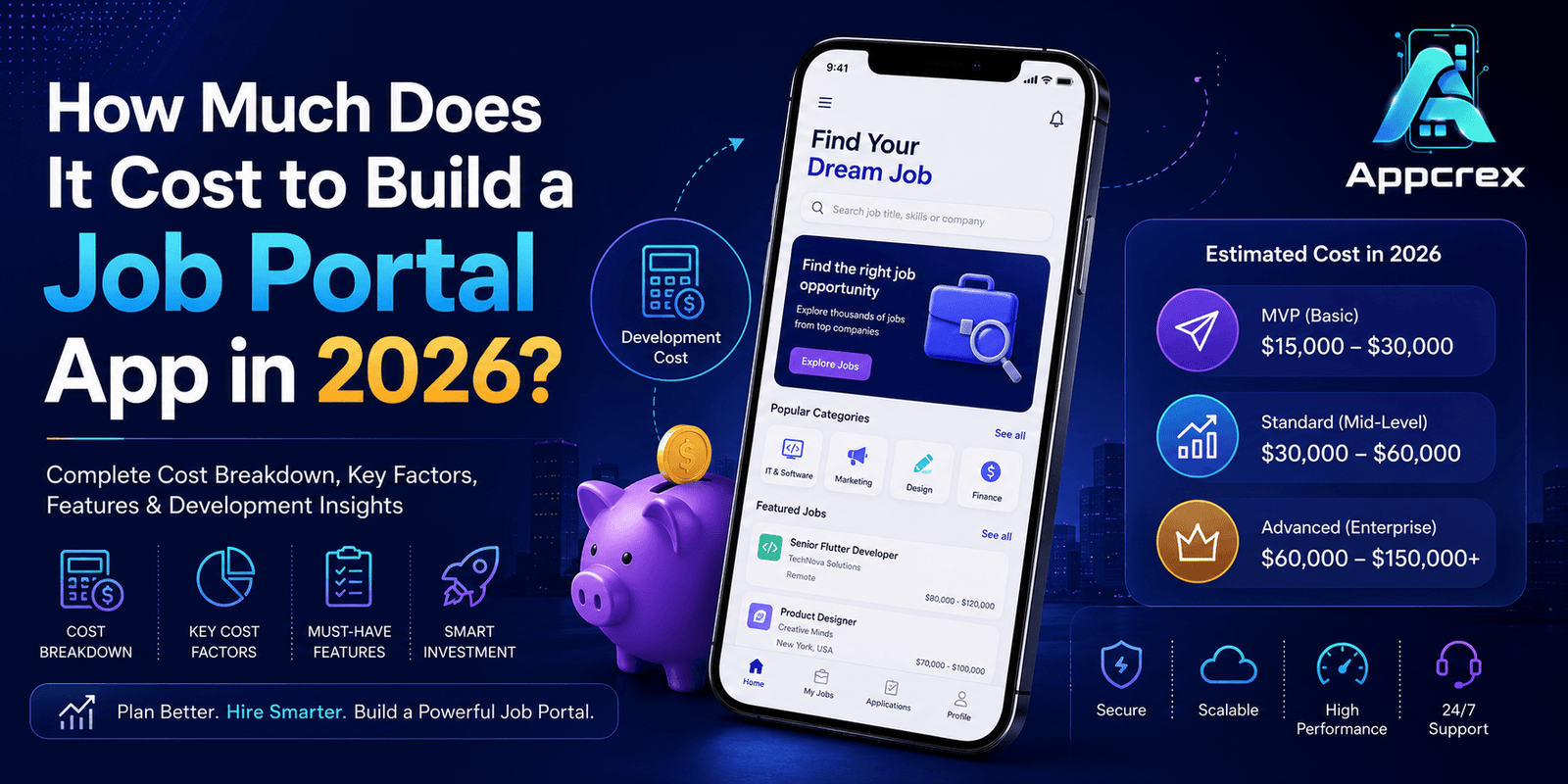
Cost by Project Complexity
| Project Type | Estimated Cost (USD) | Development Time |
|---|---|---|
| Basic Job Portal MVP | $15,000–$30,000 | 3–4 Months |
| Medium Recruitment Platform | $30,000–$60,000 | 5–7 Months |
| Enterprise Job Marketplace | $60,000–$150,000+ | 8–12+ Months |
The final investment depends on the features, integrations, technology stack, and scalability requirements.
Key Factors That Influence Development Cost
Several technical and business factors determine the overall budget.
Platform Selection
Developing for Android, iOS, or both platforms affects cost.
Cross-platform frameworks like Flutter and React Native help reduce development expenses while reaching a wider audience.
Feature Requirements
The more advanced the functionality, the greater the development effort.
Examples include:
- AI Resume Screening
- Video Interviews
- Live Chat
- Payment Integration
- Recruiter Analytics
- Job Alerts
- AI Candidate Matching
UI/UX Complexity
Custom interfaces require additional research, design, prototyping, and testing.
High-quality user experience generally improves:
- User retention
- Candidate engagement
- Recruiter productivity
Backend Infrastructure
Recruitment platforms process large volumes of data.
Backend costs increase based on:
- Database size
- API integrations
- Cloud infrastructure
- User traffic
- Security requirements
AI Integration
Artificial Intelligence adds tremendous value but also requires specialized engineering.
Common AI features include:
- Resume Parsing
- Candidate Ranking
- Job Recommendations
- AI Chatbots
- Skill Matching
- Predictive Hiring Analytics
Also Read : AI Integration Services: Complete Guide to Benefits, Use Cases, Cost & Implementation (2026)
Third-Party Services
Additional integrations may include:
- Stripe
- PayPal
- Zoom
- Google Meet
- LinkedIn Login
- Google Maps
- Firebase
- AWS
- CRM Systems
Each integration requires implementation, testing, and maintenance.
Revenue Models for Job Portal Applications
A successful recruitment platform should generate recurring revenue.
Below are the most common monetization models.
Premium Job Listings
Employers pay to feature vacancies at the top of search results.
Benefits:
- Higher visibility
- More applicants
- Faster hiring
Employer Subscription Plans
Offer monthly or yearly packages with additional features such as:
- Unlimited Job Posts
- Candidate Database Access
- AI Screening
- Advanced Analytics
Featured Company Profiles
Organizations can pay for premium employer branding.
Features may include:
- Company Videos
- Employee Stories
- Custom Branding
- Priority Placement
Candidate Premium Membership
Job seekers may subscribe for benefits like:
- Early Job Access
- Resume Reviews
- Career Coaching
- Application Insights
Advertising
Job portals can generate revenue through:
- Display Ads
- Sponsored Employers
- Recruitment Campaigns
Recruitment Services
Additional services include:
- Candidate Screening
- Recruitment Consulting
- HR Outsourcing
This creates multiple recurring revenue streams.
Common Challenges During Job Portal Development
Building a recruitment platform involves more than developing software.
Businesses should prepare for challenges such as:
Attracting Initial Users
Recruitment marketplaces require both employers and candidates.
Growth strategies are essential during launch.
Maintaining Data Quality
Duplicate listings and outdated jobs reduce platform credibility.
Strong moderation tools help maintain quality.
User Security
Recruitment platforms store sensitive personal information.
Security must remain a top priority.
Scalability
As traffic increases, infrastructure should expand without performance issues.
Cloud-native architecture supports future growth.
Why Businesses Trust AppCrex?
AppCrex delivers more than software—we build complete digital recruitment ecosystems.
Businesses choose us because we combine technical expertise with business strategy.
Our strengths include:
Complete End-to-End Development
Everything from product strategy to post-launch maintenance.
Industry Expertise
Experience across healthcare, education, enterprise, staffing, SaaS, logistics, and more.
Modern Technology
Our developers specialize in:
- Flutter
- React Native
- Android
- iOS
- Node.js
- Python
- AWS
- Azure
- AI
- Machine Learning
Transparent Development
Clients receive:
- Regular Progress Updates
- Sprint Demonstrations
- Project Roadmaps
- Dedicated Project Managers
Long-Term Partnership
We continue supporting businesses after launch through:
- Feature Enhancements
- Performance Optimization
- Security Updates
- Version Upgrades
Why Invest in a Custom Job Portal Instead of Using Existing Platforms?
Many businesses initially rely on third-party recruitment websites.
However, custom platforms offer significant advantages.
With your own recruitment application, you gain:
- Complete Branding Control
- Direct Candidate Relationships
- No Third-Party Competition
- Better Analytics
- Lower Long-Term Recruitment Costs
- Scalable Revenue Opportunities
Owning your platform creates long-term business value.
Frequently Asked Questions
1. What is a Job Portal App Development Company?
A job portal app development company designs and develops custom recruitment platforms that connect employers with job seekers through mobile and web applications.
2. How long does job portal development take?
Typical timelines include:
- MVP: 3–4 months
- Medium Platform: 5–7 months
- Enterprise Marketplace: 8–12+ months
3. Which technology is best for job portal development?
Popular technologies include:
- Flutter
- React Native
- Swift
- Kotlin
- Node.js
- Python
- AWS
The ideal stack depends on your business goals and scalability requirements.
4. Can AI improve recruitment platforms?
Yes.
AI can automate:
- Resume Screening
- Candidate Matching
- Job Recommendations
- Interview Scheduling
- Recruitment Analytics
5. Can I launch on Android and iOS together?
Absolutely.
Cross-platform frameworks like Flutter and React Native allow simultaneous deployment on both platforms.
6. Do you provide post-launch support?
Yes.
AppCrex offers:
- Maintenance
- Security Updates
- Performance Optimization
- Feature Enhancements
- Cloud Monitoring
7. Can the platform support multiple recruiters?
Yes.
Our enterprise solutions support:
- Multiple Recruiters
- HR Teams
- Departments
- Branch Offices
- Role-Based Permissions
8. Can the platform generate recurring revenue?
Yes.
Popular monetization options include:
- Premium Listings
- Employer Subscriptions
- Featured Companies
- Advertising
- Recruitment Services
Final Thoughts
The future of recruitment is digital, intelligent, and mobile-first.
Businesses that invest in modern recruitment platforms today gain a significant competitive advantage by attracting better talent, reducing hiring costs, and improving operational efficiency.
Choosing an experienced Job Portal App Development Company ensures your platform is not only functional but also scalable, secure, and ready for future growth.
At AppCrex, we help businesses transform recruitment ideas into powerful digital hiring ecosystems.
Whether you’re planning a niche recruitment platform, an enterprise hiring solution, or the next large-scale employment marketplace, our experts are ready to bring your vision to life.
