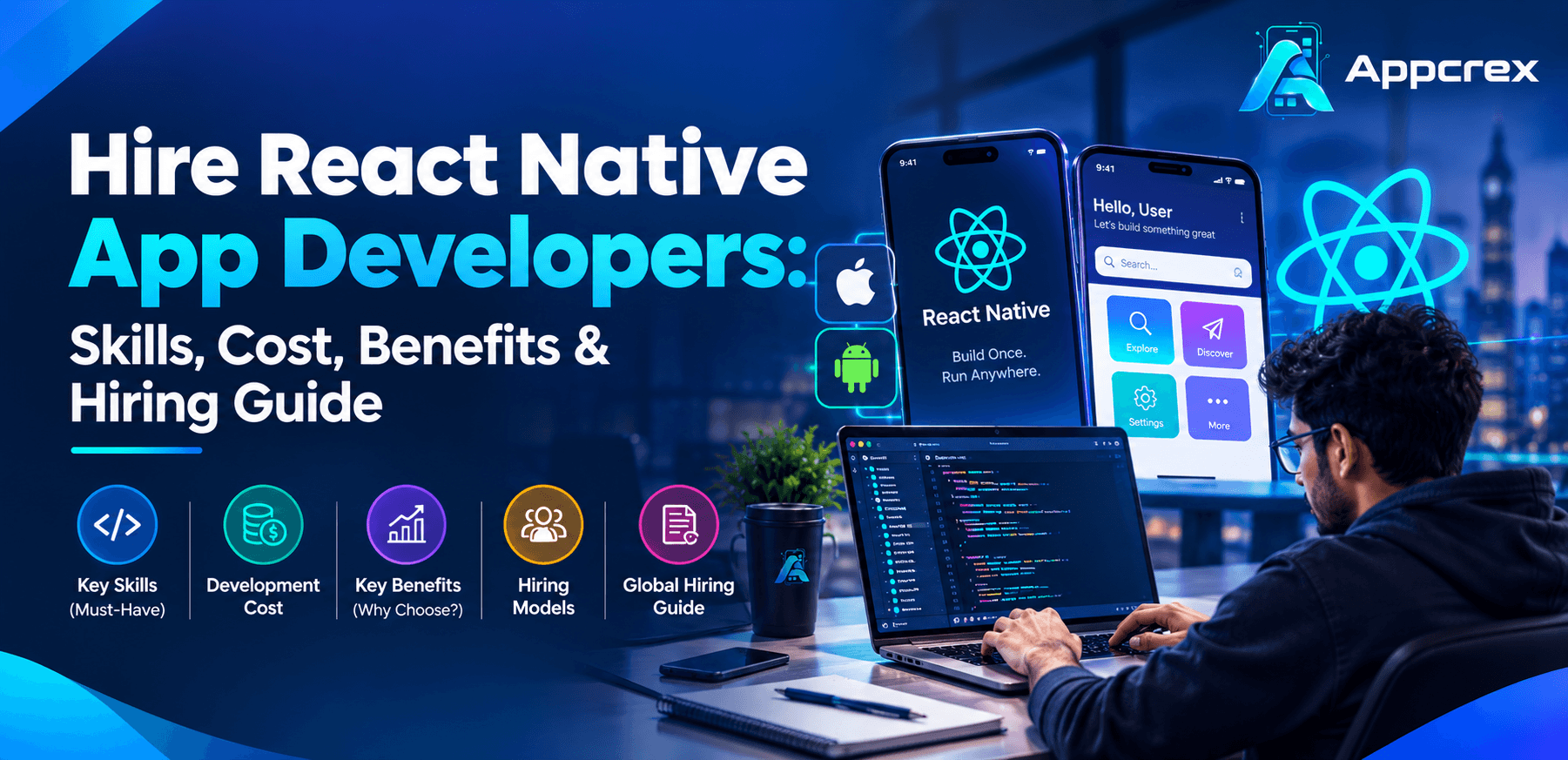
📌 Key Takeaways
- Hire React Native app developers based on relevant technical experience and your actual product requirements.
- Evaluate JavaScript, TypeScript, React Native architecture, API integration, testing, and security skills.
- Choose between freelance developers, dedicated developers, and a complete development company according to your project scope.
- Compare React Native with Flutter and native development before finalizing your technology stack.
- Budget for design, development, backend integration, testing, deployment, and ongoing maintenance.
Introduction
Businesses increasingly need mobile applications that deliver a consistent user experience across iOS and Android. However, developing and maintaining separate applications for each platform can require additional development effort, specialized resources, and ongoing coordination.
React Native offers an alternative by allowing developers to build mobile applications using JavaScript or TypeScript and a shared codebase for much of the application. This makes it a practical option for many startups, growing businesses, and enterprises that want to develop cross-platform mobile products.
However, successful React Native development requires more than knowledge of a framework. Developers must understand mobile architecture, APIs, application performance, security, testing, and platform-specific requirements.
Hiring React Native app developers means finding professionals who can turn your business requirements into a reliable, maintainable mobile application for iOS and Android. The right developers can help you validate an idea, build an MVP, modernize an existing application, or introduce new features into a growing product.
In this guide, we explain how to hire React Native developers, which skills to evaluate, how much development may cost, what hiring models are available, and how to choose a React Native app development company for your project.
What Does a React Native App Developer Do?
A React Native app developer builds and maintains mobile applications using the React Native framework. These applications can share much of their business logic and user interface code across iOS and Android, although some features may require platform-specific implementation.
Depending on the project, a React Native developer may be responsible for:
-
Building mobile application interfaces and navigation.
-
Implementing application logic with JavaScript or TypeScript.
-
Integrating REST APIs and backend services.
-
Managing application state and data.
-
Implementing authentication and user permissions.
-
Connecting payment gateways and third-party services.
-
Testing functionality across devices and operating systems.
-
Improving application performance and reliability.
-
Preparing builds for app store submission.
-
Maintaining the application after launch.
For smaller projects, one developer may handle several of these responsibilities. Larger products often need a team that includes mobile engineers, backend developers, UI/UX designers, QA engineers, and technical leadership.
Before hiring, identify the features your application needs and determine which responsibilities should belong to the React Native developer.
Why Hire React Native App Developers?
React Native can be a useful choice for businesses that want to reach users on multiple mobile platforms without maintaining entirely separate application codebases for every feature.
1. Develop for iOS and Android
One of the main reasons businesses hire React Native developers is the ability to share code between iOS and Android applications.
A shared codebase can reduce duplicated work for common functionality, such as screens, navigation, validation, and business logic.
However, code sharing is not absolute. Some integrations, device capabilities, and interface behaviors require platform-specific configuration or native code.
2. Reduce Duplicated Development Effort
Maintaining two fully separate mobile codebases can involve repeated implementation and testing.
React Native allows teams to share many components, which may simplify development and maintenance. Actual savings depend on application complexity, native integrations, team expertise, and the amount of code that can be shared.
Businesses should evaluate total project effort rather than assuming a cross-platform framework automatically cuts costs by a fixed percentage.
3. Build an MVP More Efficiently
Startups often need to validate a product idea before investing in a large application.
React Native can support an MVP that includes essential features such as user registration, profiles, search, notifications, bookings, or purchases.
Developing a focused first release allows businesses to collect user feedback and decide which features deserve further investment.
4. Maintain a Consistent User Experience
A shared component system can help teams maintain consistent branding, interactions, and workflows across platforms.
At the same time, experienced developers should understand where native platform conventions matter. A good application balances brand consistency with usability on each device.
5. Integrate APIs and Business Systems
React Native applications can connect with backend services, cloud platforms, analytics tools, payment systems, and other business applications.
For example, an e-commerce application may integrate product catalogs, inventory, customer accounts, order tracking, and payment processing.
A developer should understand API contracts, authentication, error handling, and secure data transmission—not simply how to display API responses.
6. Support Long-Term Product Development
Mobile applications rarely remain unchanged after launch. Businesses introduce features, update integrations, improve performance, and respond to customer feedback.
Hiring developers who understand code quality, testing, architecture, and documentation can make future changes easier to manage.
What Types of React Native Developers Can You Hire?
Your hiring decision should reflect the complexity of the application and the skills required to deliver it.
React Native Frontend Developer
A React Native frontend developer focuses on mobile interfaces, navigation, reusable components, user interactions, and integration with backend APIs.
This role is suitable when your application needs substantial interface development and your backend systems already exist.
Senior React Native Developer
Senior developers can take responsibility for technical decisions, application architecture, performance optimization, code reviews, and complex integrations.
They may also mentor junior developers and help establish development standards.
This role is particularly useful for products with a large codebase, demanding integrations, or long-term maintenance requirements.
Dedicated React Native Developer
A dedicated React Native developer works on your product under an agreed engagement arrangement.
This model can suit businesses that need ongoing development capacity but do not want to recruit every role as a permanent employee.
Clarify availability, reporting, responsibilities, communication, and handover arrangements before starting.
React Native Full-Stack Developer
A React Native full-stack developer combines mobile development with backend experience.
Depending on the individual’s skills, this may include API development, database integration, authentication, and server-side logic.
This can be helpful for prototypes and smaller products, although complex applications may require separate backend specialists.
React Native Development Team
A complete team may include mobile developers, backend engineers, designers, QA specialists, and a project manager or technical lead.
This model is appropriate when your product requires coordinated work across several disciplines or when you need an external team to deliver a defined project.
Essential Skills to Evaluate Before Hiring React Native Developers
A strong candidate should demonstrate practical knowledge and explain technical decisions clearly.
JavaScript and TypeScript
JavaScript is fundamental to React Native development. TypeScript adds static typing that can help teams identify certain errors earlier and make larger codebases easier to maintain.
Ask candidates how they use asynchronous operations, modules, promises, error handling, and TypeScript types in real projects.
React Fundamentals
React Native developers should understand React components, props, state, hooks, component composition, and rendering behavior.
They should also understand how to structure reusable components without making the application unnecessarily complicated.
React Native Architecture
Developers should understand application structure, navigation, platform-specific files, native modules, and the relationship between JavaScript and native platform functionality.
For larger applications, ask about modular architecture and how the team will manage dependencies between features.
State Management
Mobile applications need reliable ways to manage data and interface state.
Depending on the project, developers may use React Context, Redux Toolkit, Zustand, or other appropriate solutions.
The important question is not which library is most popular. It is whether the chosen approach suits the application’s complexity and remains understandable as the product grows.
API and Backend Integration
React Native developers should know how to connect to REST APIs and, where appropriate, GraphQL services.
Look for experience with authentication, token handling, loading states, network failures, data validation, and API error responses.
They should also understand that sensitive operations and access controls must be enforced by the backend.
Native iOS and Android Knowledge
Although React Native enables cross-platform development, developers sometimes need to work with Swift, Objective-C, Kotlin, or Java.
This may be necessary for specialized device functionality, native SDK integrations, background tasks, or platform-specific troubleshooting.
The depth of native expertise required depends on your application.
Performance Optimization
Developers should know how to diagnose slow screens, unnecessary re-renders, excessive network requests, large assets, and memory issues.
Performance should be evaluated using realistic devices and production-like scenarios rather than assumptions based on the framework alone.
Testing and Debugging
Useful skills include unit testing, component testing, integration testing, and end-to-end testing.
Depending on the application, developers may work with tools such as Jest and React Native Testing Library, along with suitable end-to-end testing frameworks.
Ask candidates how they reproduce defects and prevent previously fixed problems from returning.
Security and Privacy
Mobile applications may handle personal information, account credentials, payment-related data, and business records.
Developers should understand secure communication, appropriate credential storage, dependency management, permissions, and safe logging practices.
Applications involving sensitive or regulated data may require additional security reviews and compliance expertise.
App Store Deployment
Developers should understand the build and release process for both platforms, including signing, configuration, versioning, testing, and submission requirements.
Ask who will manage store listings, release credentials, production builds, and post-release fixes.
Also Read : How Much Does It Cost to Build a React Native App in UAE? Complete Guide (2026)
How to Hire React Native App Developers: Step-by-Step Process?
A structured hiring process helps you assess candidates consistently and avoid selecting developers based only on price or presentation.
Step 1: Define Your Application Requirements
Start by identifying the business problem and the audience your application will serve.
List the essential features, required integrations, target platforms, security requirements, and expected launch timeline.
For example, a booking application may need account creation, service listings, availability, payments, notifications, and booking management.
Separate essential launch features from improvements that can be introduced later.
Step 2: Choose Your Hiring Model
Decide whether you need a freelancer, a dedicated developer, an in-house employee, or a complete React Native app development company.
Consider the scope of work, duration, available internal expertise, and level of project management required.
If your company already has backend engineers and a product manager, one dedicated mobile developer may be sufficient. If you need end-to-end delivery, a broader team may be more appropriate.
Step 3: Review Portfolios and Relevant Experience
Ask candidates to share projects that demonstrate similar functionality or technical complexity.
Look for experience with authentication, API integration, offline behavior, notifications, payments, or other features relevant to your application.
Where possible, clarify the candidate’s actual contribution to each project.
Step 4: Conduct a Practical Technical Assessment
Use a short, realistic assessment rather than relying entirely on theoretical questions.
For example, ask the candidate to build a simple screen that retrieves data from an API, handles loading and error states, and displays the results.
Evaluate code clarity, error handling, component structure, and the ability to explain technical decisions.
Step 5: Evaluate Communication and Problem-Solving
Discuss a technical challenge the developer has encountered and how they resolved it.
Strong candidates should be able to explain trade-offs, ask clarifying questions, identify risks, and discuss alternative solutions.
Communication is particularly important when your team works remotely or collaborates across different functions.
Step 6: Compare Proposals and Engagement Terms
Review rates, availability, milestones, deliverables, payment terms, and the responsibilities included in the agreement.
For company engagements, confirm which team members will work on the project and who will be responsible for quality assurance and delivery management.
Step 7: Start With Clear Milestones
Break the work into reviewable stages, such as discovery, design, initial implementation, integration, testing, and release preparation.
Use regular demonstrations and written acceptance criteria to confirm that completed work meets expectations.
Step 8: Plan for Maintenance
Agree on how bugs, operating system updates, third-party dependency changes, and future features will be handled.
Make sure your business has appropriate access to the source code, repositories, application accounts, and project documentation.
How Much Does It Cost to Hire React Native App Developers?
The cost depends on developer experience, engagement model, project complexity, integrations, and support requirements.
A short feature implementation has a different cost profile from a complete application with custom backend services, payments, real-time functionality, and multiple user roles.
Instead of relying on one universal price, evaluate the work and team required for your particular project.
Key Factors That Affect Development Costs
Developer experience: Senior developers may charge more but can be valuable for architecture, debugging, and complex technical decisions.
Project complexity: More screens, workflows, integrations, and specialized functionality generally require additional effort.
Backend requirements: If the application needs APIs, databases, authentication services, or administration tools, backend development must be included in the estimate.
Design requirements: Custom interfaces, animations, accessibility, and extensive prototyping can affect the project budget.
Third-party integrations: Payments, maps, analytics, messaging, and other external services may require additional implementation and testing.
Quality assurance: Device compatibility, regression testing, performance checks, and security testing all contribute to the total effort.
Maintenance: Updates, bug fixes, monitoring, and new features should be included in the long-term budget.
How to Estimate Your React Native App Budget?
A practical planning formula is:
Estimated project cost = Development effort + Design + Backend and integrations + Testing and deployment + Maintenance allowance
The actual estimate should be based on the agreed scope, the team structure, and the applicable rates.
Request a breakdown that explains what is included, what is excluded, and how changes to requirements will be priced.
How to Control Development Costs?
-
Launch with a focused MVP.
-
Prioritize features by business value.
-
Confirm requirements before implementation.
-
Reuse appropriate components.
-
Identify third-party dependencies early.
-
Review progress against milestones.
-
Include testing from the beginning.
-
Reserve budget for post-launch maintenance.
The lowest initial quote is not necessarily the least expensive option over the application’s lifetime. Maintainability, quality, and clear ownership also affect total cost.
React Native vs. Flutter vs. Native App Development
React Native is one of several options for cross-platform mobile development. The right framework depends on your team’s expertise, product requirements, design needs, and integration constraints.
| Factor | React Native | Flutter | Native development |
|---|---|---|---|
| Main technologies | JavaScript or TypeScript with React | Dart | Swift for iOS; Kotlin for Android |
| Code sharing | Shared code for many mobile features | Shared code for many mobile features | Usually separate platform-specific implementations |
| UI approach | React-based components with native platform capabilities | Flutter’s widget-based rendering approach | Platform-specific UI frameworks |
| Existing team fit | Often attractive to teams experienced with React and JavaScript | May suit teams comfortable adopting Dart | Appropriate for teams focused on platform-specific engineering |
| Native integrations | Supported through libraries and native modules | Supported through plugins and native integrations | Direct access to platform APIs |
| Maintenance | Shared code can simplify many updates | Shared code can simplify many updates | Platform implementations may require separate coordination |
| Best choice | Depends on app requirements and team expertise | Depends on app requirements and team expertise | Depends on platform-specific functionality and constraints |
When Should You Choose React Native?
React Native may be suitable when:
-
You want to build for iOS and Android.
-
Your team has experience with React, JavaScript, or TypeScript.
-
You want to share application logic and many interface components.
-
Your application relies on supported libraries and integrations.
-
You want to develop an MVP or extend an existing mobile product.
When Should You Consider Flutter?
Flutter may be worth evaluating when its widget-based UI approach, rendering model, and development ecosystem better suit the product.
The decision should consider the interface requirements, developer expertise, integrations, testing needs, and long-term maintenance strategy.
When Is Native Development Better?
Native development may be appropriate when an application depends heavily on specialized platform capabilities, platform-specific SDKs, or requirements that are difficult to meet efficiently with a cross-platform framework.
An experienced technical team should assess these requirements before recommending a framework.
Why Choose a React Native App Development Company?
A React Native app development company can provide more than coding resources. Depending on the engagement, it may coordinate planning, design, mobile development, backend integration, testing, deployment, and maintenance.
Access to Multiple Skills
A complete team may include mobile developers, backend engineers, UI/UX designers, QA specialists, and technical leadership.
This can be helpful when your project requires several disciplines working together.
Structured Project Delivery
An established delivery process can help clarify requirements, track progress, review milestones, and manage scope changes.
Before hiring a company, ask how it reports progress and handles delays or technical risks.
Support Beyond the Initial Release
A mobile application may require ongoing updates, new features, dependency maintenance, and performance improvements.
Confirm whether these services are included and what the post-launch support agreement covers.
Flexible Engagement Options
Some companies provide dedicated developers, while others manage complete projects or augment existing teams.
Choose the arrangement that matches your internal capabilities and project responsibilities.
Common Mistakes to Avoid When Hiring React Native Developers
Hiring Based Only on Price
Low rates may appear attractive, but the overall result also depends on code quality, delivery reliability, and maintainability.
Compare the scope and deliverables before making a decision.
Ignoring Native Development Requirements
Not every feature can be implemented entirely through shared JavaScript or TypeScript code.
Discuss device integrations, specialized SDKs, background processing, and other platform requirements early.
Skipping Technical Assessments
A polished portfolio does not guarantee that a developer can solve your specific technical problems.
Use practical assessments and structured interviews to evaluate the required skills.
Starting Without Clear Requirements
Unclear expectations can lead to scope expansion, delays, and disputes about what should be delivered.
Document essential features, acceptance criteria, dependencies, and exclusions before development begins.
Overlooking Testing and Security
Testing and security should not be postponed until the application is almost complete.
Plan for automated tests, manual validation, secure configuration, and appropriate reviews throughout development.
Neglecting Documentation and Ownership
Your business should not lose access to its product if a developer leaves or an engagement ends.
Agree on source code ownership, repository access, documentation, credentials, and handover procedures.
Why Consider AppCrex for React Native App Development?
Choosing the right development partner starts with a clear understanding of your product goals and the capabilities required to achieve them.
AppCrex can discuss custom mobile application requirements for startups, growing businesses, and enterprises. Depending on your project scope, the engagement may include:
-
React Native app development: Cross-platform mobile application planning and implementation.
-
Custom mobile app development: Solutions built around your business requirements and user workflows.
-
UI/UX design: User journeys, wireframes, prototypes, and interface planning.
-
Backend and API integration: Connections to databases, authentication services, and third-party platforms.
-
AI feature integration: Evaluation of suitable AI services for search, conversational interfaces, recommendations, and automation.
-
Testing and deployment planning: Quality checks, release preparation, and maintenance arrangements.
Before starting, discuss your requirements, delivery milestones, team responsibilities, source code ownership, and post-launch support. The recommended team and technology choices should follow from the project rather than a one-size-fits-all package.
FAQs
1. How do I hire React Native app developers?
Define your application requirements, review relevant portfolios, evaluate JavaScript and TypeScript knowledge, and assess API integration, testing, and debugging skills. Compare engagement models and agree on deliverables before starting.
2. What skills should a React Native developer have?
Important skills include JavaScript or TypeScript, React fundamentals, React Native architecture, state management, API integration, debugging, testing, and mobile application security. Native iOS or Android experience may also be required.
3. How much does it cost to hire React Native developers?
Costs depend on experience, project scope, integrations, engagement model, and ongoing support. Request a detailed estimate based on your requirements instead of relying on a universal price.
4. Can React Native developers build applications for iOS and Android?
Yes. React Native supports both platforms and allows teams to share much of the application code. Certain features may still require platform-specific implementation or native modules.
5. Is React Native suitable for startup MVPs?
Yes. It can be a suitable option when the product requirements fit the framework and a shared codebase offers practical benefits. Define the essential features first and validate the technical requirements.
6. What is the difference between a React Native developer and a React Native app development company?
A developer implements application functionality. A development company may offer a broader team and coordinate design, mobile development, backend integration, QA, deployment, and support. Actual responsibilities depend on the engagement.
7. Can React Native integrate with existing backend systems?
Yes. React Native applications can connect to REST APIs, GraphQL services, authentication providers, databases through backend services, and other external platforms. Integration design should address permissions, error handling, and secure data transmission.
8. Can I hire dedicated React Native developers for long-term work?
Yes. Dedicated developers can support ongoing product development, maintenance, and feature improvements. Define availability, responsibilities, reporting, and handover arrangements in advance.
9. Is React Native suitable for AI-powered mobile applications?
Yes. React Native applications can integrate with AI APIs and backend services to support chatbots, intelligent search, recommendations, and other AI-enabled features. The implementation must account for privacy, performance, reliability, and operating costs.
10. What should I check before hiring a React Native development company?
Review relevant experience, technical capabilities, development processes, quality assurance, communication, ownership terms, and maintenance arrangements. Ask for a clear proposal with deliverables, milestones, and exclusions.
11. How long does React Native app development take?
The timeline depends on the scope, integrations, team size, design complexity, and testing requirements. A focused MVP may take a few months, while complex applications can require substantially longer.
12. Can React Native developers maintain an existing mobile app?
Yes. They can fix bugs, update dependencies, improve performance, add features, and help prepare releases. A technical assessment can establish the current application’s condition and identify the highest-priority improvements.
Conclusion
Hiring the right React Native app developers can help your business build a mobile application that serves users across iOS and Android while supporting future product improvements.
The process should begin with clear requirements and a realistic understanding of the technical work involved. Evaluate developers on practical skills, problem-solving, communication, and code quality. Choose an engagement model that provides the expertise and project oversight you need.
Whether you are developing an MVP, launching a customer-facing mobile product, or improving an existing application, a structured hiring process can help reduce risk and support better long-term results.
Hire React Native App Developers with AppCrex
Looking to build a custom cross-platform mobile application? AppCrex can discuss your requirements and help you evaluate an appropriate development approach.
Share your product idea, essential features, target platforms, integrations, and expected timeline to begin defining the project scope.
Explore AppCrex for custom mobile app development: https://appcrex.com/