📌 Key Takeaways
- Entertainment app development can cost around $25,000 to $300,000+, depending on complexity.
- Video streaming, social media, gaming, live entertainment, and creator platforms require different feature sets.
- AI personalization, recommendations, moderation, and content discovery can increase engagement but also affect development costs.
- USA, UK, UAE, Saudi Arabia, and India offer different opportunities for entertainment-focused digital products.
- A scalable backend, strong content management system, analytics, security, and monetization strategy are as important as the mobile interface.
Introduction
Entertainment has moved far beyond traditional television, cinema, and music platforms. Today, users watch short videos, stream movies, follow creators, join fan communities, listen to podcasts, play games, attend virtual events, and interact with brands through mobile apps.
This shift has created opportunities for businesses that want to build their own digital entertainment platforms.
An entertainment app can be a video streaming platform, creator community, short-video app, social entertainment platform, podcast app, gaming companion, live-event app, or a combination of several experiences.
According to PwC’s 2026 Global Entertainment & Media Outlook, the global entertainment and media industry generated around $3.5 trillion in 2025 and is projected to reach $4.2 trillion by 2030. Digital technologies, AI-powered personalization, advertising, streaming, and interactive experiences are important parts of this growth.
That makes entertainment app development an interesting opportunity for startups, media companies, content creators, broadcasters, event businesses, and established brands.
But the development cost depends heavily on the type of app, features, integrations, content model, platforms, and technology stack.
What Is an Entertainment App?
An entertainment app is a mobile or web platform designed to help users consume, create, share, discover, or interact with entertainment content.
The app can focus on one category or combine several experiences.
Common examples include:
- Video streaming
- Short-form video
- Music and podcasts
- Social entertainment
- Live streaming
- Gaming communities
- Celebrity and fan platforms
- Event discovery
- Digital magazines
- Creator platforms
- Movie and TV discovery
- Live events
- Interactive storytelling
- User-generated content
The business model also varies.
Some apps depend on subscriptions. Others use advertising, premium content, commissions, virtual goods, sponsorships, or a combination of these models.
Modern entertainment platforms are also becoming more personalized. Deloitte’s 2026 Media and Entertainment Outlook highlights the growing importance of user-created content, personalized content streams, audience data, and AI efficiency across the media ecosystem.
Also Read : Video Streaming App Development Company: Features, Cost & Development Process
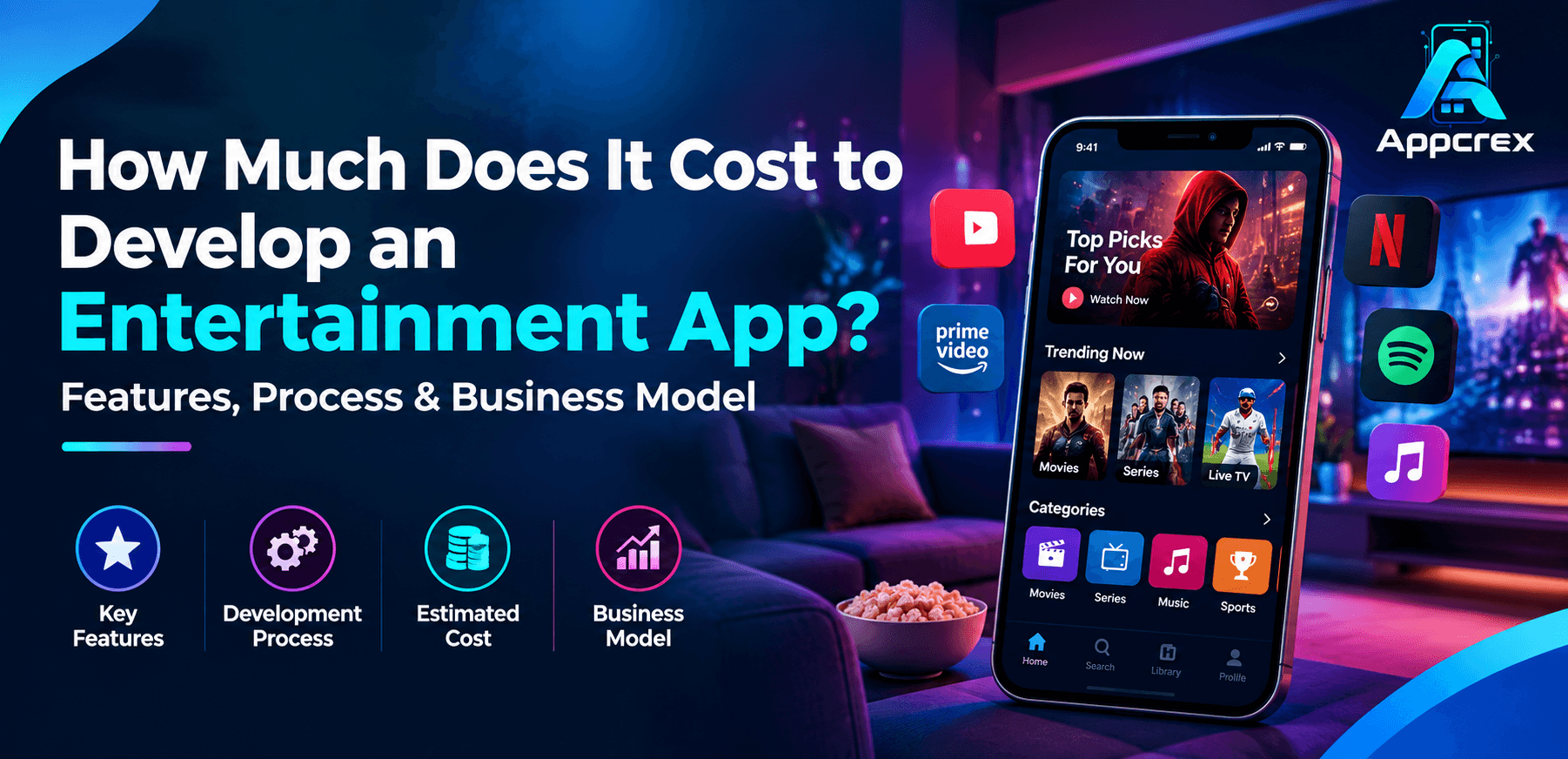
How Much Does It Cost to Develop an Entertainment App?
The cost to develop an entertainment app generally falls into these ranges:
| App Type | Estimated Development Cost | Typical Timeline |
|---|---|---|
| Basic Entertainment MVP | $25,000–$45,000 | 3–5 months |
| Standard Entertainment App | $45,000–$80,000 | 5–7 months |
| Advanced Entertainment Platform | $80,000–$150,000+ | 7–10 months |
| Large-Scale Entertainment Ecosystem | $150,000–$300,000+ | 10–15+ months |
These are planning ranges rather than fixed quotations.
For example, a simple content discovery app may need authentication, profiles, search, categories, notifications, and an admin panel.
A large streaming or social entertainment platform may require:
- Video processing
- Live streaming
- Recommendation engines
- Creator dashboards
- Social feeds
- Real-time messaging
- Content moderation
- Subscription management
- Advertising
- Analytics
- Cloud infrastructure
- Multiple payment methods
- Advanced security
Naturally, the second project requires much more engineering work.
What Determines Entertainment App Development Cost?
Several factors influence the final budget.
1. Type of Entertainment App
The app category is one of the biggest cost factors.
A podcast application has different requirements from a short-video social platform.
Similarly, a live-streaming application needs infrastructure that a simple movie-discovery application may not require.
2. Number of Platforms
Developing for:
- iOS
- Android
- Web
- Smart TV
- Tablets
- Wearables
can increase the overall budget.
A cross-platform approach using Flutter or React Native can reduce duplicated development work in some projects.
3. Backend Architecture
Entertainment apps often handle large amounts of:
- User data
- Images
- Videos
- Audio
- Comments
- Messages
- Likes
- Follows
- Recommendations
- Subscription records
The backend must therefore be designed for scalability.
4. Content Infrastructure
Video and audio applications need more than standard databases.
Depending on the product, you may need:
- Cloud storage
- Content delivery networks
- Video transcoding
- Compression
- Streaming infrastructure
- DRM
- Content management
- Media processing
- Backup systems
These components can significantly affect both development and operating costs.
Entertainment App Development Features
A successful entertainment platform needs features that support both users and business operators.
User Registration and Profiles
Users should be able to create accounts through:
- Phone number
- Social login
- Apple or Google authentication
Profiles can store preferences, watch history, playlists, favorites, followed creators, and subscription information.
Personalized Home Feed
Personalization is becoming an important part of entertainment products.
Instead of showing identical content to every user, the app can analyze:
- Viewing history
- Search activity
- Likes
- Shares
- Follows
- Completion rate
- Genre preferences
- Session behavior
The system can then recommend relevant content.
Search and Discovery
A strong search system helps users find:
- Movies
- Shows
- Songs
- Creators
- Podcasts
- Events
- Videos
- Categories
- Topics
Filters and smart suggestions can make discovery faster.
Content Categories
Depending on the business model, categories could include:
- Movies
- TV shows
- Music
- Podcasts
- Sports
- Gaming
- Comedy
- News
- Short videos
- Live events
- Creator content
Social Media App Development for Entertainment Platforms
Social media app development can add a powerful engagement layer to an entertainment platform.
Instead of simply allowing users to consume content, businesses can let users participate in the content ecosystem.
Common social features include:
- User profiles
- Followers and following
- Likes
- Comments
- Shares
- Direct messaging
- Stories
- Short videos
- Live streaming
- Hashtags
- Mentions
- Communities
- Creator profiles
- Notifications
- Trending content
This model can turn a standard entertainment application into a community-driven platform.
For example, users could watch a show, discuss it with other users, follow related creators, share clips, and receive recommendations based on their activity.
Deloitte’s 2026 research notes that audiences increasingly engage with fandom across multiple platforms and that entertainment businesses are exploring year-round social content, shopping, and exclusive experiences.
AI Features in Entertainment Apps
AI can improve both the user experience and the business side of an entertainment platform.
AI Recommendation Engine
The recommendation engine can suggest content based on individual behavior.
For example:
User watches three comedy videos → AI identifies similar interests → app recommends related creators and videos.
AI Content Moderation
For social entertainment platforms, moderation becomes important as users upload content.
AI can help identify potentially problematic:
- Images
- Videos
- Comments
- Text
- Audio
Human review can remain part of the moderation workflow where needed.
AI Search
Users can search using natural language instead of exact keywords.
For example:
“Show me funny family movies under two hours.”
The system can interpret the request and return relevant results.
AI Chatbot
An AI chatbot can help users discover content, manage subscriptions, answer questions, or navigate the platform.
This is where an AI app development company can help integrate conversational AI into an entertainment product.
AI Agents
More advanced platforms can also explore AI agents for workflows such as:
- Content tagging
- Customer support
- Creator assistance
- Content analysis
- Recommendation workflows
- Marketing automation
An AI agent development company can design these workflows around the business’s specific requirements.
Advanced Entertainment App Features
A large-scale platform may require additional functionality.
Live Streaming
Useful for:
- Concerts
- Sports
- Gaming
- Events
- Creator broadcasts
- Interviews
Real-Time Chat
Users can communicate during live broadcasts or events.
Watch Parties
Users can watch content together while communicating through chat or reactions.
Creator Dashboard
Creators can manage:
- Content
- Followers
- Revenue
- Analytics
- Comments
- Subscribers
Subscription Management
Users can select different subscription plans and manage billing.
Digital Wallet
For apps using virtual credits or purchases, a wallet system may be required.
Push Notifications
Notifications can promote:
- New releases
- Live streams
- Creator activity
- Personalized recommendations
- Subscription updates
- Special events
Entertainment App Monetization Models
Choosing the monetization strategy early can influence your architecture and features.
Subscription Model
Users pay monthly or annually for premium access.
This model works well for:
- Streaming
- Premium content
- Exclusive communities
- Educational entertainment
- Creator platforms
Advertising Model
The app can generate revenue through:
- Banner ads
- Native ads
- Video ads
- Sponsored content
- Rewarded ads
Advertising is an important part of the wider entertainment ecosystem. PwC expects global advertising revenue across entertainment and media to reach approximately $1.4 trillion by 2030, with AI-powered personalization playing an important role.
Freemium Model
Users receive basic features for free and pay for premium functionality.
In-App Purchases
Possible purchases include:
- Virtual gifts
- Coins
- Premium videos
- Exclusive content
- Creator subscriptions
- Digital items
Commission Model
If the platform connects users with creators, performers, event organizers, or other businesses, the platform can take a percentage from transactions.
Where Is Entertainment App Development in High Demand?
Entertainment apps can target different markets depending on content, language, monetization, and audience behavior.
USA
The USA remains a major entertainment and media market.
PwC reports that the US video streaming market generated $113.3 billion in 2025, making it the world’s largest video streaming market that year.
For developers, opportunities can include:
- Streaming platforms
- Social entertainment
- Creator apps
- Sports entertainment
- Gaming communities
- Live events
- AI-powered content discovery
For businesses targeting this market, scalability, privacy, subscription infrastructure, content licensing, and analytics are important considerations.
UK
The UK has a mature digital entertainment ecosystem, making it suitable for products focused on:
- Streaming
- Social video
- Podcasts
- Gaming
- Creator communities
- Live entertainment
- Digital content subscriptions
A UK-focused entertainment application may also need strong privacy, payment, moderation, and content-management capabilities.
UAE
The UAE is an important market for premium digital experiences and multilingual applications.
Entertainment products can target:
- Streaming
- Events
- Social entertainment
- Influencer communities
- Luxury experiences
- Gaming
- Creator platforms
Arabic and English support can be valuable when designing the user experience for the region.
Saudi Arabia
Saudi Arabia is another market worth considering for entertainment technology.
Deloitte’s 2026 Saudi consumer research highlights high digital adoption and growing expectations around connected digital experiences. Its survey of 1,000 Saudi consumers aged 18–50 also examined video consumption, online engagement, AI usage, and social-media behavior.
Potential entertainment products include:
- Video platforms
- Gaming apps
- Social entertainment
- Live-event platforms
- Creator communities
- Arabic entertainment applications
Arabic-first UX, localization, payment support, moderation, and regional content can become important development considerations.
India
India has a large and rapidly evolving digital entertainment ecosystem.
EY and FICCI reported that India’s media and entertainment sector grew 9% in 2025 to INR 2.78 trillion, while digital media crossed INR 1 trillion in revenue. Paid video subscriptions also reached 216 million in 2025.
Entertainment businesses can explore:
- Short-video platforms
- OTT applications
- Music and podcast platforms
- Social media entertainment
- Regional-language content
- Creator platforms
- Gaming communities
- Live-event applications
India is especially interesting for apps that support multiple languages and different pricing models.
Technology Stack for Entertainment App Development
The technology stack depends on the application’s scale.
| Layer | Possible Technologies |
|---|---|
| iOS | Swift |
| Android | Kotlin |
| Cross-Platform | Flutter, React Native |
| Backend | Node.js, Python, Java, .NET |
| Database | PostgreSQL, MySQL, MongoDB |
| Cloud | AWS, Microsoft Azure, Google Cloud |
| Real-Time | WebSockets, Firebase |
| Video | AWS Media Services, Cloudflare, specialized video infrastructure |
| AI/ML | Python, TensorFlow, PyTorch, cloud AI services |
| Payments | Stripe, PayPal, regional payment gateways |
| Analytics | Firebase, GA4, Mixpanel, custom analytics |
The final stack should be selected according to the product rather than simply following the latest technology trend.
How to Build an Entertainment App?
A structured development process reduces technical and business risks.
Step 1: Define the Entertainment Concept
Start by deciding what users will do inside the application.
For example:
- Watch videos
- Create videos
- Listen to podcasts
- Follow creators
- Join communities
- Buy event tickets
- Watch live content
Avoid trying to launch every feature at once.
Step 2: Research the Target Audience
Understand:
- Age groups
- Location
- Content preferences
- Spending behavior
- Devices
- Languages
- Subscription preferences
This information helps shape the product.
Step 3: Select the Business Model
Decide whether the app will use:
- Subscription
- Advertising
- Freemium
- Commission
- In-app purchases
- Sponsorships
The monetization model should influence the product architecture from the beginning.
Step 4: Build the MVP
Start with the features required to validate the idea.
An entertainment MVP might include:
- Registration
- Profiles
- Content feed
- Search
- Categories
- Content player
- Favorites
- Notifications
- Admin dashboard
Social features and AI can then be added in later versions.
Step 5: Design UI/UX
Entertainment applications depend heavily on visual experience.
The interface should make it easy to:
- Discover content
- Continue watching
- Save content
- Follow creators
- Share content
- Manage subscriptions
Step 6: Develop Backend and APIs
The backend handles:
- Authentication
- Content
- User activity
- Recommendations
- Payments
- Notifications
- Analytics
- Moderation
Step 7: Add AI and Advanced Features
Once the core application works, businesses can add:
- Recommendation engines
- AI search
- AI chatbot
- AI moderation
- Predictive analytics
- AI personalization
- AI agents
This phased approach can help control the initial development budget.
Step 8: Test and Launch
Testing should cover:
- Performance
- Security
- Streaming quality
- Payments
- Device compatibility
- API reliability
- User flows
- Content moderation
After launch, analytics should guide future improvements.
How Much Does It Cost to Add AI to an Entertainment App?
AI costs vary according to the use case.
| AI Function | Approximate Development Range |
|---|---|
| Basic AI Recommendation | $5,000–$15,000 |
| AI Search | $5,000–$15,000 |
| AI Chatbot | $5,000–$20,000 |
| AI Content Moderation | $8,000–$25,000 |
| Advanced Personalization | $15,000–$40,000+ |
| AI Agent Workflows | $15,000–$50,000+ |
These figures are planning estimates. API usage, model selection, data preparation, integrations, infrastructure, and ongoing inference costs can change the total.
Businesses may also require an AI integration service when connecting third-party AI models with an existing entertainment application.
For example, AI chatbot integration may connect customer support, subscriptions, content discovery, and account management into a single conversational experience.
Entertainment App Development Challenges
Entertainment applications have several technical and business challenges.
Content Licensing
If the platform distributes movies, music, sports, or other copyrighted material, licensing must be handled properly.
Scalability
A sudden increase in users can put pressure on:
- Servers
- Databases
- APIs
- Streaming infrastructure
- CDN
- Notifications
Content Moderation
User-generated platforms need systems to detect and handle inappropriate content.
User Retention
Users have many entertainment choices.
Personalized feeds, social interaction, fresh content, notifications, and loyalty features can help businesses build stronger engagement.
Security
The app may store:
- Personal information
- Payment details
- Viewing history
- User-generated content
- Subscription records
Security should therefore be considered from the architecture stage.
How Can You Reduce Entertainment App Development Cost?
You do not need to build every advanced feature in version one.
Consider these approaches:
Start With an MVP
Build the core user journey first.
Use Cross-Platform Development
Flutter or React Native may help reduce duplicated development effort for suitable projects.
Use Cloud Services
Managed cloud infrastructure can reduce the need to build every backend component from scratch.
Integrate Proven APIs
Third-party services can handle payments, analytics, authentication, messaging, and selected AI capabilities.
Add AI in Phases
Start with one valuable AI feature instead of building a complete AI ecosystem immediately.
Design for Scalability
A cheap initial architecture can become expensive when the user base grows. Plan the backend for future expansion.
Why Choose AppCrex for Entertainment App Development?
AppCrex can help businesses develop entertainment applications from concept to launch.
Our entertainment app development services can cover:
- iOS app development
- Android app development
- Cross-platform app development
- Social media app development
- Video streaming applications
- Creator platforms
- Podcast applications
- Live-streaming solutions
- AI-powered recommendations
- AI chatbot integration
- AI personalization
- Cloud backend development
- Payment integration
- Subscription systems
- Analytics dashboards
- Admin panels
- API integration
- Post-launch maintenance
We can also help businesses evaluate the MVP scope, technology stack, monetization strategy, integrations, and scalability requirements before development begins.
FAQs
Q. How much does it cost to develop an entertainment app?
An entertainment app can cost approximately $25,000 to $300,000+, depending on features, platforms, content infrastructure, integrations, AI capabilities, and scalability requirements.
Q. How long does it take to build an entertainment app?
A basic MVP may take around 3–5 months. A standard platform can take 5–7 months, while advanced entertainment ecosystems can require 7–15+ months.
Yes. You can combine entertainment content with profiles, followers, likes, comments, sharing, messaging, communities, stories, short videos, and live streaming.
Q. Is AI useful for entertainment apps?
Yes. AI can support recommendations, personalization, search, moderation, content tagging, customer support, and AI agents.
Q. Can AppCrex develop an entertainment app for the USA?
Yes. AppCrex can develop entertainment platforms for businesses targeting the USA and other international markets, including the UK, UAE, Saudi Arabia, Canada, and India.
Q. Can an entertainment app support Arabic and English?
Yes. The application can be designed with multilingual architecture and Arabic RTL support when targeting markets such as the UAE and Saudi Arabia.
Q. What is the best technology for entertainment app development?
There is no single technology that fits every entertainment app. Flutter or React Native can work well for many cross-platform products, while native iOS and Android development may be preferred for applications requiring deeper platform-specific capabilities.
Q. How do entertainment apps make money?
Common models include subscriptions, advertising, premium content, commissions, sponsorships, virtual goods, and in-app purchases.
Conclusion
Entertainment app development is no longer limited to building a simple video or music player.
Modern entertainment platforms combine content, social interaction, personalization, AI, community features, subscriptions, advertising, and analytics.
The right development strategy depends on the audience and business model. A startup may begin with a focused MVP, while an established media company may require a complete streaming, social, and AI-powered ecosystem.
Markets such as the USA, UK, UAE, Saudi Arabia, and India offer different opportunities for entertainment products. The important step is to identify the right audience, content model, monetization strategy, and feature set before development begins.
If you are planning an entertainment platform, AppCrex can help turn the concept into a scalable mobile and web product.
Build Your Entertainment App With AppCrex
Looking to build an entertainment app with social media features, AI personalization, streaming, subscriptions, creator tools, or custom monetization?
AppCrex can help you plan, design, develop, integrate, and scale your entertainment application. Contact AppCrex to discuss your entertainment app idea and development requirements.