📌 Key Takeaways
- Deep learning helps businesses build intelligent AI applications and automate complex tasks.
- Custom deep learning solutions support computer vision, NLP, predictive analytics, and AI integration.
- The right model depends on business goals, data, and technical requirements.
- Development costs depend on model complexity, data, infrastructure, and application features.
- Successful AI solutions require proper testing, deployment, security, and ongoing monitoring.
Introduction
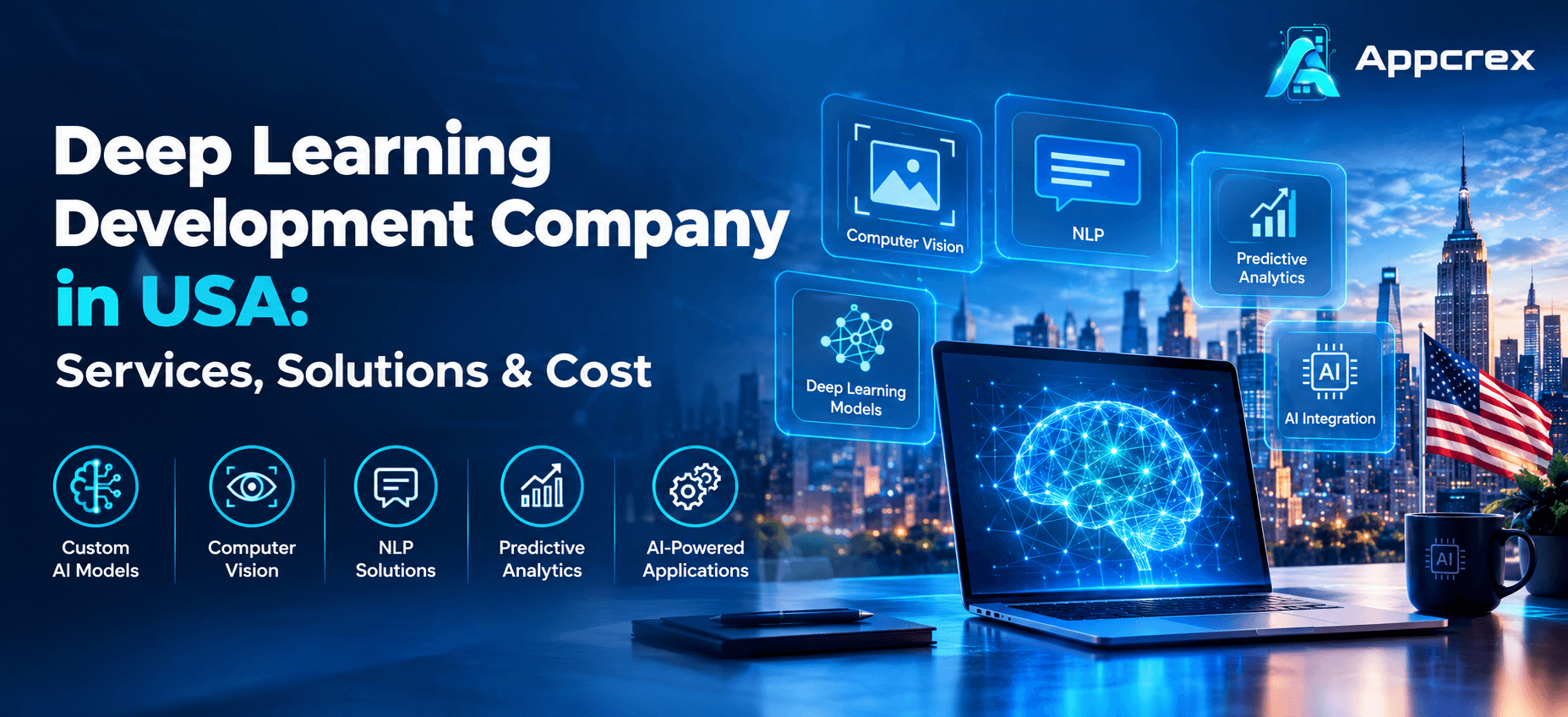
AppCrex is a deep learning development company serving businesses in the USA with custom AI models, computer vision, natural language processing, predictive analytics, and AI-powered application development. We help businesses explore, build, integrate, and deploy deep learning solutions based on their operational requirements, available data, and business goals.
As an experienced app development company in the USA, AppCrex helps businesses build intelligent digital products by combining deep learning, AI integration, and custom application development to solve real business challenges.
Deep learning enables software applications to recognize patterns, analyze complex information, process images, understand language, and support intelligent automation. Businesses can use these capabilities to improve existing applications, develop new AI-powered products, and streamline selected workflows.
Our deep learning development services focus on practical business applications. Whether you need a custom neural network, an AI-powered software application, an image recognition system, or deep learning integration into an existing platform, we can help you plan the right development approach.
Looking for a deep learning development company in the USA? AppCrex can help you evaluate your requirements, identify suitable AI technologies, and develop a solution aligned with your business objectives.
What Is Deep Learning Development?
Deep learning development is the process of building AI systems that use multi-layer neural networks to learn patterns from data and perform tasks such as image recognition, language processing, prediction, and classification.
Unlike traditional software that follows only predefined rules, deep learning models learn patterns from training data. Once developed and evaluated, these models can be integrated into applications to support specific business tasks.
For example, a manufacturing company may use deep learning to identify product defects from images. A retailer may use it to improve visual product search. A financial services company may explore deep learning to analyze transaction patterns.
Deep learning development typically includes:
- Business requirement analysis
- Data assessment and preparation
- Model selection
- Neural network development
- Model training and evaluation
- AI application integration
- Deployment and monitoring
The right approach depends on the business problem. Deep learning is particularly useful for complex data such as images, text, audio, and large datasets, but traditional machine learning or rule-based systems may be more appropriate for some applications.
Deep Learning Development Services in USA
AppCrex provides deep learning development services for businesses looking to build intelligent applications, automate selected processes, and integrate AI capabilities into their software.
Our development approach considers the business objective, data availability, technical requirements, application architecture, and expected outcomes.
1. Custom Deep Learning Model Development
Custom deep learning model development helps businesses build AI systems around specific requirements rather than relying entirely on generic solutions.
Our custom model development process can include:
- Business problem assessment
- Dataset analysis
- Neural network architecture selection
- Model development
- Training and experimentation
- Performance evaluation
- Application integration
Depending on the use case, we can explore convolutional neural networks, transformer-based architectures, recurrent neural networks, and other suitable deep learning techniques.
For example, a company processing thousands of product images may need a model that identifies specific product categories. A business analyzing customer documents may require a model that extracts relevant information from text.
The model should be selected based on the problem, available data, accuracy requirements, inference speed, and deployment environment.
2. Computer Vision Development Services
Computer vision enables software applications to analyze images and video and identify relevant information.
Deep learning-based computer vision can support businesses that need automated visual analysis, image classification, object detection, or image-based information processing.
Our computer vision development services can include:
- Image classification
- Object detection
- Image segmentation
- Image recognition
- Visual inspection
- Video analytics
- Image-based search
- Automated visual monitoring
Business example: A manufacturing company can explore computer vision to identify visible product defects during quality inspection. The system analyzes images and flags potential issues for further review.
Other applications include retail product recognition, construction site monitoring, warehouse image analysis, and visual inventory workflows.
The performance of computer vision systems depends on image quality, training data, environmental conditions, and the model’s ability to handle variations.
3. Natural Language Processing and Deep Learning
Natural language processing (NLP) helps software applications analyze, understand, and process human language.
Deep learning has made NLP applications more capable of handling complex text, context, classification, summarization, and language-related tasks.
Our NLP and deep learning development services can support:
- Text classification
- Sentiment analysis
- Document processing
- Information extraction
- Semantic search
- Text summarization
- Language-based AI assistants
- Conversational AI integration
For example, an enterprise application may use NLP to classify customer inquiries and organize them by topic. A document management platform may use AI to summarize business documents and extract important information.
For applications involving large language models, development may also include prompt engineering, retrieval-augmented generation (RAG), model evaluation, and AI workflow integration.
4. Predictive Analytics and Deep Learning
Deep learning can help businesses identify complex patterns in historical and real-time data.
Depending on the business problem, deep learning models may support forecasting, classification, anomaly detection, and pattern recognition.
Potential applications include:
- Demand forecasting
- Customer behavior analysis
- Equipment failure prediction
- Operational forecasting
- Risk pattern analysis
- Business data classification
For example, a logistics company may use historical operational data to support demand forecasting. A manufacturing business may explore equipment monitoring to identify patterns associated with maintenance requirements.
Deep learning should not be selected automatically for every predictive analytics project. Traditional machine learning, statistical methods, and optimization techniques may offer better results for some business problems.
5. Deep Learning Application Development
Deep learning application development combines AI models with software functionality to create applications that solve business problems.
Businesses may need a complete application rather than a standalone model.
AppCrex can help plan and develop AI-powered applications involving:
- Web application development
- Mobile application development
- Backend development
- AI model integration
- Database integration
- API development
- Application testing
- Deployment planning
For example, a retail business may need a mobile application that uses image recognition to help customers discover products. The application may include a frontend, backend services, product database, and AI model integration.
The development approach depends on the required features, user experience, application platform, and technical environment.
6. Deep Learning Model Integration
Businesses with existing software may want to add AI capabilities without rebuilding their entire application.
Deep learning model integration can help connect AI functionality with existing applications, databases, APIs, and business workflows.
Integration services may include:
- AI model API development
- Backend integration
- Data processing
- Application workflow integration
- Model output validation
- Authentication and access controls
- Performance testing
- Deployment support
For example, an existing customer support platform may integrate a deep learning model to classify incoming messages and prepare responses for human review.
Integration should include appropriate error handling, data validation, security controls, and monitoring.
7. Deep Learning Consulting and AI Strategy
Businesses often need technical guidance before investing in custom AI development.
Deep learning consulting can help evaluate whether the proposed application is technically feasible and whether deep learning is the right approach.
Our planning process can address:
- Business use case identification
- AI feasibility assessment
- Data availability
- Model selection
- Technical architecture
- Development scope
- Project requirements
- Deployment considerations
This helps businesses make informed decisions before committing to a larger development project.
Deep Learning Solutions for USA Businesses
Businesses in the United States operate across different industries, each with its own data, workflows, and technology requirements.
Deep learning can support industry-specific applications when the model is developed around a clearly defined problem.
Deep Learning for Healthcare
Healthcare organizations can explore deep learning for medical image analysis, administrative documentation, information processing, and selected healthcare workflows.
Potential applications include:
- Medical image classification
- Healthcare document processing
- Medical research data analysis
- Patient communication assistance
- Healthcare information retrieval
- Administrative workflow automation
Healthcare applications require careful attention to patient privacy, data security, clinical validation, and applicable regulations.
AI-generated information should not replace qualified medical professionals or be used for clinical decisions without appropriate validation and oversight.
Deep Learning for Banking and Financial Services
Banks, fintech companies, and financial service providers can explore deep learning to analyze complex data and support selected business operations.
Potential applications include:
- Transaction pattern analysis
- Fraud detection support
- Financial document classification
- Customer behavior analysis
- Risk modeling
- Financial information processing
For example, a financial institution may use deep learning to identify unusual patterns in transaction data for further investigation.
Financial AI applications require appropriate security, governance, testing, and regulatory review.
Deep Learning for Retail and Ecommerce
Retail businesses can use deep learning to improve product discovery, visual search, customer experience, and operational analytics.
Our potential ecommerce and retail use cases include:
- Product image recognition
- Visual product search
- Recommendation systems
- Customer behavior analysis
- Demand forecasting
- Product classification
- Image-based inventory workflows
A visual search application, for example, may allow customers to upload an image and find similar products in a catalog.
The system needs accurate product data, suitable images, and testing across different product categories.
Deep Learning for Manufacturing
Manufacturing companies can explore deep learning to support quality inspection, equipment monitoring, and production analytics.
Potential applications include:
- Automated defect detection
- Visual quality inspection
- Equipment condition analysis
- Predictive maintenance
- Production monitoring
- Industrial image recognition
Deep learning can help identify patterns in industrial images and sensor data.
However, models should be tested in the actual production environment. Lighting, equipment variation, image quality, and operating speed can affect performance.
Deep Learning for Logistics and Transportation
Logistics businesses manage large amounts of operational data, shipment information, documents, and customer inquiries.
Deep learning applications may support:
- Shipment document classification
- Package image analysis
- Demand forecasting
- Delivery information processing
- Operational pattern analysis
- Logistics document extraction
For example, an AI-powered logistics application may classify shipping documents and extract information for review by operations teams.
Route optimization and scheduling may require additional algorithms beyond deep learning.
Deep Learning for Real Estate and Construction
Real estate and construction businesses can use deep learning to analyze property images, construction documents, and visual information.
Potential applications include:
- Property image classification
- Visual property search
- Construction image analysis
- Document processing
- Site monitoring
- Building-related data analysis
The appropriate solution depends on the available data and the intended business outcome.
Deep Learning for Agriculture
Agriculture businesses can explore deep learning for crop image analysis, plant monitoring, quality inspection, and agricultural data processing.
Potential applications include:
- Crop image classification
- Plant disease detection assistance
- Agricultural image analysis
- Product quality inspection
- Crop monitoring
These applications need representative data and testing across different environmental conditions.
Deep Learning Technologies and Tools
The deep learning technology stack depends on the model, application requirements, available data, and deployment environment.
Deep Learning Frameworks
Depending on the project, development may use:
- TensorFlow: Deep learning model development and deployment workflows.
- PyTorch: Neural network development, experimentation, and training.
- Keras: High-level model development and experimentation.
- OpenCV: Image processing and computer vision workflows.
- Hugging Face: Model libraries and tools for language and other AI applications.
The framework should be selected based on the project requirements rather than popularity alone.
Programming Languages
Python is widely used in deep learning development because of its AI libraries, data processing ecosystem, and model development tools.
Other programming languages may be used for application integration, backend services, mobile applications, and performance-sensitive components.
Data Processing and Model Training
Deep learning development may require data cleaning, labeling, preprocessing, dataset splitting, training, and evaluation.
The process depends on the dataset size, data quality, model architecture, and expected performance.
For some applications, transfer learning or pretrained models can reduce the need to train a model from scratch.
Cloud Infrastructure and Deployment
Deep learning applications may require cloud infrastructure for training, storage, model serving, and application hosting.
Infrastructure planning can consider:
- GPU availability
- Model size
- Inference speed
- Expected traffic
- Data storage
- Security
- Scalability
- Operating costs
The deployment environment should support the application’s performance and business requirements.
Our Deep Learning Development Process
AppCrex follows a structured development approach to help businesses plan, build, test, and integrate deep learning applications.
1. Business Requirement Analysis
We begin by understanding the business problem, target users, application requirements, available data, and expected outcomes.
This helps identify the role deep learning should play in the application.
2. Data Assessment and Preparation
We assess the available data and identify preparation requirements.
This may include data cleaning, labeling, preprocessing, quality checks, privacy considerations, and training dataset planning.
The amount of data needed depends on the model, use case, and whether pretrained models are suitable.
3. Model Selection and Architecture Planning
We evaluate possible model architectures based on the problem and technical requirements.
For example, image processing may require a computer vision model, while language-based applications may use transformer-based architectures.
The selection should consider accuracy, complexity, latency, data requirements, and deployment constraints.
4. Model Development and Training
The model is developed and trained using suitable data and methods.
The process may involve experimentation, parameter tuning, model comparison, and training optimization.
For some projects, transfer learning can help adapt an existing model to a specific business application.
5. Model Evaluation and Testing
The model is evaluated using appropriate test data and performance criteria.
Depending on the application, evaluation may include:
- Accuracy
- Precision
- Recall
- Classification performance
- Error analysis
- Inference latency
- Robustness
- Performance across relevant data groups
The evaluation criteria should reflect the business problem rather than relying on one metric.
6. Application Development and Integration
The model is integrated into the intended application.
This may involve frontend development, backend services, APIs, database integration, authentication, and application workflows.
The application should handle invalid inputs, unavailable model services, errors, and unexpected outputs.
7. Deployment and Production Testing
The application and model are prepared for the selected deployment environment.
Deployment may include cloud hosting, containerization, model serving, monitoring, access controls, and production testing.
The architecture should support the expected traffic, performance, and security requirements.
8. Monitoring and Maintenance
After deployment, the application may require ongoing monitoring and improvements.
Maintenance can include model performance review, data quality checks, model updates, retraining, security updates, and infrastructure optimization.
The maintenance plan should reflect how frequently the data and business requirements change.
How Much Does Deep Learning Development Cost in USA?
Deep learning development costs vary based on the project scope, data requirements, model complexity, application features, and deployment environment.
A project that integrates an existing model may require less development than a custom deep learning application involving data preparation, model training, backend development, and production deployment.
Factors That Affect Deep Learning Development Cost
Project complexity: A basic image classification application and an industrial computer vision system have different development requirements.
Data preparation: Data collection, cleaning, labeling, and validation can significantly affect project effort.
Model development: Custom architecture development, training, experimentation, and evaluation influence the scope.
Application development: Web applications, mobile applications, APIs, dashboards, and third-party integrations add development requirements.
Infrastructure: GPU resources, cloud hosting, storage, and model serving may create ongoing costs.
Security and compliance: Sensitive data and regulated use cases may require additional safeguards, testing, and documentation.
Maintenance: Model monitoring, retraining, technical support, and infrastructure updates should be included in long-term planning.
How to Estimate Your Project?
To get a more useful estimate, businesses should define:
- The business problem
- Available data and its quality
- Required AI functionality
- Application platform
- Integration requirements
- Deployment environment
- Testing and security requirements
- Maintenance expectations
A defined scope helps identify development effort, technical dependencies, and potential risks.
Why Choose AppCrex for Deep Learning Development?
Choosing a deep learning development company requires evaluating technical capabilities, business understanding, communication, and the ability to deliver a practical application.
AppCrex can help businesses explore deep learning projects involving:
- Custom AI model development
- Computer vision applications
- NLP and language processing
- Predictive analytics
- AI model integration
- Backend and API development
- Web and mobile applications
- AI application testing
- Deployment and maintenance planning
Businesses looking to hire app developers in the USA for AI-powered products can work with AppCrex to build custom applications, integrate deep learning models, and develop scalable digital solutions tailored to their business goals.
Our approach begins with understanding the business requirements and identifying the right technical solution.
For USA businesses, project planning can also consider target users, application workflows, data requirements, security expectations, and operational needs.
We focus on building solutions that address defined business objectives rather than adding AI functionality without a clear purpose.
Deep Learning Development Company for USA Businesses
Deep learning can help businesses develop intelligent software, analyze complex data, and support selected operational workflows.
But successful implementation requires more than selecting a neural network.
Businesses need suitable data, an appropriate model, reliable application integration, evaluation, security, and a deployment plan.
AppCrex can help you explore custom deep learning solutions based on your business requirements and technical environment.
Whether you are developing a new AI-powered product or adding deep learning functionality to an existing platform, the right development strategy begins with a clearly defined problem.
FAQs
Q. What does a deep learning development company do?
A deep learning development company helps businesses design, develop, train, evaluate, integrate, and deploy deep learning models and AI-powered applications.
Services may include custom model development, computer vision, NLP, predictive analytics, AI integration, testing, and maintenance.
Q. What are deep learning development services?
Deep learning development services include custom neural network development, model training, computer vision, natural language processing, predictive analytics, AI integration, model evaluation, deployment, and maintenance.
The exact services depend on the business problem and application requirements.
Q. How much does deep learning development cost in the USA?
Deep learning development costs depend on project complexity, data preparation, model development, application features, infrastructure, testing, and maintenance.
A reliable estimate requires a defined project scope and technical requirements.
Q. How long does it take to develop a deep learning application?
The development timeline depends on data availability, model complexity, application features, integration requirements, and testing.
An application using an existing model may require less development than a custom model that needs extensive training and evaluation.
Q. What industries use deep learning?
Deep learning is used across healthcare, banking, financial services, retail, ecommerce, manufacturing, logistics, transportation, real estate, construction, and agriculture.
Common applications include image analysis, document processing, predictive modeling, recommendation systems, and intelligent automation.
Q. Is deep learning better than traditional machine learning?
Not always.
Deep learning can be useful for complex image, language, audio, and other data-intensive tasks. Traditional machine learning may be more suitable for smaller datasets, simpler problems, or applications that require easier interpretation.
The best approach depends on the data, business objective, performance requirements, and available resources.
Q. Can deep learning be integrated into an existing application?
Yes. Deep learning models can be integrated into existing web applications, mobile apps, enterprise platforms, and backend systems through APIs or other suitable deployment methods.
The integration approach depends on the application’s architecture, data, and performance requirements.
Q. Can AppCrex develop custom deep learning models?
AppCrex can discuss custom deep learning model development based on your business requirements, data availability, and technical scope.
Some projects may benefit from custom model training, while others may be better suited to pretrained models, transfer learning, or existing AI services.
Q. What is the difference between deep learning and generative AI?
Deep learning is a broad AI approach that uses neural networks with multiple layers to learn patterns from data.
Generative AI is a category of AI systems that create new content, such as text, images, audio, or code. Many modern generative AI systems use deep learning, but not every deep learning application is generative AI.
Q. How do businesses get started with deep learning?
Start by identifying the business problem, reviewing available data, defining expected outcomes, and assessing whether deep learning is appropriate.
Then establish the model requirements, application scope, evaluation criteria, deployment environment, and project budget.
Build Custom Deep Learning Solutions with AppCrex
Looking to develop a deep learning application, integrate AI into your existing software, or explore computer vision and predictive analytics for your business?
AppCrex can help you evaluate your requirements and plan a custom AI solution around your business goals.
From technical planning and model development to application integration, testing, deployment, and ongoing improvements, our team can discuss the right approach for your project.
Ready to explore deep learning for your business?