📌 Key Takeaways
- Prepare your app: Complete development, testing, app signing, and compatibility checks before submission.
- Use App Store Connect: Create your listing, upload the app build, provide required information, and manage the review process.
- Follow Apple’s guidelines: Privacy disclosures, app functionality, payments, content, and security must meet applicable requirements.
- Plan for global distribution: Configure country availability, localization, pricing, and regional requirements according to your target audience.
- Monitor the launch: Track performance, user feedback, crashes, and updates after publication.
Introduction
Publishing an iOS app on the Apple App Store is an important step for businesses planning to reach iPhone and iPad users worldwide. However, launching an application involves more than writing code. Developers must prepare the app, test its functionality, configure its App Store listing, meet Apple’s review requirements, and plan its release for the intended markets.
Whether you are a startup founder, an established business, or a product team preparing a new digital product, understanding the iOS app deployment process helps reduce launch delays and improve the user experience.
In this guide, we explain how to publish an iOS app step by step, what the process costs, how long approval takes, which common mistakes to avoid, and how businesses prepare applications for international markets.
What Is App Store Deployment?
App Store deployment is the process of preparing, submitting, reviewing, and releasing an iOS application through Apple’s App Store. It includes technical preparation, quality assurance, store listing configuration, compliance checks, and post-launch monitoring.
For businesses, successful deployment connects an application with its intended users while ensuring it meets Apple’s technical and distribution requirements.
The process typically involves Xcode, App Store Connect, Apple’s developer tools, testing services, and the App Store review process. The exact steps depend on the app’s functionality, business model, integrations, and distribution requirements.
How Do You Publish an iOS App on the Apple App Store?
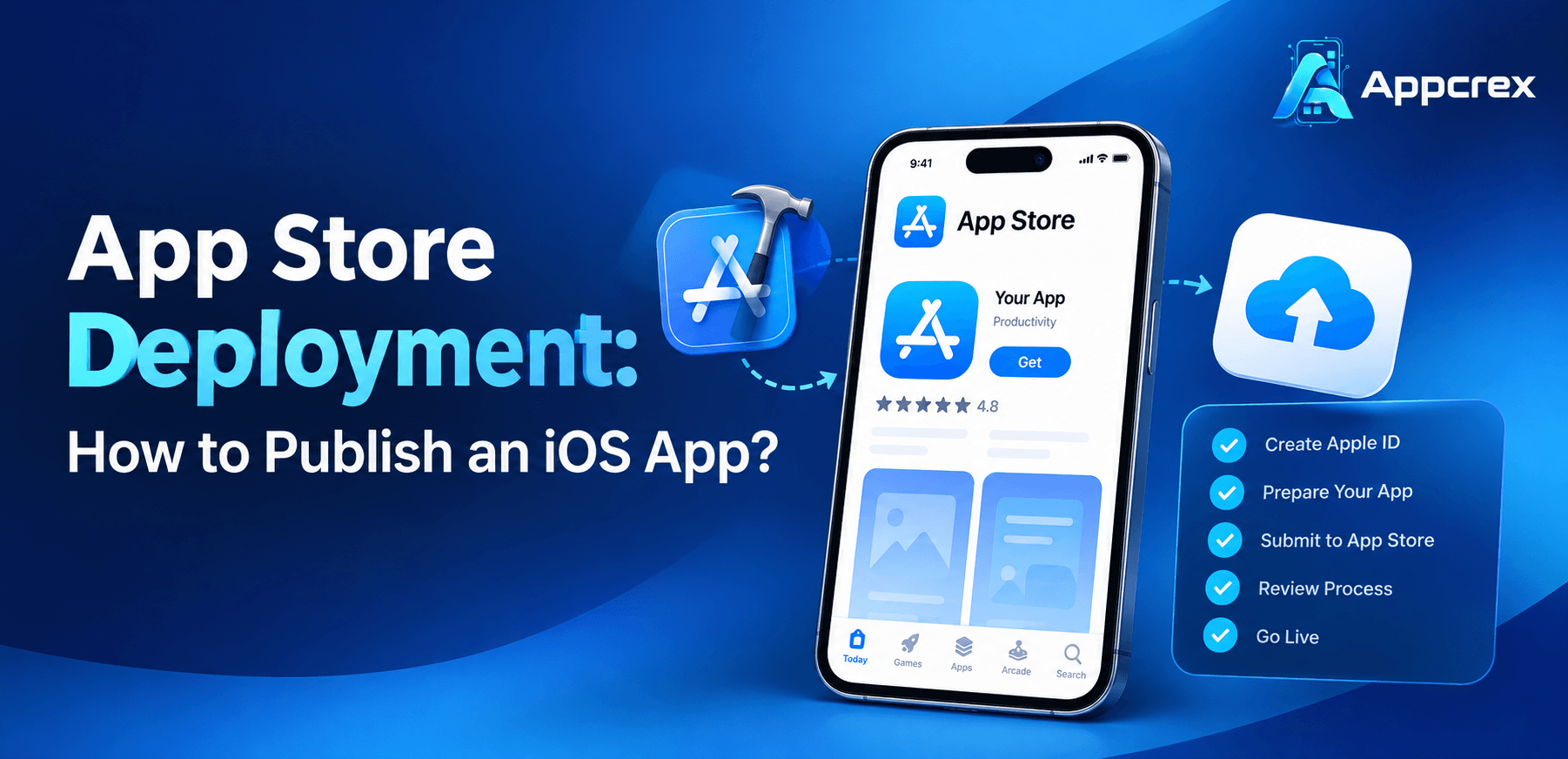
To publish an iOS app, enroll in the Apple Developer Program, prepare and test your application, create an app record in App Store Connect, upload a build, complete the required listing and privacy information, and submit the app for Apple’s review. Once approved, select the release method and make the app available to users.
Here is the complete process.
Step 1: Prepare Your iOS App for Deployment
Before submitting your application, confirm that development is complete and the app is ready for real-world use.
Review the following areas:
- Core features and user flows
- iPhone and iPad compatibility, where applicable
- Navigation and interface consistency
- Performance and memory usage
- Authentication and account management
- API integrations and backend connectivity
- Error handling and offline behavior
- Security and data protection
- Accessibility and readable interface elements
Test the application on supported devices and operating system versions. Resolve critical bugs, broken links, incomplete screens, and unexpected crashes before creating your release build.
For business applications, validate important workflows such as account registration, checkout, bookings, subscriptions, messaging, and data synchronization.
A complete app experience helps reduce user frustration and prepares the product for Apple’s review.
Step 2: Enroll in the Apple Developer Program
Publishing an app through Apple’s standard App Store distribution process generally requires membership in the Apple Developer Program.
Membership provides access to development and distribution capabilities, including app submission through App Store Connect.
Review the official program details before enrolling:
https://developer.apple.com/programs/
Apple lists the standard membership price as US$99 per year, or the equivalent in local currency where applicable. Eligibility for fee waivers and other arrangements depends on Apple’s current rules.
Organizations should review their enrollment options carefully. Apple might require legal entity information, verification, and an authorized representative during organization enrollment.
Before proceeding, confirm:
- Your Apple Account is ready for enrollment.
- Your developer membership is active.
- Your legal and contact information is accurate.
- Your organization details match the relevant records, where applicable.
- You understand the responsibilities associated with distributing an app.
Step 3: Configure Your App in Xcode
Xcode is Apple’s integrated development environment for building, testing, archiving, and preparing iOS applications for distribution.
Before creating a release build, review your project settings.
Important configuration items include:
- Bundle identifier
- App version and build number
- Supported devices and operating system versions
- Signing and provisioning settings
- Required capabilities and entitlements
- App icons and launch assets
- Production API endpoints
- Environment-specific configuration
- Permission descriptions for sensitive features
Your bundle identifier should match the app record configured in App Store Connect.
Use production-ready settings for the release build. Remove test credentials, debug configurations, temporary endpoints, and unnecessary diagnostic output.
Check that any permissions requested by the app, such as camera, microphone, location, or photo library access, have a legitimate purpose and appropriate explanations.
Step 4: Test the App Before Submission
Testing is one of the most important stages of iOS app deployment. An app that works on a developer’s device might still experience problems across different devices, network conditions, or user scenarios.
Use a combination of automated testing, manual quality assurance, and beta testing.
What Should You Test Before Publishing an iOS App?
| Testing area | What to verify |
|---|---|
| Functional testing | Features, forms, navigation, and workflows work correctly |
| Device testing | Layout and performance across supported devices |
| Performance testing | Startup time, responsiveness, memory usage, and battery impact |
| Security testing | Authentication, authorization, data handling, and secure communication |
| Network testing | Behavior under slow, unstable, or interrupted connections |
| Payment testing | Eligible purchase flows, transactions, and subscription handling |
| Accessibility testing | Labels, text readability, navigation, and assistive technology support |
| Regression testing | Existing features continue to work after changes |
Just read : AI Software Development Company: Custom AI Solutions, Cost & Development Process
How Does TestFlight Help With iOS App Deployment?
TestFlight is Apple’s beta-testing service for distributing pre-release app builds to testers.
It helps development teams gather feedback, identify issues, and validate user journeys before a public release. Internal and external testing options have different requirements, and external beta testing might involve Apple’s beta review process.
Official resource: https://developer.apple.com/testflight/
For a business launching a customer-facing product, beta testing helps validate the experience before investing in a larger marketing campaign.
Step 5: Create Your App Listing in App Store Connect
App Store Connect is the platform developers use to manage app information, builds, submissions, releases, and performance data.
After signing in, create a new app record and provide the requested information.
Common listing requirements include:
- App name
- Primary language
- Bundle identifier
- SKU or internal reference
- App description
- Promotional text, where supported
- Keywords
- Category
- Screenshots and other required media
- Support URL
- Privacy policy URL
- Age rating information
- Copyright and relevant ownership details
Your app listing should explain the product clearly. Focus on the problem it solves, its main features, and the value it offers to users.
Avoid misleading claims, keyword stuffing, unsupported performance promises, and screenshots that do not reflect the actual app experience.
For worldwide distribution, consider preparing localized store metadata for the languages and markets your business intends to target.
Step 6: Complete App Privacy Information
Privacy requirements are an important part of the App Store submission process.
Developers must provide accurate information about data collected by the app and its integrated third-party services. The applicable disclosures depend on how the app and its SDKs handle information.
Review:
- Personal information collected
- Data linked to a user or device
- Analytics and advertising technologies
- Third-party SDK behavior
- Data sharing with external providers
- Account creation and deletion requirements, where applicable
- Permission requests and their purposes
- Privacy policy disclosures
Apple’s App Store privacy information is based on the app’s actual data practices. Ensure your disclosures match the production build, privacy policy, and third-party integrations.
If your app collects or processes personal information, assess the legal requirements relevant to your target markets. Depending on the business and audience, these might include privacy and consumer protection obligations in the European Union, the United Kingdom, the United States, Canada, Australia, and other jurisdictions.
Publishing an app does not automatically make it compliant with every country’s laws.
Official reference: https://developer.apple.com/app-store/review/guidelines/
Step 7: Upload Your App Build
Once the application has passed testing, create an archive in Xcode and upload the build using Apple’s supported distribution workflow.
A typical upload process includes:
- Open the iOS project in Xcode.
- Select the appropriate build configuration and destination.
- Verify the bundle identifier, version, and build number.
- Create an archive of the app.
- Validate the archive when the available workflow supports validation.
- Upload the build to App Store Connect.
- Wait for processing to finish.
- Select the processed build for the intended app version.
Check for upload errors, missing assets, invalid signing settings, and configuration issues.
Uploading a build does not automatically publish it. You still need to complete the submission requirements and send the app for review.
Step 8: Configure Pricing and Country Availability
Before submitting or releasing your application, decide how users will access it.
You can configure distribution options and availability through App Store Connect, subject to Apple’s current policies and regional requirements.
Consider the following questions:
- Will the app be free or paid?
- Will it include subscriptions or in-app purchases?
- Which countries or regions are relevant to your business?
- Do you need localized app descriptions and screenshots?
- Are there local payment, tax, or regulatory considerations?
- Does the app depend on services available only in certain regions?
How Do You Make an iOS App Available Worldwide?
To distribute an iOS app internationally, configure its country and region availability in App Store Connect, prepare suitable localized store information, review regional pricing and legal requirements, and ensure the app supports users in the markets you select.
Worldwide availability does not mean every market is automatically suitable for your product. Language support, local regulations, payment methods, content restrictions, infrastructure, and customer support all affect launch readiness.
For example, a travel booking app might need localized dates, currencies, and customer service options. An eCommerce app might require region-specific shipping rules, tax handling, and payment integrations.
Review Apple’s official guidance on pricing and availability:
https://developer.apple.com/help/app-store-connect/reference/pricing-and-availability/app-pricing-and-availability
Step 9: Submit Your App for Apple’s Review
When your app build and listing information are ready, submit the version for review through App Store Connect.
Apple reviews applications against its App Review Guidelines. The review can cover functionality, safety, privacy, business practices, design, payments, and other applicable requirements.
Before submission, verify that:
- The app is stable and complete.
- The metadata accurately describes the product.
- The privacy disclosures are correct.
- Required permissions work as expected.
- Demo account details are provided when reviewers need access.
- Backend services are available during review.
- In-app purchases and subscription details are configured correctly.
- Required supporting information is included.
If your application requires login, provide clear instructions and working credentials where requested. Reviewers should be able to access the features needed to evaluate the app.
Official resources:
- App Review Guidelines: https://developer.apple.com/app-store/review/guidelines/
- Submission guidance: https://developer.apple.com/help/app-store-connect/manage-submissions-to-app-review/submit-an-app
How Long Does Apple App Review Take?
Apple states that approximately 90% of submissions are reviewed in under 24 hours. Actual review times vary according to the app, submission details, and review requirements. Additional review or corrections might extend the timeline.
Do not schedule a business launch on the assumption of guaranteed approval by a particular hour. Build time into your release plan for review, possible rejection, fixes, and resubmission.
Step 10: Fix Rejection Issues if Necessary
If Apple rejects an app, review the feedback in App Store Connect and identify the specific issue.
Common reasons for rejection include:
- Crashes or incomplete functionality
- Broken links or inaccessible backend services
- Inaccurate metadata or screenshots
- Missing privacy disclosures
- Permission requests without adequate explanations
- Incomplete review information
- Payment flows that do not follow applicable rules
- Repeated, low-value, or misleading app experiences
- Intellectual property or content concerns
The correct response depends on the reason given by Apple. Fix the underlying issue, test the revised build, and resubmit it. If you believe the review decision is incorrect, use Apple’s available communication or appeal process.
A structured release checklist and clear documentation often reduce avoidable submission problems.
Step 11: Release Your App on the App Store
Once Apple approves the app, choose the release method available for your submission.
Depending on the options offered in App Store Connect, you might release the app automatically after approval, release it manually, or schedule a release where supported.
Before making the app available, confirm:
- The correct version has been approved.
- Pricing and country availability are configured.
- The website and support channels are ready.
- Analytics and crash monitoring are working.
- Customer support teams have the information they need.
- Marketing materials match the published version.
After release, availability can vary based on the selected release method, regional storefront settings, and other processing requirements.
Official guide: https://developer.apple.com/help/app-store-connect/manage-your-apps-availability/overview-of-publishing-your-app-on-the-app-store
Also Read : React Native vs Flutter: Which Framework Should You Choose for Mobile App Development in 2026?
How Much Does It Cost to Publish an iOS App?
The cost of publishing an iOS app depends on developer membership, app complexity, development effort, testing requirements, backend infrastructure, and ongoing maintenance.
Apple’s standard Developer Program membership is US$99 per year, subject to applicable local pricing and eligibility rules. Development and maintenance costs are separate from the membership fee.
| Cost component | What affects the cost |
|---|---|
| Developer membership | Apple’s applicable enrollment fee |
| App development | Features, design, integrations, and technical complexity |
| Quality assurance | Device coverage, automation, and testing requirements |
| Backend infrastructure | Hosting, databases, APIs, and monitoring |
| Localization | Translation and market-specific adjustments |
| Third-party services | External APIs, SDKs, or other paid tools |
| Maintenance | Bug fixes, compatibility updates, and new features |
| Marketing | App Store Optimization, campaigns, and customer acquisition |
A simple application with limited functionality generally requires less development effort than a platform with subscriptions, real-time communication, advanced analytics, or multiple third-party integrations.
For a meaningful estimate, assess the required features, supported devices, backend architecture, security needs, and launch markets before setting a budget.
What Is the Difference Between App Development and App Store Deployment?
App development focuses on planning, designing, coding, integrating, and testing an application. App Store deployment focuses on preparing the release, submitting it for review, configuring distribution, and making it available to users.
| App development | App Store deployment |
|---|---|
| Defines features and requirements | Prepares the release build |
| Designs the user experience | Configures listing information |
| Implements app functionality | Uploads the build to App Store Connect |
| Integrates APIs and services | Completes submission requirements |
| Tests features and workflows | Manages review and release |
| Improves the product during development | Monitors launch and release stability |
Both activities are connected. Deployment planning should begin during development rather than being postponed until the app is finished.
How Do You Optimize an iOS App for Global Users?
A global launch requires more than selecting multiple countries in App Store Connect. Your product, store listing, infrastructure, and support processes should match the needs of your intended audiences.
1. Localize Your App Store Listing
Translate the app description, screenshots, and other relevant store information for priority markets. Use language and terminology familiar to local users.
2. Review Regional Requirements
Evaluate privacy, consumer protection, payment, content, and industry-specific rules relevant to each market. Obtain qualified legal advice where necessary.
3. Prepare for Localized User Experiences
Support appropriate date formats, currencies, units, languages, and regional settings. Test text expansion and layout changes across localized versions.
4. Check Infrastructure and Performance
Confirm that your backend, APIs, content delivery, and support systems perform reliably for users in different locations.
5. Build a Localized App Store Optimization Strategy
Research search terms and user expectations in each target market. Avoid translating keywords mechanically without checking their local meaning and relevance.
6. Monitor International Feedback
Use reviews, support requests, crash reports, and analytics to identify differences in user needs across markets.
A staged rollout focused on priority regions often provides a clearer way to validate demand before expanding further.
How Does App Store Optimization Support iOS App Deployment?
App Store Optimization (ASO) improves how an app is presented and discovered in app marketplaces. It complements deployment by helping users understand the app and decide whether to install it.
Important ASO activities include:
- Researching relevant search terms
- Writing a clear app title and description
- Selecting an appropriate category
- Creating accurate screenshots and preview assets
- Localizing store metadata
- Encouraging genuine customer feedback
- Monitoring conversion and discovery performance
ASO does not guarantee top rankings or a specific number of downloads. Results depend on competition, relevance, user behavior, product quality, and other factors.
For international applications, assess search intent and language differences by market rather than using the same keyword list everywhere.
What Should Businesses Look for in an iOS App Development Company?
Choosing an experienced development partner helps businesses coordinate development, testing, deployment, and post-launch support.
Consider the following factors when evaluating a software development company:
iOS development experience: Review relevant projects and technical expertise in the required app category.
Deployment knowledge: Ask how the team handles signing, builds, App Store Connect, submission requirements, and release planning.
Quality assurance: Confirm the testing strategy, supported devices, regression testing, and bug management process.
Security and privacy: Understand how the team handles data protection, third-party SDKs, permissions, and sensitive information.
Global readiness: Ask about localization, regional requirements, performance, and international release planning.
Communication and ownership: Clarify project milestones, documentation, source code ownership, maintenance, and post-launch responsibilities.
Transparent estimates: Request a breakdown of development, testing, integrations, deployment, and ongoing support costs.
The right partner should explain trade-offs clearly and align the technical approach with your business goals.
How Can AppCrex Help With iOS App Development and Deployment?
Businesses planning an iOS app need a reliable process from initial planning through development, testing, deployment, and maintenance.
AppCrex provides software development services for businesses exploring digital products and custom software solutions. Depending on your project requirements, a development engagement might include:
- App planning and technical consultation
- UI/UX design and application development
- API and backend integration
- Quality assurance and device testing
- App Store submission preparation
- Post-launch improvements and maintenance
The appropriate scope depends on your product, technical requirements, timeline, and target markets. Discuss your requirements with the AppCrex team to establish a suitable project plan.
Planning an iOS app launch? Visit https://appcrex.com/ to discuss your project requirements and explore software development options for your business.
Frequently Asked Questions About App Store Deployment
1. How do you publish an iOS app for the first time?
Enroll in the Apple Developer Program, prepare and test your app, create its App Store Connect record, upload a build, complete the listing and privacy details, and submit it for Apple’s review. Release the app after approval.
2. Do you need an Apple Developer account to publish an app?
Standard public App Store distribution generally requires Apple Developer Program membership. Check Apple’s current enrollment terms for eligibility, fees, and any applicable exceptions.
3. How much does it cost to publish an iOS app?
Apple’s standard Developer Program membership costs US$99 annually, subject to applicable terms and local pricing. Development, testing, infrastructure, localization, and maintenance costs are separate.
4. How long does it take to publish an iOS app?
The total timeline depends on development readiness, testing, submission preparation, review, and any required corrections. Apple reports that approximately 90% of submissions are reviewed in under 24 hours, but this is not a guaranteed approval time.
5. What is App Store Connect used for?
App Store Connect helps developers manage app records, metadata, builds, submissions, pricing, availability, releases, and app performance information.
6. Why does Apple reject iOS apps?
Rejections might result from crashes, incomplete features, inaccurate metadata, privacy issues, missing review information, or violations of applicable guidelines. Read Apple’s specific feedback and correct the underlying issue before resubmitting.
7. Can an iOS app be published worldwide?
Yes, developers can configure availability across supported countries and regions through App Store Connect. Availability depends on Apple’s distribution options and applicable regional requirements.
8. Is TestFlight required before App Store submission?
TestFlight is not universally required for every app submission. It is a useful beta-testing service for identifying issues and collecting feedback before release.
9. Can an app be updated after publication?
Yes. Developers can submit new versions and updates through App Store Connect. Updates are subject to the applicable submission and review requirements.
10. What is the difference between App Store submission and release?
Submission sends an app version to Apple for review. Release is the process of making an approved version available to users according to the configured distribution and release settings.
11. How do businesses prepare an app for international markets?
Businesses should review language support, localized metadata, regional pricing, privacy and legal obligations, payment requirements, infrastructure performance, and customer support before expanding distribution.
12. Should a business hire an iOS app development company?
A development company is useful when a business needs specialist engineering, design, testing, backend integration, deployment support, or ongoing maintenance. Evaluate relevant experience, project transparency, quality assurance, and post-launch services before selecting a partner.
Conclusion
App Store deployment is a structured process involving development readiness, testing, listing preparation, privacy disclosures, submission, review, and release management. Businesses planning an international launch should also consider localization, regional requirements, pricing, infrastructure, and ongoing support.
Keeping deployment requirements in mind from the beginning helps development teams reduce avoidable delays and prepare a stronger release.
If your business is planning a new iOS application or improving an existing digital product, AppCrex can be a starting point for discussing your software development requirements and launch objectives.
Ready to plan your iOS app project? Visit https://appcrex.com/ to explore your options.